
Yes, Invisalign is absolutely a powerful and popular way to fix many types of overbites. For anyone with a mild to moderate case, these clear aligners are a fantastic, discreet alternative to traditional metal braces and have successfully helped countless patients.
Understanding Invisalign for Overbite Correction
An overbite happens when your upper front teeth overlap your lower front teeth too much. Think of a perfect bite like a box with a lid that fits just right—an overbite is when that lid hangs way over the edge. While a little bit of overlap is totally normal, a deep overbite can lead to jaw pain, premature tooth wear, and even trouble with your speech.
For decades, the go-to solution was a mouth full of metal braces. Today, Invisalign offers a much different experience. It uses a series of custom-made, clear plastic trays that gently and gradually shift your teeth into the right position. It’s not just a less obvious way to straighten teeth; it’s backed by seriously impressive results.
How Effective Is the Treatment?
The success of clear aligners in correcting bite problems is well-established. Clinical studies have shown that Invisalign achieves a very high success rate in fixing overbites. Real-world case analyses show significant improvements in both appearance and function. Many patients even report relief from jaw pain and clearer speech after treatment, which typically takes around 14 to 18 months. You can learn more about these outcomes at inspiresmilessd.com.
This guide will walk you through exactly how this technology gets the job done, including:
- The mechanics behind how the clear aligners work.
- Who makes a great candidate for this kind of treatment.
- What the entire treatment journey really looks like from start to finish.
Getting a handle on these key points will give you the confidence you need to weigh your orthodontic options and decide if Invisalign is the right move for your smile.
Here's a quick rundown of what you can expect when using Invisalign to correct an overbite.
Invisalign for Overbite at a Glance
| Aspect | Details |
|---|---|
| What It Is | A series of clear, custom-fit plastic aligners that gradually move teeth. |
| Best For | Mild to moderate overbites. Severe cases may require braces or surgery. |
| Treatment Time | Typically 14 to 18 months, but varies based on individual case complexity. |
| Key Features | Aligners are removable, virtually invisible, and comfortable. |
| Process | Digital scan, custom treatment plan, new aligners every 1-2 weeks. |
| Effectiveness | High success rate for suitable candidates, improving both aesthetics and function. |
This table gives you the highlights, but let's dive deeper into how this process actually unfolds.
How Clear Aligner Technology Reshapes Your Smile
To really get how Invisalign can fix an overbite, you have to see it as more than just a simple plastic tray. It’s a sophisticated orthodontic system, powered by some seriously advanced technology, designed to gently nudge your teeth and jaw into their perfect spots. The whole process is built on a foundation of incredible precision, right from the very first appointment.
It all kicks off with a detailed 3D scan of your mouth. Forget those old, goopy impression molds you might remember. This is a quick, comfortable digital scan that creates an exact blueprint of your smile as it is today. This digital model is what your entire treatment plan is built upon.
Using this model, your orthodontist maps out every single movement each tooth needs to make to correct your overbite. Every tiny shift is planned with meticulous accuracy. Based on that roadmap, a series of custom-made clear aligners are created for you—each one representing the next small step in your smile’s transformation.
The Mechanics of Movement
The real secret sauce of Invisalign is how it applies force. The aligners are made from a patented material called SmartTrack®, engineered to deliver gentle but constant pressure to move your teeth effectively. But when it comes to complex jobs like correcting an overbite, the aligners sometimes need a bit of a helping hand.
This is where some specialized features come into play:
-
SmartForce® Attachments: These are tiny, tooth-colored bumps bonded to specific teeth. Think of them as little handles that give the aligners the grip they need to apply force in just the right direction for trickier movements, like rotating a tooth or tweaking its vertical position.
-
Precision Wings: For certain overbite cases, especially in teens, some aligners are designed with small "wings" on the sides. When you bite down, these wings engage with each other to help guide the lower jaw forward, gradually correcting the skeletal part of the overbite over time.
This infographic gives a great overview of the core stages of the treatment journey.
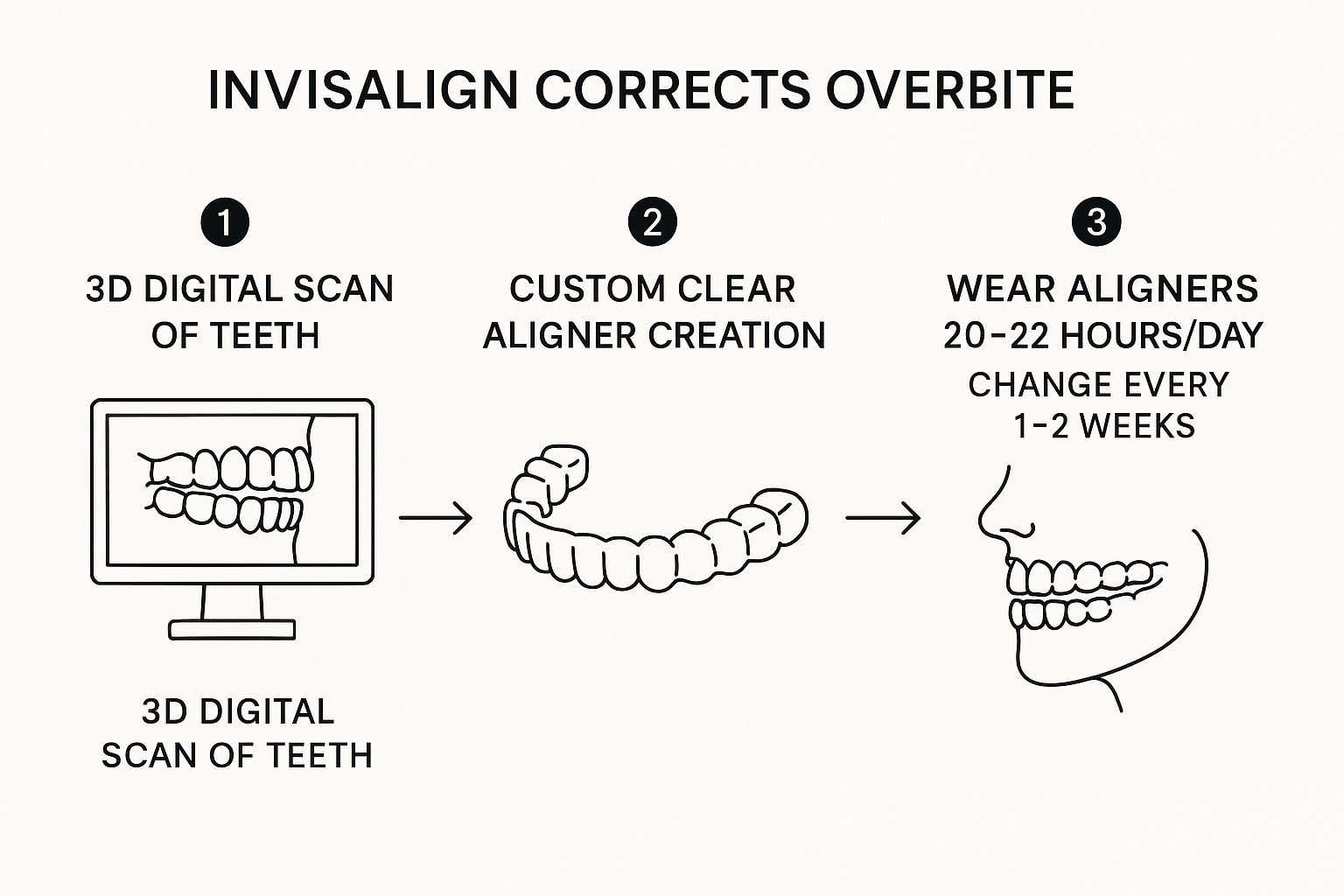
As you can see, the process is a continuous cycle of consistent wear and gradual changes, all driven by that initial digital plan.
A Progressive and Controlled Process
You'll wear each aligner in your series for about one to two weeks, and you have to be diligent about keeping them in for 20-22 hours a day. When you pop in the next aligner, it’s shaped just a little differently than the last one, designed to continue that gradual movement. This step-by-step approach is what makes the whole process feel so comfortable and predictable.
The key thing to remember is that Invisalign doesn't just push teeth sideways. Its advanced features give your orthodontist control over the vertical position and angle of your teeth, which is absolutely essential for reducing a deep overbite and creating a healthy, functional bite.
This targeted force is what allows the treatment to do more than just straighten teeth—it can actually improve your jaw position. By progressively shifting the teeth while also guiding the jaw, Invisalign effectively reshapes your entire smile.
If you're curious whether this technology could be the right fit for you, it's worth learning more from the experts. The providers of clear aligners in Glendale can create a personalized plan and walk you through the specifics. This careful, pre-planned approach ensures your journey to fixing that overbite is as efficient as it is discreet.
Are You a Good Candidate for Invisalign Overbite Treatment?
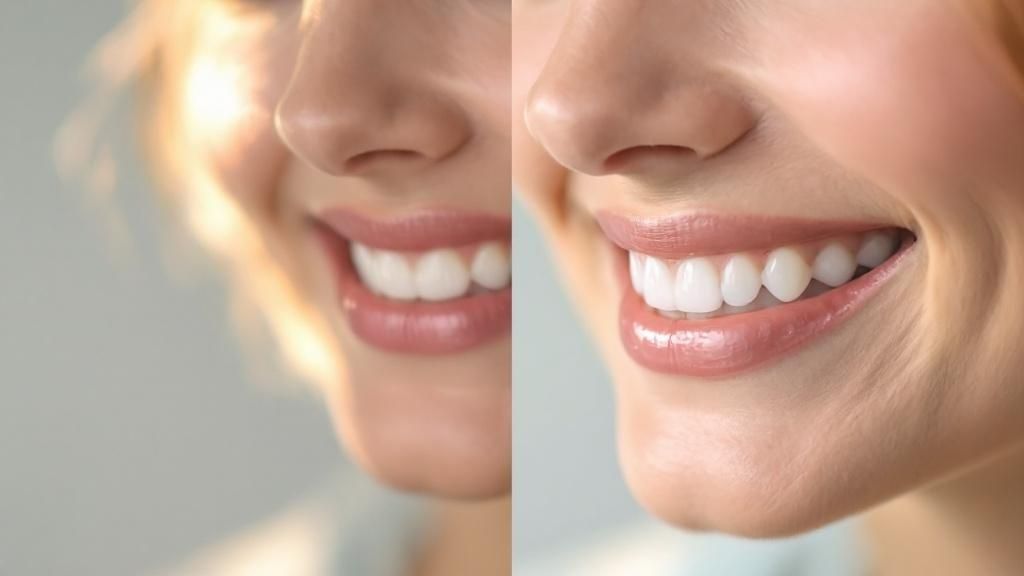
While clear aligner technology has come a long way, it’s not a magic wand for every single bite issue out there. Figuring out if you’re a good fit for Invisalign really comes down to two things: the type of overbite you have and your personal commitment to seeing the treatment through.
An orthodontist's first job is to get to the root of the problem. They need to figure out if your overbite is a tooth issue or a jaw issue, because that single distinction changes everything about the best way to fix it.
Dental Overbites vs. Skeletal Overbites
Understanding what’s causing your overbite is the key to knowing if Invisalign is the right tool for the job. Your orthodontist will determine if your bite is dental or skeletal in nature.
-
Dental Overbite: This is when the jawbones are positioned correctly, but the teeth themselves are out of whack. Maybe your front teeth tilt too far forward or just grew in at an angle that creates too much overlap. For these cases, Invisalign is highly effective. It excels at precisely shifting teeth back into their proper alignment to correct mild to moderate dental overbites.
-
Skeletal Overbite: This is a bigger-picture issue where the problem lies with the jaws themselves. The upper jaw might be too large, or the lower jaw could be too small or set too far back. While Invisalign can sometimes help with minor skeletal issues, especially in teens whose jaws are still growing, severe skeletal overbites usually need a more heavy-duty approach. This often means traditional braces paired with other appliances, or in some cases, corrective jaw surgery.
Factors Your Orthodontist Will Consider
Beyond just the type of overbite, your orthodontist will look at a few other critical factors. First and foremost is your overall dental health. Any active issues like gum disease or cavities have to be taken care of before starting orthodontic work. The severity of the overbite is, of course, a huge piece of the puzzle.
A professional consultation is non-negotiable. An expert assessment using digital scans is the only way to get a definitive answer and build a treatment plan that uses the right tools to fix the root cause of your overbite.
Finally, a big part of the success equation comes down to you. Invisalign only works if you wear it. The aligners need to be in for 20-22 hours every single day—no exceptions. Your orthodontist needs to be confident you’re ready for that level of commitment. This self-discipline is what keeps the treatment on track and delivers the fantastic results you’re looking for.
And for those who are also dealing with spacing issues, learning how Invisalign can fix crowded teeth can give you an even clearer picture of what’s possible.
Your Invisalign Journey From Start to Finish
So, what does correcting an overbite with Invisalign actually look like, day in and day out? Knowing the whole process from the get-go makes the entire experience feel less like a mystery and more like a predictable, manageable project. Your path to a better bite follows a clear, structured series of steps.
It all kicks off with an initial consultation. This is where your orthodontist will assess your bite and confirm if Invisalign is the right tool for the job. If you get the green light, the next step is a quick and comfortable 3D digital scan of your mouth. This scan creates a precise digital model that your doctor uses to map out every single tooth movement needed to fix your overbite.
From Digital Plan to Daily Wear
Once your custom treatment plan is locked in, your unique series of clear aligners are made just for you. The day you get your first set is a pretty exciting milestone. Your dental team will make sure they fit perfectly and walk you through all the essentials of daily care.
From that day forward, your main responsibility is simple but absolutely crucial: wear your aligners for 20-22 hours every single day. You’ll only pop them out to eat, drink anything other than water, and for your daily brushing and flossing routine.
The modern patient journey, including treatments like Invisalign, is increasingly supported by technological innovations. To understand how broader healthcare experiences are being enhanced, you can explore the impact of solutions like virtual assistants in healthcare.
Every one to two weeks, you’ll switch to the next set of aligners in your series. Each new tray is a little different from the last, applying gentle, consistent pressure that keeps guiding your teeth toward their final, corrected positions. You'll have periodic check-ins with your orthodontist, usually every six to eight weeks, so they can monitor your progress and hand over your next batches of aligners.
Timelines and Perfecting the Results
For most people wondering, "will Invisalign correct an overbite?" the treatment timeline generally lands somewhere between 12 to 24 months. The exact duration really hinges on how complex your specific case is, but clinical data shows that effective overbite correction is very achievable within this window.
One study on bite correction, for instance, showed an average treatment time of around 18.2 months with about 25 aligner sets, though some cases naturally required tweaks along the way.
As you near the end of your main treatment, many patients enter what’s called a "refinement" phase. This is a common and important step that involves taking a new scan to create a few extra aligners. These refinements are all about making small, precise adjustments to perfect the final details of your bite and smile. Think of it as the finishing touch that ensures the best possible outcome. A great first step to starting your own journey is exploring your options for Invisalign in Glendale AZ.
Comparing Invisalign and Traditional Braces for Overbites
When you’re looking to fix an overbite, you’re usually facing the classic orthodontic showdown: Invisalign or traditional braces? It’s a big decision, so let’s put them head-to-head and look at what really matters for patients day-to-day.
There’s no denying Invisalign’s biggest appeal—it’s nearly invisible. For adults and teens who feel a bit self-conscious about undergoing orthodontic work, this is a huge win. You get to straighten your teeth without the metallic look of braces.
Braces, on the other hand, are highly visible but they are the heavy lifters of the orthodontic world. They’re known for their sheer power, capable of applying the strong, consistent force needed to tackle very severe or complex overbites.
Lifestyle and Daily Habits
Think about your daily routine, because it’s a major factor here. With Invisalign, you can pop the aligners out and eat whatever you want. That freedom comes with a trade-off, though. You absolutely have to be disciplined enough to wear them for 20-22 hours a day and keep them sparkling clean.
Braces are fixed to your teeth, so you can’t forget to wear them. But this means you get a list of restricted foods—nothing sticky, hard, or chewy that could snap a wire or pop off a bracket. Cleaning is also more of a project, requiring special tools to navigate around all that hardware.
While both treatments get the job done, the choice often boils down to a trade-off between aesthetics and convenience versus raw corrective power. Your orthodontist will help determine which method's force application is best suited for your specific bite correction needs.
Now, while Invisalign works wonders for many, it’s not a magic bullet for every case. One retrospective study found that 17.2% of patients who started with Invisalign for various bite issues, including overbites, eventually had to switch to traditional braces to get the results they wanted. The study also noted that their treatment took about five months longer than originally planned, which really speaks to the complexities of bite correction.
To help you sort through this big decision, we've put together a simple comparison table that lays out the key differences.
Invisalign vs. Traditional Braces for Overbite Correction
| Feature | Invisalign | Traditional Braces |
|---|---|---|
| Appearance | Nearly invisible clear plastic aligners. | Visible metal or ceramic brackets and wires. |
| Comfort | Smooth plastic, generally more comfortable. | Can cause some initial soreness and irritation. |
| Diet | No restrictions; aligners are removed for eating. | Must avoid sticky, hard, and chewy foods. |
| Hygiene | Easy to clean teeth; aligners are removable. | More challenging; requires special tools. |
| Discipline | High; must be worn 20-22 hours daily. | Low; they are fixed and work continuously. |
| Effectiveness | Best for mild to moderate overbites. | Highly effective for even the most severe cases. |
Ultimately, this table gives you a quick snapshot, but the best choice is always the one that fits your specific dental needs and lifestyle.
For a much deeper dive into how these two popular options stack up, check out our complete guide comparing Invisalign vs traditional braces. A good chat with your orthodontist is the final step to figuring out which path is truly the best one for you.
Answering Your Top Questions About Invisalign for Overbites
Even after learning how the process works, you probably still have a few questions floating around. Let's tackle the most common ones we hear from patients considering Invisalign for their overbite.
How Much Discomfort Should I Expect?
This is easily one of the most frequent questions we get. When you pop in a new set of aligners, you’ll likely feel some pressure for the first day or two. This is actually a good sign—it means the aligners are actively working to shift your teeth into place.
The feeling is usually described as a snug pressure, which is much milder than the soreness people often experience after getting traditional metal braces tightened. If you do feel any temporary sensitivity, an over-the-counter pain reliever is typically all you need.
Will an Overbite Correction Change My Face Shape?
Yes, it often does, and the results are almost always a welcome surprise for our patients! Correcting a noticeable overbite, especially one where we guide the lower jaw forward, can create subtle but positive changes in your facial profile.
By bringing your jaw into proper alignment, many people notice a more balanced, defined jawline and chin. While our primary goal is always to improve your oral health and bite function, the aesthetic boost to your facial harmony is a fantastic bonus.
The main goal is to improve your bite and overall oral health, but the aesthetic enhancement to your facial profile is a common and welcome result of successful overbite correction.
Is Invisalign Faster Than Braces for Overbites?
The honest answer? It really depends on your specific case. For mild to moderate overbites, Invisalign treatment time is often very similar to, or sometimes even a bit faster than, traditional braces. A typical timeframe falls somewhere between 12 to 24 months.
However, for very severe or complex skeletal overbites, traditional braces might still be the more efficient tool for the job. The best way to get a clear timeline is to discuss the pros and cons of clear aligners vs braces in Glendale with an experienced orthodontist who can assess your unique needs.
Ready to see if Invisalign is the right solution for your overbite? The team at Beyond Dental Care is here to provide an expert consultation and create a personalized treatment plan just for you. Schedule your visit today at https://beyonddentalcare.com.