
Direct Answer: Dental implants come in several types — single-tooth, implant-supported bridges, and full-arch options — and each one is built for a different clinical situation. Choosing the wrong type doesn’t just affect cost; it affects long-term outcomes.
Most people searching for dental implants in the Arrowhead Ranch or Stetson Valley area start with one question: how much does it cost? That’s a fair place to start. But there’s a question that matters more before you ever talk price — which type of implant are you actually a candidate for?
The category of ‘dental implants’ covers several distinct procedures that work differently, cost differently, and suit different clinical situations. A patient missing one tooth has very different options than someone missing several teeth in a row — or someone who has been wearing dentures for years and wants something that stays in place.
This guide breaks down the implant types that matter most, what separates them clinically, and what you should understand before walking into any consultation.
Single-Tooth Implants vs. Implant-Supported Restorations: They’re Not the Same Thing
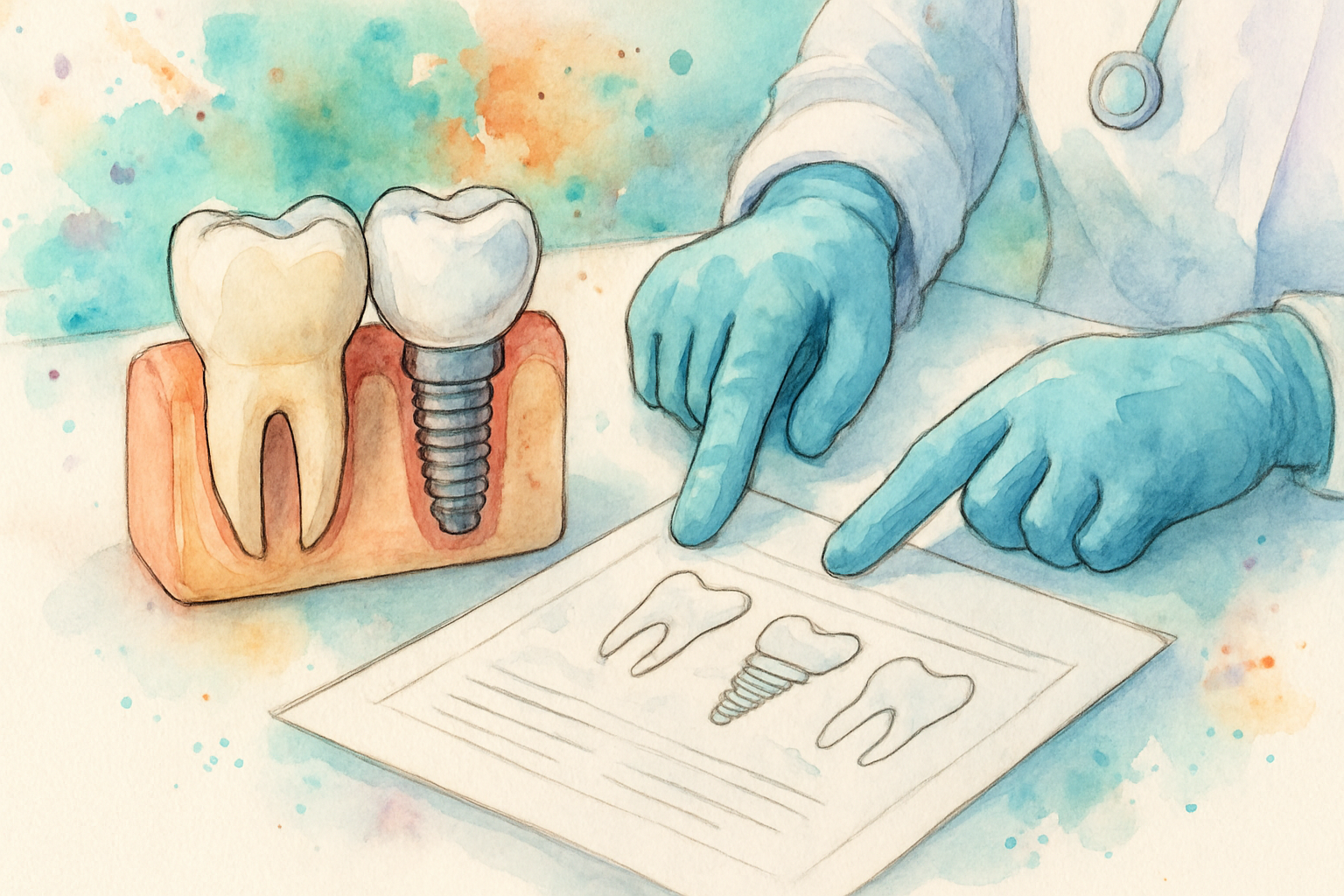
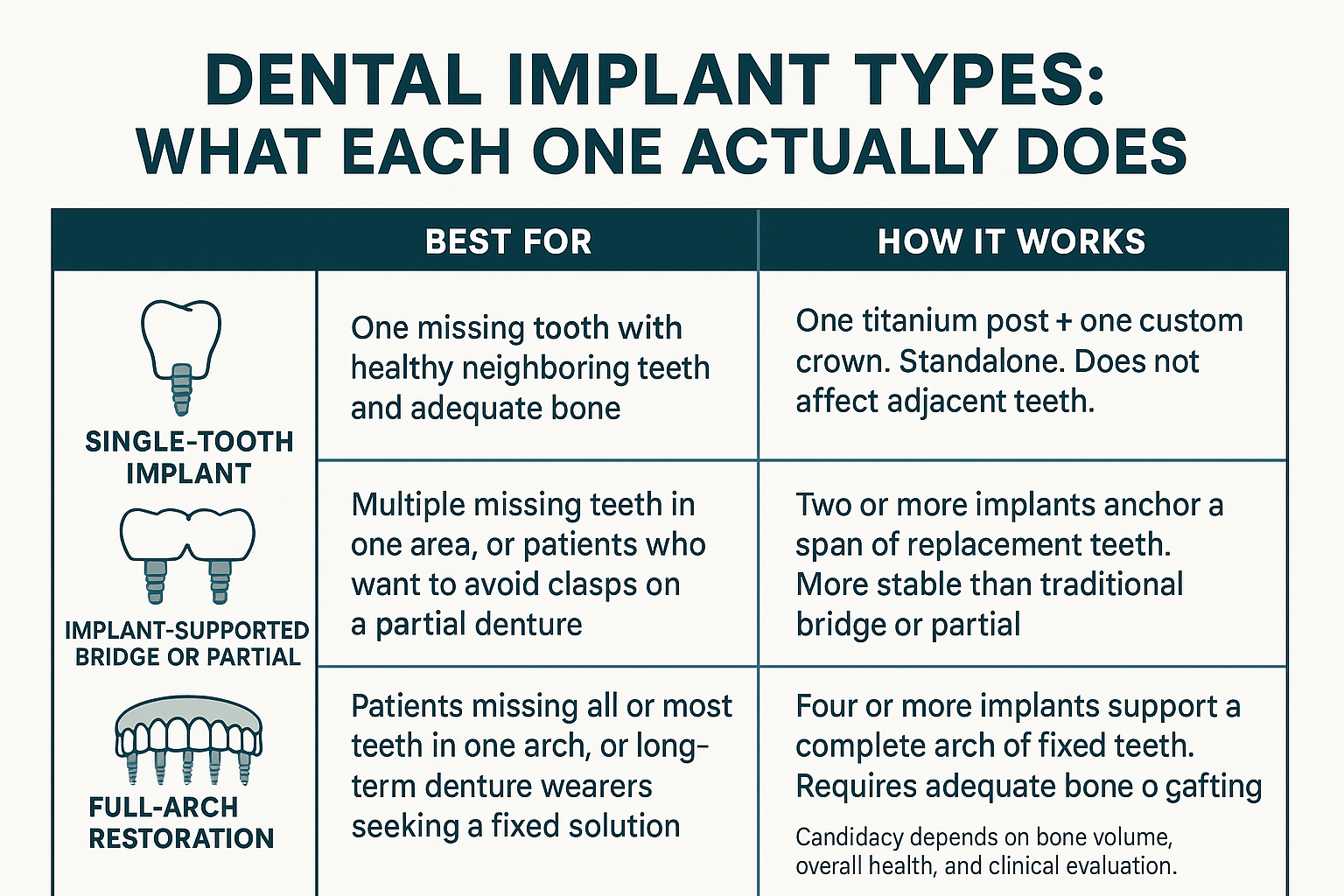
When most people picture a dental implant, they’re picturing a single-tooth implant — one titanium post placed into the jawbone, topped with a custom crown. It’s designed to replace exactly one missing tooth and function independently, without affecting the teeth on either side.
That matters more than people realize. A traditional dental bridge — the older alternative — requires the dentist to reshape two perfectly healthy neighboring teeth to anchor the replacement. A single implant avoids that entirely. The implant integrates directly with the bone, which also helps prevent the gradual bone loss that happens naturally after a tooth is removed.
An implant-supported restoration is a broader category. It includes:
- Implant-supported bridges, where two implants anchor a multi-tooth span without crowning the teeth beside them
- Implant-retained partial dentures, which snap onto implants instead of using metal clasps on natural teeth
- Full-arch restorations (sometimes called All-on-4 or similar), where four or more implants support an entire arch of replacement teeth
The phrase ‘dental implants’ gets applied to all of these, which is part of why patients get confused when they start comparing prices or reading about procedures online. A single implant and a full-arch restoration are about as different as a filling and a crown — same category, completely different scope.
Why Bone Volume Changes Which Implant You Qualify For
Here’s something most patients don’t hear until they’re already sitting in a consultation chair: your jawbone has to have enough volume to hold an implant in place. And if a tooth has been missing for more than a year or two, that bone has likely already started to shrink.
Bone resorption — the natural process where the jaw loses density and height after tooth loss — is one of the biggest factors that determines which implant type is realistic for a given patient. It’s also why timing matters. Patients who address a missing tooth within six to twelve months of extraction often have more straightforward options than patients who wait three or four years.
For patients in Vistancia or North Peoria who’ve been wearing a conventional denture for five or more years, bone loss may have progressed enough that a bone graft is needed before implant placement can even happen. That adds both time (typically three to six months for the graft to heal) and cost to the process.
This is also why the full set of dental implants path looks different from patient to patient — it’s not a one-size procedure. The amount of remaining bone, the shape of the jaw, and how long teeth have been missing all shape the treatment plan. Anyone who quotes you a flat price without a proper clinical evaluation and imaging hasn’t actually assessed you yet.
If bone volume is a concern, a dentist experienced in implant dentistry can usually identify it early through a CBCT scan — a three-dimensional X-ray that shows the jaw in full. That kind of imaging is what separates a thorough workup from a cursory consultation.
Implant Types at a Glance: What Each One Is Designed For
This infographic breaks down the three main implant categories, who they’re suited for, and how they differ in scope and complexity.
Implant Type Comparison: Scope, Timeline, and Cost Range in Arizona
These are general ranges based on typical treatment in the Northwest Phoenix market. Individual costs vary based on bone condition, materials, and the number of teeth involved.
| Implant Type | Typical Timeline | Estimated Cost Range (AZ) |
|---|---|---|
| Single-Tooth Implant | 3–6 months (no graft) | $3,000–$5,500 per tooth |
| Implant-Supported Bridge | 4–8 months | $6,000–$12,000 depending on span |
| Implant-Retained Partial | 3–6 months | $4,500–$9,000 |
| Full-Arch Restoration (e.g., All-on-4) | 6–12+ months | $20,000–$35,000 per arch |
| With Bone Graft Added | Add 3–6 months | Add $1,500–$4,000 per site |
What Implant-Supported Restorations Can Do That Dentures Can’t
For patients in communities like Cibola Vista or Hillcrest Ranch who are currently wearing a conventional full or partial denture, this is often the most important distinction to understand.
Traditional dentures sit on top of the gum tissue. They’re held in place by suction, adhesive, or metal clasps — and none of those methods are particularly stable under normal chewing pressure. Over time, continued bone loss under the denture makes the fit worse, which is why most denture wearers find themselves relining or replacing their appliance every three to five years.
Implant-supported restorations attach to the bone directly. That changes the experience in two ways:
- Chewing function improves significantly — patients can generally eat a much wider range of foods without fear of slippage
- Bone loss slows down — because the implant transmits chewing forces into the bone, the jaw gets the stimulation it needs to maintain density
Patients sometimes ask whether a full set of dentures is still a reasonable option in 2026. It depends entirely on the clinical picture and patient preference. Conventional dentures remain a legitimate choice for some patients — but it’s worth understanding what you’re trading off when you choose them over an implant-supported solution.
For patients who are nervous about the investment, it’s also worth knowing that HSA funds can often be used for dental implants — something a lot of patients don’t think to ask about until after they’ve already made a decision.
The Part Most Patients Overlook: What Happens After Placement
Getting an implant placed is only part of the process. How an implant performs over the next 10, 20, or 30 years depends almost entirely on what happens after.
Osseointegration — the process where the titanium post fuses with the surrounding bone — takes three to six months on average. During that window, the implant site needs to be protected from excessive force, and the patient’s home care routine matters more than most people expect.
After final restoration, long-term maintenance for implants includes:
- Regular professional cleanings, typically every three to six months depending on gum health
- Monitoring for peri-implantitis, which is an infection of the tissue around the implant that can develop if plaque is allowed to accumulate
- Periodic checks of the crown or prosthetic component, since the crown can wear or loosen over time even when the implant post itself remains sound
Peri-implantitis is the most common reason implants fail after successful placement. It develops quietly, often without pain, which is why consistent professional monitoring is not optional. Patients who skip follow-up appointments put their implant investment at real risk.
For a deeper look at what realistic long-term outcomes actually look like, the how long do dental implants actually last guide covers the research honestly — including the factors that reduce lifespan and what patients can do to push the odds in their favor.
And if you’ve been researching the process and wondering why so many patients say they wish they’d had more guidance before starting, it almost always comes down to this phase — not the surgery itself, but understanding what the post-placement period actually requires.
Frequently Asked Questions About Dental Implant Types
Can I get an implant if I’ve had a tooth missing for several years?
Possibly, but bone loss will likely be a factor. When a tooth is missing for more than a year, the surrounding bone starts to shrink. A CBCT scan can measure how much volume remains. If it’s not enough to place an implant directly, a bone graft is usually the next step — which adds three to six months and typically $1,500–$4,000 to the process. It doesn’t automatically rule you out, but it does change the timeline and cost.
What’s the difference between a single implant and an implant-supported bridge?
A single implant replaces one tooth — one post, one crown. An implant-supported bridge replaces two or more consecutive missing teeth using implant posts on either end as anchors, with artificial teeth spanning the gap between them. No healthy adjacent teeth are reshaped to make either one work, which is the main advantage both have over traditional bridges.
Is All-on-4 the same thing as dental implants?
All-on-4 is a brand name for a specific full-arch restoration technique where four implants support an entire arch of fixed teeth. It falls under the dental implant category, but it’s a much more involved procedure than a single-tooth implant — different scope, different surgical planning, different cost, and different candidacy requirements. The term gets used loosely online, which causes a lot of confusion.
Will my dental insurance cover any part of this?
Some plans cover a portion of implant-related costs — usually the crown or restoration component rather than the implant post itself, which most plans still categorize as a non-covered service. Benefits vary widely depending on the plan. If you have an HSA or FSA, those funds can typically be applied to implant treatment, which is worth factoring into your planning.
How do I know which implant type is right for me before I go to a consultation?
Honestly, you can’t know for certain until a dentist reviews your imaging and clinical history. But a general rule: if you’re missing one tooth, a single implant is the starting point for the conversation. Multiple consecutive missing teeth usually points toward a bridge or partial restoration. Missing most or all teeth in an arch opens the door to full-arch options. Where your bone health lands will shape which of those paths is actually viable.
Ready to Get a Straight Answer About Your Implant Options?
Beyond Dental Care serves patients across North Glendale, Arrowhead Ranch, Stetson Valley, Norterra, and the surrounding Northwest Phoenix area with implant consultations that start with imaging and end with a clear, honest picture of what’s realistic for your specific situation. Dr. Dariene Lazore, DMD, takes time to walk through every option — including what each one costs, how long it takes, and whether your bone health supports it. To schedule a consultation, call 623-267-8088 or visit beyonddentalcare.com.