
Direct Answer: The dental visit most people skip is the routine preventive exam — before anything hurts. Skipping it doesn’t prevent problems; it just delays finding them until they’re more expensive to fix.
Most people in North Glendale, Arrowhead Ranch, and across the Upper West Side Phoenix area don’t skip the dentist because they don’t care about their teeth. They skip because nothing hurts, life is busy, and a preventive appointment feels easy to postpone when everything seems fine.
But dental problems don’t start with pain. By the time something hurts — a tooth, a gum, a jaw — the issue has usually been developing quietly for months, sometimes years. A routine exam is exactly when a dentist can find those problems early, when the fix is simpler and far less involved.
This article breaks down what actually happens at a preventive dental visit, what gets missed when people skip them, and why the gap between ‘I feel fine’ and ‘I need a crown’ is shorter than most patients expect.
What a Preventive Dental Visit Actually Includes
A lot of patients picture a preventive visit as a quick cleaning and a toothbrush handout. In a well-run private dental practice, it’s considerably more than that.
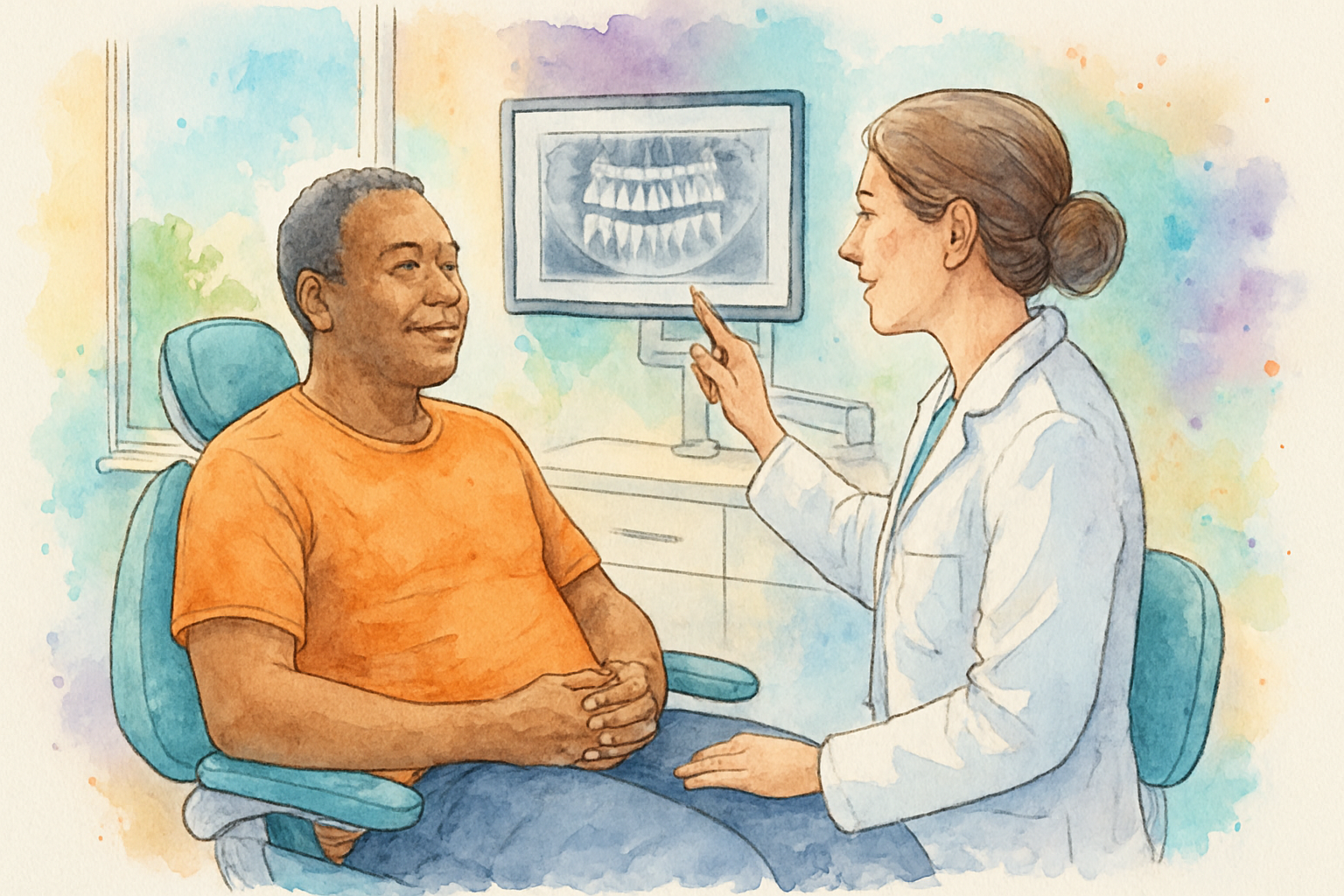
At Beyond Dental Care, a preventive appointment with Dr. Dariene Lazore, DMD includes a full dental exam, digital X-rays, a professional cleaning, a periodontal evaluation to assess gum tissue health, and an oral cancer screening. Each of those components serves a specific purpose — and skipping any of them creates a blind spot.
Here’s what each piece of the visit is actually looking for:
- Dental exam: Checks for cavities, cracked teeth, wear patterns, and early signs of structural breakdown
- Digital X-rays: Reveals decay between teeth, bone loss around roots, and issues that are invisible to the naked eye
- Professional cleaning: Removes hardened calculus (tartar) that brushing and flossing cannot touch — calculus is the primary driver of gum disease
- Periodontal evaluation: Measures gum pocket depth to catch early-stage gum disease before it progresses to bone loss
- Oral cancer screening: A visual and physical check of soft tissues — tongue, floor of mouth, cheeks, throat — that most people would never think to examine themselves
The cleaning portion typically runs 45 to 60 minutes for patients with healthy gums who have been seen recently. Patients who have gone more than a year without a cleaning often require additional time or a separate periodontal maintenance appointment depending on what the exam finds.
Why ‘Nothing Hurts’ Is Not the Same as ‘Nothing Is Wrong’
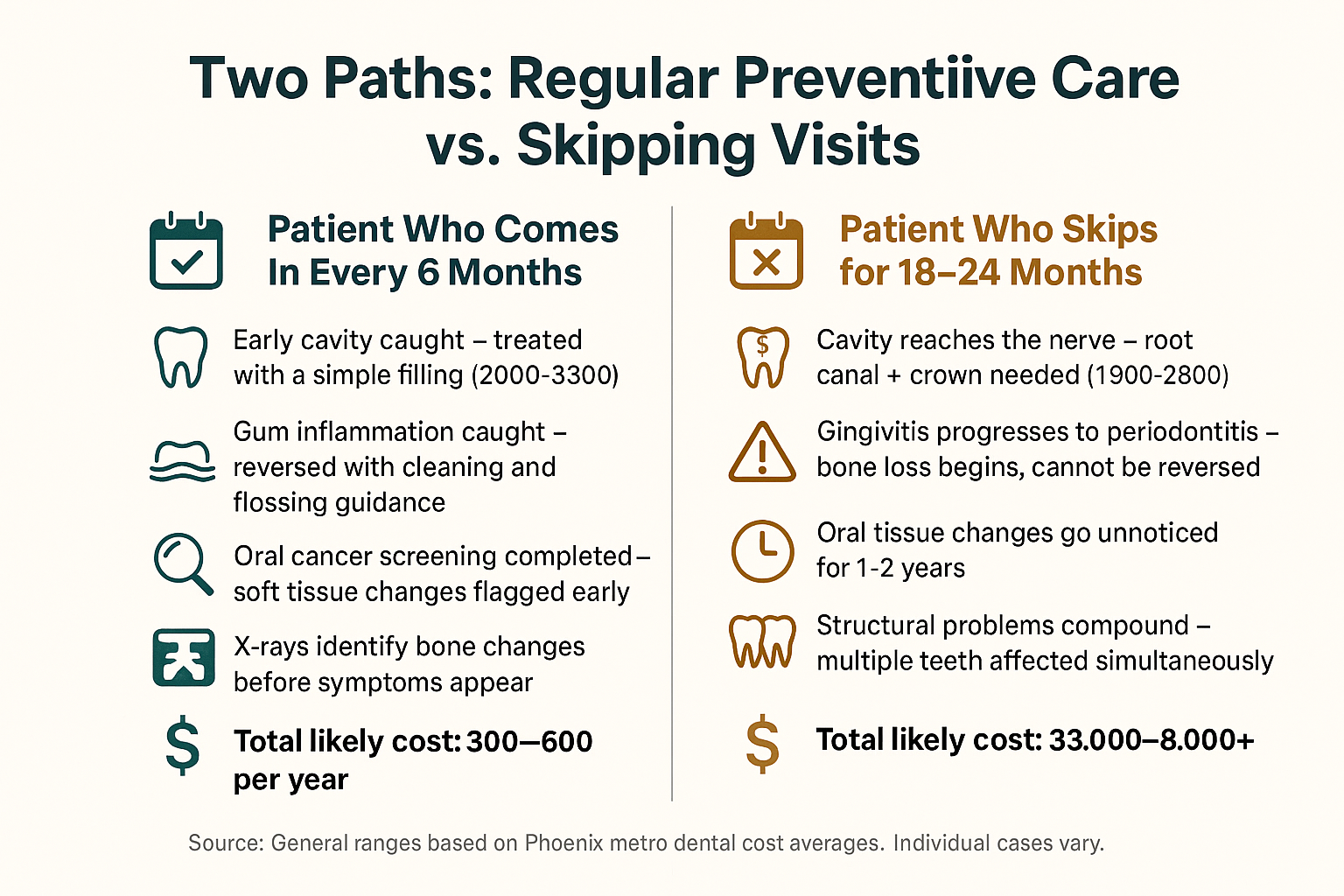
Tooth decay and gum disease share one frustrating quality: they develop silently for a long time before they cause pain. A cavity that would take 20 minutes and roughly $200–$300 to fill in its early stages can quietly expand toward the pulp of the tooth over 12 to 18 months. Once it reaches the nerve, the patient needs a root canal — a procedure that typically runs $900–$1,400 in the Phoenix metro area — plus a crown on top of that.
Gum disease follows a similar pattern. Early-stage gingivitis has no pain and is fully reversible with a professional cleaning and improved home care. But left untreated, it progresses to periodontitis — a condition involving actual bone loss around the teeth that cannot be reversed, only managed. As explained in how long a cavity can go untreated, the timeline from ‘minor issue’ to ‘major procedure’ is shorter than most patients expect.
For residents across Stetson Valley, Norterra, and Vistancia — neighborhoods with a high proportion of busy working adults and dual-income households — this is a particularly common pattern. Schedules fill up, the appointment gets pushed back, and by the next available opening, something that was manageable has become a bigger conversation.
The clinical reality is straightforward: dental problems do not pause while you’re busy. They compound.
What Gets Caught at a Preventive Visit — vs. What Gets Missed
This infographic shows the two paths a patient can take — attending preventive visits regularly versus skipping them — and what each path typically leads to over a 2-year window.
How Often Adults Actually Need to Come In
The standard recommendation of twice per year — every six months — works well for most adults with healthy gums and a low cavity history. But it’s not a universal rule.
Some patients need to be seen every three to four months, particularly those with:
- A history of periodontal disease or active gum pocketing
- Diabetes, which significantly increases gum disease risk
- Dry mouth caused by medications (a very common issue in adults 50+)
- A personal history of frequent cavities despite solid home care
- Recent crown, bridge, or implant restorations that need periodic monitoring
On the other side, some adults with exceptional oral health, no restorations, and stable gum tissue may do fine with one annual visit — but that’s a clinical determination, not something to assume without an exam confirming it.
For a deeper look at how appointment frequency is actually determined, how often adults should really see a dentist walks through the decision-making process in plain terms.
Patients in Arrowhead Lakes and Cibola Vista often ask about this when they’re setting up care at a new practice. The honest answer is: your frequency should be based on your mouth, not a calendar rule. A dentist who looks at your chart and asks the right questions will give you a more accurate answer than any general guideline.
Preventive vs. Restorative: What Early Detection Actually Saves
These are general cost comparisons based on Phoenix metro area dental averages. Early treatment is almost always simpler and less expensive than treating the same problem after it has progressed.
| Problem | Caught Early | Caught Late |
|---|---|---|
| Small cavity (enamel or dentin) | Filling: $200–$350 | Root canal + crown: $1,900–$2,800 |
| Early gum inflammation (gingivitis) | Standard cleaning + home care guidance | Periodontal scaling/root planing: $500–$1,200 |
| Cracked tooth (hairline, no symptoms) | Monitoring or simple bonding: $300–$600 | Crown or extraction + implant: $2,500–$5,500+ |
| Early bone loss (caught on X-ray) | Increased cleaning frequency, management | Tooth loss, implant or bridge needed |
| Worn enamel from grinding | Night guard: $400–$700 | Multiple crowns or veneers: $4,000–$12,000+ |
What Happens to Patients Who Switch to a New Dentist After Years Away
One of the most common scenarios at a private practice like Beyond Dental Care is the patient who hasn’t seen a dentist in three, five, or even ten years — and finally books an appointment, often because something is starting to bother them.
There’s no judgment in that. Life circumstances, insurance gaps, anxiety, and bad past experiences all play a role. But it does mean the first visit often involves more ground-level assessment than a standard preventive appointment.
For patients returning after a significant gap, the first appointment typically includes:
- A full set of updated X-rays (not just bitewings) to assess bone levels and identify anything that developed during the gap
- A thorough periodontal charting to establish a baseline for gum health
- A detailed exam to prioritize what — if anything — needs to be addressed, and in what order
This kind of visit is actually more involved than a routine preventive appointment, and understanding that before you arrive prevents any surprise. For patients who feel nervous about what might be found after a long gap, why people feel nervous about seeing a new dentist addresses that honestly.
The goal of that first appointment isn’t to overwhelm you with a list of problems. It’s to give you an accurate picture so you can make informed decisions about your care — on your own timeline, without pressure.
Patients across North Peoria and Hillcrest Ranch who’ve experienced corporate dental chains often describe feeling like their past-due treatment list was read to them like a bill. That’s not how a patient-centered private practice approaches it.
Frequently Asked Questions About Preventive Dental Visits
Is a preventive dental visit covered by insurance?
Most dental insurance plans cover two preventive visits per year at 100% — meaning the exam, X-rays (on the standard schedule), and cleaning are included with no out-of-pocket cost. Plans vary, so it’s worth confirming your specific benefits before your appointment. Patients without dental insurance can also use HSA funds for preventive care — here’s a guide on using HSA funds for dental if that applies to you.
What if I’m nervous about what the dentist might find after a long gap?
That feeling is more common than you’d think, and it’s a real reason people keep postponing. The short answer is: whatever is found is easier to address now than it will be in another year. A good dentist won’t pressure you or overwhelm you — they’ll explain what they see, answer your questions, and let you decide how to move forward.
Do I really need X-rays at every visit?
Not necessarily every visit. Bitewing X-rays (the ones that check between teeth for cavities) are typically recommended once per year. A full mouth series, which gives a complete picture including bone levels, is usually taken every 3 to 5 years depending on your history. Digital X-rays used at modern practices emit a fraction of the radiation of older film X-rays, so the clinical benefit of taking them on the recommended schedule significantly outweighs any exposure concern.
What is an oral cancer screening, exactly?
It’s a visual and physical examination of all the soft tissues in and around your mouth — your lips, tongue, the floor of your mouth, the insides of your cheeks, your throat, and your lymph nodes. The dentist is looking for unusual patches, lumps, sores that haven’t healed, or tissue color changes. It takes about two to three minutes and requires nothing from the patient. It’s one of the most important parts of a preventive visit that patients rarely think to ask about.
What’s the difference between a regular cleaning and a periodontal maintenance cleaning?
A standard prophylaxis (routine cleaning) is for patients with healthy gum tissue and no history of gum disease. A periodontal maintenance cleaning is a more involved procedure for patients who have been diagnosed with and treated for gum disease — it goes deeper below the gumline to maintain the progress made through earlier treatment. They are billed differently and serve different purposes. This article explains the distinction in detail.
I brush and floss every day. Do I still need professional cleanings?
Yes. Brushing and flossing prevent plaque from hardening, but they can’t remove calculus once it forms — and calculus forms even in patients with excellent home care habits, particularly near the salivary glands on the back of the lower front teeth. Only professional instruments can remove it. Consistent home care absolutely reduces how much calculus accumulates, but it doesn’t eliminate the need for a professional cleaning.
Ready to Get Back on Track with Your Oral Health?
Whether you’re overdue for a cleaning or looking for a long-term dental home in North Glendale or anywhere across the Upper West Side Phoenix area, Beyond Dental Care offers evening and Saturday appointments to fit real schedules. Dr. Dariene Lazore and her team take the time to give you an honest picture of your oral health — without pressure and without surprises. Reach out at 623-267-8088 or visit beyonddentalcare.com to get started.