
Direct Answer: Most adults do well with two dental visits per year, but your actual ideal frequency depends on your gum health, cavity history, and whether you have conditions like dry mouth or diabetes.
Most adults in the Arrowhead Ranch and Stetson Valley areas grew up hearing the same rule: see your dentist every six months. And for a lot of people, that advice still holds. But a surprising number of adults are either going too often for what their mouth actually needs — or not nearly often enough for where their oral health currently stands.
The “twice a year” rule was never based on a clinical study. It came from a 1950s toothpaste advertisement. What actually determines how often you should be seen is a combination of your gum health history, your cavity risk, and whether you have any underlying conditions that affect your mouth.
This article breaks down how those factors work in practice, what a thoughtful dental provider looks for when setting your schedule, and when the standard twice-a-year recommendation genuinely applies — and when it doesn’t.
Why “Twice a Year” Is a Starting Point, Not a Rule
The six-month interval became standard because it works well for the average adult with healthy gums and no active decay. For that person, a professional cleaning every six months removes the tartar buildup that brushing can’t touch, and a twice-yearly exam gives a dentist enough of a window to catch problems before they become expensive ones.
But most adults aren’t the “average” case. Research published in the Journal of Dental Research found that low-risk patients — those with no history of gum disease, minimal decay, and good home hygiene — can maintain excellent oral health with annual visits. Meanwhile, high-risk patients who stick to a twice-yearly schedule may actually need to be seen every three to four months to stay ahead of problems.
The practical issue is that most patients never get told which category they’re in. They leave an appointment with a cleaning scheduled six months out and assume everything is fine — even when their provider has documented early gum changes that warrant a closer look. Understanding your own risk category is one of the most useful things a dental exam can give you, and it’s something a private practice like Beyond Dental Care builds into every periodontal evaluation.
For patients who want to understand what a deeper cleaning involves, this guide on periodontal maintenance cleaning explains exactly what that process looks like and why some patients need it.
The Conditions That Change Your Ideal Visit Frequency
Several common health and lifestyle factors push patients out of the standard twice-a-year window. Knowing which ones apply to you makes it much easier to have a productive conversation with your dentist about what schedule actually makes sense.
Conditions that typically mean more frequent visits:
– Gum disease (periodontitis or gingivitis) — Active or previously treated gum disease almost always calls for visits every 3–4 months rather than every 6. Bacteria recolonize below the gum line faster than most people expect.
– Diabetes — High blood sugar slows healing and raises infection risk in oral tissue. People managing diabetes often need quarterly exams to stay ahead of gum complications.
– Dry mouth (xerostomia) — Saliva is your mouth’s natural defense against decay. When it’s reduced — often due to medications — cavity risk climbs fast. Many patients in the Norterra and Vistancia communities are managing this as a side effect of blood pressure, allergy, or antidepressant medications.
– Smoking or tobacco use — Tobacco suppresses the visible signs of gum disease, which means problems can progress further before they’re noticed. More frequent monitoring closes that gap.
– History of frequent cavities — If you’ve had more than two or three fillings in the past few years, that pattern suggests something in your diet, hygiene routine, or saliva chemistry is working against you.
Conditions where annual visits may be appropriate:
– No history of gum disease
– No active decay in three or more years
– Excellent home hygiene with consistent flossing
– No systemic conditions affecting oral health
If you’ve ever wondered how long a cavity can go untreated before it becomes a bigger problem, the answer depends heavily on where it is and how fast your decay progresses — another reason visit frequency isn’t one-size-fits-all.
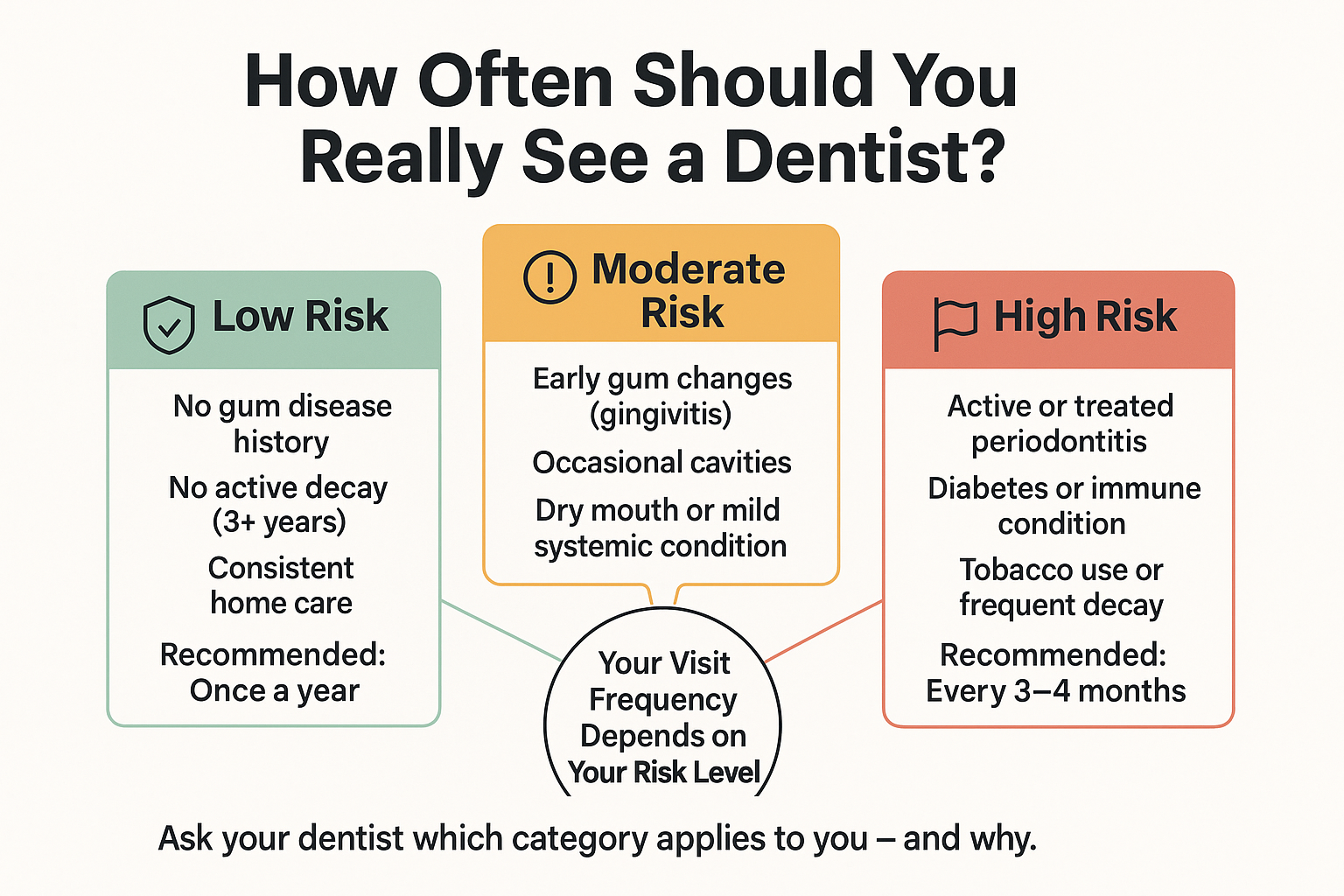
Dental Visit Frequency by Risk Level
This infographic shows how three different patient risk profiles translate into different recommended visit schedules — and what factors determine which category you’re in.
What Actually Happens at a Preventive Dental Exam
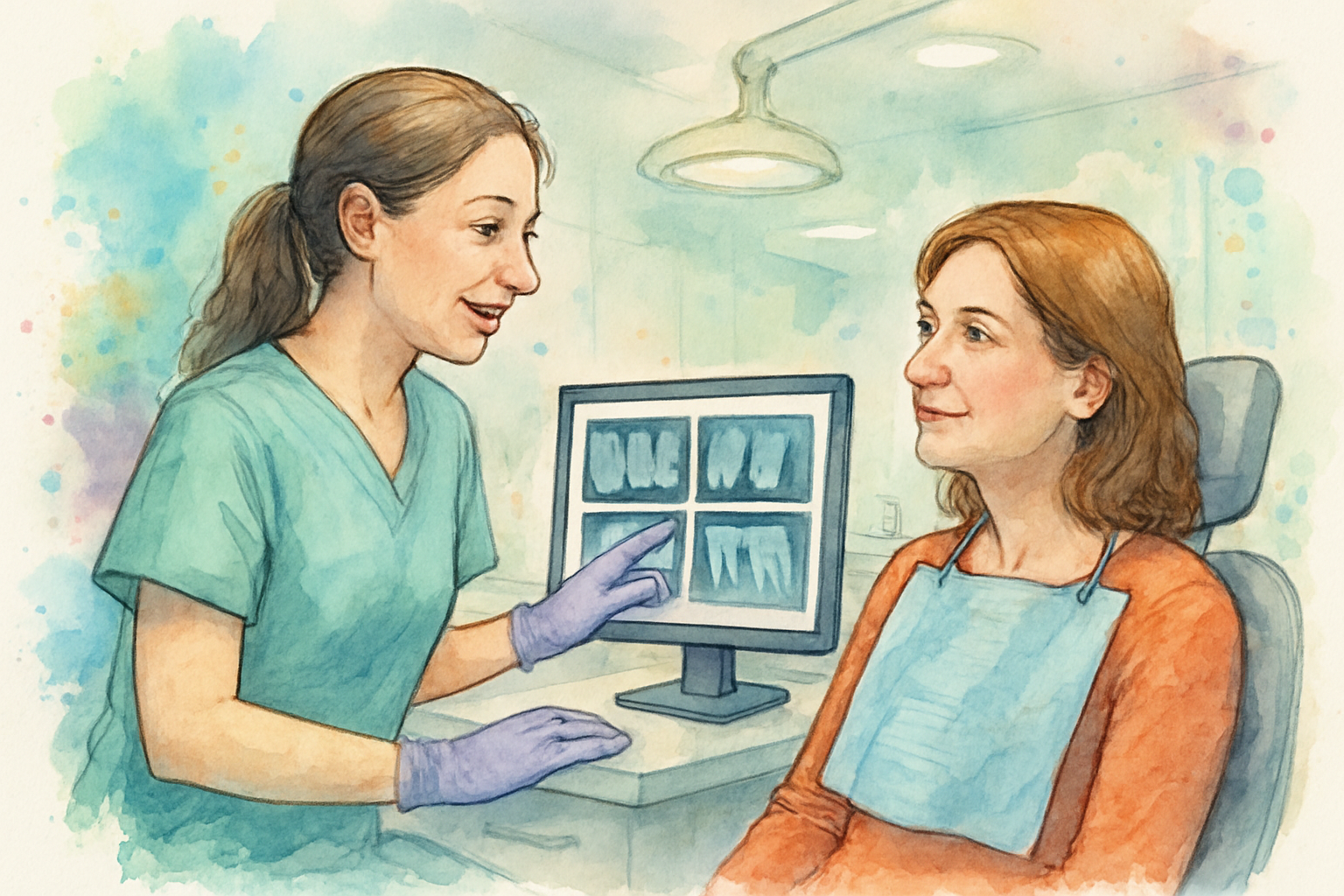
A lot of adults skip or delay dental visits because they’re not sure what the appointment actually involves — or they assume it’s just a cleaning and some X-rays. A thorough preventive exam at a private practice is more involved than most patients expect.
At Beyond Dental Care, a comprehensive dental exam with Dr. Dariene Lazore, DMD includes a full periodontal evaluation — meaning your gum pocket depths are measured, not just glanced at. That’s how early gum disease gets caught before it requires more involved treatment. Digital X-rays are taken as needed (not on a rigid annual schedule) and expose patients to a fraction of the radiation of older film X-rays.
An oral cancer screening is part of every exam. This takes about two minutes and involves a visual and tactile check of the soft tissues in your mouth, throat, and neck. The Arrowhead area has a high proportion of adults over 45, and oral cancer risk increases with age — yet many patients have never had a formal screening.
The cleaning itself — performed by a dental hygienist — removes calcified tartar from areas your toothbrush physically can’t reach. If your gums have started to pull away from your teeth, the cleaning process changes. Brushing too hard is one of the most common causes of gum recession, and it often goes undetected until a hygienist spots it at a routine appointment.
After the exam, you should leave with a clear picture of where your oral health stands and what — if anything — needs to be addressed. If that’s not happening at your current practice, that’s worth paying attention to.
Recommended Visit Frequency by Patient Profile
This table gives a quick reference for how often different types of patients should typically be seen, based on their oral health history and risk factors.
| Patient Profile | Recommended Frequency | Primary Reason |
|---|---|---|
| Healthy adult, no history of gum disease or decay | Once a year | Low bacterial recolonization rate; stable oral environment |
| Average adult with minor gum changes or occasional cavities | Every 6 months | Standard monitoring prevents small problems from escalating |
| Adult with treated periodontitis or active gum disease | Every 3–4 months | Bacteria below the gum line recolonize within 90 days |
| Adult with diabetes, dry mouth, or tobacco use | Every 3–4 months | Systemic conditions raise infection risk and mask symptoms |
| Adult with recent major restorative work (crowns, implants) | Every 6 months minimum | New restorations need monitoring during the integration period |
| Senior with partial dentures or implant-supported restorations | Every 6 months | Soft tissue and bone changes need regular evaluation |
The Cost of Waiting Too Long — What North Phoenix Patients Need to Know
One of the most common reasons adults in North Glendale and the broader Northwest Phoenix corridor delay dental visits is cost. That’s understandable. But the math usually runs in the wrong direction.
A routine cleaning and exam at a private dental practice in the Phoenix metro area typically runs between $150 and $300 for patients without insurance, depending on what the exam reveals. A single filling — the result of catching a cavity at that routine visit — runs roughly $150 to $250 per tooth. A dental crown, which becomes necessary when a cavity is left too long, starts around $1,200 to $1,800 in this market.
The pattern is consistent: the longer a patient waits, the more the treatment cost grows. A problem caught at a six-month visit is almost always simpler and less expensive than the same problem caught eighteen months later. If cost is a concern, it’s worth knowing that HSA funds can be used for most dental procedures — including exams, cleanings, fillings, and restorations.
For adults who have been avoiding the dentist due to anxiety rather than cost, that concern is worth addressing directly. It’s more common than most people admit, and a practice with a patient-first approach handles it differently than a high-volume corporate office.
Frequently Asked Questions About Dental Visit Frequency
Is twice a year really necessary if my teeth feel fine?
Feeling fine isn’t the same as being fine. Gum disease doesn’t hurt in its early stages, and cavities often don’t cause sensitivity until they’re moderately advanced. A dentist can detect both long before you’d notice anything on your own. Whether you need to come in twice a year or once a year depends on your risk profile — but skipping visits entirely because nothing hurts is how small problems become expensive ones.
My previous dentist put me on a three-month cleaning schedule. Is that normal?
Yes, and it’s usually a sign your gum health needs closer monitoring. A three-month (quarterly) schedule is standard for patients who have been treated for periodontal disease or who have systemic conditions like diabetes that raise oral infection risk. It’s not a sales tactic — it’s based on how fast bacteria recolonize below the gum line after a cleaning.
Do seniors need to see a dentist more often than younger adults?
Often, yes. Gum tissue and bone density change with age, medications become more common (which can cause dry mouth), and restorations like crowns or implants need regular monitoring. Many seniors in the Vistancia and Cibola Vista communities are also managing implant-supported restorations that require twice-yearly exams at minimum. If you’re over 60 and have had significant restorative work, annual visits probably aren’t enough.
What if I haven’t been to the dentist in several years?
The first step is a comprehensive exam to get a full picture of where things stand. Your dentist will measure gum pocket depths, review X-rays, and identify anything that needs attention. From there, a treatment timeline gets built around what’s most urgent. Most patients who’ve been away for a few years are surprised to find things are more manageable than they feared — though waiting longer does narrow those options. You can read more about what people feel when they’re nervous about seeing a new dentist — it’s a genuine concern that a patient-centered practice takes seriously.
Can I go to the dentist less often if I brush and floss perfectly?
Excellent home hygiene reduces your risk, but it doesn’t eliminate the need for professional care. No toothbrush or floss can remove hardened tartar — that requires professional instruments. And even patients with pristine home routines can develop gum issues that only show up during a clinical exam. Great home care earns you a lower-risk status; it doesn’t replace your visits.
How do I know if a dentist is recommending visits based on my actual needs vs. just filling their schedule?
A trustworthy dentist explains the clinical reason behind your recommended frequency — pocket depth measurements, cavity history, systemic conditions. If you’re being moved to a three-month schedule, you should be told exactly why. If the explanation is vague or the practice can’t point to specific findings, that’s worth questioning. This guide on how to tell if a dentist is just trying to sell you something walks through the signs of a transparent practice versus one that’s working against your interests.
Ready to Know Where Your Oral Health Actually Stands?
Beyond Dental Care serves adults and seniors across North Glendale, Arrowhead Ranch, Norterra, and the surrounding Northwest Phoenix communities with thorough, unhurried preventive care built around each patient’s actual risk profile — not a generic schedule. Dr. Dariene Lazore and her team offer evening and Saturday appointments for busy schedules, and new patients are always welcome to start with a comprehensive exam. To schedule or ask questions, call 623-267-8088 or visit beyonddentalcare.com.