
Direct Answer: In-office whitening delivers faster, more dramatic results. Take-home trays from a dentist can match that brightness over time — and both outlast anything from a drugstore shelf.
Most people searching for whiter teeth eventually hit the same wall: a drugstore shelf full of strips and rinses that don’t do much, and a vague sense that the dentist option probably works better — but no real idea what the difference actually is. The question isn’t just which one is stronger. It’s which one actually holds up over months, not just days.
This comes up often in practices across North Glendale and the Arrowhead Ranch area, where patients book consultations after months of inconsistent results from over-the-counter products. The answer isn’t always the same for every person, and the method that produces lasting results depends on what’s causing the discoloration in the first place.
This article breaks down the two professional whitening options — in-office treatment and dentist-prescribed take-home trays — and explains exactly what affects how long those results hold. No fluff, just the information you need to make a good decision.
What’s Actually Different Between the Two Methods
Both in-office and take-home whitening use peroxide-based bleaching agents, but the concentration, delivery, and timing are completely different.
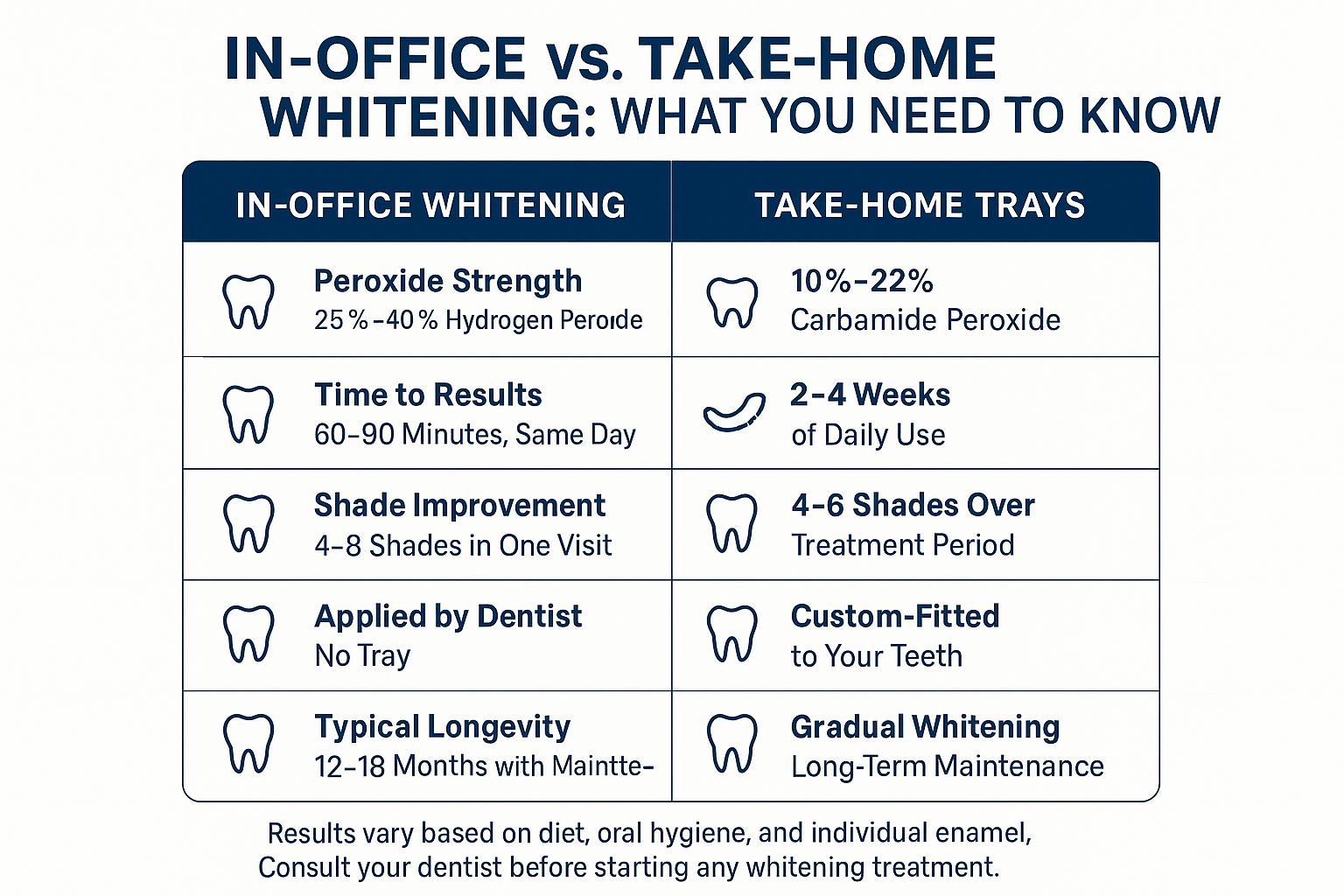
In-office whitening — sometimes called chairside whitening — uses a high-concentration hydrogen peroxide gel, typically between 25% and 40%, applied directly to the teeth by a trained dental professional. The appointment usually runs 60 to 90 minutes, and some systems use a light or laser to activate the gel. You leave the same day with noticeably brighter teeth.
Take-home trays prescribed by a dentist use a lower-concentration gel — usually 10% to 22% carbamide peroxide — in custom-fitted trays made from an impression of your actual teeth. You wear them for a set amount of time each day, typically 30 minutes to several hours, depending on the strength your provider recommends. Results build over 2 to 4 weeks.
The key distinction most people miss: over-the-counter strips use a much weaker formula and a generic tray that doesn’t seal tightly against the tooth surface. That loose fit lets saliva dilute the gel and leaves the edges of teeth uneven. Dentist-prescribed trays eliminate both problems.
If you’re curious about why teeth discolor in the first place, the cause matters more than most patients realize — and it directly affects which whitening option will work for you.

Which One Actually Lasts Longer — And Why
This is where most comparisons get vague. The honest answer is that longevity depends less on the method and more on what you do afterward.
In-office whitening delivers the fastest visible change. Most patients see 4 to 8 shades of improvement in a single appointment. But that rapid result comes with a caveat: teeth are temporarily more porous after a high-concentration treatment, which means the first 24 to 48 hours are a critical window. Coffee, red wine, tomato-based sauces, and dark berries during that window can reverse progress quickly.
Take-home trays create a slower, more gradual shift — but many patients report that the results feel more stable over time. The lower concentration causes less surface sensitivity, and the extended treatment period allows the whitening to penetrate more evenly across the enamel.
For most adults in the Stetson Valley and Norterra area who are committed to consistent at-home maintenance, dentist-prescribed take-home trays often produce results that hold up well beyond 12 months. For patients who want immediate results before a specific event — a wedding, a reunion, a job interview — in-office treatment is the more practical choice.
The variables that most affect how long results last:
- Coffee and tea consumption (daily drinkers see fading faster)
- Red wine and dark-pigmented foods in the regular diet
- Tobacco use — one of the fastest ways to reverse whitening results
- Oral hygiene consistency — plaque buildup accelerates restaining
- Whether you use a maintenance tray every few weeks after the initial treatment
Patients who combine an in-office session with a custom take-home tray for periodic touch-ups consistently report the longest-lasting results — often 18 to 24 months before a noticeable refresh is needed.
In-Office vs. Take-Home Whitening at a Glance
This comparison lays out the key differences between in-office and take-home whitening across the factors that matter most to patients making a decision.
Cost Comparison: Professional Whitening in the Phoenix Metro
Pricing for professional whitening in the Northwest Phoenix and Glendale area varies based on the method and provider. These are typical ranges patients encounter when researching options.
| Whitening Type | Typical Cost Range | What’s Included |
|---|---|---|
| In-Office (Chairside) | $300–$650 | Single 60–90 min session, protective gum barrier, immediate results |
| Dentist Take-Home Trays | $150–$400 | Custom trays + professional-grade gel syringes, 2–4 week supply |
| In-Office + Take-Home Combo | $450–$800 | Same-day results plus maintenance trays for touch-ups |
| OTC Whitening Strips | $25–$75 | Generic fit, low-strength gel, no custom tray, slower/uneven results |
What Makes a Whitening Result Actually Hold Up Over Time
The biggest misconception about whitening is that the treatment is the finish line. It’s really the starting point.
Teeth don’t stay white on their own. Enamel is porous, and the foods and drinks that stained your teeth before will stain them again — often faster in the weeks immediately following treatment, when the surface is at its most open. That’s why the maintenance strategy matters as much as the initial method.
For patients in the Vistancia and North Peoria area who ask how to stretch their results, the most practical approach is to:
- Avoid dark-pigmented foods and drinks for 48 hours after any professional whitening
- Use a whitening toothpaste 2–3 times per week (not daily — overuse can thin enamel over time)
- Do a 10–15 minute tray touch-up session every 4–6 weeks if you have custom trays
- Stay consistent with professional cleanings — restaining accelerates when plaque accumulates
Sensitivity is the other factor patients underestimate. High-concentration in-office treatments can cause temporary tooth sensitivity lasting 1–3 days. This is normal and resolves on its own, but patients with pre-existing sensitivity or thin enamel may find lower-concentration take-home trays more manageable over the long run.
If you’re thinking about whitening as part of a broader smile update, it’s worth reading why whitening, bonding, and veneers solve completely different smile problems before committing to any single approach. And if you’re still early in the research phase, what to ask before starting any cosmetic dental treatment is a useful starting point for the right questions to bring to a consultation.
One Thing That Can Derail Any Whitening Treatment
Starting whitening treatment before addressing underlying gum health is one of the more common mistakes patients make — and it’s one a good provider will catch before it becomes a problem.
Active gum inflammation or uncontrolled periodontal disease makes whitening results unpredictable and can make sensitivity significantly worse. If you haven’t had a periodontal evaluation recently, that’s the right first step before any cosmetic treatment, including whitening.
The same applies to existing restorations. Crowns, veneers, and composite bonding don’t respond to peroxide the way natural enamel does. If you have visible restorations on front teeth, whitening the surrounding teeth can create a noticeable color mismatch. A dentist reviewing your full mouth before treatment can flag that issue before you’re surprised by the result.
Frequently Asked Questions About Teeth Whitening
Is in-office whitening actually worth the higher cost compared to take-home trays?
It depends on your timeline. If you need visible results before a specific event and can’t wait 3–4 weeks, the $300–$650 price point for in-office treatment is justified. If you’re not in a hurry, dentist-prescribed take-home trays at $150–$400 can produce comparable results over a few weeks — and the custom tray is reusable for touch-ups, which gives you more value over time.
How long will my teeth stay white after professional whitening?
Most patients see results hold for 12 to 18 months with reasonable diet habits and consistent oral hygiene. Heavy coffee or wine drinkers may notice fading closer to 6 to 8 months. Doing a brief tray touch-up every 4–6 weeks significantly extends that window.
Can I whiten my teeth if I have crowns or veneers?
Whitening agents don’t change the color of crowns, veneers, or composite bonding. If you whiten the natural teeth around existing restorations, you may end up with a noticeable color difference. Talk to your dentist about what restorations you have before starting any whitening treatment — this is exactly the kind of thing a pre-treatment exam is designed to catch.
Will whitening make my teeth more sensitive?
It can, temporarily. In-office treatments using high-concentration peroxide cause sensitivity in 1–3 days for many patients, then resolve on their own. Take-home trays with lower-concentration gel tend to cause less sensitivity overall, which is why they’re often recommended for patients who already have sensitive teeth. If sensitivity is a concern for you, bring it up before treatment starts.
Do whitening strips from the drugstore do anything?
They can lighten surface stains slightly, but the results are limited and uneven. The gel concentration is much lower than professional-grade products, and the generic strip doesn’t seal tightly against the teeth, so saliva dilutes the gel before it fully contacts the enamel. For minor maintenance between professional treatments they’re fine — but as a primary whitening method, most patients are disappointed by the outcome.
Is teeth whitening safe for everyone?
For most healthy adults, professional whitening is safe when supervised by a dentist. It’s generally not recommended during pregnancy, for patients with active periodontal disease, or for teeth with significant enamel erosion. A standard dental exam before whitening rules out those issues and makes the whole process more predictable.
Ready to Get a Straight Answer on Which Whitening Option Fits You?
Beyond Dental Care sees patients from across North Glendale, Arrowhead Ranch, Stetson Hills, and the surrounding Northwest Phoenix area who want honest guidance before committing to any cosmetic treatment — including whitening. Dr. Dariene Lazore and the team at the practice take the time to review your current oral health, existing restorations, and whitening goals before recommending a path forward. To schedule a consultation, call 623-267-8088 or visit beyonddentalcare.com.