
Direct Answer: A permanent tooth that moves should be examined within a few days, not weeks. If there is swelling, pus, or pain when chewing, call the same day. Looseness signals bone or ligament trouble.
You pushed on it with your tongue, and it gave. Just slightly, but it moved, and now you keep checking it every ten minutes hoping it will firm back up.
I will save you the suspense. A permanent tooth that moves does not tighten on its own, because adults do not grow a second set. The movement itself is the finding, and it is telling you something about the bone and ligament holding that tooth in place.
This comes up more than people think. Urgent calls about pain or something breaking make up roughly one in ten of the calls we handle at our office off Happy Valley Road, and loose teeth sit right alongside abscesses and knocked-out teeth on that list. Below is how to read your own situation, what the visit actually looks like, and what waiting really costs.
Why a Loose Permanent Tooth in Adults Is a Structural Signal
A tooth is not cemented into your jaw. It hangs in the socket on a thin band of fibers called the periodontal ligament, and that ligament anchors into bone on both sides.
So when a tooth moves, one of three things has usually happened:
- The ligament is inflamed or stretched, often from an impact or from months of clenching and grinding
- The bone around the root has receded, which is what gum disease does over time
- The root itself is cracked or fractured, which changes how the tooth sits under pressure
The uncomfortable part is that bone loss is almost always painless until late. The CDC’s page on gum disease lists loose or sensitive teeth, painful chewing, and a change in how your teeth fit together as signs of periodontitis, and it is clear that the bone loss involved can be slowed and managed but not reversed.
That is the whole reason timing matters. We can work with bone that is still there. We cannot rebuild what is already gone. A patient in Stetson Valley who comes in the week the tooth starts moving has more options on the table than the same patient six months later.
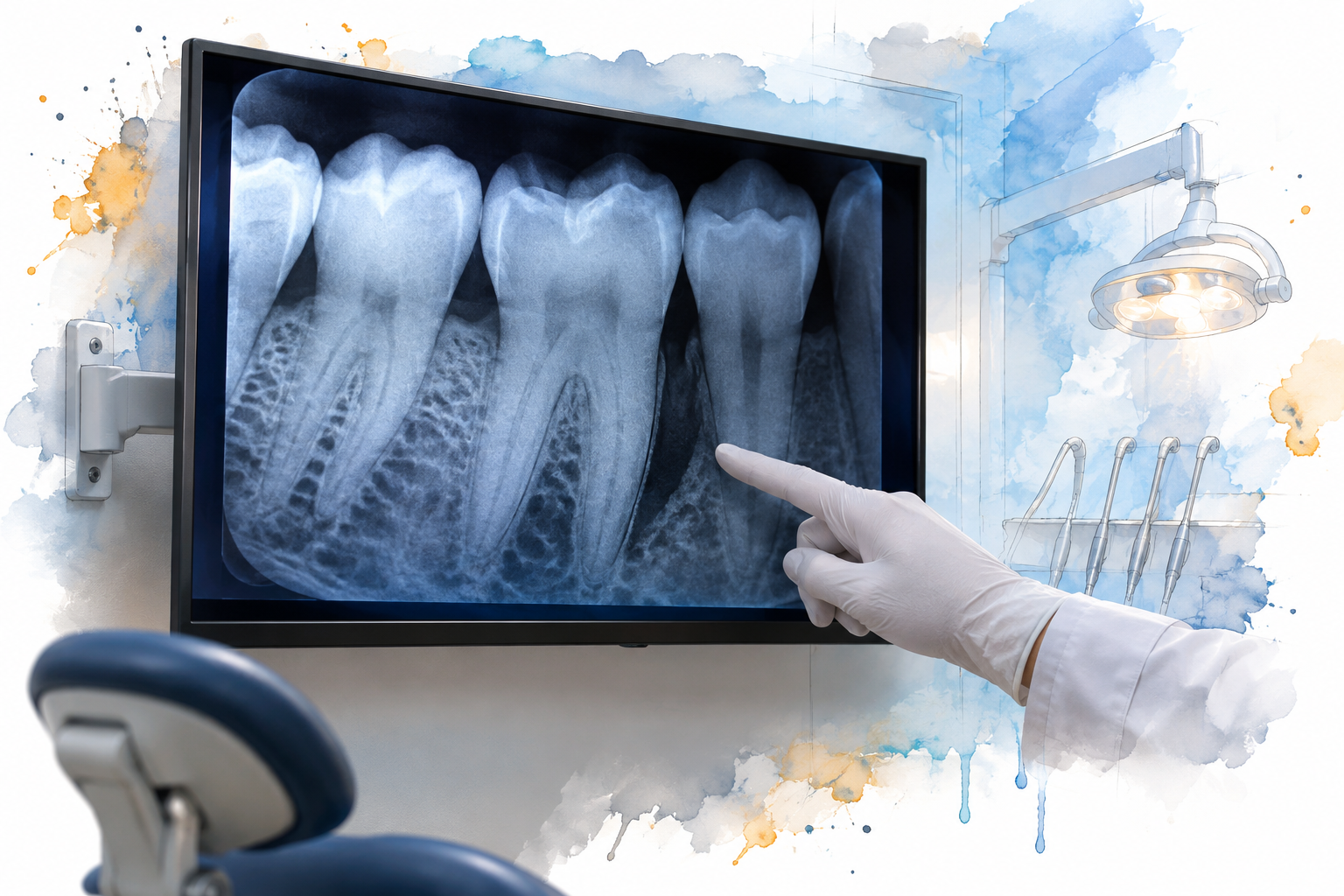
Three Kinds of Looseness, Three Different Timelines
Not every loose tooth is the same emergency, and I would rather you understand the difference than either panic or ignore it. In my experience these sort into three buckets.
Sudden movement after an impact. A fall on the Thunderbird Conservation Park trails, an elbow at a weekend game, biting down hard on something unexpected. The ligament may just be bruised, or the root may be cracked, and only imaging separates those two. This one gets seen the same day.
Gradual drift you notice as a bite that feels off. Maybe food started packing in a spot that never used to catch, or a night guard or partial suddenly fits differently. That shift usually means support has been quietly disappearing for a while.
Looseness that shows up with swelling or a bad taste. That combination points toward infection around the root. One of our callers described it simply as her gums giving her a really hard time, and that kind of wording usually means more is going on than irritation.
If you are also getting jaw pain that radiates down one side, the source may not be the tooth at all, which is another reason guessing from home rarely works.
How Urgent Is It? A Quick Read on Your Own Situation
Use this to decide whether you are looking at a today problem or a this-week problem. When two rows apply, go with the faster one.
| What you are noticing | What it often points to | How soon to be seen |
|---|---|---|
| Tooth moved right after a fall, elbow, or hard bite | Ligament injury, crack, or root fracture | Same day |
| Swelling in the cheek or gum, bad taste, or pus | Infection around the root or under the gum | Same day |
| Sharp pain when chewing on that side | A tooth carrying pressure it can no longer support | Within a few days |
| Bite feels different or a tooth looks like it shifted | Gradual bone loss from gum disease | Within a week |
| Slight movement you only notice with your tongue | Early support loss, clenching, or grinding | Within a week or two |
| A partial denture or night guard suddenly fits wrong | Teeth have changed position | Within a week |
What Actually Happens at a Loose Tooth Appointment
Most people picture an extraction the second they call. The first visit is diagnostic, and here is the order it runs in.
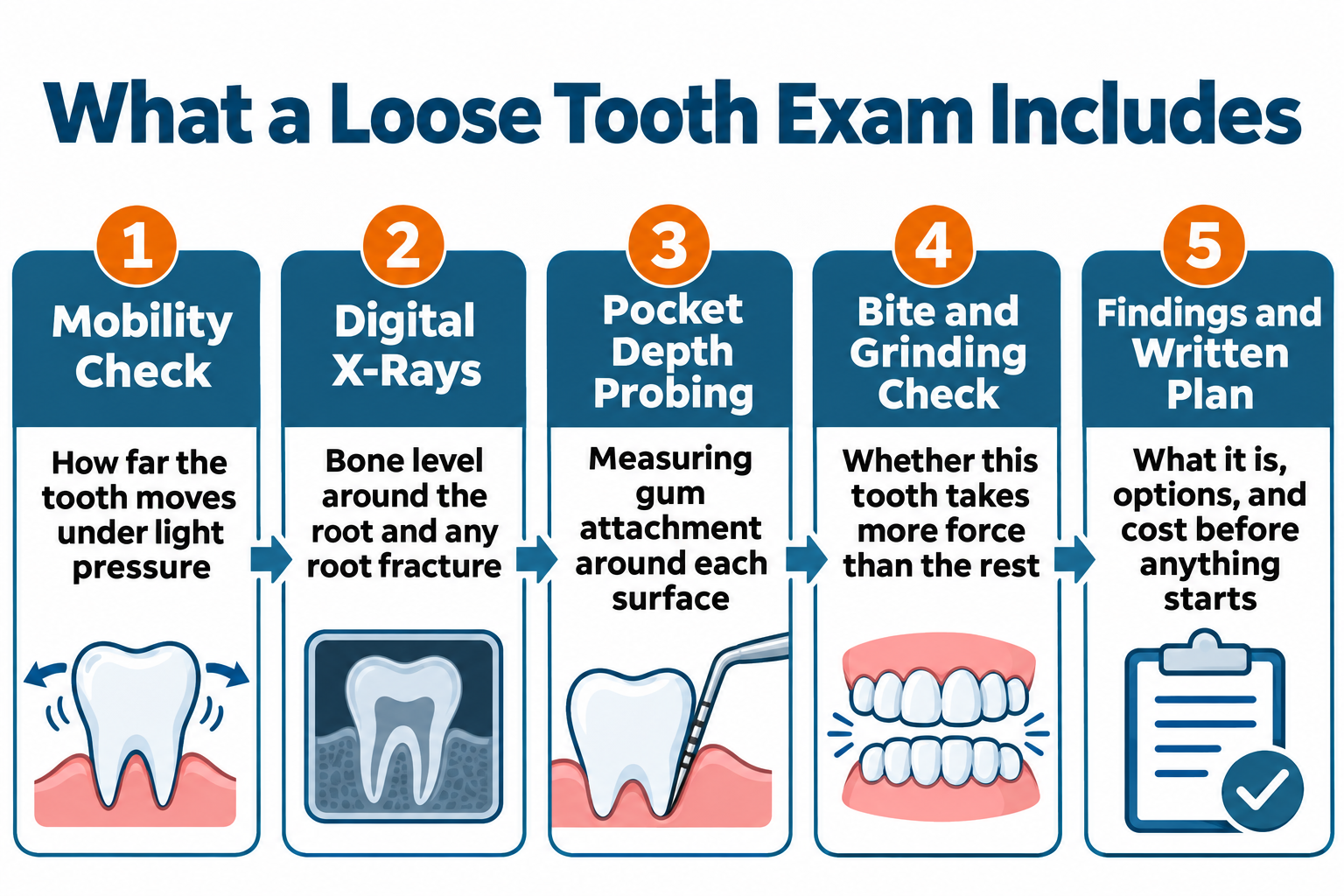
The Exam, and What It Costs to Find Out
Two fears usually show up together in these calls. People are half afraid of the diagnosis and half afraid of the bill, and the second fear is often what delays the first.
So here is the straight version. Our published price for an emergency exam with X-ray is a flat $99, and that covers the visit where we figure out what is going on. Anything beyond that depends entirely on what the imaging shows, and we quote it before treatment starts.
The exam itself is not dramatic. We check how the tooth moves under pressure, take digital X-rays to look at bone level around the root, probe the pocket depth around each surface of the tooth, and check how your bite loads that tooth compared to the others. Together those four things separate a gum support problem from a cracked root from a grinding problem.
Scheduling is the other practical piece. We hold same-day appointments for patients in pain, run late Monday through Thursday with evening slots as late as 7pm, and take Friday and Saturday by request. Somebody wrote in once asking specifically to be seen on a Saturday for a severe toothache with a loose tooth, which is exactly the kind of request that extended hours exist for. And if your appointment is hours away, what helps in the meantime is worth reading.
Can the Tooth Be Saved? The Honest Answer
Some loose teeth are kept. Some are not. Anyone who tells you otherwise before looking at an X-ray is guessing.
What the path forward looks like depends on the cause:
- Deep cleaning below the gumline. Scaling and root planing with ultrasonic instruments removes the bacteria and tartar under the gum that is driving bone loss. Laser treatment can support healing in some cases.
- A bite adjustment. Sometimes one tooth is absorbing far more force than it should, and reshaping the contact relieves it.
- A night guard. Grinding is a quiet cause of movement. One patient who had just moved to the area came in needing a night guard and some restorative work, and that pairing is common.
- Stabilizing the tooth while the ligament recovers, usually after trauma.
- A referral to a periodontist when the case is advanced enough to need specialist care.
The point of the appointment is to find out which situation you are in while there is still bone to work with. You are not walking in to receive a verdict. You are walking in to get information you cannot get from your tongue.
What Waiting Actually Costs
Pain is a poor gauge here. I have seen patients across North Glendale, Arrowhead Ranch, and Norterra manage around a moving tooth for months because it did not hurt, and the bone kept going the whole time.
Once a tooth is lost, the conversation changes completely. The bone and tissue under the gap begin to lose stability, neighboring teeth drift toward the space, and chewing changes on that side. Then you are weighing a bridge against an implant, which is a longer, more involved, and more expensive road than treating the loose tooth would have been.
Timing matters in one more practical way. Mid-October through December is when most insured households still have unused annual benefits sitting there before the calendar-year reset, and those do not roll over. For patients without insurance, our in-office membership plan takes 20% off treatment.
If swelling has already started, read what an abscess does next before you decide to sleep on it.
If Dread Is the Real Reason You Have Not Called
Fear keeps more of these teeth unexamined than anything else. People have told us outright they are afraid of the dentist and asked how we handle it before they will book, and nobody here is going to lecture you about how long you waited.
This is a private practice owned and operated by Dr. Dariene Lazore, DMD, so the same dentist sees you every visit and explanations do not get rushed. Sedation is available for anxious patients, and our comfort dog Mr. Woodford has talked more than a few nervous people into sitting down.
As one patient put it in a review: “If you’re looking for a dentist that is gentle on your teeth and gums, I would highly recommend Beyond Dental Care.”
Frequently Asked Questions About a Loose Permanent Tooth
Can a loose adult tooth tighten back up on its own?
Occasionally, if the cause was a short-term injury and the ligament is only bruised, some firmness returns. But you cannot tell the difference at home, and if the looseness is from bone loss, waiting only costs you more bone. Get it imaged.
Should I go to the emergency room for a loose tooth?
Usually no. Hospital emergency rooms do not have dental X-rays or a dentist on hand, so most people leave with pain medication and instructions to see a dentist anyway. The exception is facial swelling that is spreading, trouble breathing, or trouble swallowing, which is a medical emergency.
Does a loose tooth always mean it has to be pulled?
No. Plenty of loose teeth are stabilized and kept, especially when the cause is gum inflammation or a bite problem caught early. Extraction becomes the realistic option when the root is fractured or when too much supporting bone is already gone.
Is it safe to keep chewing on that side?
I would avoid it until you are seen. Every bite loads a tooth that is already losing support, and chewing hard or sticky food on a mobile tooth can turn a manageable problem into a fractured one.
What will the first visit cost if I do not have insurance?
Our published flat fee for an emergency exam with X-ray is $99. What comes after depends on what the X-ray shows, and we go over the numbers with you before any treatment begins. Our membership plan takes 20% off treatment for patients without insurance.
Wondering how soon your loose tooth needs to be looked at?
Beyond Dental Care keeps same-day appointments open for patients in pain, with evening availability Monday through Thursday and Friday or Saturday by request, serving North Glendale, Stetson Valley, Arrowhead Ranch, North Peoria, and the Upper West Side Phoenix area. The emergency exam and X-ray is a flat $99, and you will know what the imaging shows before anything else is decided. Call 623-267-8088 or visit beyonddentalcare.com when you are ready.