
Direct Answer: An implant replaces the tooth at the root and leaves neighboring teeth alone, but takes several months. A bridge is faster, usually two visits over a few weeks, but requires reshaping both adjacent teeth.
You lost one tooth. Maybe a molar cracked and could not be saved, or a crown failed under an old filling and the tooth underneath gave out. Now you have a gap, and two options on the table that sound similar but are not.
I have this conversation almost every week with patients from North Glendale, Arrowhead Ranch, and Stetson Valley. Most people come in already leaning one direction because of something they read, and most of the time the reason they are leaning that way is not the reason that actually matters for their mouth.
So here is how I walk through it. Not a pitch for one over the other, because I place both, and both are the right answer for different people. This is the decision framework I use with a patient sitting in the chair looking at their own X-ray.
Start With What Each One Actually Is
The names get used interchangeably by patients, and they should not be. These are structurally different repairs.
A dental bridge solves the visible gap. We shape down the two natural teeth on either side of the space, then cement a single piece across all three positions. The middle tooth is artificial and it rests on the gum. It is held up entirely by the teeth beside it.
A dental implant solves the gap at the root. We place a titanium post into the jawbone where the root used to be, let it fuse with the bone, then attach a standalone crown on top. The neighboring teeth are never touched.
That last part is the piece most people miss. With a bridge, two healthy teeth get permanently altered to fix one missing tooth. If those neighbors already have large fillings or old crowns on them, that trade is easy to accept, because they were going to need work anyway. If they are pristine, untouched teeth, I want you to understand what you are giving up before you agree to it.
One more difference worth knowing: a bridge is one connected unit, so you cannot floss between those three teeth normally. You use a floss threader or a water flosser under the false tooth, every day, for as long as you have it.
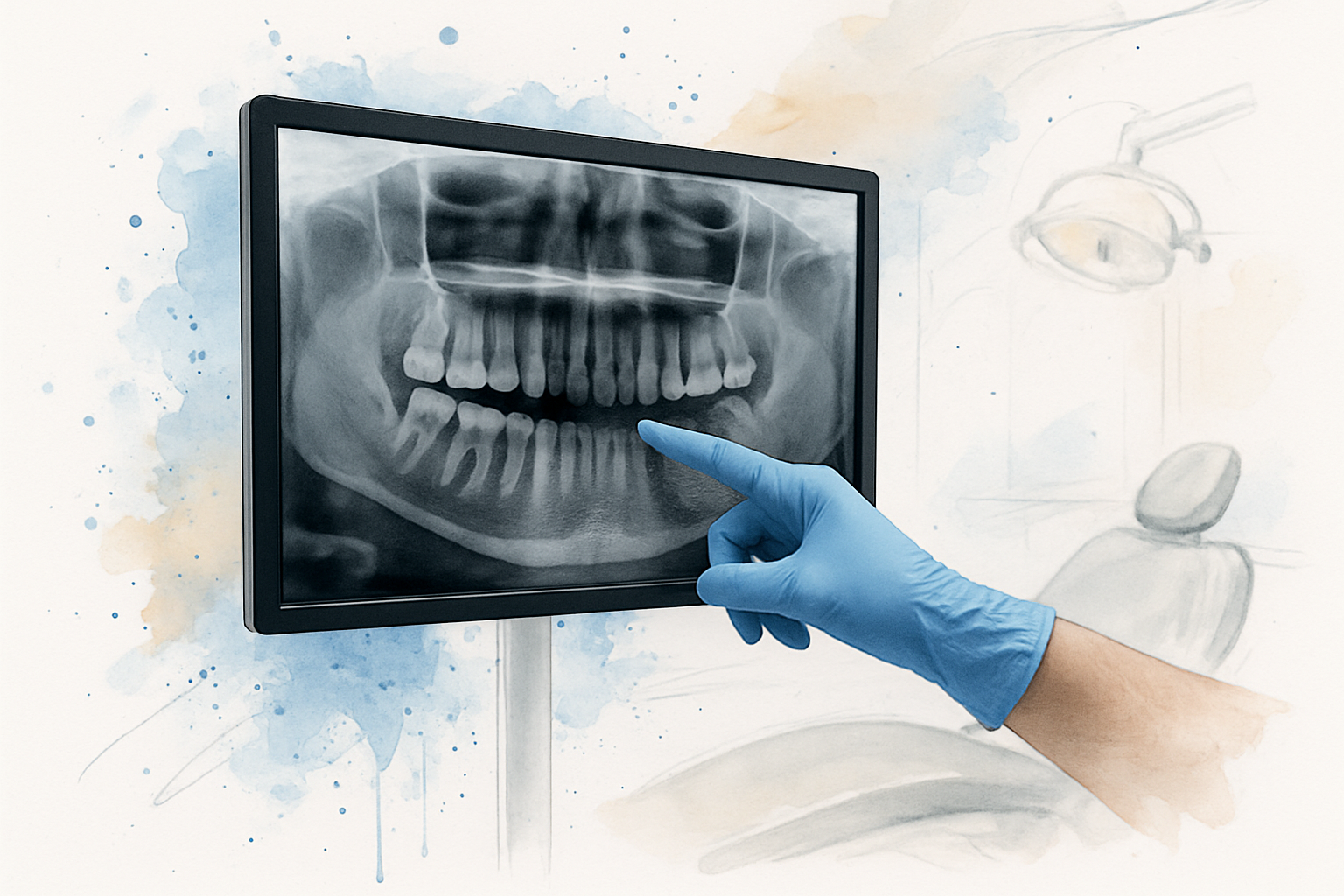
The Bone Under the Gap Is the Part Nobody Thinks About
Your jawbone stays dense because it gets loaded. Every time you chew, the root of a tooth transmits force down into the bone, and the bone responds by maintaining itself. Take the root away and that signal stops.
An implant post picks that job back up. It sits in the bone and takes chewing force the way a natural root does. A bridge does not, because nothing is in the socket space at all. The false tooth just floats above the gum.
So over the years, the ridge under a bridge can slowly shrink. You may notice a small shadow or gap appear under the false tooth as the gum and bone recede beneath it. It is not an emergency and it does not mean the bridge failed. But it is real, and the National Institute of Dental and Craniofacial Research notes bone changes as one of the consequences of tooth loss.
Why this matters for your decision:
- If you are 35 and losing your first tooth, you have decades of that shrinkage ahead of you. Preserving bone carries more weight.
- If you are 75 and the neighboring teeth already have crowns, the math changes. A bridge that uses teeth already needing work is a reasonable, conservative plan.
- If bone volume is already reduced where the tooth is missing, an implant may need grafting first, which adds time and steps.
None of that decides it on its own. It is one input among several.
Be Honest About the Timeline
This is where I see the most surprise, and it is the easiest thing to fix by explaining it up front.
A bridge is typically two appointments over a few weeks. First visit we prepare the neighboring teeth, take the impressions or digital scan, and place a temporary. Second visit we seat the final bridge. You leave with a working tooth.
An implant is a staged process, often several months from placement to final crown. The post goes in, then there is a healing phase while bone grows around it and locks it in place. Only after that integration is confirmed do we build and attach the crown. If grafting is needed first, add more time. I break the full sequence down in how long dental implants really take from start to finish.
Here is the part I want to be clear about: a bridge is not the lesser option because it is faster. It is the right fit for a different set of circumstances.
A teacher heading into the school year, a patient with a front tooth gap before a wedding, someone whose health history makes a surgical phase more complicated, someone with limited bone who does not want a graft. Those are all legitimate reasons to choose a bridge, and I say so.
Bridge vs Implant: A Side by Side Look
This is the summary I sketch out on paper for patients. Your specific case may differ, which is what the exam and imaging are for.
| Consideration | Dental Bridge | Dental Implant |
|---|---|---|
| Time from start to finish | Often two visits over a few weeks | Often several months, including a healing phase |
| Neighboring teeth | Both are permanently shaped down to hold it | Left completely untouched |
| Bone under the gap | Not loaded by chewing, can shrink over time | Loaded by the post, similar to a natural root |
| Surgery involved | No surgical placement | Yes, a post is placed into the jawbone |
| Daily cleaning | Floss threader or water flosser under the false tooth | Flossed like a natural tooth |
| Often a good fit when | Neighbors already need crowns, or bone volume is limited | Neighbors are healthy and bone volume is adequate |
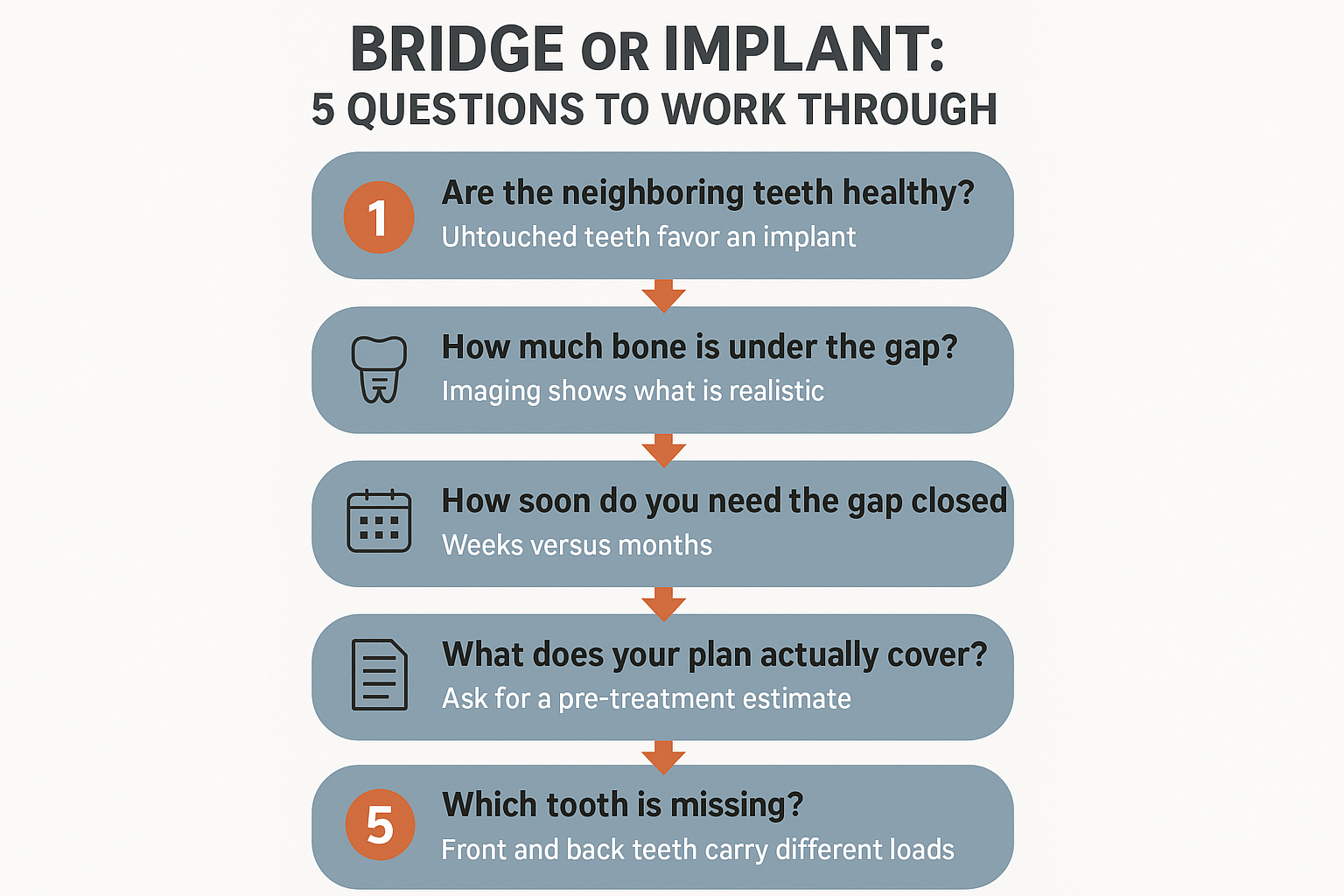
Five Questions to Work Through Before You Decide
If you want a short version to think about before your consultation, this is the order I ask these questions in.
Cost, Insurance, and the Question People Are Really Asking
Cost belongs in this conversation. Pretending otherwise does not help anyone.
Both procedures involve multiple components, so a single sticker price is misleading. What actually moves the number:
- Whether bone grafting is needed before an implant can be placed
- Which tooth is missing, since front and back teeth involve different materials and demands
- The condition of the neighboring teeth if a bridge is on the table
- Your plan’s annual maximum and how much of it you have already used
- How your plan classifies each procedure, which is not always the same for both
That last one catches people off guard constantly. Several patients have called us assuming coverage works the same way for a bridge and an implant. It often does not. I go deeper into the components in what really drives the price of a dental implant.
The only way to see your real number is a pre-treatment estimate submitted to your plan before anything starts. We do this routinely, and I would encourage you to ask any office for one. Treat it as a planning step, not a hurdle.
One more thing worth raising at your consultation. A patient planning a multi-step restorative case once asked us what order of procedures made the most sense with her insurance, and that is a smart question. Benefits reset on a schedule, and staging treatment across two benefit periods can sometimes reduce what you pay out of pocket. I wrote about that timing in what the January benefits reset means for planned treatment.
If You Are Over 65, Age Is Rarely the Deciding Factor
I get asked this constantly by patients in Arrowhead Lakes and Norterra, usually phrased as some version of “am I too old for an implant?”
Many of the implant patients I treat are in their 60s and 70s, and age by itself is rarely what rules someone out. What actually matters is bone density at the site, your medical history, any medications affecting bone metabolism, and how well your gums are doing.
That evaluation is not a guessing game. It comes from imaging. We look at the height and width of bone available, the position of the sinus or the nerve, and the health of the surrounding tissue. Then we can tell you whether an implant is realistic for that specific tooth, whether grafting would be needed first, or whether a bridge is the more sensible path.
If you want to know what that workup looks like before you sit down for it, I covered it in what the imaging reveals about implant candidacy and in what bone health has to do with candidacy as you age.
And if the answer for you is a bridge, that is a good outcome, not a consolation prize. A well-made bridge restores chewing, holds the neighboring teeth from drifting, and looks natural.
Frequently Asked Questions About Replacing One Missing Tooth
Does dental insurance cover a bridge and an implant the same way?
Often not. Many plans classify them differently, and some treat the implant post and the crown as separate line items. This is the single most common thing patients call us about before committing. The reliable answer comes from a pre-treatment estimate submitted to your specific plan, not from a general rule.
Can I get a bridge now and switch to an implant later?
Sometimes, but it is more complicated than people expect. The neighboring teeth have already been shaped down for the bridge, so they will still need crowns afterward. And the bone under the gap has had years without loading, which may mean grafting is required before a post can go in. If you think you may eventually want an implant, say that out loud at the consultation so it factors into the plan.
Will a bridge look as natural as an implant crown?
In the right hands, yes, especially in the back of the mouth. The place where the difference can show up over time is at the gumline of a front tooth, where the ridge under the false tooth may recede and create a small shadow. That is worth discussing specifically if the missing tooth is visible when you smile.
The tooth is still in my mouth and it hurts. What do I do first?
Get seen before you decide anything. Pain, swelling, or a loose tooth needs to be evaluated now, not after you have researched replacement options. We keep same-day appointments open for patients in pain, the emergency exam and X-ray is $99 flat, and we are open until 7pm Monday through Thursday so you do not have to miss work. Call 623-267-8088.
How long does each one last?
Both can serve you for many years with good home care and regular checkups, and both can fail early if the surrounding gums and bone are not maintained. The honest answer is that longevity depends more on your daily cleaning and your bite than on which option you picked. Ask your dentist what the specific risk factors are for your mouth.
Want a Straight Answer About Your Own Missing Tooth?
The right choice depends on your bone, your neighboring teeth, your timeline, and your coverage, and all four of those are specific to you. If you are in North Glendale, North Peoria, Stetson Valley, or anywhere across the Upper West Side of Phoenix and you want that walked through without pressure, our consultations are open and Dr. Dariene Lazore, DMD reviews the imaging with you directly. You can reach the office at 623-267-8088 or find more at beyonddentalcare.com.