
Direct Answer: Send your old dental office a signed written request. Under Arizona rules, they must provide a copy of your full record within 15 days, and they may charge a reasonable copying fee.
Most people who want to switch dentists do not stall because they are unsure about the new office. They stall because of one loose end: what happens to years of X-rays, charts, and treatment history sitting at the old place?
I see this constantly with households new to North Glendale, Stetson Valley, Arrowhead Ranch, Norterra, and North Peoria. They moved last month, they have deferred a cleaning through the whole process, and the records question is the thing keeping the appointment unbooked.
So let me walk through exactly how the handoff works in Arizona, what a clean request looks like, what your old images are actually good for, and the one step that really decides whether a switch happens.
Your Dental Records Belong to the Dentist. The Copy Belongs to You.
This is the part almost nobody explains. Under Arizona rules, the original patient record is the property of the licensee or business entity that created it. You cannot walk out with the chart.
But you do have a clear right to a copy, on a set timeline. According to the Arizona State Board of Dental Examiners, after a patient makes a written request, the dentist or business entity must provide a copy of the entire patient record within 15 days. A reasonable fee may be charged for copies.
A few things worth knowing before you send anything:
- The written request starts the clock. A phone call asking nicely does not. Put it in writing.
- 15 days is the outside window, not the normal wait. Most offices send digital images within a few days.
- Ask about the copying fee up front. It is allowed, and it is better to hear the number before the invoice shows up.
- Old records usually still exist. State rules require retention for at least six years after an adult’s last visit. For a child, it is at least three years past the eighteenth birthday or six years after the last visit, whichever is later.
That turns a vague worry about losing your dental history into a short, finite task.

What a Clean Records Request Actually Looks Like
Here is something I have learned from both sides of this: transfers almost always stall on the sending side, not the receiving side. Our office has had requests from other practices die simply because the phone number on file no longer worked.
So make the request easy to act on. A clean one includes:
- A signed written release from the patient
- Full legal name, plus any former name the chart might be under
- Date of birth
- The date range of care you want covered
- The exact email address the new office uses to receive images
- Whether you want radiographs only, or the full record including notes and periodontal charting
You do not have to invent this document. It is completely normal to call the new office and ask them to send you their release form, or to ask for the email where images should go. We hand that out all day.
One more step that takes two minutes and saves the whole thing: call the new office three or four days before your appointment and confirm the records actually arrived. A transfer that was never completed tends to reveal itself at the worst possible moment, which is when you are already in the chair.
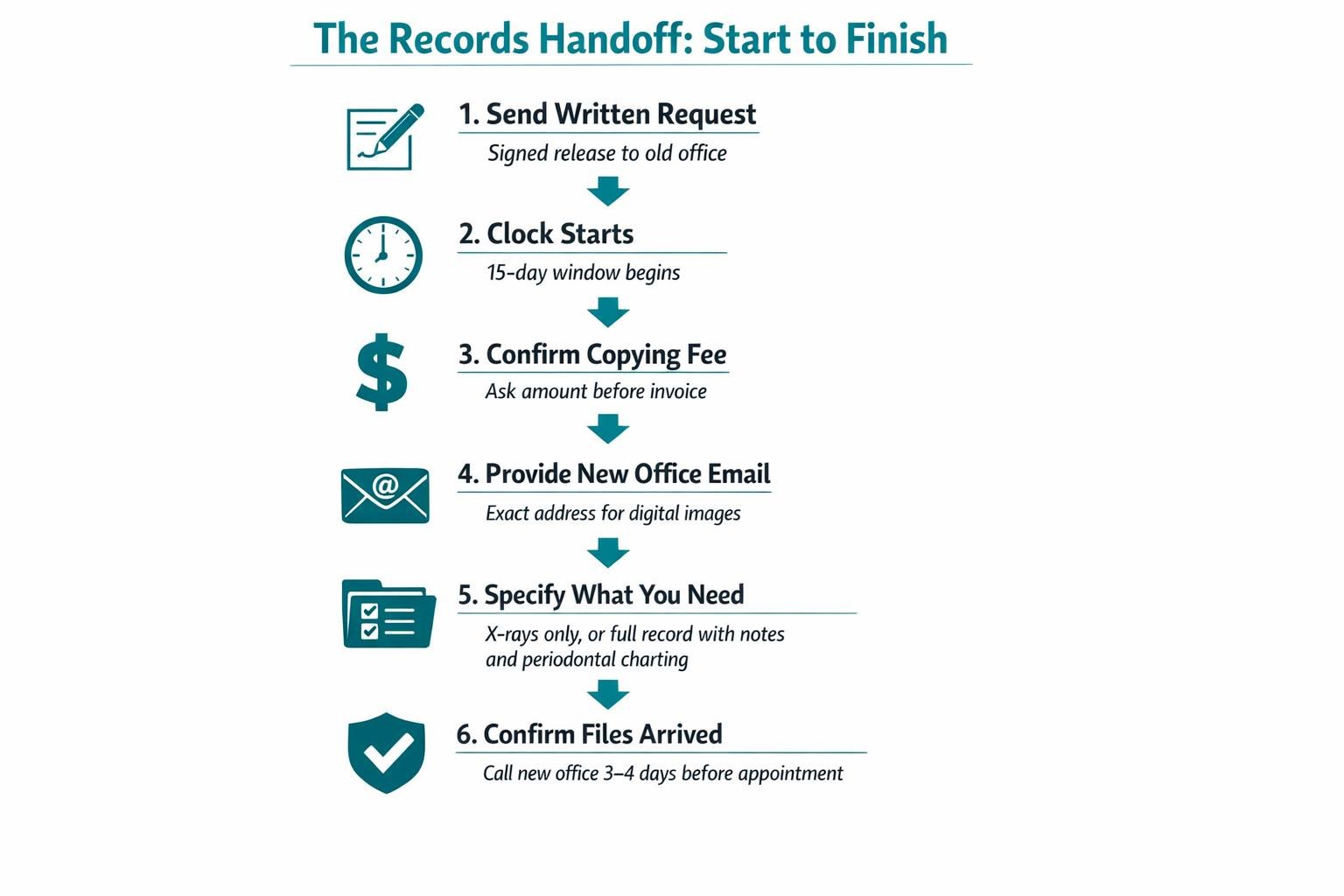
The Records Handoff, Start to Finish
Here is the whole sequence in order, from the first written request to confirming the files landed.
What Old X-Rays Are Good For, and Why Some Imaging Gets Repeated
This is the question people have not thought to ask, and it matters if you do not want to pay twice for the same images.
Old records are valuable for history, not as a replacement for a current exam. Bitewings from a year ago can be read alongside new ones to show what actually changed: whether a watched spot grew, whether bone levels shifted, whether a filling margin is breaking down.
Prior periodontal measurements, treatment notes, and a record of what work was done and when are often more useful to me than the films themselves. A crown placed in 2019 and a crown placed last spring call for different conversations.
That said, older films may simply be too dated to diagnose from. Decay and bone change move. A radiograph from four years ago tells me what your mouth looked like four years ago, which is useful context and not a current picture.
A good new office will tell you in advance whether it can use what you send. If you want a deeper look at the imaging side, we covered how often dental X-rays are actually needed separately, and what a thorough first exam covers if you want to know what the visit itself looks like.
What Transfers, and How Much It Helps
A quick reference for what to ask the old office to send and what each piece does for your new dentist.
| Record Type | What It Tells a New Dentist | Usually Repeated? |
|---|---|---|
| Bitewing X-rays (under 12 months) | Baseline for comparing decay and bone levels | Often usable as-is |
| Full mouth or panoramic X-rays | Root anatomy, wisdom teeth, jaw and sinus context | Depends on age and image quality |
| X-rays older than 2-3 years | Historical reference only | Typically retaken |
| Periodontal charting | Gum pocket depths over time, disease progression | New measurements taken, old ones compared |
| Treatment notes and ledger | What was done, when, and with what materials | Not repeated, pure history |
| Intraoral photos | Visual record of wear, cracks, and cosmetic concerns | New photos usually taken |
Insurance Is the Step That Actually Decides Whether You Switch
Honestly? The records rarely kill a switch. Insurance uncertainty does. In our own call data, coverage questions were the single most common reason a first call did not end in a booked appointment, coming up in roughly one out of every eight calls.
The plans people name over and over include Delta Dental, Cigna, Blue Cross Blue Shield, United and UnitedHealthcare, Humana, MetLife, TRICARE, Mercy Care, Dentegra, and Medicare or AARP supplemental coverage.
Have these four things in hand before you dial, and this becomes a single phone call:
- The plan name exactly as printed on the card
- Your member ID
- The group number
- Whether the plan is a PPO or an HMO
Then ask for network status on the spot, not a callback. A callback is where switching patients get lost. If the front desk cannot tell you in that conversation, ask when they can and who will call.
And if you have never used dental coverage before, you are not alone. One caller put it plainly: “I’ve never used dental insurance… is there a cap, or how does that work?” Yes, most plans have an annual maximum. We broke down what in-network, out-of-network, PPO, and HMO each mean for a bill and exactly what to confirm before you book if you want the full picture.
Timing the Switch Around a Northwest Valley Calendar
Timing matters more here than in most markets, for two reasons.
First, most dental plans run on a calendar year, and the annual maximum does not roll over on January 1. If you start a records request in early October, the old office gets its full 15-day window and you still have room to use this year’s benefits. Waiting until December is how unused coverage quietly disappears. More on that in our piece on what happens when benefits reset every January.
Second, the Northwest Valley fills up on a schedule. Market research puts somewhere around 300,000 to 400,000 seasonal residents arriving in the Phoenix metro near November and heading out by April, and this corridor carries a heavy share of them.
A five month stay is plenty of time for a cleaning, a crown, or a phased treatment plan, but only if the first visit happens in November rather than February. February arrivals tend to run out of runway.
And for families, build around the real calendar. Deer Valley Unified break weeks are the easiest time to get a teenager in without pulling them from class, and appointments near Happy Valley Road move faster outside the morning commute crunch.
What a Responsive Office Looks Like During a Switch
Here is the quiet truth underneath all of this. Most people switching dentists are not shopping for a procedure. They are shopping for an office that answers.
One patient who had recently moved to the area wrote in a review: “Awesome experience, we just moved and had a couple other offices not even respond!” That is the bar a lot of people are measuring against, and it is a low one.
Watch how an office handles the handoff before you ever sit in the chair. Do they send you the release form the same day? Do they confirm network status live? Can you text the front desk a question instead of leaving a voicemail? That behavior before the first visit is a reliable preview of the behavior after it.
Frequently Asked Questions About Transferring Dental Records and X-Rays
Can my old dentist refuse to send my records if I owe them money?
Your right to a copy of your record is separate from a billing dispute, and Arizona rules require the office to provide the copy after a written request within 15 days. A reasonable copying fee is allowed, though, so settle that piece up front and ask what the charge is before you submit the request.
Do I have to request the records myself, or can the new office do it?
Either works, but it still needs your signed release. The smoothest version is that the new office sends you their release form, you sign it, and it goes to the old practice with the exact email where images should be sent.
How far back should I ask for records?
Three to five years covers most of what is useful. If you have had implants, root canals, crowns, or periodontal treatment, ask for the full history on those teeth regardless of date, because knowing what was placed and when changes how it gets managed later.
Will I still need new X-rays if I send mine over?
Sometimes yes, sometimes no. Bitewings taken within the last year are often usable, while films older than two or three years are generally retaken because they no longer show what is happening now. Ask the new office before your visit so there are no surprises.
What if my old dental office has closed or I cannot reach them?
Start with any practice that acquired the patient base, since records usually transfer with the business. If that goes nowhere, the Arizona State Board of Dental Examiners is the right place to ask about custody of records from a closed practice.
Thinking About Making the Switch?
Beyond Dental Care handles records requests and insurance verification before the first visit, so the paperwork is settled by the time you sit down. Patients are seen Monday through Thursday with extended weekday hours, and Friday or Saturday by request. If you are somewhere in North Glendale, Arrowhead Ranch, Stetson Valley, Norterra, or North Peoria and want help with the handoff, call 623-267-8088 or visit beyonddentalcare.com.