
Direct Answer: Swelling in the cheek, gum, or jaw alongside a bad tooth means the infection has moved out of the tooth and into surrounding tissue. That needs a same-day exam, not a wait-and-see week.
A tooth that hurts is one problem. A tooth that hurts while your cheek, gum, or jaw is visibly swelling is a different problem, and the difference decides how fast you need to be seen.
Swelling means the infection has moved out of the tooth and into the tissue around it. At that point, waiting does not just stretch out the discomfort. It changes what treatment looks like and how much of the tooth we can save.
I see this pattern a lot in the Happy Valley corridor, especially from households in Stetson Valley, Arrowhead Ranch, and Norterra. So here is the plain version: which symptoms mean call today, which can wait until morning, and what the first appointment actually involves.
Swelling Is the Line Between a Toothache and a Spreading Tooth Infection
A dental abscess is a pocket of infection, usually at the root tip of a tooth or deep in the gum tissue beside it. It forms when bacteria from decay or a crack reach the nerve inside the tooth and the body walls the infection off.
That pocket has to go somewhere. When it pushes out through bone into soft tissue, you get the swollen face, and that is the signal that matters more than the pain level.
Put these in the same-day column:
- Swelling along the cheek or under the jaw, even if it is mild
- A pimple-like bump on the gum near a sore tooth, with or without drainage
- A bad taste that keeps coming back after you rinse
- Fever alongside tooth pain
- Pain that wakes you up at night or does not respond to over-the-counter medication
- Trouble swallowing or opening your mouth fully
That last one is not a dentist call. Swelling that affects swallowing, breathing, or vision belongs in an emergency room immediately. If you are not sure which situation you are in, this breakdown of when the ER is the right place for a dental problem walks through the line.
Everything else on that list is treatable in a dental chair, usually the same day.
Same-Day Column or Morning Column: A Quick Read
Here is how I sort symptoms when someone calls describing pain and swelling together.
| What you are noticing | What it usually means | When to call |
|---|---|---|
| Swelling along the cheek or under the jaw | Infection has left the tooth and entered soft tissue | Same day |
| Pimple-like bump on the gum | An abscess has found a drainage point | Same day |
| Bad taste that keeps returning | The abscess is draining into your mouth | Same day |
| Fever with tooth pain | Your body is fighting a spreading infection | Same day |
| Pain that wakes you at night | The nerve is badly inflamed or dying | Same day |
| Trouble swallowing, breathing, or opening wide | Swelling may be affecting the airway | Emergency room now |
| Cold sensitivity that fades in a few seconds | Often early decay or a worn spot | Call in the morning |
| A chip with no pain and no swelling | Usually a repair, not an infection | Call in the morning |
When the Throbbing Stops, the Infection Usually Has Not
This is the single most misread signal in all of this, and I want to be direct about it.
A tooth throbs for days. Then it goes quiet. People read that quiet stretch as the problem working itself out, and they cancel the appointment.
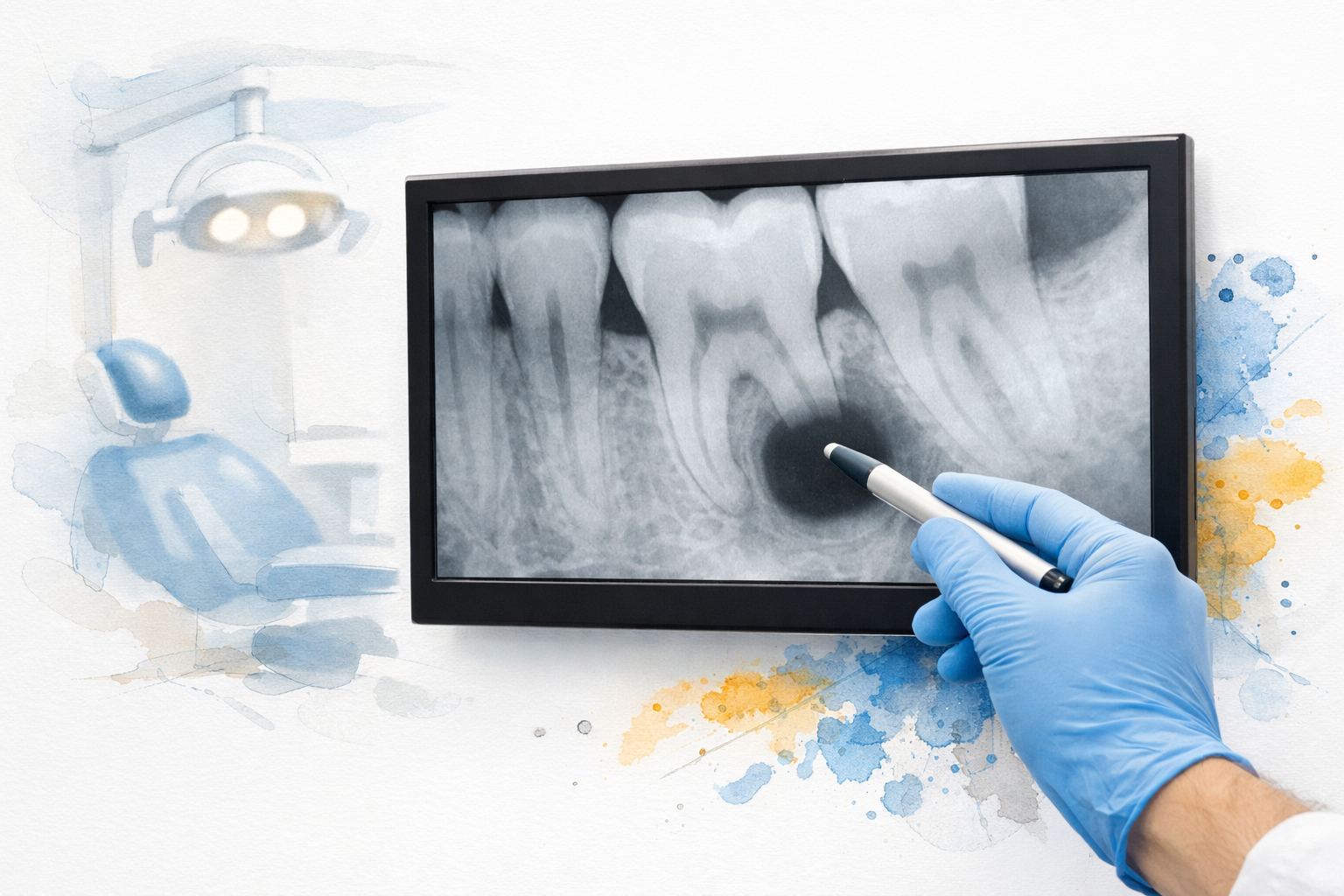
What usually happened is that the nerve inside the tooth died. Dead nerve tissue stops sending pain signals, but the bacteria are still there, and the infection keeps building at the root while you feel fine.
The tooth that quits hurting after days of throbbing is often the one that needs attention fastest. A few weeks later it comes back as a swollen face, and by then there is less tooth left to work with.
The signs that bring a tooth to this point are consistent:
- Severe pain when biting or under pressure
- Lingering sensitivity to hot and cold
- Dark discoloration in a single tooth, which often means the nerve has died
- Swollen, tender gums around one specific tooth
The National Institute of Dental and Craniofacial Research describes how untreated decay progresses from enamel into the inner pulp, which is exactly the path that ends in an abscess.
Antibiotics From Urgent Care Are a Bridge, Not a Fix
The other common misread is the course of antibiotics. Someone goes to urgent care over a weekend, gets a prescription, the swelling drops, and the pain eases. That feels like it is handled.
Antibiotics work on the infection that has spread into the surrounding tissue. They do not reach the dead tissue inside the tooth itself, because there is no blood supply left in there to carry the medication.
So the source stays put. Once the course ends, the infection has a clear path to rebuild, and the second round is usually worse than the first.
There are two real ways to remove the source:
- Root canal therapy, which cleans out the infected pulp, disinfects the canal, and seals it so the natural tooth stays in place
- Extraction, when the tooth is cracked too deeply or broken down too far to restore
If the tooth is saved with a root canal, a crown almost always follows to protect it from fracturing. Here is what each step of getting a crown involves if you want to see the sequence ahead of time.
What the First Abscess Appointment Actually Looks Like
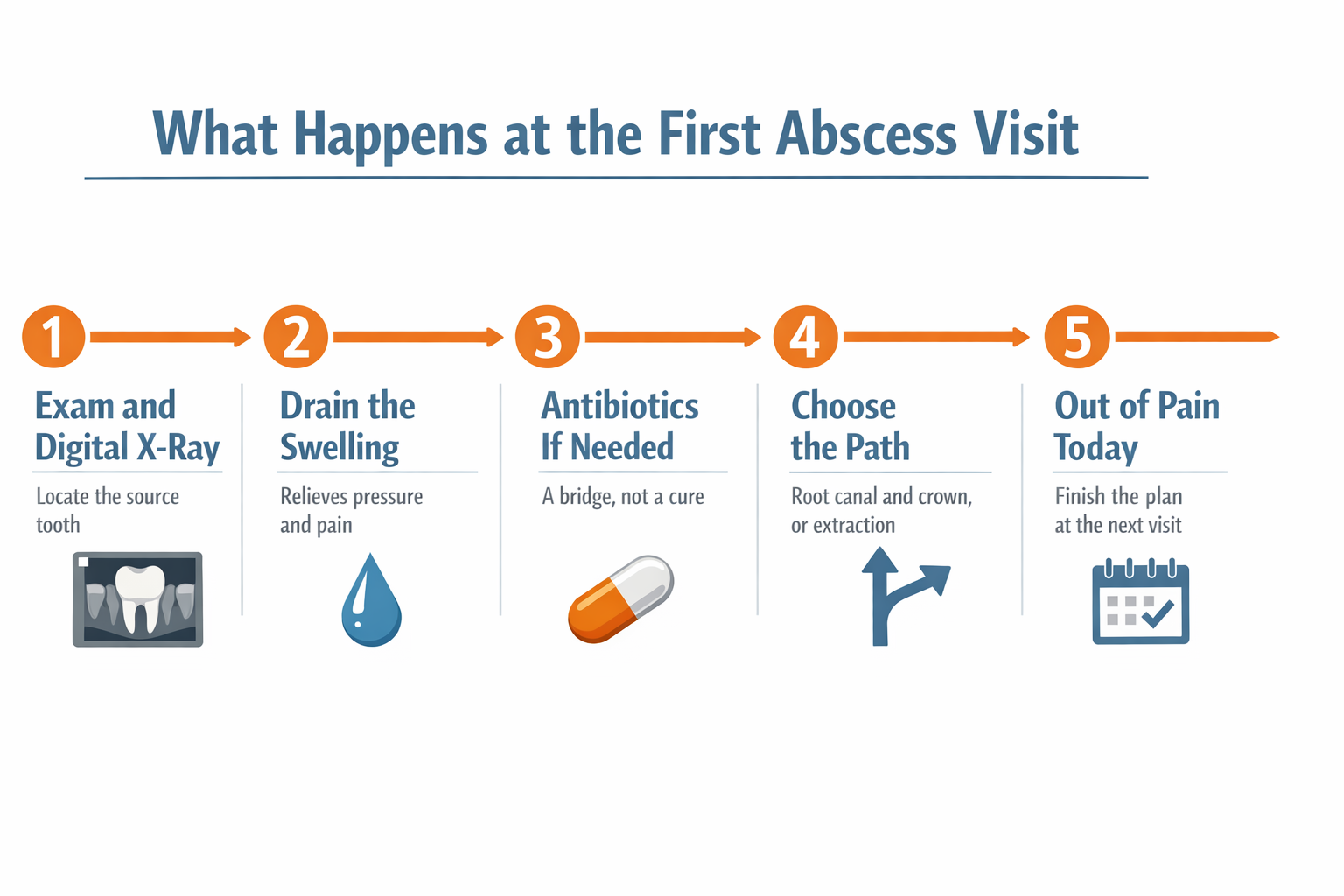
Not knowing what happens in that first visit is a big part of what keeps people sitting in the parking lot. Here is the order it usually runs in.
The First Visit Is About Control, Not Finishing Everything
I want to set that expectation clearly, because people often brace for a four hour afternoon and then talk themselves out of calling.
The visit starts with an exam and a digital X-ray to find which tooth is the source. Swelling spreads, so the tooth that hurts is not always the tooth causing it.
If there is a collection of pus, draining it brings immediate relief from the pressure. Antibiotics may go out the same day to calm the tissue while the definitive treatment gets scheduled.
Then we talk through the two paths. Save the tooth with root canal therapy and a crown, or remove it and discuss replacement later, once the infection is gone and the site has healed.
The goal of that first appointment is getting the infection under control and getting you out of pain. The rest gets planned, not rushed.
One practical note. For anything urgent, pick up the phone instead of fighting with an online booking form. A patient once wrote in to say the online system would not take their card while they had an active toothache, which is a slow way to get a fast problem solved. Calling gets you a real time on the calendar.
What Drives the Cost, and What to Ask on the Phone
Asking about money while you are in pain is reasonable, not awkward. In our own call records, cost and insurance uncertainty is the most common reason someone hesitates to book.
I cannot quote you a total in an article, because the number depends on things we have not looked at yet. What drives it:
- The exam and X-ray come first, and that is a fixed, known starting point
- Whether the tooth is restorable or needs to come out
- Which tooth it is, since back molars have more canals and cost more to treat than front teeth
- Whether a crown follows a root canal, which is a separate procedure with its own fee
- Whether any bone grafting is needed after an extraction
On insurance, the diagnostic visit and the major work that follows are typically handled under different categories of your plan, often at different percentages. General market reporting puts most annual dental plan maximums somewhere in the $1,000 to $2,000 range, and one infected molar can eat through a lot of that in a single calendar year. This piece on why benefits do not roll over explains why timing matters.
When you call, ask for these four things:
- The cost of the emergency exam and X-ray
- Whether your plan is in network, with your card in hand
- How much of your annual maximum is still available
- An estimate for each stage separately if a root canal and crown are likely
In our office the emergency exam and X-ray is $99 flat, with no billing surprises after. We also run an in-office membership plan with 20% off treatment for patients without insurance. An exact figure for your situation comes from the front desk, not a web page.
Why I See More of These Between Halloween and New Year’s
Our calendar in the Northwest Valley runs opposite to most of the country. October through March is when people here are out, hosting, traveling, and eating, with daytime temperatures in the comfortable 65 to 90 degree range.
That stretch from Halloween through New Year’s is roughly eight straight weeks of hard candy, caramel, sticky desserts, and acidic drinks landing on teeth that already have old fillings or hairline cracks in them.
Then the holiday weeks arrive and a lot of offices close. A molar that cracked on a Tuesday suddenly has nowhere to go, and by Saturday the cheek is swollen.
If you already know a tooth is bothering you heading into November, that is the moment to deal with it, not after the second slice of pie. This guide to reading a dental problem that starts on a Friday covers the weekend version of this question.
Frequently Asked Questions About Dental Abscess Swelling
Can a dental abscess go away on its own?
No. The swelling can go down and the pain can fade, which feels like healing, but the infected tissue inside the tooth is still there. An abscess does not resolve without treatment of the source, which means either root canal therapy or removing the tooth.
How fast does a tooth infection spread?
It varies a lot. Some abscesses sit quietly for months, and others go from a dull ache to a swollen jaw in about 48 hours. Once there is visible swelling, treat it as a same-day issue rather than trying to predict the pace.
My urgent care gave me antibiotics. Do I still need to see a dentist?
Yes. Antibiotics reduce the infection in the tissue around the tooth, but they cannot reach the dead pulp inside it. That is the source, and it will reinfect once the prescription runs out. Book the dental visit even if you feel better.
Will I get the root canal the same day I come in with swelling?
Sometimes, and sometimes not. If the tissue is badly inflamed, anesthetic works poorly, so the first step may be draining the area and starting antibiotics, then doing the root canal in a few days once things settle. Either way, the first visit should get you out of pain.
What if I need the tooth pulled instead?
That happens when a tooth is cracked below the gum or too broken down to rebuild. The extraction clears the infection, and replacement options get discussed afterward once the site heals. Thinking through a bridge versus an implant is a conversation for a calmer day, not the day you walk in swollen.
What can I do before my appointment?
Cold compress on the outside of the face, head elevated when you sleep, and no heat on the swelling. Here is a fuller rundown of what helps while you wait.
If the Swelling Started Today
We keep same-day appointments open for patients in pain, with a flat $99 emergency exam and X-ray and transparent pricing after that. Weekday hours run Monday through Thursday into the evening until 7pm, with Friday and Saturday by request, which matters when a swollen jaw shows up at 5pm and the alternative is waiting until next week. Beyond Dental Care is a private, non-corporate practice in the Happy Valley corridor led by Dr. Dariene Lazore, DMD, serving North Glendale, North Peoria, and the Upper West Side Phoenix area. Call 623-267-8088 or visit beyonddentalcare.com.