
Direct Answer: Tooth pain usually spikes on biting, hot, or cold and throbs at night on one spot. Joint pain is worst on waking, clicks when you open, and eases with soft food.
It almost always starts on one side. A deep ache near the back molars that creeps up toward the ear, or a pull along the temple that shows up every time you chew a bagel.
You look in the mirror and nothing is broken. Nothing is black. So you take ibuprofen, chew on the other side, and tell yourself it will settle down by the weekend.
I see this one constantly in patients from North Glendale, Stetson Valley, and the Happy Valley corridor, and the same question comes with it every time: is this a tooth problem or a jaw joint problem? Here is how I sort the two, what imaging can settle on the first visit, and what it honestly cannot.
Jaw Pain on One Side: Tooth or TMJ?
You cannot diagnose yourself from symptoms alone. But the pattern of the pain points in a direction, and that is worth knowing before you call anyone.
Pain that usually comes from a tooth:
- A sharp spike the moment you bite down on something firm
- A zing from hot or cold that lingers after the drink is gone
- Throbbing that starts on its own, often worse once you lie down at night
- Soreness when you tap or press that one tooth with a fingernail
- Pain that is clearly getting worse week over week, not up and down
Pain that usually comes from the joint and chewing muscles:
- Worst in the first hour after waking, then loosening through the morning
- A click, pop, or catch when you open wide
- A tired, dull ache across the cheek and temple rather than one pinpoint spot
- Noticeable relief on soft food and worse after a long meal or a stressful week
- Tenderness when you press the muscle in front of the ear or along the cheekbone
Here is the part I want people to actually hear. Tooth problems get louder. Joint and muscle problems fluctuate. If the pain has climbed steadily for five days straight, that is a tooth pattern until proven otherwise.
A Quick Side-by-Side on What You Are Feeling
I use a version of this in the chair when a patient is trying to describe what is happening. It is not a diagnosis, but it narrows things fast.
| What you notice | Points toward a tooth | Points toward the joint or muscles |
|---|---|---|
| Biting down | Sharp, quick pain on pressure | Dull ache that builds over a long meal |
| Hot or cold | A zing that lingers after | Usually no reaction at all |
| Timing | Throbs on its own, worse overnight | Worst on waking, eases by midday |
| Sound | None | Clicking or popping when opening |
| Opening wide | Normal range | Limited, stiff, or catches partway |
| Location | One tooth, one small spot | Spreads across cheek, ear, temple |
| Over a week | Steadily worse | Comes and goes with stress or chewing |
If a Doctor Sent You Here to Rule Out TMJ
A different reader shows up with this same pain, and they are not panicked. They are tired.
They have already seen a physician. Maybe a neurologist. They are holding a referral and a list of appointments, and the dentist is one box on it. One caller put it almost exactly this way: “We’re running the gamut of tests from eyes to jaw to dentistry to spinal tap. This is just one part of the equation of the testing he wants us to do.”
If that is you, here is what a dental evaluation actually contributes to the larger workup:
- Checking for a cracked, decayed, or abscessed tooth that could be driving referred pain
- Looking at how the bite comes together and whether one side is carrying more load
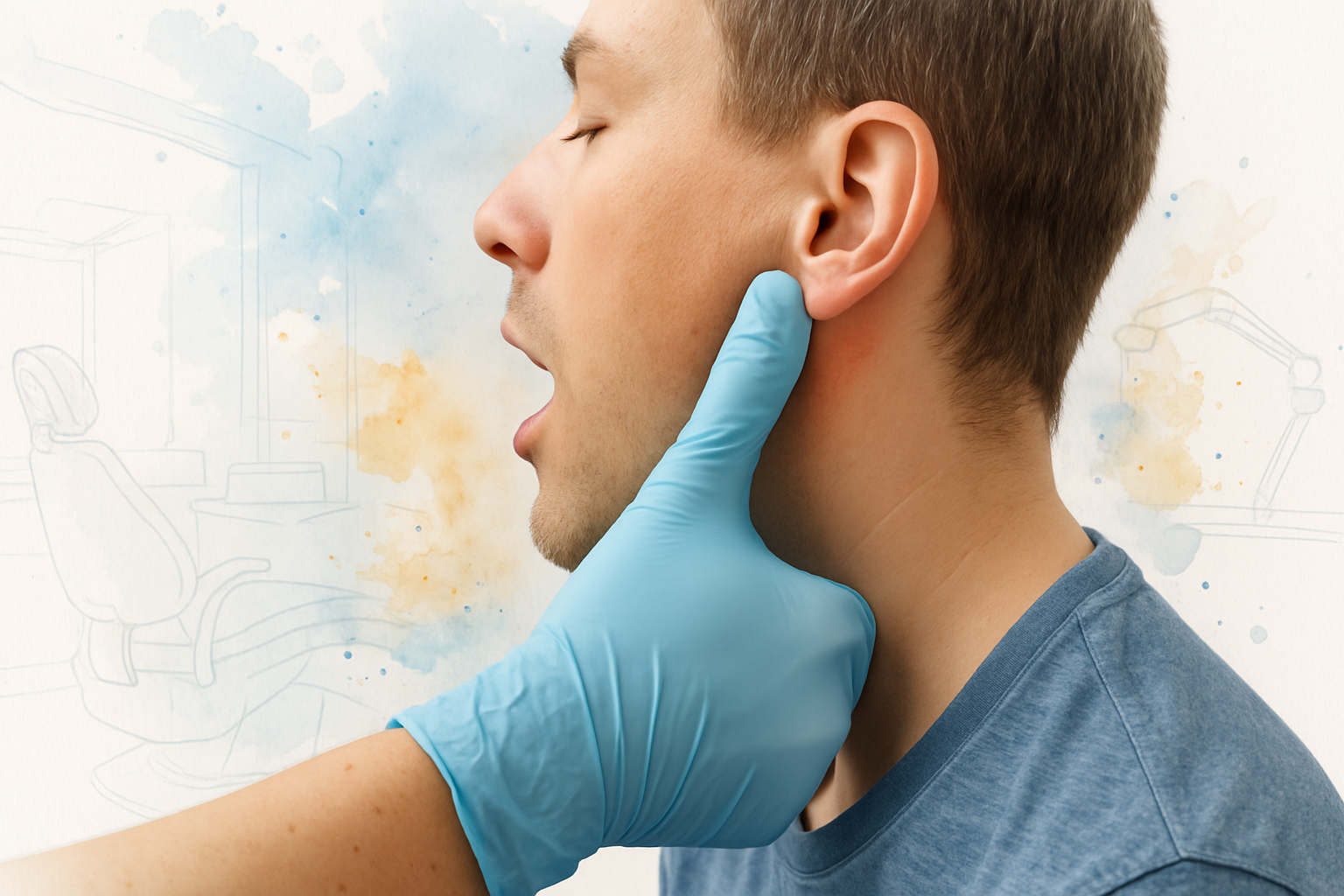
- Examining the joint itself and palpating the chewing muscles for tenderness and limited opening
- Documenting findings in writing so the referring physician can cross dentistry off or keep it on
I want to be straight about scope. As a general dentist, my job here is evaluation and conservative care first, and a clear referral onward when the case belongs with a specialist. Mayo Clinic notes that jaw joint problems are managed across a wide range, from conservative pain management through medical therapies and, in a small minority of cases, surgery. That range is exactly why nobody should commit to a treatment plan before someone has actually looked.
What an Exam and X-Ray Settle on Day One, and What They Don’t
When someone hears the word X-ray, what they are really asking is: will this give me an answer, and what is it going to cost me to find out?
What a digital X-ray and exam can confirm or rule out that same day:
- An abscess or infection at the root tip
- Decay that has reached or is approaching the nerve
- A failing crown, a leaking filling, or recurrent decay underneath old work
- Bone loss around a tooth that has started to feel loose
- Many, though not all, tooth fractures
Now the honest half. Joint and muscle problems often show nothing on a standard dental X-ray. The soft tissue inside the joint and the muscles doing the clenching do not appear on that image.
A normal X-ray is still useful. It takes the urgent, treatable items off the table, which means you are no longer wondering whether you are sitting on an infection while you work through the rest of your testing.
Our posted price for that first urgent visit is a flat $99 emergency exam and X-ray, with no billing surprises attached to it. Anything beyond that first visit depends entirely on what we find, so call the office at 623-267-8088 for specifics rather than trusting a number you read online.
When Jaw Pain Becomes a Same-Day Call
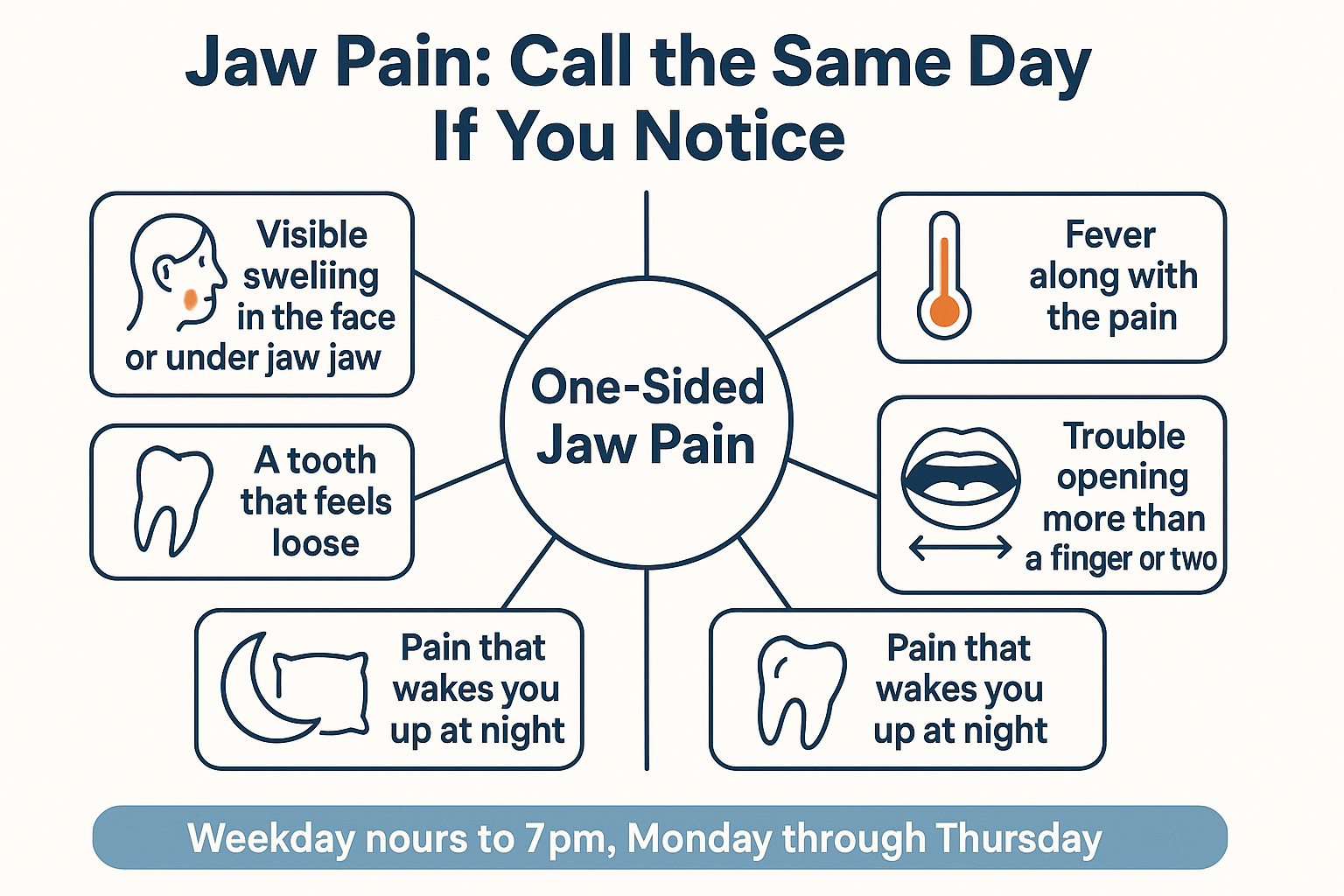
Most jaw pain can wait for a scheduled slot. These signs cannot, and waiting on them is how a treatable problem turns into a bigger one.
Why Waiting Three Weeks Usually Costs More
The pattern I see is predictable. Someone tries to push through on ibuprofen, the pain quiets down for a day or two, and that short break convinces them it is fine.
Meanwhile, if a nerve is dying inside a tooth, the quiet stretch is not healing. A tooth that could have been handled one way in week one sometimes needs more by week four.
That is also why I would rather someone call than sit in an ER waiting room at 9pm. If you are weighing that choice tonight, this walks through it: tooth pain at 9pm and whether the ER is the right place. And if you already have an appointment on the books and just need to get through the hours in between, here is what actually helps while you wait.
We keep weekday hours until 7pm Monday through Thursday. A jaw flare that starts at a desk in Norterra or Stetson Valley at 2pm does not have to cost you a full day of work to get looked at. The number is 623-267-8088.
When It Is Both: Clenching and a Cracked Tooth at the Same Time
Here is the wrinkle that trips people up. The same jaw can hurt for two unrelated reasons at once.
Chronic nighttime grinding tends to leave the muscles sore on both sides, and it wears teeth down slowly over years. A cracked tooth or an infection usually announces itself on one side and gets worse instead of better.
Plenty of patients have both going on. Years of clenching put a hairline fracture into a heavily filled molar, and now the molar is the loud problem sitting on top of the quiet one.
This matters for a practical reason. Treating the tooth does not fix the clenching, and a night guard does not fix the tooth. If you only address one, the pain partially improves and then stalls, which is how people end up frustrated and convinced nothing worked.
So the exam looks at both before anyone commits to a plan. If the long-term grinding side of this sounds like you, I wrote about what nighttime clenching does over time separately. And if the answer turns out to be a cracked or worn tooth, how a dentist decides between a crown and a filling covers what drives that call.
Frequently Asked Questions About One-Sided Jaw Pain
Can a tooth problem really cause ear pain?
Yes, and it is common. The nerves serving the lower molars sit close to the ear, so an infected or cracked back tooth often reads as ear pain, ear pressure, or a headache along the temple rather than tooth pain. If your ear has been checked and looks clear, the tooth is worth ruling out.
Will a regular dental X-ray show TMJ?
Usually not. A standard dental X-ray shows teeth, roots, and bone, not the soft tissue inside the joint. That is why the exam itself matters as much as the image, and why a normal X-ray is still a useful result. It narrows the list.
How fast can I actually be seen if I am in pain?
We hold same-day appointments for patients in pain during weekday hours, and the first visit for an urgent problem is a flat $99 exam and X-ray. Calling gets you a specific time far faster than the online booking form does when you are hurting. The number is 623-267-8088.
I do not have dental insurance. Can I still come in for this?
Yes. A fair number of the people who call us about urgent pain are paying on their own. There is an in-office membership plan that takes 20% off treatment for patients without insurance, and the front desk will walk through what applies before anything gets scheduled.
What if it turns out not to be my teeth at all?
Then you get that in writing and you take it back to whoever is coordinating your care. Ruling dentistry out is a real result, not a wasted visit, especially if you are in the middle of a longer workup with other providers.
Getting a Clear Answer on One-Sided Jaw Pain
An unhurried evaluation here means Dr. Dariene Lazore, DMD, sees you herself, explains what she is finding, and refers you onward when the case belongs with a specialist. One patient put it simply in a review: “Dr. Lazore was very thorough and explained everything so clearly.” Mr. Woodford, our comfort dog, tends to meet people in the waiting room who arrive tense. Same-day availability for patients in pain is open to households across North Glendale, Arrowhead Ranch, and the Happy Valley corridor at 623-267-8088 or beyonddentalcare.com.