
Direct Answer: Drugstore and mail-order guards can protect teeth short term, but only an office-made guard is built from a verified scan and checked against your bite after delivery, which is what controls fit and lifespan.
You wake up with a tight jaw, your back teeth feel sore, and your partner says you sound like a coffee grinder at 2am. So you end up standing in a pharmacy aisle in Stetson Valley or scrolling a mail-order site at midnight, trying to figure out if the cheaper tray is good enough.
I get this question a lot from adults across North Glendale, Arrowhead Ranch, and Hillcrest Ranch. It is almost always framed as a comfort question, but comfort is not really what separates these three options.
What separates them is coverage, material thickness, and whether anyone ever checks the guard against your bite after you start wearing it. This article walks through all three paths honestly, including what a store-bought guard genuinely does well. It is about the device itself, not about what long-term clenching does to the joint, which is a separate conversation.
The three ways to get a night guard in Glendale
Every guard sold is made one of three ways, and the manufacturing method drives almost everything else.
- Drugstore boil-and-bite or disposable tray. You soften a preformed guard in hot water, bite into it, and it holds a rough impression of your teeth. Disposable versions skip even that and come one size for everyone.
- Mail-order custom guard. A kit arrives at your house, you mix putty and take your own impression, mail it back, and a lab fabricates a guard from whatever that impression captured.
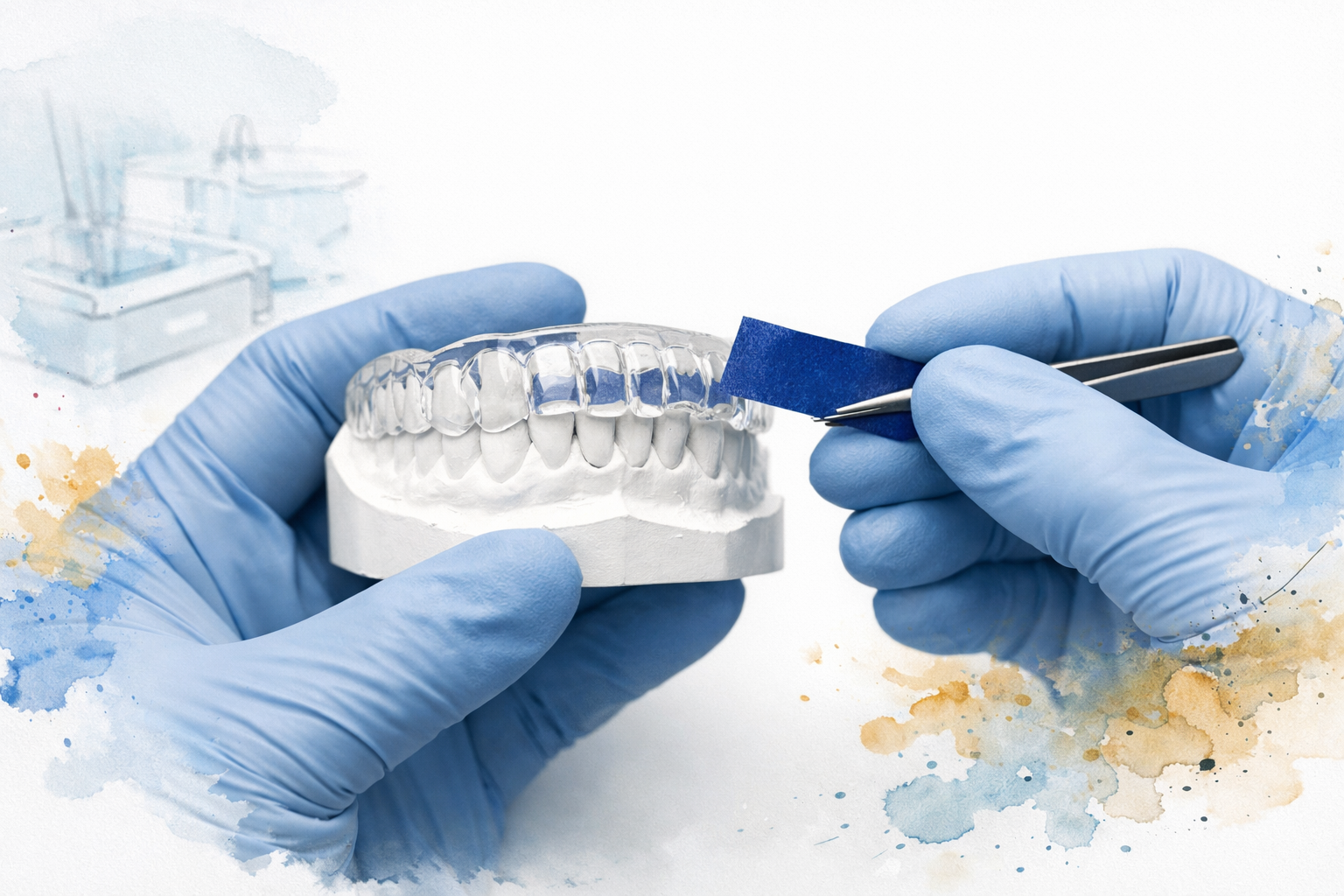
- Office-made guard. We take a digital scan or a traditional impression in the chair, a lab builds the guard to that model, and you come back so it can be seated, adjusted, and checked against how your teeth actually meet.
The honest part people skip: a boil-and-bite guard from a pharmacy on West Happy Valley Road does work as short-term protection. If you cracked a filling last night and you are three weeks out from an appointment, a drugstore guard is better than sleeping unprotected.
Where it falls apart is over months, not nights. A home impression has no one standing next to you making sure the putty seated fully over the back molars, and a boil-and-bite tray records your teeth in a squeezed-down position rather than at rest.
Coverage, thickness, and the bite check nobody mentions
Three technical differences matter more than anything printed on a box.
Coverage. A guard should sit over every tooth in the arch. Some over-the-counter and mail-order products only cover the front teeth. When the back teeth are left free to keep touching and moving, teeth can drift over months of nightly wear.
Even force distribution. A well-made guard spreads clenching force across the whole arch. A guard that rocks on one side concentrates that force onto a few cusps instead, which is the opposite of the point.
Material and thickness. Guards are made in soft, dual-laminate, and hard acrylic materials at different thicknesses. A soft guard is comfortable but can encourage some people to chew it. A heavy grinder usually needs more material than a thin soft tray provides, and that call depends on how worn the teeth already are.
Then there is the step that only happens in a chair. After a guard is delivered, I check it with articulating paper and adjust it so the bite contacts land evenly. No mail-order kit includes that, because no one on the other end can see your mouth. The National Library of Medicine’s overview of bruxism is a reasonable starting point if you want neutral background reading before you decide.
Night guard options side by side
Here is how the three paths compare on the things that actually change your experience. Lifespans vary by how hard you grind, so treat these as general ranges rather than promises.
| Option | How it’s made | Typical lifespan | Main limitation |
|---|---|---|---|
| Disposable pharmacy tray | Preformed, one size, no custom step | Often labeled for only a few nights of wear | Loose fit, little real protection for a heavy grinder |
| Boil-and-bite guard | Softened in hot water, bitten into at home | Commonly a few months for a moderate grinder | Records a squeezed bite, bulky, often front-heavy coverage |
| Mail-order custom guard | Home putty impression mailed to a lab | Longer than boil-and-bite, varies widely by material | No one verifies the impression or adjusts the bite after delivery |
| Office-made guard | Digital scan or chair-side impression, lab fabricated, fitted and adjusted | Often several years with care, rechecked at cleanings | Highest upfront cost and requires two visits |
The replacement math most people never run
Cost per guard is the wrong number. Cost per year is the real one.
A guard you replace four times a year is a different proposition than a guard you bring to your cleaning once a year and have checked. Run that out over five years and the gap between the two paths narrows a lot more than the shelf price suggests.
And the most common complaint I hear about a store-bought or mail-order guard is not pain. It is that the guard stopped seating the way it did in month one. It goes in loose, it clicks when you shift, or it only grips on one side. That is the point where it has quietly stopped distributing force the way it was supposed to.
There is one more thing nobody puts on a package. A guard that is wearing out is hard to judge from your own bathroom mirror. When a guard is made here, I can look at the wear pattern on the plastic and tell you something useful about how you are grinding, which is information a mailed box cannot give you.
Should you buy a guard, or get looked at first?
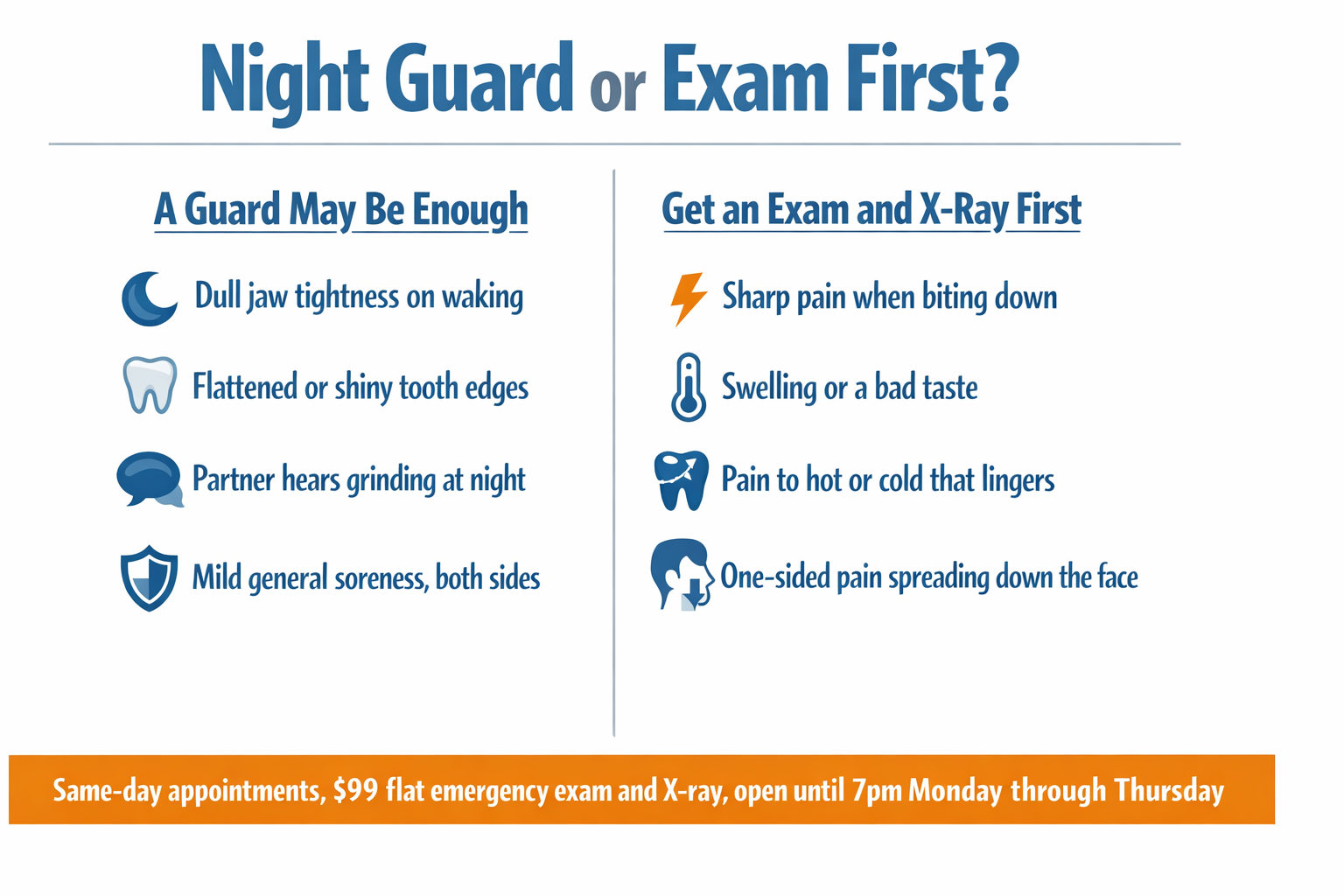
Some jaw pain is a worn bite. Some is a cracked tooth or an infection, and a guard will not touch either one. This breakdown shows how to tell the difference.
When a painful jaw needs an exam before a guard
A twelve dollar tray will not help an infected or fractured tooth, and wearing one can blur the timeline on a problem that is getting worse.
I have had patients call describing severe jaw pain radiating down one side of the face, and one new patient came in after a neurologist sent him to rule out a joint cause as part of a longer workup. Those are not guard conversations until something has been imaged.
Watch for pain that spikes when you bite down on one specific tooth, swelling, a lingering reaction to hot or cold, or pain that is clearly one-sided. Those point toward a crack, an abscess, or a joint issue rather than general wear.
If that is where you are, Beyond Dental Care keeps same-day appointments open with a flat $99 emergency exam and X-ray, and the office stays open until 7pm Monday through Thursday, so a painful jaw does not have to wait for a day off work. If you are weighing where to go after hours, this piece on whether the ER is the right place for a dental problem is worth a read.
What grinding costs later, and why the guard is the cheap half
The reason I push on this is that grinding usually shows up in my chair as restorative work, not as jaw pain.
One patient wrote in describing two worn-down front teeth and asked whether crowns or bonding made more sense. The wear traced back to a bite issue and a stretch of grinding years earlier tied to a medication. By the time the question arrives, it is a restorative conversation.
Enamel does not grow back. Existing dental work takes the brunt too, because crowns, veneers, and large fillings sit right in the path of that force.
- A chipped cusp usually needs a crown, not a filling
- A worn crown margin can let decay start underneath
- Worn front edges often mean bonding or veneers to rebuild length
- Severe wear across an arch can turn into a full mouth restoration plan
Compared with any of that, a guard is the inexpensive half of the equation. If you want the fuller picture on what nightly clenching does over years, we covered that in waking up with a tight jaw.
What drives the cost, and how to check your coverage
I will not quote you a number here, because the honest answer depends on a few things.
- The material and thickness the lab uses
- Whether the record is a digital scan or a traditional impression
- The fit and adjustment appointment after delivery
- Any bite work needed before the guard is made
Insurance is the single most common first question we get on the phone. Callers name Delta Dental, Cigna, United, Blue Cross Blue Shield, and Medicare supplemental plans, and one caller who had never used dental insurance asked plainly whether there is a cap and how it works.
Many plans treat a night guard as a covered appliance with its own frequency limit, usually one every few years. Other plans exclude it entirely. One phone call to confirm beats guessing.
Two things worth knowing if you are in an 85310 household. Most calendar-year plan maximums do not roll over past December 31, so an unused benefit disappears. And for patients without insurance, the in-office membership plan takes 20% off treatment, which is explained further in this comparison of a membership plan versus a private dental policy.
One office for the guard and whatever the grinding already did
Grinding is one of the few problems where the same office ends up handling both halves. The guard, and the repairs the grinding caused before anyone noticed.
That is the practical argument for having it made where you get your cleanings. I can scan, fit, adjust, and then watch the same teeth year over year, comparing wear facets against what I saw last time instead of starting from zero.
One patient who had just moved here put it simply in a review: “I needed a night guard and some dental work done. They got me scheduled quickly, the team was very friendly and did an excellent job.” That pairing is the normal order of events, not the exception.
What patients tell us they value most is straight talk about what is actually needed. A guard is worth recommending when it protects something. It is not worth selling to someone whose real problem is a cracked molar.
Frequently Asked Questions About Night Guards for Grinding
Is a drugstore night guard ever the right call?
Yes, as short-term protection. If you are waiting a few weeks for an appointment and you know you are grinding, a boil-and-bite guard is better than nothing. The problem is using it as a permanent solution, since most are built for months, not years.
How long does a custom night guard last?
It depends on how hard you grind and what material it is made from. Many people get several years out of a lab-made guard when it is cared for and checked at cleanings. Heavy grinders go through them faster, which is useful information in itself.
Why does my mail-order guard feel loose now?
Usually because the home impression did not capture the back teeth fully, or the guard has worn down in the spots where you grind hardest. A loose guard is not just uncomfortable, it stops spreading force evenly. Bring it in and have it looked at rather than just tolerating it.
Will insurance pay for a night guard?
Some plans cover it as an appliance with a frequency limit, and others exclude it. Delta Dental, Cigna, United, and Blue Cross Blue Shield plans all handle it differently. One call to the office to verify your specific plan is faster than reading your benefits booklet.
Can I get a night guard if I already have crowns or veneers?
Absolutely, and that is often when it matters most. Existing restorations take real force during grinding, and a crown margin or veneer edge that chips is a bigger repair than the guard would have been.
Thinking through a night guard decision?
If you want someone to look at the wear on your teeth before you commit to any of the three options, that conversation is available. The practice serves households across North Glendale, North Peoria, Norterra, and the Upper West Side Phoenix area, and can be reached at 623-267-8088 or at beyonddentalcare.com.