
Direct Answer: Nighttime clenching loads teeth with heavy, sustained force. Over time that shows up as flattened chewing surfaces, shortened front teeth, hairline cracks, sensitivity, and morning jaw soreness rather than as a cavity.
Almost nobody calls me and says “I think I grind my teeth.” They call and say their jaw is tight in the morning, or that pain runs down one side of the face, or that something aches but they cannot point to the tooth.
That vagueness is the whole problem. Pain that has no obvious source sends people bouncing from one provider to the next, and by the time they reach a dental chair they are frustrated and tired of being told nothing is wrong.
I see this pattern constantly across North Glendale, Arrowhead Ranch, Stetson Valley, and Norterra. Below is what teeth grinding and jaw pain actually do to teeth over the years, what a dentist can and cannot see, and how the options really work.
Why Teeth Grinding and Jaw Pain Are So Hard to Pin Down
One caller reached us after a neurologist sent her in to rule out a jaw joint issue. She described the process as running the gamut of tests, “from eyes to jaw to dentistry to spinal tap.”
That is not an unusual story. Facial pain can come from a lot of places, and jaw muscles are late on most people’s list of suspects.
Here is the honest boundary of what I can evaluate as a dentist:
- What I can see: wear patterns on enamel, cracked or flattened cusps, cracked restorations, muscle tenderness on palpation, how the upper and lower teeth meet
- What I can ask about: morning soreness, headaches at the temples, sensitivity to cold, a partner who hears grinding at night
- What I cannot diagnose: nerve conditions, sinus disease, or anything outside the mouth and jaw
The federal dental research institute lists headaches, jaw or ear pain, tooth sensitivity, and visible tooth wear among the common signs of bruxism, and notes that untreated cases can damage teeth and existing dental work.
So a dental exam does not close the case on facial pain. But it can rule a big contributor in or out quickly, and that is worth doing early rather than last.
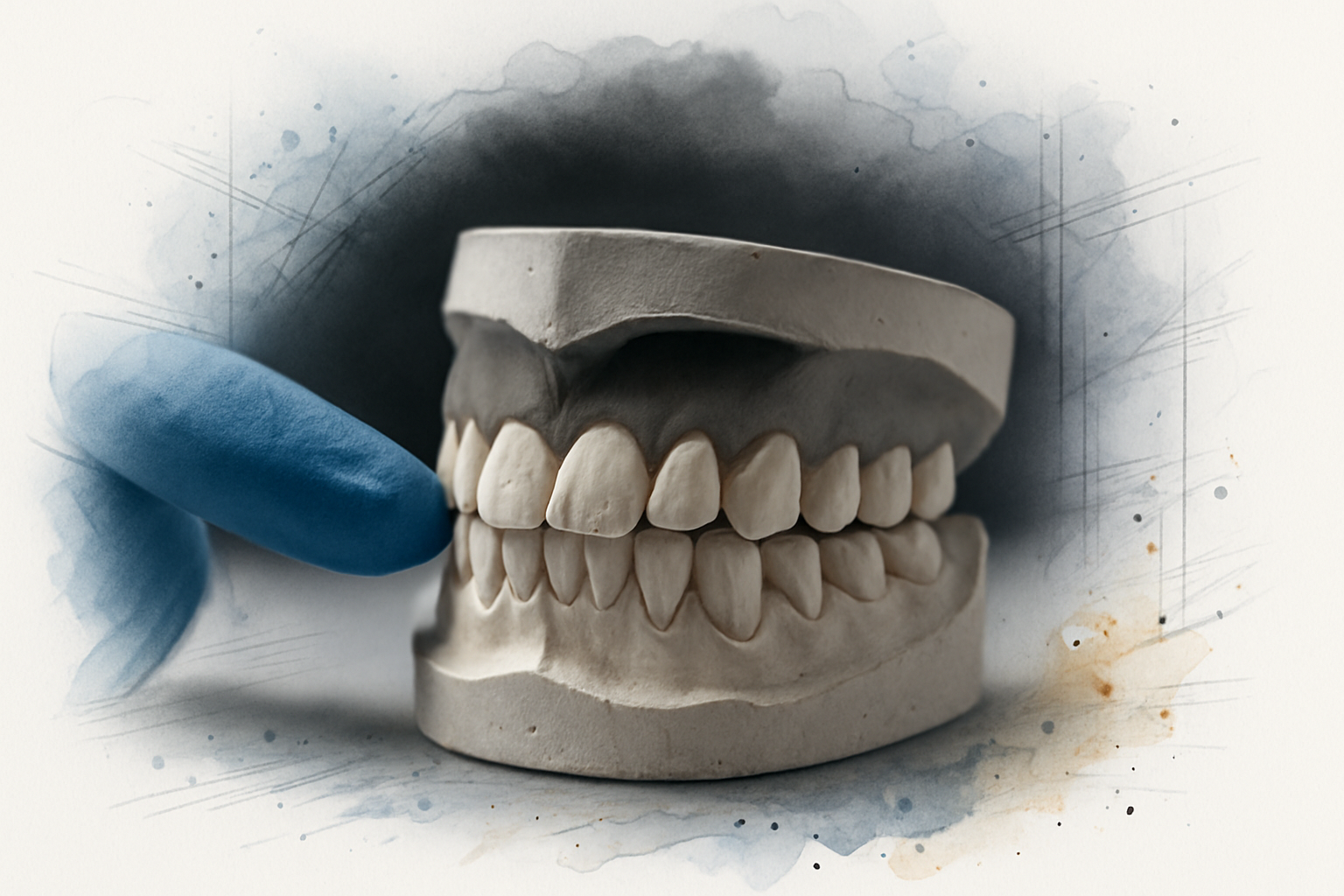
What Clenching Actually Does to Teeth
Normal chewing puts modest force on teeth in short bursts. You bite, you release, and the whole thing lasts seconds.
Clenching is different in two ways that matter. The force is much higher, and it is sustained for long stretches while you are asleep and have no reflex telling you to stop.
That is why grinding damage does not look like a cavity. It looks like:
- Flattened chewing surfaces on molars, where the cusps have been ground down level
- Shortened front teeth with straight, even edges instead of natural contours
- Hairline cracks running vertically through enamel
- Cold sensitivity where enamel has worn thin near the gumline
- Notches at the gumline from flexing under repeated load
Canines and front teeth usually show it first, because they take the brunt of side-to-side movement.
Most people never hear themselves grinding. It happens during sleep, and unless someone else in the house mentions it, the wear pattern is often the first real evidence anyone has. That is why I compare photos and scans over several visits instead of guessing from one appointment.
Common Signs and What They Usually Point To
This is roughly how I sort the symptoms patients describe when they come in with morning jaw pain.
| What the patient describes | What it often points to | What I look at first |
|---|---|---|
| Tight, sore jaw on waking that eases by midday | Sustained overnight muscle activity | Muscle tenderness, wear facets on canines |
| Aching that radiates down one side of the face | Muscle referral, not a single bad tooth | Bite contacts, joint range of motion |
| Front teeth look shorter than they used to | Years of accumulated attrition | Photos, scans, comparison to older records |
| Sharp cold sensitivity with no visible cavity | Thinned enamel or a hairline crack | Transillumination, digital X-rays |
| A crown or veneer that keeps loosening | Overload on the restoration | Tooth underneath for decay or fracture |
Why the Bite Gets Checked Before Worn Teeth Get Rebuilt
A longtime patient once wrote in describing two badly worn upper front teeth. She traced the wear back years, partly to a bite issue and partly to grinding tied to a medication she no longer takes.
Her question was reasonable and it comes up often: could she skip straightening and go straight to crowns or bonding on those two teeth?
The answer depends entirely on whether the force that caused the wear is still there. If it is, new porcelain or composite takes the same beating the natural enamel did, and it will not hold up any better.
So the sequence I work through looks like this:
- Confirm whether active clenching is still happening, or whether the wear is historic
- Check how the teeth meet, and whether crowding or a deep bite is concentrating force on a few teeth
- Decide whether to protect first, adjust the bite, or straighten before restoring
- Then rebuild the worn teeth, once they will not be immediately re-damaged
Sometimes the answer really is that the grinding stopped years ago and restoration can move forward. Sometimes crowding is doing so much of the work that clear aligner treatment makes more sense as step one. Either way, that call gets made from records, not from a hunch.
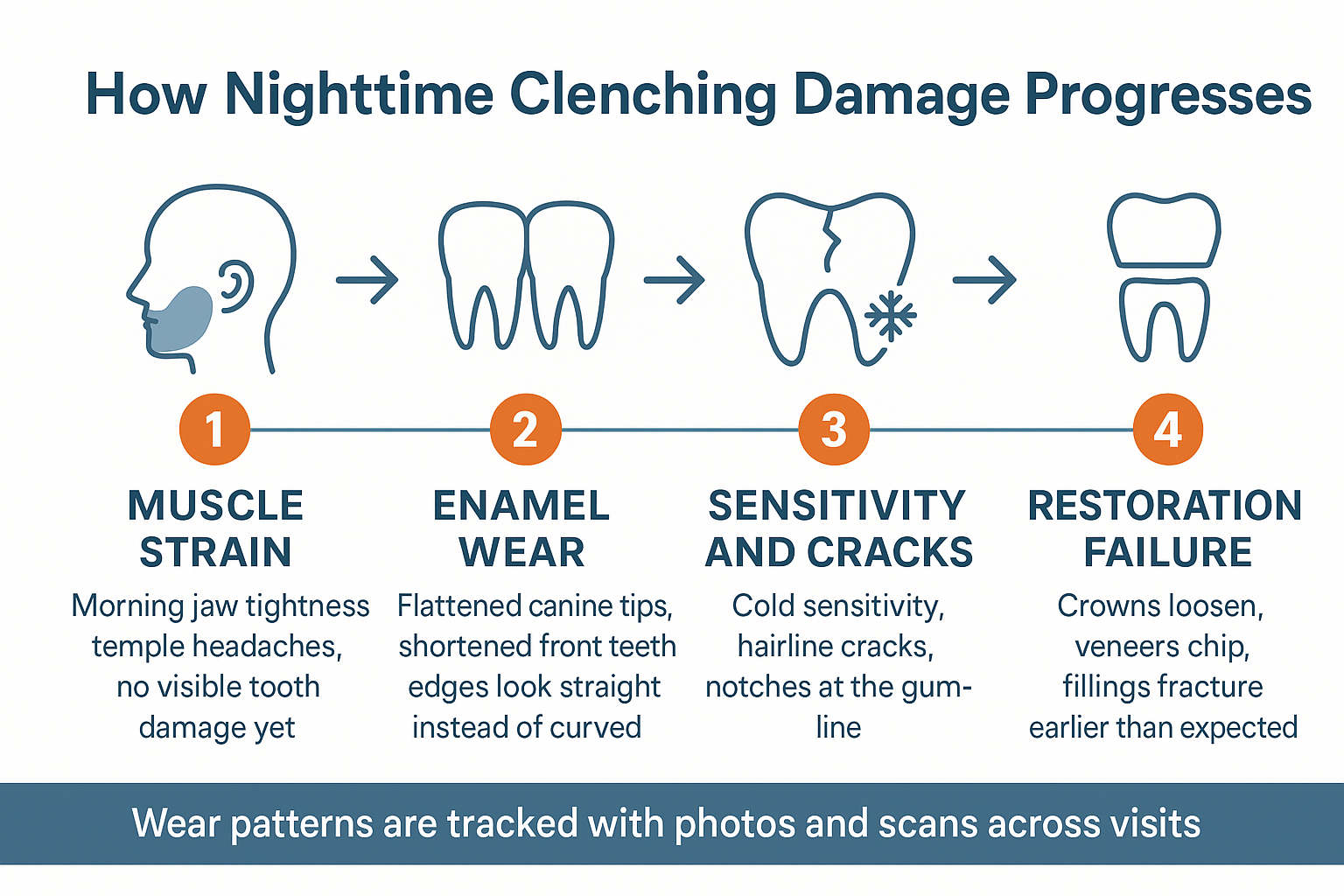
How Clenching Damage Builds Over the Years
Grinding damage rarely announces itself. It moves through fairly predictable stages, which is why tracking it visit to visit matters more than any single exam.
When a Crown Comes Off or a Veneer Starts Hurting
A real slice of our urgent calls are restoration problems. A cap broke. A crown came off during dinner. A veneer that felt fine for years suddenly hurts.
Clenching is a common contributor. Dental work is built to handle normal chewing, and sustained overnight force is not normal chewing.
When someone comes in with a loose or lost restoration, this is the order of operations:
- Examine the tooth underneath for decay and fracture before anything gets recemented or remade
- Take digital X-rays to see what is happening below the gumline
- Decide whether the original restoration is still usable or needs to be replaced
- Talk through whether the bite is the reason it failed in the first place
In the meantime, patients are almost always told to chew on the other side and avoid anything hard or sticky on the affected tooth.
If a restoration fails and there is pain or swelling with it, that is same-day territory. Our office keeps same-day appointments open, holds a flat $99 emergency exam and X-ray, and runs extended hours Monday through Thursday until 7pm, with Friday and Saturday by request. Call 623-267-8088.
The Honest Range of What Can Be Done
There is no single fix for teeth grinding and jaw pain. There is a set of tools, and which ones apply depends on how much damage is already there.
A custom night guard is usually the starting point. It is made from a scan or impression of your actual teeth, so it seats without rocking and distributes force evenly across the arch.
A boil-and-bite version from the drugstore is molded by hand over a sink. It tends to be bulky, loosen during the night, and in some cases it shifts load onto a few teeth instead of spreading it out.
Beyond a guard, the options include:
- Bite adjustment, reshaping a small amount of enamel where contacts are landing too hard
- Restoring worn teeth with tooth-colored fillings, bonding, or crowns once the bite is stable
- CandidPro Clear Aligners when crowding or a bad bite relationship is part of what is driving the wear
- A periodontal evaluation, since gumline wear and recession often travel together
On cost, I will not throw out a number that may not apply to you. What drives it is real and worth understanding: the guard material and thickness, whether records or digital scans are needed, and above all how much restorative work the wear has already created. Rebuilding two front teeth is a different conversation than a guard alone. Call the office for an exact figure for your situation, and know there is an in-office membership plan offering 20% off treatment for patients without insurance.
Why Documentation Matters More Than a Single Opinion
Wear is slow. You cannot judge it well from one appointment, which is exactly why I photograph and scan it and compare over time.
One reviewer put it plainly: “The dentist took the time to take photos of my problem, to explain what is happening.” That is the standard I hold myself to, because a patient who can see the wear on a screen makes better decisions than one who is told to trust a verdict.
This matters locally. Northwest Phoenix is a commuting, working-adult market, and clenching complaints often show up alongside stress, short sleep, and the dry-air mouth breathing that comes with a Valley summer.
Most people dealing with this are trying to get it looked at without giving up a workday. Evening appointments through the week and Saturday by request exist for exactly that reason, whether you are driving in from Vistancia, North Peoria, or just up Happy Valley Road.
Beyond Dental Care is a private, non-corporate practice, which is what a lot of our patients say they were looking for after leaving chain offices where nobody explained anything. Dr. Dariene Lazore, DMD documents what she sees and lays out options without pressure.
Frequently Asked Questions About Teeth Grinding and Jaw Pain
How do I know if I grind my teeth if nobody hears me at night?
Most people never hear it. The clues are morning jaw tightness, temple headaches, cold sensitivity with no cavity, and flattened or shortened teeth. A dentist can spot the wear pattern even when you have no idea it is happening.
Is a drugstore night guard good enough to start with?
It is better than nothing for a short stretch, but it is molded over a sink rather than fitted to your teeth. Boil-and-bite guards tend to loosen overnight and can concentrate force on a few teeth instead of spreading it across the arch. A custom guard made from a scan seats without rocking, which is the entire point.
Should I straighten my teeth before getting worn front teeth rebuilt?
Sometimes yes, sometimes no. If crowding or a deep bite is still concentrating force on those teeth, new crowns or bonding will take the same beating the enamel did. If the grinding stopped years ago and the bite is stable, restoring directly can be reasonable. That decision comes from looking at the bite, not from a general rule.
Can clenching make a crown or veneer fail early?
Yes, and it is one of the more common reasons dental work loosens or cracks sooner than expected. When that happens, the tooth underneath gets checked for decay and fracture before anything is recemented or remade.
My doctor sent me to rule out a jaw problem. Can a dentist actually help with that?
A dental exam can tell you whether your bite, your jaw muscles, or tooth wear are contributing, and that is genuinely useful information for the rest of your workup. It will not diagnose nerve or sinus conditions. But it can rule a major contributor in or out fairly quickly.
Wondering Whether Your Jaw Pain Is Coming From Your Teeth?
If you have been waking up sore and want someone to actually look at the wear and explain what they see, the practice keeps evening appointments through the week and Saturday times by request for households across North Glendale, Arrowhead Ranch, Stetson Valley, and North Peoria. You can reach the office at 623-267-8088 or read more at beyonddentalcare.com.