
Direct Answer: Most hospitals have no dentist on staff, so an ER can treat spreading infection, trauma, and bleeding, but it cannot fix the tooth. For pain alone, a dental office is the right call.
Roughly one in nine calls we take is not someone booking a cleaning. It is someone in pain right at that moment. A crown that came off in the middle of dinner. A cap that cracked. Pain around a veneer. One caller described severe jaw pain radiating down the side of his face and asked to be seen that same day for an exam and X-ray.
And almost none of those callers are asking whether the problem is serious. They already know it is. The real question is where do I go tonight, the hospital or a dental office.
I want to answer that plainly, because guessing wrong costs you money and a whole night. Below is what a hospital can actually do for a tooth, the short list of times the ER truly is the right choice, and how the answer shifts depending on what time the clock says.
What a hospital ER can and cannot do for a tooth
Most people assume an emergency room solves a tooth problem. It usually does not, and the reason is simple staffing. Most hospitals do not have a dentist on staff.
An emergency department is built to keep you safe, not to repair teeth. It is very good at a specific set of jobs:
- Controlling bleeding that will not stop
- Managing facial trauma and possible jaw fractures
- Treating an infection that is spreading into the face or neck
- Prescribing pain medication and antibiotics
Here is what nobody there is going to do. No one is re-cementing your crown, replacing a broken filling, doing a root canal, or taking the tooth out. So an ER trip for a toothache usually ends the same way: pain medication, sometimes antibiotics, and instructions to see a dentist anyway.
The cost gap is the part that stings. The American Dental Association’s Action for Dental Health program documents roughly 2 million emergency department visits a year in the US for dental pain, and compares typical ER costs against dental office costs. General industry figures put an ER visit for dental pain somewhere in the several hundred to well over a thousand dollar range, versus a fraction of that in a dental chair. Those are market numbers, not a quote, so confirm pricing with any office or hospital directly.
When the ER or 911 genuinely is the right choice
I am not telling anyone to avoid the hospital. There is a real list, and it is short. Go to the emergency room or call 911 if you have:
- Facial swelling that is spreading toward your eye or down under your jaw
- Difficulty breathing or swallowing
- Fever alongside swelling
- Bleeding that will not stop
- A jaw injury from a fall or a hit where a fracture is possible
Those are airway and infection situations. They are not tooth situations, and they need a hospital.
Everything else on the common list is dental chair work: a lost crown, a broken filling, a cracked or chipped tooth, a knocked-out tooth, an abscess without spreading swelling, severe gum inflammation. One caller put her problem simply, saying her gums were giving her a really hard time. That pain is real and worth being seen for. But it is not an emergency room problem, and a hospital has no tool for it.
If the pain is more of a deep ache in the joint and muscles than a single sore tooth, that is a different path again. Nighttime clenching and jaw tension can mimic a toothache closely enough that people show up convinced a tooth is dying.
Dental Chair or Emergency Room: A Quick Sort
This is the sort I run through on the phone with someone in pain. It is not a diagnosis, just a starting point.
| What’s happening | Where to go | Why |
|---|---|---|
| Crown, cap, or filling came off | Dental office, same day if possible | Needs re-cementing or a new restoration. No hospital does this. |
| Throbbing toothache, no swelling | Dental office | Needs an X-ray to find the cause. An ER can only medicate it. |
| Chipped or cracked tooth | Dental office | Repair depends on how deep the break goes. |
| Knocked-out permanent tooth | Dental office immediately, within about an hour | Time-critical. Reimplantation odds drop fast. |
| Swelling spreading toward the eye or under the jaw | ER or 911 | Possible airway or spreading infection risk. |
| Fever plus facial swelling | ER | Infection may be moving beyond the tooth. |
| Jaw injury from a fall or impact | ER | Fracture needs imaging a dental office may not carry. |
| Bleeding that will not stop | ER | Bleeding control is exactly what an ER is built for. |
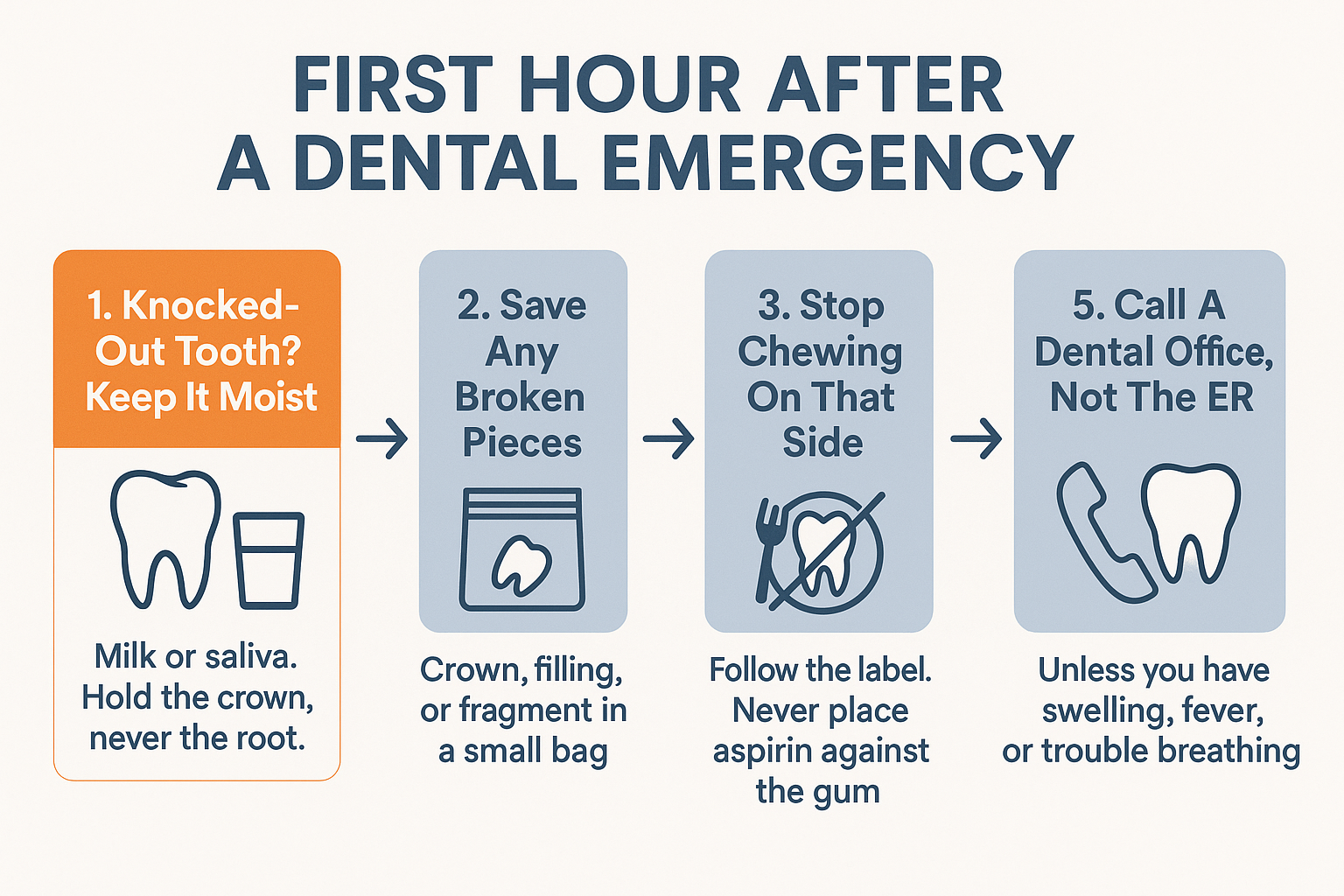
What to Do in the First Hour
Print this or screenshot it. The first hour is where most people either save a tooth or lose one.
The answer changes by the hour and by the day
A tooth problem at 2pm on a Tuesday is a phone call, full stop. Offices in North Glendale that run extended weekday hours to 7pm can often get someone in that same evening, which means nobody has to burn a sick day or pull a teenager out of school.
A tooth problem at 10pm is different. For most cases, that is a hold-until-morning situation, and holding it well matters more than people realize.
The one exception is a knocked-out permanent tooth. That is time-critical and needs care within roughly an hour, so that is worth a call to any after-hours line you can reach.
While you wait, a few practical steps:
- Keep a knocked-out tooth moist in milk or saliva, and handle it by the crown, never the root
- Save the crown, cap, or filling piece in a small bag and bring it with you
- Avoid chewing on that side entirely
- Take an over-the-counter anti-inflammatory per the label, and do not press aspirin against the gum
That last one comes up often. Aspirin held against gum tissue burns it, which adds a second problem on top of the first.
Insurance is the real reason people stall, so let’s settle it
Our phone log is full of the same opening question. Delta Dental. Cigna. United. Blue Cross Blue Shield. Medicare and AARP supplemental plans. And our form submissions include people with no coverage at all asking outright what a visit will cost before they will book.
That hesitation is understandable, and it is also the most expensive delay in dentistry. A cracked tooth does not pause while you research networks.
Two things are worth knowing. First, a hospital bill and a dental office bill for the same toothache are not comparable, so do not let a bad ER memory shape what you expect from a dental office. Second, a dental office can usually tell you the exam and X-ray cost before you arrive, which a hospital cannot.
That is why many private practices keep a flat emergency exam fee. At Beyond Dental Care, the emergency exam and X-ray is a flat $99, and there is an in-office membership plan that takes 20% off treatment for patients without insurance. Pricing can change, so confirm the current number when you call. If you are working without coverage, what actually shapes the cost of an exam and cleaning is worth reading before you need it.
What comes after the exam depends on what the X-ray shows. A shallow crack may be a filling, a deeper one may need a crown, and how that call gets made is a conversation, not a surprise on a printout.
Why the Northwest Valley phone rings hardest from October through April
There is a season to this. The stretch from Halloween through New Year’s is eight straight weeks of hard candy, caramel, ice chewing, and toffee, and it lands right when regular offices close for holiday travel and when family arrives from out of state.
Then comes the second wave. Winter residents settling into Peoria, Vistancia, Sun City, and Arrowhead from November through April often show up with a problem that started somewhere else and no local dental home yet.
A tooth that has been quietly cracked for months tends to announce itself at the worst possible moment. Which is the whole argument for spending ten minutes now figuring out who you would call, instead of typing “er for tooth pain” into your phone at 9pm with your hand on your jaw. If you are new to the area, choosing a dental home before you need one is the cheapest thing on this page.
Frequently Asked Questions About Using the ER for Tooth Pain
Will the emergency room pull my tooth?
Almost never. Most hospitals do not have a dentist on staff, and extraction is a dental procedure. Expect pain management and a referral instead.
If the ER gives me antibiotics, is the infection handled?
Antibiotics can calm a spreading infection and buy you time, which matters. But they do not treat the source. If the pulp inside the tooth is infected, the tooth still needs a root canal or an extraction, and the infection tends to come back until that happens.
What do I do if a crown comes off on a Sunday?
Put the crown in a small bag, keep the exposed tooth clean, and avoid chewing on that side. Do not use household glue. It contaminates the tooth and can make the original crown unusable, which turns a simple re-cement into a full crown appointment.
Is jaw pain a dental problem or something else?
Sometimes neither, and sometimes both. We have seen patients sent to us by a neurologist to rule out a jaw joint cause while other specialists ruled out theirs. An exam and X-ray can tell you fairly quickly whether a tooth is the source or whether the muscles and joint are doing it.
How fast can a dental office actually see someone in pain?
Often the same day if you call during business hours, and evening slots exist at offices that stay open to 7pm. One reviewer put it about as plainly as anyone could: “It’s was an excellent visit got in and out in 1/2 hr for a chipped tooth!” That was Deborah V., and that is the realistic version of a same-day visit.
Know where you’d call before a tooth wakes you up
Our office sits on West Happy Valley Road, a private, non-corporate practice led by Dr. Dariene Lazore, DMD, serving North Glendale, Arrowhead Ranch, Stetson Valley, Norterra, North Peoria, and Vistancia. Same-day appointments are available during extended weekday hours, and reviewers mention two things over and over: not being upsold, and being told what is happening and why. There is also a comfort dog named Mr. Woodford who shows up in more reviews than he probably expected. The number is 623-267-8088, and more detail is at beyonddentalcare.com whenever you want to read it.