
Direct Answer: Most dental plans reset on January 1. Any unused portion of your annual maximum disappears instead of carrying forward, so benefits you paid premiums for all year simply go away.
Every fall I start hearing the same question from patients across North Glendale and Arrowhead Ranch. Some version of: “I’ve barely used my dental insurance this year. Does that just carry over?”
Almost always, the answer is no. Most dental plans reset on January 1, and whatever you did not use of your yearly coverage is gone. You paid premiums for twelve months and the leftover balance does not follow you into the new plan year.
So let me walk through what actually resets, why the calendar matters more than people think, and how patients here plan treatment around it. Whether you have coverage, an HSA at work, or no insurance at all.
How a Dental Plan Year Actually Works
Dental insurance is not like medical insurance. It behaves less like catastrophic coverage and more like a prepaid spending allowance with a hard ceiling.
That ceiling is your annual maximum. It is the most your plan will pay toward your care in one plan year. Once you hit it, you pay the rest yourself.
Here is what most plans include:
- An annual maximum. Plan maximums vary widely, but many employer dental plans in Arizona land somewhere in the range of roughly $1,000 to $2,000 per person per year. Yours could be higher or lower, so read your plan.
- A deductible. A set amount you pay before the plan starts contributing. It resets too.
- Frequency limits. Two cleanings a year, X-rays at set intervals, and so on. Skip one and it does not bank for later.
- Coverage tiers. Preventive care is often covered at a higher percentage than fillings or crowns.
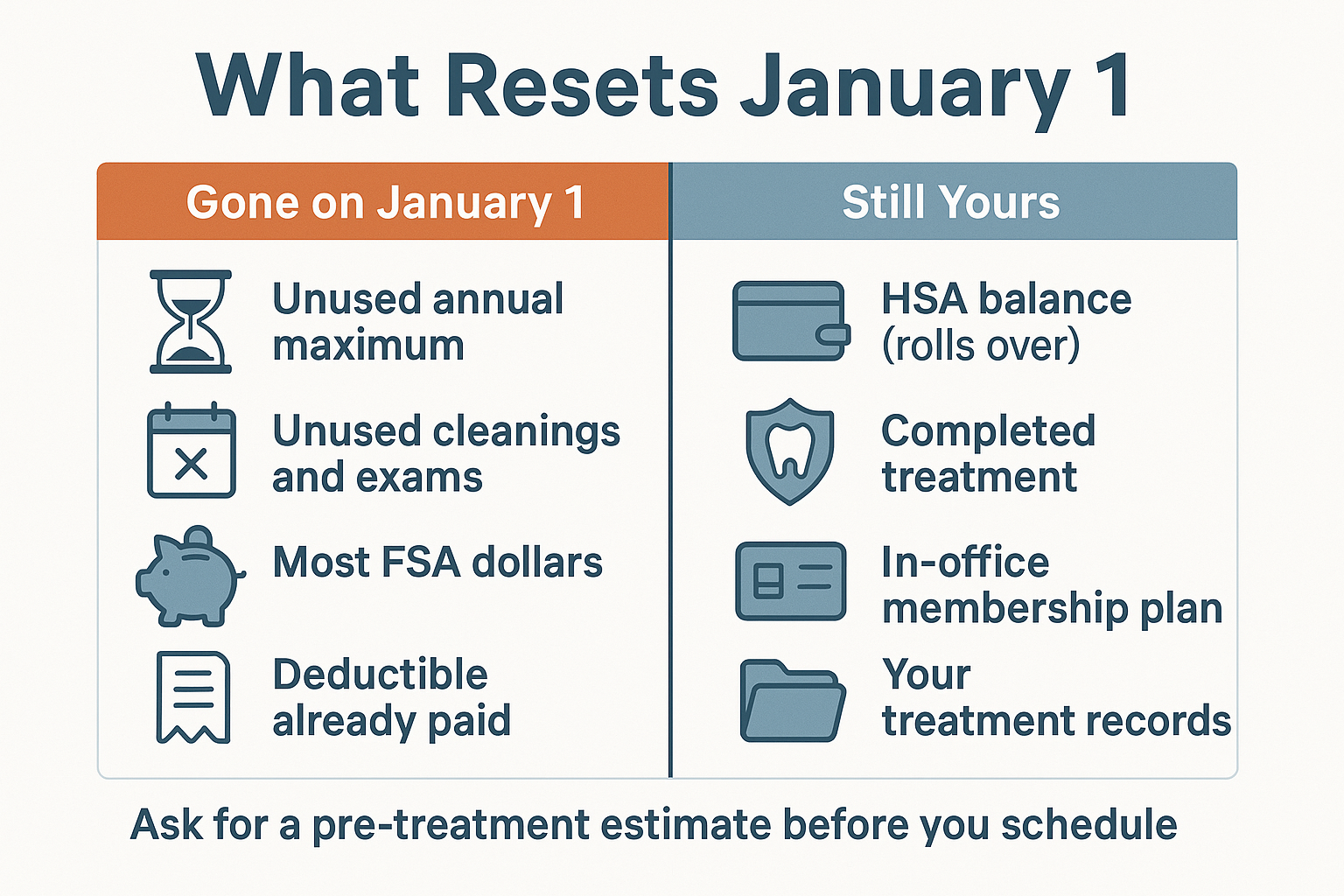
The part that surprises people is the direction the math runs. An unused maximum does not roll forward. A used one does not roll back. On January 1 the counter goes to zero and the deductible comes back.
One caller told us she had never used dental insurance before and honestly did not know whether there was a cap. That is a completely reasonable question, and the answer for almost every plan is yes.
Why Waiting Until January Often Costs More
Say a patient in Stetson Valley needs two crowns. The plan has room left this year to help with one of them.
If both crowns get done in January, they both hit the same new annual maximum. If one gets done in December and one in January, the patient is drawing from two separate plan years and two separate maximums.
Same treatment. Different out-of-pocket number, sometimes by a meaningful amount.
There is a clinical side to this too, and I care about it more than the billing side. Dental problems do not pause while you wait for a better calendar date. A small cavity that could have been a filling in November can become a crown, or a root canal, by spring.
I have seen this play out with:
- Cracked or worn teeth that stay quiet until the crack reaches the nerve
- Early gum inflammation that responds to periodontal therapy but progresses if ignored
- Failing old fillings where the decay underneath keeps spreading out of sight
This is one reason I push preventive visits so hard. What a preventive dental visit actually catches before it gets expensive is the whole argument in one page. Timing your treatment around your benefits only works if you know what treatment you need in the first place.
What Happens to Your Benefits on January 1
A quick visual on what resets, what expires, and what stays with you when the calendar turns.
Bundling Treatment Before December 31
This comes up constantly with cosmetic and restorative work, because that kind of care is often planned in stages.
One patient wrote in wanting to sort out front-tooth crowns, some bonding to close a gap, whitening, and possibly veneers on the remaining upper teeth. She also asked us to send her plan a pre-treatment estimate before anything got scheduled. That is exactly the right instinct.
A pre-treatment estimate is a request submitted to your insurance company describing the planned procedures. The plan responds with what it expects to cover. It is not a promise, but it removes most of the guesswork before you commit.
When benefits are about to reset, sequencing matters:
- Get the diagnosis and the plan first, so you know the full scope
- Request the estimate early, since plans can take a few weeks to respond
- Schedule the covered portion while this year’s maximum still has room
- Stage the rest for the new plan year if the treatment allows it clinically
Not everything should be rushed. Purely elective whitening is rarely covered anyway, and some restorative work has healing steps that cannot be compressed. But if you are already planning multi-step treatment, the calendar is a real variable worth discussing.
If you are in the research phase, what to ask before starting any cosmetic dental treatment covers the questions I wish more patients asked upfront.
What Rolls Over and What Does Not
Here is the short reference version. Confirm the details with your specific plan and your employer’s benefits documents.
| Benefit or Account | Rolls Over? | What to Do Before Year End |
|---|---|---|
| Dental plan annual maximum | No, resets January 1 | Use remaining coverage on needed treatment |
| Dental plan deductible | No, resets January 1 | Finish work in the same year you paid it |
| Covered cleanings and exams | No, frequency resets | Book the second cleaning if you skipped it |
| FSA dollars | Usually no, limited exceptions | Check your plan’s deadline and spend accordingly |
| HSA dollars | Yes, balance carries forward | No deadline pressure, but still usable now |
| In-office membership plan | Runs on its own term | Ask how the term lines up with your treatment |
The HSA and FSA Piece People Miss
Around tax season we get a wave of requests for billing records and itemized statements. That conversation almost always leads somewhere useful, because it turns out a lot of patients have pre-tax dollars sitting in an account they forgot about.
The two accounts behave very differently.
An HSA belongs to you. The balance carries forward year after year, even if you change jobs. There is no December deadline hanging over it.
An FSA generally does not. Most FSA money is use-it-or-lose-it at the end of the plan year, though some employers allow a limited carryover amount or a short grace period into the new year. The IRS guidance on health flexible spending arrangements spells out how those exceptions work, and your HR department can tell you which one your employer chose.
Both can typically be used for qualifying dental care. If you have an FSA with money left in it and a filling you have been putting off, that is a straightforward decision.
For the details on which dental services qualify and how to document them, we put together a full walkthrough on using an HSA for dental care. Same principles apply to most FSA spending, minus the rollover.
If You Do Not Have Dental Insurance at All
A good share of the people who reach out to us have no coverage and are paying out of pocket by choice. Someone new to Norterra or Vistancia looking for a dental home. A patient who wants a crown fixed and asks straight out what it will run.
For those patients the January reset is irrelevant, and honestly that is a kind of freedom. There is no deadline. There is also no plan telling anyone what is or is not allowed.
What matters instead is price clarity before treatment starts:
- Ask for a written estimate at the consultation, not after the work
- Ask what drives the cost on that specific procedure, since materials and complexity vary
- Ask about the in-office membership plan, which takes 20% off treatment for patients without insurance
- Ask what happens if the plan changes once we are actually looking at the tooth
One review that stuck with me described our office as having “no sales pitches, just honest conversation about needs.” That is the standard I want us held to whether someone has a plan or not.
If you want a sense of what a first visit involves without coverage, what shapes the cost of a cleaning and exam breaks down the variables honestly.
Frequently Asked Questions About Dental Benefits and Year-End Timing
Do any dental plans let unused benefits carry over?
A small number of plans offer a carryover or rollover feature that banks a limited amount of unused maximum for future years, usually only if you kept up with preventive visits. It is the exception, not the rule. Check your summary of benefits or call your plan directly, because the feature has specific conditions attached.
My plan year does not start in January. Does that change anything?
Yes. Some employer plans run on a fiscal year instead of a calendar year. The reset logic is identical, your deadline is just a different month. Ask HR for your plan year start date.
Should I rush treatment just to use my benefits?
No. Clinical need comes first, always. If treatment is genuinely indicated and can be safely completed this year, timing it around your benefits is smart. If it is elective and not urgent, there is no reason to force it into December.
How long does a pre-treatment estimate take?
It varies by carrier, but plan on a few weeks. If you want an estimate back before year end, submit it well ahead of Thanksgiving rather than in mid-December.
What if I have a dental emergency and no coverage left for the year?
Pain does not wait for a plan year. Our emergency exam and X-ray is a flat $99, with same-day appointments during extended weekday hours to 7pm, Monday through Thursday. You will know the exam cost before you walk in, and we go over any treatment pricing with you before anything is scheduled.
Thinking Through Your Remaining Benefits This Year?
If you are somewhere in North Glendale, Arrowhead Ranch, Stetson Hills, or North Peoria and you are trying to figure out what your plan still covers, we are happy to look at it with you and put a written estimate in your hands before anything gets scheduled. For patients without insurance, the in-office membership plan and the flat $99 emergency exam and X-ray both give you a predictable number to work from. Beyond Dental Care can be reached at 623-267-8088, or you can read more at beyonddentalcare.com.