
Direct Answer: Many dental plans do cover clear aligners, but through a separate orthodontic benefit with its own lifetime maximum that never renews. Some plans cover teens only, or exclude adult orthodontics entirely.
Our phones tell me the same story almost every week. Before anyone asks about treatment time or how the trays feel, they ask whether we take their plan.
Roughly one in eight callers to our office opens with some version of that question. They name Delta Dental, Cigna, Blue Cross Blue Shield, United, or a Medicare supplemental plan, and the ones weighing clear aligners stall at the exact same spot.
One caller put it about as plainly as it gets. She had never used dental insurance before and wanted to know if there was a cap, or how any of it even worked. That question, not the treatment itself, is what keeps a lot of North Glendale and Arrowhead Ranch adults from ever booking a consult.
Does Dental Insurance Cover Clear Aligners? Usually Yes, But From a Different Bucket
Most people picture their dental plan as one pot of money. Cleanings come out of it, a crown comes out of it, and aligners would come out of it too.
That is not how it works. Orthodontic benefits typically sit in their own separate category, with their own rules, their own percentage, and their own cap.
A general plan usually has an annual maximum that refills each benefit year. Market-wide, plan documents commonly land somewhere in the $1,000 to $2,000 range, though that is context only and your plan may read differently.
Orthodontic coverage works on a different clock. Plans that include it usually pay a set percentage of the treatment fee up to a lifetime maximum, and as Delta Dental explains in its plain-language breakdown of dental maximums, that orthodontic figure does not renew the way an annual maximum does.
So the honest answer to whether insurance covers clear aligners is: often partially, once, and only if your specific plan includes orthodontics at all. The only way to know your numbers is to have them pulled from your plan.
The Lifetime Cap That Never Resets
This is the part almost nobody has had explained to them. A lifetime orthodontic maximum means exactly what it sounds like: once that money is spent, it is gone for as long as you hold that plan.
It does not refill in January. It does not roll forward. It does not care that you have not used your general benefits in five years.
I want to be clear that this is a different conversation from the one we have every December. If you are trying to time crowns, fillings, or a bridge around a renewing annual maximum, that is covered in our piece on how dental benefits reset every January, and in a related article on why unused benefits usually do not roll over.
Orthodontics does not follow that pattern. Which means the year-end rush strategy that works for restorative treatment does very little for aligners.
What matters more here is confirming three things before you sit down for a consult:
- Whether your plan includes orthodontic coverage for your age group, not just for dependents
- The lifetime maximum amount and how much of it has already been used
- Whether a waiting period applies and, if so, when it ends
Annual Maximum vs. Orthodontic Lifetime Maximum
Here is the difference between the two caps side by side. Treat the figures as general market context rather than your plan’s actual numbers.
| How it works | Annual maximum | Orthodontic lifetime maximum |
|---|---|---|
| Renews | Yes, every benefit year | No, one time only |
| Typical range cited in plan documents | Often around $1,000 – $2,000 | Varies widely by plan and often lower |
| What it applies to | Cleanings, fillings, crowns, most general care | Orthodontic treatment only, including aligners |
| Age restrictions | Rarely | Common, some plans cover dependents only |
| Waiting period | Sometimes on major work | Frequently, and often longer |
| Strategy that helps | Sequencing treatment across benefit years | Verifying eligibility and cap before starting |
Teens Are Often Covered Better Than Adults
This surprises parents in Stetson Valley and Norterra more than anything else I explain. A plan can cover a 15 year old’s orthodontic treatment and cover nothing at all for the 45 year old paying the premium.
Some plans limit orthodontic benefits to dependent children, often ending eligibility somewhere around age 19. Others include adults but at a lower percentage. And plenty exclude adult orthodontics entirely.
Waiting periods add another layer. It is common for orthodontic coverage to sit unusable for 6 to 12 months after a plan starts, so a family that switched carriers when a job changed in the spring may not have a usable benefit until well into the following year.
None of this changes whether aligner treatment is a good clinical fit. It changes what it will cost you and when you can start. If you are weighing treatment for a teenager and yourself at the same time, the process itself differs too, which we walk through in clear aligners for teens vs. adults.
Ask for a Pretreatment Estimate Before You Commit to Anything
This is the single most useful step in the whole process, and hardly anyone knows to ask for it.
One patient wrote to our office asking us to send her plan a pretreatment estimate before she agreed to any work. That instinct was exactly right. A pretreatment estimate, sometimes called a predetermination, is when the office submits the proposed treatment to your carrier and the carrier responds in writing with what it expects to pay.
For that to happen, the office generally needs:
- Your carrier name, member ID, and group number
- The subscriber’s name and date of birth, which is not always the patient
- Diagnostic records, meaning current X-rays, photos, and a digital scan
- The proposed treatment codes and the office’s fee for them
Carriers usually take a few weeks to respond, and some take longer. Plan for that timeline rather than assuming you will hear back in days.
A written estimate beats a verbal quote from anyone, including a front desk and including a phone rep at the carrier. Verbal answers are quotes of eligibility, not commitments to pay. When the estimate comes back on paper, you know the percentage, the remaining lifetime cap, and your share before a single tray is ordered.
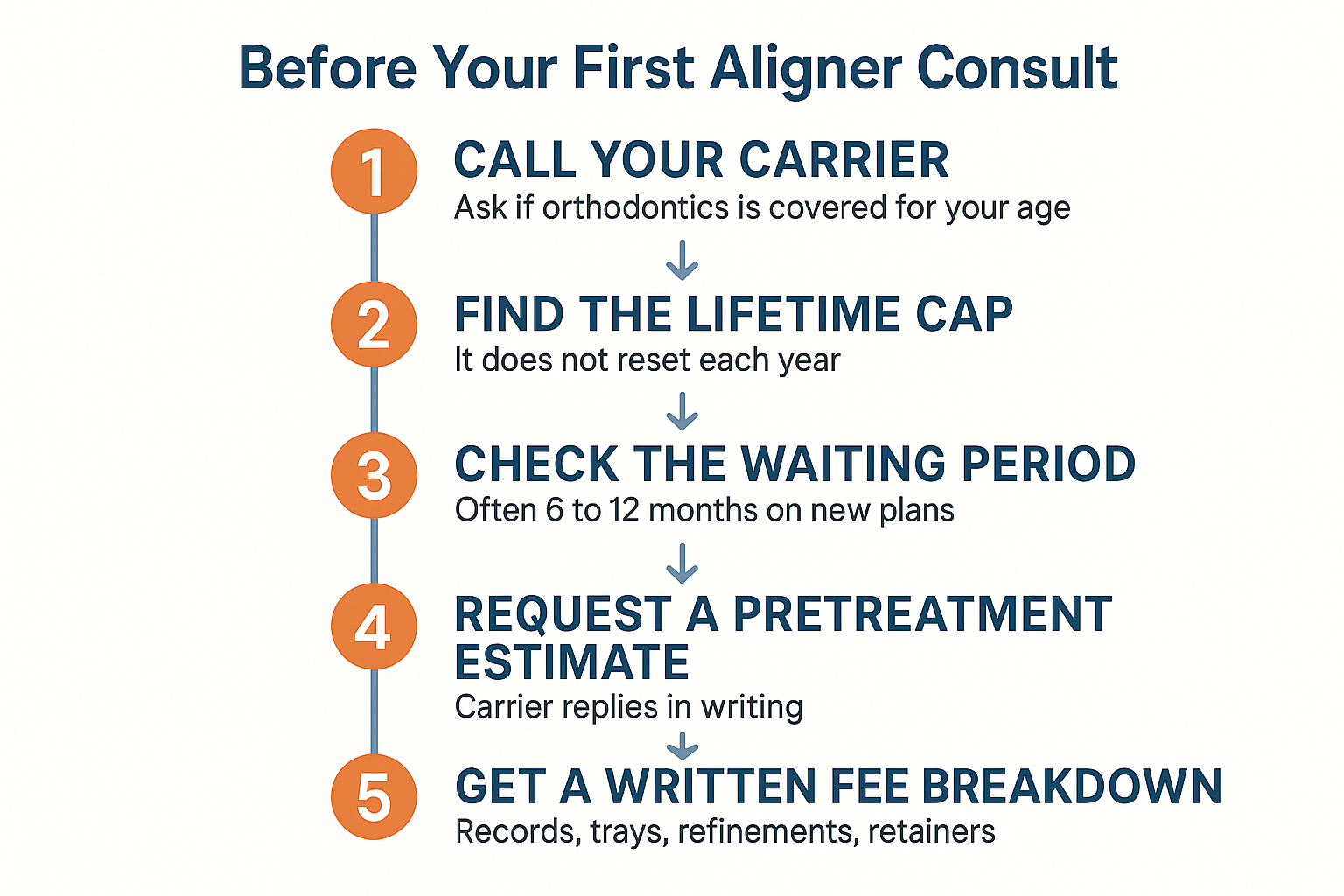
What to Verify Before Your First Aligner Consult
This walks through the order I recommend to patients who want the money question settled before treatment starts.
What Drives Your Share, No Matter What the Plan Pays
Coverage rarely covers the whole thing. So the more useful question is what moves the rest of the number.
Several things do:
- Case complexity. Mild crowding and a complex bite correction are not the same amount of work.
- Number of trays. More movement means more trays and a longer plan.
- Refinement trays. Many cases finish with a short round of refinements to fine-tune the last bit of movement.
- Retention. Retainers are a real long-term cost people forget to budget for, and they get replaced over the years. That side of it is covered in our article on what keeps teeth from shifting back.
- Records and consultation. The exam, X-rays, and digital scan are a separate line item from treatment itself.
I will not print a treatment price here, because a fee written in an article is not a fee for your mouth. Ask any office for a written breakdown that separates records, treatment, refinements, and retention before you start, and read it before you sign.
One patient described that conversation in her review this way: “Savannah went over the pricing/insurance breakdown with me. She explained it so well, answered all of my questions and didn’t make me feel rushed at all.” That is the standard the financial conversation should meet anywhere you go.
The August School Calendar Has Nothing to Do With Your Benefit Year
Parents around here make orthodontic decisions on the school calendar. Glendale Union High School District classes begin August 10, 2026, and I hear from families in Hillcrest Ranch, Arrowhead Lakes, and Vistancia in the weeks right before that date almost every year.
That instinct makes sense for a teenager’s schedule. It has nothing to do with insurance.
A plan’s benefit year might start in January, in July, or on the anniversary of an employer’s enrollment date. A waiting period ends when it ends, regardless of when school starts.
So before you assume treatment can begin in the fall, check both calendars. If the waiting period closes in October, starting in August means paying more out of pocket than you needed to for no clinical reason at all.
The same goes in reverse. If a lifetime benefit is sitting there unused and eligibility is already active, there is no advantage to waiting for a school break.
Frequently Asked Questions About Clear Aligner Insurance Coverage
Is there a cap on what my plan will pay for clear aligners?
Almost always, yes. Orthodontic coverage typically carries a lifetime maximum rather than an annual one, meaning once it is used it does not come back. Your carrier can tell you the exact figure and how much is left, and an office can request it in writing through a pretreatment estimate.
Do plans treat clear aligners differently from metal braces?
Many do not. Plenty of plans define the benefit as orthodontic treatment generally and pay the same percentage either way. Some plans do carve out aligners specifically, so it is worth asking that exact question rather than assuming.
How long does a pretreatment estimate take?
Usually a few weeks, sometimes longer depending on the carrier and how quickly records are submitted. If you are trying to start treatment around a specific date, begin the estimate well ahead of it.
What if my plan excludes adult orthodontics entirely?
Then aligner treatment becomes a self-pay decision, which many adults in North Peoria and the Upper West Side make anyway. Ask about written fee breakdowns and payment arrangements, and know that our in-office membership plan offers 20% off treatment for patients without insurance.
Does using my orthodontic benefit affect my regular cleanings and fillings?
Generally no, because they come from different buckets. Orthodontic treatment draws on the lifetime orthodontic maximum, while cleanings and restorative work draw on the annual maximum that renews each benefit year.
Want the Coverage Question Answered Before You Start?
For readers across North Glendale, Arrowhead Ranch, and the Upper West Side of Phoenix who would rather sort out the numbers up front than after the fact, Beyond Dental Care handles that conversation first. Dr. Dariene Lazore, DMD, offers CandidPro Clear Aligners with orthodontist-reviewed treatment plans and remote check-ins through the ProMonitoring app, which means fewer trips to the office on Happy Valley Road for working adults. Consultations and pretreatment estimate requests can be arranged at 623-267-8088 or through beyonddentalcare.com.