
Direct Answer: Some wisdom teeth come out in a general dental office, and some go to an oral surgeon. The deciding factors are tooth position, root development, and nerve proximity, which an exam and X-ray reveal.
Most people searching about wisdom teeth are not asking whether they should get them out. They are asking something more practical: can this office actually do it, or am I going to get handed a phone number for somebody else?
I get that question through our website form more than you would think. One person wrote in asking flat out if we do wisdom teeth extractions. Another just said they needed to set up an appointment to get theirs removed.
So let me answer it the honest way. Some wisdom teeth come out right here in North Glendale. Some belong with an oral surgeon. The difference is not about who wants the case, it is about the tooth itself, and an X-ray is what tells us which one you have.
General Dentist vs Oral Surgeon Referral: Two Different Procedures
A fully erupted wisdom tooth that has come in straight, sits above the gumline, and has a clean grip for an instrument is a routine extraction. That is a procedure a general dentist does regularly.
A wisdom tooth that is buried in bone, angled into the tooth in front of it, or sitting close to the inferior alveolar nerve is a different operation. That one goes to an oral surgeon, and it should.
When I refer someone out, it is not a brush-off. It is a judgment about the tooth. Our office keeps working relationships with surgeons and specialists across the Northwest Valley, and those relationships are used often. We have had patients call months later asking for the surgeon’s contact info again, which tells you the handoff is a normal part of care, not an exit.
Here is the part that takes the pressure off: finding out which path you are on takes an exam and an X-ray, not a commitment to surgery. You can leave that appointment knowing exactly what you have and still decide nothing that day.
What We Actually Look At on the X-Ray
This is the part nobody publishes, and it is the part that turns anxiety into an actual decision. Four things change both the difficulty of the removal and whether it should happen at all:
- Position of the tooth. Upright, tipped forward, lying sideways, or rotated. An angled tooth pressing into the second molar is a different problem than one standing straight.
- Stage of root development. Roots that are still forming come out more easily than roots that are fully built and curved. This is why age matters so much in the conversation.
- Distance from the nerve canal. The closer the root tips sit to that canal on the lower jaw, the more the case belongs with a surgeon.
- Erupted, partially erupted, or fully impacted. A tooth half covered by gum tissue traps food and bacteria. A fully buried tooth with no symptoms may be doing nothing at all.
And here is something I want more adults to hear. Not every wisdom tooth needs to leave.
I see patients in Arrowhead Ranch and Stetson Valley in their forties who still have all four, have never had a flare-up, and are doing fine. Professional guidance from the oral and maxillofacial surgery association supports that removal is indicated when a third molar carries disease or a high risk of developing it, and that patients who keep healthy, disease-free wisdom teeth may go their whole lives without trouble.
Monitored retention is a legitimate plan, not a stall. That means tracking the teeth with digital X-rays over a few years and watching for decay, gum inflammation around the tissue flap, pressure on the neighboring molar, or cyst formation.
Which Cases Usually Stay In-House, and Which Get Referred
Every case gets its own look, but these patterns hold up most of the time.
| What the X-ray shows | What it usually means | Who typically handles it |
|---|---|---|
| Fully erupted, upright, clear access | Routine extraction, local anesthetic | General dentist in-office |
| Partially erupted with a gum flap, roots mostly formed | Depends on angle and access | Often in-office, case by case |
| Tipped into the second molar, partial bone coverage | Surgical extraction, bone removal likely | Usually referred to an oral surgeon |
| Fully impacted in bone, roots near the nerve canal | Higher-complexity surgical case | Oral surgeon |
| Healthy, disease-free, no symptoms | Monitoring may be the better call | General dentist, tracked with X-rays |
| All four at once with sedation requested | Single surgical appointment preferred | Oral surgeon |
What Actually Changes the Price
Cost questions come up on nearly every call about this, so here is what moves the number before anyone looks at a dollar figure.
Talking About Cost Without Pretending to Quote You
Insurance is the single most common first question we get on the phone. Roughly one in eight callers leads with it, and one person told us straight out that they had never used dental insurance before and wanted to know whether there was a cap and how that even worked.
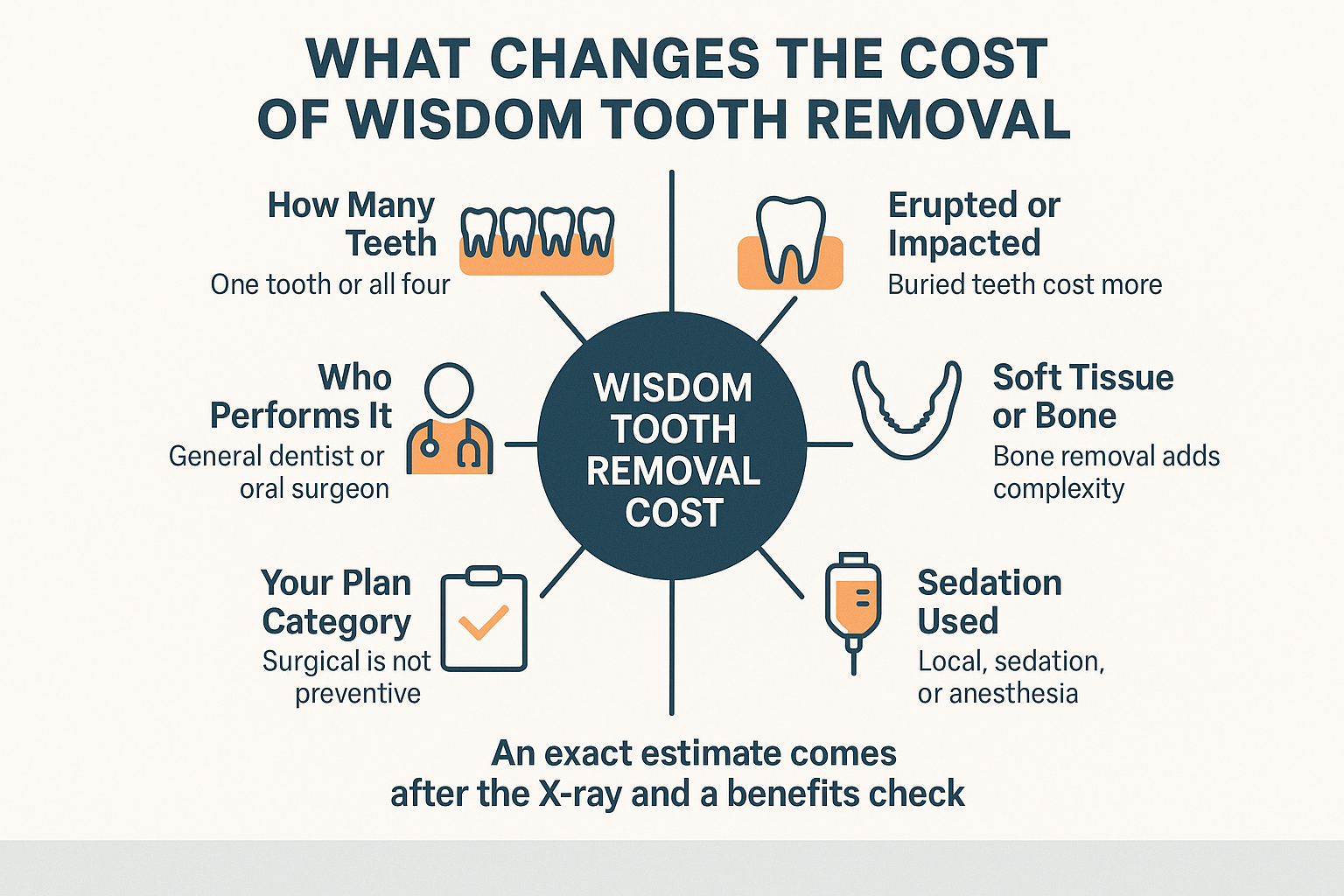
I am not going to put a price on your wisdom teeth in a blog post. What I can do is hand you the variables so you can ask sharper questions wherever you go:
- How many teeth are coming out in one appointment
- Whether each one is erupted or impacted, since those are billed as different procedures
- Whether removal involves soft tissue only or bone
- Whether you want sedation, and what level
- Whether a general dentist or an oral surgeon is doing the work
One more thing worth knowing. Surgical extractions usually fall into a different coverage category than a cleaning or an exam, and some plans apply a waiting period or a separate percentage to them. That is why a real estimate comes after the imaging, not before.
If coverage is your sticking point, it helps to read up on what in-network, out-of-network, PPO, and HMO actually mean for a dental bill and what to confirm before you book a visit. For patients without coverage at all, our in-office membership plan takes 20% off treatment, and this piece on a membership plan versus a private policy walks through the math.
Why Fall and Winter Are the Natural Windows
Wisdom teeth are one of the only dental procedures people schedule around a calendar instead of around pain. Families here plan it the same way every year.
The 85310 area sits in Deer Valley Unified, where fall break lands in early October and winter break runs through late December. Those two windows are when a teenager or a college kid home for the holidays can take a few recovery days without missing anything.
And Phoenix runs opposite of a snow market. October through March is when people are most available and most willing to leave the house, which is exactly why those months fill up.
Two scheduling points that make this easier:
- The consultation and the extraction are usually separate visits, so you can get the imaging done in early fall and put the procedure itself on a break week.
- Our weekday appointments run Monday through Thursday until 7pm, with Friday and Saturday by request, so an evaluation does not have to cost a school day or a shift.
I have moved appointments for a Diamondbacks game and for a rescheduled baseball game more than once. Parents book back-to-back slots for themselves and their kids all the time. If it helps to think through the logistics, which dental visits fit after work and which need a morning slot breaks it down.
When It Is Already Swollen, Do Not Wait for a Break Week
A partially erupted wisdom tooth that traps food is the most common way people find out they have a problem. The tissue flap over the tooth gets inflamed, and it goes from annoying to serious fast.
See someone now if you have:
- Swelling at the back of the jaw or along the cheek
- Trouble opening your mouth fully
- A bad taste or discharge near the back molar
- Pain that wakes you up at night
- Fever along with any of the above
Urgent calls make up roughly one in seven of the calls we take, and painful swelling and severe gum inflammation are both on our emergency list. One caller described severe jaw pain radiating down the side of the face and was booked the same day for an exam and X-ray.
The path is short. Call 623-267-8088, ask for a same-day appointment, and the visit starts with a flat $99 emergency exam and X-ray with no billing surprises. We are here until 7pm Monday through Thursday. If it is already late and you are weighing your options, whether the ER is the right place for a dental problem is worth two minutes of reading.
For a Lot of Teenagers, This Is Their First Real Procedure
That is the part I think about most. A cleaning is familiar. A surgical consult is not, and a nervous seventeen-year-old does not need technology talk, they need to know what is going to happen before it happens.
So we explain each step out loud as we go. Sedation is available for anxious patients, and general anesthesia is an option for children and young adults with special needs or severe dental anxiety in complex cases. If that is where your family sits, how sedation options differ covers the differences plainly.
There is also a comfort dog named Mr. Woodford on site, and he earns his keep on days like this.
A parent wrote this after a first visit: “Brought my daughter in who has extreme anxiety amongst other challenges and they were so patient, took the time to explain everything they’d be doing and what it would feel like.” That is Jaime K., and that is the standard.
Dr. Dariene Lazore, DMD, is a general dentist who treats children, teens, adults, and seniors in one private, non-corporate practice. A teen’s wisdom tooth evaluation and a grandparent’s restorative work get handled in the same place, by the same team, which is most of the reason families across North Peoria, Norterra, and Vistancia stay put.
Frequently Asked Questions About Wisdom Teeth Extraction and Referrals
Can I find out if I need my wisdom teeth out without committing to surgery?
Yes. The evaluation is an exam and an X-ray. You leave knowing the position of each tooth, whether it is impacted, and whether removal or monitoring makes more sense. Nothing gets scheduled unless you want it scheduled.
If I get referred to an oral surgeon, am I starting over?
No. The imaging and the findings go with you, and the referral is made to a specific surgeon, not a list. We stay in the loop on the case and you come back here for follow-up and your regular care.
I am 45 and still have all four. Is that a problem?
Not automatically. If they are disease-free, positioned reasonably, and cleanable, monitoring them with periodic X-rays is a recognized approach. Plenty of adults keep theirs for life. The things that change that answer are decay, gum inflammation, pressure on the second molar, or a cyst forming.
What does a wisdom tooth extraction cost?
It depends on how many teeth, whether they are erupted or impacted, whether bone is involved, whether you use sedation, and who performs the procedure. Surgical extractions also sit in a different insurance category than preventive visits. A real number comes after the X-ray and a benefits check, so call 623-267-8088 and ask.
How fast can I be seen if my jaw is swollen right now?
Same-day appointments are available during our hours, which run Monday through Thursday until 7pm, with Friday and Saturday by request. The emergency exam and X-ray is $99 flat.
Is there a best age to have them removed?
Earlier generally means less developed roots and an easier recovery, which is why late teens and early twenties is the common window. But age alone does not decide it. Position and disease risk do.
Want to Know Which Path Your Wisdom Teeth Are On?
Evaluations are available for patients across North Glendale, Arrowhead Ranch, Stetson Valley, and the Upper West Side Phoenix area, and same-day appointments are open for anyone dealing with pain or swelling right now. Beyond Dental Care can be reached at 623-267-8088 or at beyonddentalcare.com if you would like to have a look at the X-ray and talk it through.