
Direct Answer: Call the dental office directly with your card in hand. Give them the full plan name, member ID, and group number, then ask if that exact plan is in network as of today.
The card is sitting on the counter. The phone is in your hand. And the only thing standing between you and a scheduled cleaning is one question you are not sure how to ask.
This comes up more than anything else on our phone line. Over a recent three month stretch, “do you take my insurance?” was the single most common question callers asked, and it was the most common reason someone hung up without booking.
So this article is about that one call. What to gather first, what to read off your card, what an office can confirm on the spot, and what it cannot. Whether you are in Arrowhead Ranch, Stetson Valley, Norterra, or anywhere along the Happy Valley Road corridor, one well-prepared call should settle it.
What should I have in front of me before I call about insurance?
Have the actual card, not a memory of the logo. Most of the stalled calls I have listened to go sideways because the caller knows the carrier name and nothing else.
Before you dial, pull together:
- The full plan name, not just the carrier. It is usually printed under or beside the logo.
- The network line, which often reads something like PPO, Premier, HMO, or a named network.
- The subscriber or member ID number.
- The group number, if your plan comes through an employer.
- The policy holder’s name and date of birth, which may not be you.
- Any secondary plan information, which matters more often than people expect.
That last one trips up a lot of households. One inquiry we received asked whether we took a Humana plan or an AARP secondary that contracted with one network in one year and a different one the next. That is a reasonable question, and it is not answerable without the card.
If you are a parent coordinating around Deer Valley Unified schedules and booking for three people, check whether everyone is on the same plan. Sometimes a teenager is on one parent’s policy and a younger sibling is on another. Five minutes of gathering saves a second phone call.

Why does my card say Delta Dental but the office still says “it depends”?
Because a carrier name is not a plan. This is the single biggest source of confusion, and almost nobody explains it before the bill shows up.
The logo on your card tells you who administers the benefits. Network participation is set by the specific plan underneath that logo. Two people can walk in holding cards from the same carrier and get two different answers at the same front desk.
I have seen exactly that play out. One caller left a message asking specifically whether we accepted a Delta Dental HMO plan. Around the same stretch, a different caller who had been referred by a coworker was confirmed in network on a Delta Dental PPO. Same logo, different contracts.
The detail most people skip entirely is whether their plan requires an assigned primary dental office. Plans that assign you to a single office behave very differently from plans that let you pick any participating dentist. If your card or your benefits paperwork lists an assigned office, say so on the first call. It changes the answer.
If the terminology itself is murky, it is worth reading up on what in-network, out-of-network, PPO and HMO actually mean for a dental bill before you call.
What to read off your card, and why the front desk needs it
Here is the short version of what gets asked for on nearly every verification call, and what each item is actually used for.
| What to find | Where it usually appears | Why it matters |
|---|---|---|
| Full plan name | Under or beside the carrier logo | Determines which contract applies, not just which company |
| Network designation | Often a line reading PPO, Premier, HMO, or a named network | A PPO and an HMO from the same carrier can get opposite answers |
| Member or subscriber ID | Front of the card, largest number | Required to pull live benefits from the carrier |
| Group number | Front of the card, usually smaller | Identifies the employer plan and its specific coverage levels |
| Policy holder name and birth date | Not always printed, check your paperwork | Benefits are pulled under the subscriber, not the patient |
| Assigned dental office | Welcome packet or the carrier portal | Some plans only pay at the office you are assigned to |
Can I just use my insurer’s “find a dentist” tool instead of calling?
You can start there. I would not finish there.
Online provider directories are a snapshot, not a contract. They lag behind real contract changes, they carry old addresses and disconnected phone numbers, and they sometimes list offices that never participated in that specific plan at all.
This is a documented pattern, not a local gripe. Peer reviewed research on provider directory accuracy found that listings flagged as inaccurate frequently still carried at least one inaccuracy when checked again later, and that roughly a quarter of listed providers could not be reached at all.
A direct call is faster and more accurate. Two questions settle almost every case:
- “Is this exact plan in network as of today?”
- “Can you run a benefits check on my ID before my appointment?”
Most offices can verify the major plans in a few minutes when you have the ID and group number ready. In our own call records, the verifications that resolved fastest were the ones handled live on the phone rather than pushed to a callback. If an office tells you they will get back to you in a few days, that is your signal to ask whether they can check it while you wait.
The verification call, start to finish
This is the whole process in five steps, in the order they actually happen.
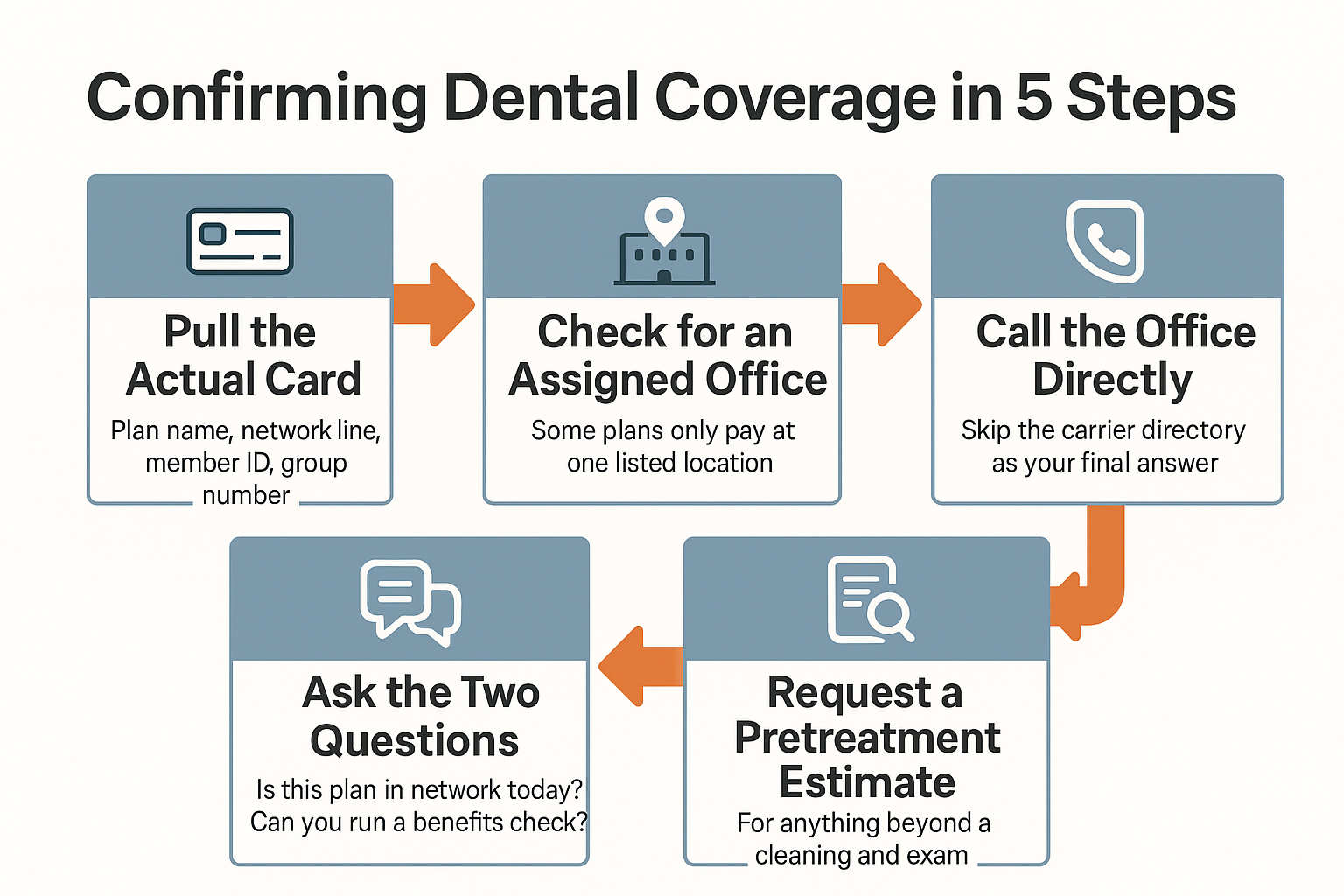
They said yes, they take my plan. Why could I still get a bill?
Because “we take your plan” answers less than it sounds like it does. It tells you the office has a contract with your network. It does not tell you what your share of a specific treatment will be.
Coverage levels vary by category. A cleaning and exam are usually covered at one percentage, fillings at another, crowns and implants at another still. Add in waiting periods, frequency limits, and whatever you have already used this year, and the number can move quite a bit.
The follow up question that produces real numbers is this: can you submit a pretreatment estimate to my carrier before we schedule the work?
A pretreatment estimate is a submission describing the planned treatment, sent to your insurer, with the expected payment returned in writing before anything happens. It is standard practice and most carriers handle it routinely. One of our patients asked for exactly that ahead of a planned crown and bonding case, which is the right instinct.
I would ask for one on anything beyond a cleaning and exam. For a crown, an implant, a bridge, or a treatment plan with several steps, getting the estimate in writing first is the cleanest way to avoid a surprise statement six weeks later. Your exact numbers depend on your plan, so the office is the place to get them.
What if the office isn’t in my network? Is that the end of it?
No, and this is where a lot of people give up too early.
Many offices will still file the claim on your behalf even when they are out of network with your plan. Your share is typically higher, but you are not left mailing paperwork to the carrier yourself. Ask directly: “Do you file out of network claims for patients?”
If you are switching offices, handle your records before the first visit:
- Request your most recent X-rays from your previous office in writing.
- Ask whether a signed release is needed, since most offices require one.
- Have them sent to the new office ahead of the appointment, not the morning of.
- Mention any recent specialist records, like a periodontist or oral surgeon.
That one step spares you a repeat set of images and gives the new dentist something to compare against. Records transfers are a steady part of our week, usually moving between offices around the Valley, and the ones that go smoothly are the ones started a week early.
And if you have no plan at all, you are not alone, though you are in the minority locally. Census estimates put the uninsured rate in the 85310 ZIP near 5 percent. For patients without coverage, this practice keeps an in-office membership plan offering 20% off treatment, which some people compare against buying a private policy. If that is your situation, it is worth understanding what shapes the cost of a cleaning and exam without insurance and how a membership plan stacks up against a private dental policy.
What a good insurance conversation actually sounds like
The part patients in North Peoria, Vistancia, and Arrowhead Lakes mention most in reviews is not the dentistry. It is someone sitting down and walking through the numbers without rushing.
One patient put it this way: “Then Savannah went over the pricing/insurance breakdown with me. She explained it so well, answered all of my questions and didn’t make me feel rushed at all.”
Another review used the phrase “no sales pitches, just honest conversation about needs,” which is the standard a private practice owned by Dr. Dariene Lazore, DMD can hold to in a way a corporate group often cannot.
If you want to know what the rest of that first appointment looks like, here is what a thorough new patient exam actually covers.
Frequently Asked Questions About Confirming Dental Insurance
What should I have in front of me before I call a dental office about insurance?
The physical card, plus a few details that are not always printed on it. Have the full plan name, the network line (PPO, HMO, Premier, or a named network), the member ID, the group number, and the policy holder’s name and date of birth. If you have a secondary plan, have that card too.
Why does my card say Delta Dental but the office says it depends?
Because the carrier name on the card is not the plan. Network participation is set by the specific plan underneath the logo, so a PPO and an HMO from the same carrier can get completely different answers at the same front desk. Check whether your plan assigns you to a primary dental office, because that changes everything.
Can I just use my insurer’s online “find a dentist” tool?
Use it to build a short list, not to make the decision. Published research on provider directories found that flagged inaccuracies often persisted over time and that about a quarter of listed providers could not be reached at all. A direct call to the office is faster and more reliable.
They said yes, they take my plan. Why could I still get a bill?
Because accepting a plan is different from covering a specific procedure at 100 percent. Coverage percentages, waiting periods, and frequency limits all affect your share. For anything beyond a cleaning and exam, ask the office to submit a pretreatment estimate so the carrier’s expected payment comes back in writing before you schedule.
What if the office is not in my network?
Ask whether they will still file the claim for you. Many offices do, and your share is simply higher than it would be in network.
Should I have my old X-rays sent over before my first visit?
Yes, and start a week ahead. Most offices need a signed release, and having recent images on hand can spare you a repeat set and gives your new dentist a baseline to compare against.
Want your own plan checked before you book?
If you have your card in hand and want a straight answer about your specific plan, the office can check most major carriers while you are on the phone at 623-267-8088, or you can start at beyonddentalcare.com. Extended weekday hours run Monday through Thursday until 7pm, which gives households across North Glendale and the Upper West Side Phoenix area room to call after work. Have your member ID and group number ready and the conversation usually takes just a few minutes.