
Direct Answer: Yes. Teeth move at any age because the bone around them remodels throughout life. After 60, gum health and bone support matter more than birthdate when deciding if aligners are realistic.
I hear a version of the same sentence a few times a month, usually from someone in their late sixties sitting in the chair after a cleaning. It sounds like: “I’ve hated my bottom teeth for forty years, but I’m too old to do anything about it now.”
That belief costs people more than they realize. Crowded lower teeth are harder to clean, and after 60, harder to clean often turns into gum problems, recession, and eventually a tooth you can’t save.
So let me answer the question straight. Age by itself is not what decides whether clear aligner treatment works. Below I’ll walk through what actually determines candidacy after 60, why aligners tend to fit an older adult’s daily life better than brackets and wires, and what patients across North Glendale, Arrowhead Ranch, and Stetson Valley usually want to know before they commit.
Does Age Actually Stop Teeth From Moving?
No. And this is the part most people get wrong.
Teeth are not cemented into the jaw. Each one sits in bone, suspended by a ligament, and that bone is living tissue that breaks down and rebuilds itself constantly. Apply steady, controlled pressure to a tooth and the bone in front of it dissolves slightly while new bone fills in behind it.
That process does not switch off on a birthday. It runs your whole life. A 68-year-old’s teeth respond to the same forces a 28-year-old’s do.
What does change is the environment around the tooth. With age, a few things become more relevant:
- Bone density may be lower, which can affect how movement is planned and paced
- Gum tissue has often receded somewhat, leaving less support around the root
- Existing restorations like crowns, bridges, and implants change what’s possible
- Dry mouth from common medications raises decay risk during treatment
Movement is sometimes a little slower in older adults, and treatment plans are usually built more conservatively. But slower is not the same as impossible. In my experience, the patients over 60 who do well are often the most consistent aligner wearers I have, because they actually follow the instructions.
What Actually Decides Candidacy After 60
When an older adult asks me about clear aligners for seniors teeth straightening, my first appointment is not about the teeth at all. It’s about the foundation holding them.
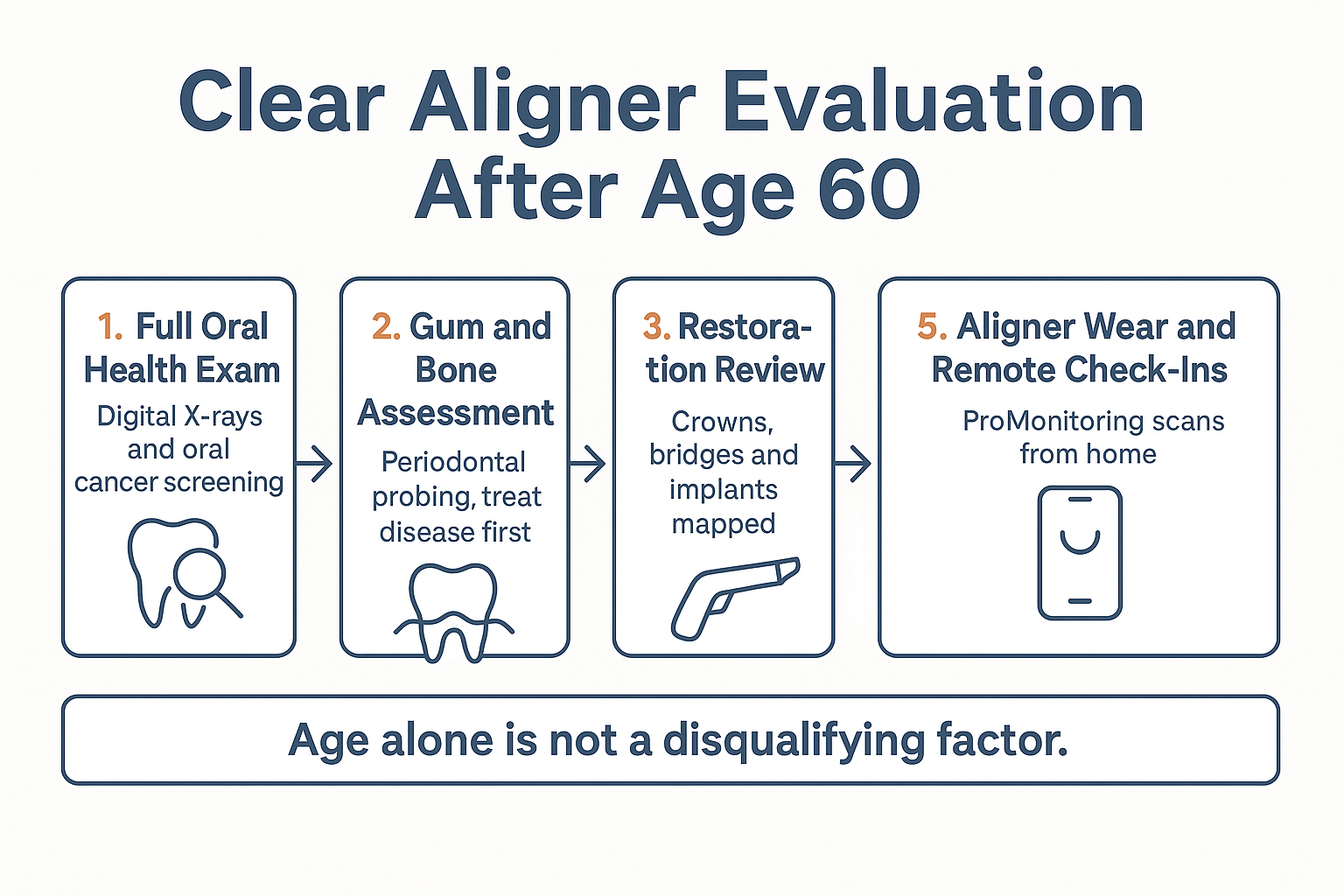
A healthy periodontium is a prerequisite. You cannot safely move a tooth through bone that is actively infected or already badly compromised. That’s why the evaluation starts with a full oral health assessment: periodontal probing, digital X-rays, and a look at every existing restoration in the mouth.
Here’s what I’m specifically checking:
- Active gum disease. This has to be treated and stable first. According to the National Institute of Dental and Craniofacial Research, gum disease becomes more common with age, so this is a real screening step, not a formality.
- Bone support around each root. Significant loss changes what movements are reasonable.
- Crowns and bridges. A crowned tooth moves fine. A bridge, though, splints several teeth together, so they move as one unit and cannot be separated.
- Implants. Implants are fused to bone and do not move at all. They become fixed anchors the plan has to work around.
- Bite and jaw joint history. Some bite problems are beyond what aligners alone can correct.
None of this is meant to discourage anyone. Most of these are questions with answers, not automatic disqualifiers. But an honest evaluation is the only way to know, and I would rather tell someone up front that aligners are not the right tool than start something that won’t hold.
The Evaluation Path for Adults Over 60
Here’s the sequence a patient over 60 actually goes through before any aligner is made, and why each step exists.
Why Aligners Fit an Older Adult’s Life Better Than Braces
Even when metal braces would technically work, they are a rough fit for most patients over 60. The reasons are practical, not cosmetic.
Cleaning is the big one. If you already have crowns, bridges, or areas of recession, you need real access to those margins every single day. Brackets and wires block that access. Aligners come out, you brush and floss normally, and you put them back in.
Diet is the second. Fixed appliances come with a list of foods you can’t eat, and that list gets longer the more restorative work you already have. Aligners have no food restrictions because you remove them to eat.
Then there’s how you feel walking around. One patient’s review put it better than I could: “I feel so much more confident in my teeth. Someone was talking about teeth the other day and I didn’t hide.” Nobody at 65 wants to explain metal brackets at a dinner in Norterra or a grandchild’s graduation.
The CandidPro system we use has a trimline designed to need fewer attachments than some alternatives, which keeps the trays looking cleaner in the mouth. If you’re weighing systems against each other, our breakdown on CandidPro versus Invisalign covers the mechanical differences in more detail.
Braces vs. Clear Aligners After 60: A Practical Comparison
This is the comparison I actually walk older patients through, focused on daily life rather than technical specs.
| Consideration | Traditional Metal Braces | Clear Aligners |
|---|---|---|
| Daily cleaning around crowns and bridges | Brackets and wires block access | Removed completely for brushing and flossing |
| Food restrictions | Long list of foods to avoid | None, trays come out to eat |
| Visibility in social settings | Clearly visible hardware | Nearly invisible trays |
| Office visits | Typically every 4 to 6 weeks for adjustments | Fewer visits with remote scan check-ins |
| Comfort with dry mouth or sensitive tissue | Brackets can irritate cheeks and lips | Smooth trays with a comfort-focused trimline |
| Compliance required from patient | Low, appliance is fixed in place | High, trays must be worn 20 to 22 hours a day |
Fewer Trips to the Office Actually Matters
This is the benefit older patients underrate until they’re in it.
Many of the patients I see in their seventies are already managing a cardiology appointment, a dermatology follow-up, an eye exam, and a physical therapy schedule. Adding an orthodontic adjustment every four weeks for a year and a half is a genuine burden, especially for someone driving in from Vistancia or the far side of North Peoria.
The CandidPro system uses an FDA-cleared app called ProMonitoring. You take a guided scan of your teeth with your phone from your kitchen table, and it gets reviewed remotely. Progress is tracked without you sitting in traffic on Happy Valley Road.
That means:
- Fewer in-office visits across the full course of treatment
- Problems caught between visits, not six weeks after they start
- Total treatment time is often shorter, since tray changes can be paced to what the scans actually show
Every treatment plan is also reviewed by a US-based licensed orthodontist working alongside Dr. Dariene Lazore, DMD, so the remote piece adds oversight rather than replacing it.
What Drives the Cost, and What to Ask About Coverage
I won’t quote you a number in a blog post, because the honest answer is that it depends heavily on the case.
Clear aligner treatment across the Phoenix metro generally runs in the low-to-mid four figures, but the range is wide and the number on your specific plan depends on real factors:
- Case complexity. Mild crowding and a complex bite correction are not the same amount of work.
- Number of trays and expected treatment length.
- Preliminary work. If gum therapy or a restoration needs to happen first, that’s a separate cost.
- Whether refinements are needed near the end.
Insurance is the other half. Roughly one in eight callers to our office is asking some version of “do you take my plan and what does it actually cover.” For orthodontics specifically, many dental plans carry a lifetime orthodontic maximum that is separate from your annual maximum, and some plans exclude adult orthodontics entirely. Medicare typically does not cover routine dental treatment.
That’s worth confirming before you get attached to a plan. If you’re timing treatment around benefits, our note on how dental benefits reset every January is useful reading.
Frequently Asked Questions About Clear Aligners for Seniors
Is 72 too old for clear aligners?
No. There is no upper age limit on orthodontic treatment. Bone remodels throughout life, so teeth respond to controlled pressure at 72 the same way they do at 32. What matters is gum health and bone support, and both are assessed at the consultation.
Can I do aligners if I already have crowns and a bridge?
Crowns usually move fine, since the root underneath is what’s actually moving. A bridge is different. It joins several teeth into one rigid unit, so those teeth can only move together, which limits the plan. Implants don’t move at all and become fixed reference points. None of these automatically rule you out, but they all shape what’s realistic.
How long does treatment usually take for an older adult?
It varies with case complexity. Mild crowding may be measured in months while a more involved case runs over a year. Movement can be paced more gradually in older patients, so I’d rather give you a real estimate after seeing your scans than a number that sounds good in an article.
What happens if I have gum disease right now?
It gets treated first. Moving teeth through actively inflamed, infected tissue can accelerate bone loss, so periodontal therapy comes before any aligner. Once things are stable and the tissue is healthy, aligner treatment can often be revisited.
Will my teeth just shift back afterward?
They will drift without retention, at any age. Retainers are part of the plan, not an afterthought. Most adults wear them nightly long term, which is a small trade for keeping the result.
Wondering Whether Aligners Are Realistic for Your Situation?
The only way to know is an evaluation, because age is not the deciding factor. Gum health, bone support, and what restorations you already have are what set the plan, and none of that can be sorted out from a website. Beyond Dental Care sees teens, adults, and seniors from North Glendale, Arrowhead Ranch, Stetson Valley, Norterra, North Peoria, and Vistancia, with evening and Saturday availability for patients working around other appointments. If you’d like to talk it through, the office can be reached at 623-267-8088 or at beyonddentalcare.com.