
Direct Answer: Most dental plans reset January 1. Your annual maximum, deductible, and covered cleaning count all start over, and unused maximum benefit from the prior year does not carry forward.
Every fall, I have some version of the same conversation with patients. Someone has a crown they’ve been putting off, or a periodontal evaluation they agreed to in June, and they want to know whether it makes any difference if they come in now or wait until spring.
The honest answer is that it can make a real difference, and it has almost nothing to do with your teeth. It has to do with how calendar-year dental plans are built.
So here is what actually happens to your coverage on January 1, why unused benefits vanish on December 31, and how I think about sequencing treatment when a plan year is about to turn over. No pressure, just the math.
The Three Things That Reset on January 1
Most employer dental plans run on the calendar year. That means three separate pieces of your coverage go back to zero at midnight on New Year’s Eve.
- Your annual maximum. This is the total dollar amount your plan will pay toward your care in one year. Whatever you don’t use is gone. It does not roll over, and it does not bank.
- Your deductible. This is what you pay out of pocket before the plan starts contributing. If you already met it this year, you’re past that hurdle. In January, the clock starts again. Healthcare.gov has a plain-language explanation of how deductibles work if you want the general definition.
- Your frequency benefits. Things like two covered cleanings per year, or one set of X-rays in a given window. Use them or lose them.
In most employer PPO plans I see, the annual maximum lands somewhere in the low four figures, though plans vary widely and yours may be higher or lower. Your benefits booklet or your HR portal will have the exact figure.
One caller told us she had never used dental insurance before and asked whether there was a cap and how that even worked. That’s a completely reasonable question, and it’s the piece most people were never taught.

Why a Met Deductible Changes the Math
Here’s where year-end planning stops being abstract.
Picture two patients with identical plans and an identical crown recommendation. One has already had a cleaning, X-rays, and a filling this year, so her deductible is met and she has a few hundred dollars of unused annual maximum sitting there. The other hasn’t been in at all.
If both of them schedule the crown in February, they are in the same boat. Both pay a fresh deductible first, and both start drawing down a brand new annual maximum.
But if the first patient schedules before December 31, her plan contribution starts immediately, because she already cleared the deductible. Her leftover maximum gets applied instead of expiring. Then on January 1 she has a full new maximum available for whatever comes next.
That’s the whole idea behind dental benefits year-end planning. You’re not squeezing in extra treatment. You’re placing treatment you already agreed to on the side of the calendar where more of it gets covered.
What Resets, What Carries Over
A quick reference for the three moving parts of a calendar-year plan.
| Plan Component | What It Does During the Year | What Happens December 31 |
|---|---|---|
| Annual maximum | Caps the total dollars your plan pays out | Unused portion expires and does not roll over |
| Deductible | Amount you pay before the plan contributes | Resets to zero; you pay it again in the new year |
| Frequency benefits | Limits things like covered cleanings per year | Unused visits are forfeited |
| Treatment already completed | Claims processed against the current year | Stays applied to the year the work was done |
| HSA or FSA funds | Can be spent on qualifying dental care | Depends on account type; FSA rules often differ from HSA |
A Simple Way to Think About Your Benefit Year
This is roughly the order I walk patients through when they ask how to plan the rest of their year.
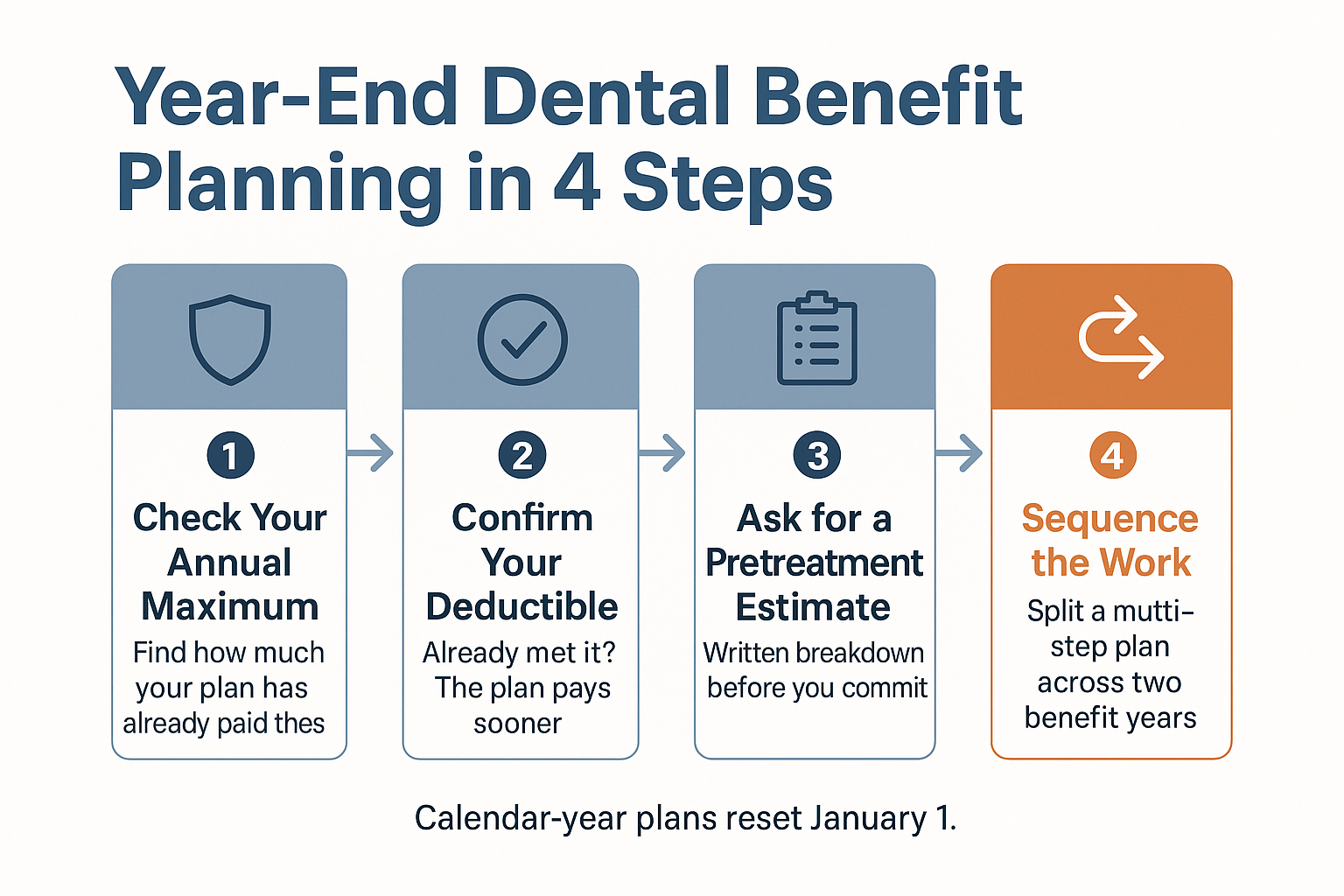
Sequencing a Multi-Step Treatment Plan
One patient wrote in with a plan that involved crowns and a partial and asked, in effect, what order makes the most sense with insurance. Another said she needed four fillings and wanted to split them across two weeks. Both instincts are sound.
When a plan has several parts, the sequence usually comes down to a few questions I ask myself:
- What is clinically time-sensitive? Active decay, a fractured tooth, or gum disease that’s progressing sets the order first. Coverage never outranks health.
- What can safely wait 60 to 90 days? Elective and cosmetic work is often the flexible piece.
- Where does the annual maximum run out? If phase one uses up this year’s maximum, phase two naturally lands in January with a fresh one.
- How many appointments does it take? Splitting fillings or crowns across visits is normal, and it also spreads the cost across two benefit years when the timing lines up.
A lot of the households we see across Arrowhead Ranch, Hillcrest Ranch, Stetson Valley, and Norterra carry employer PPO plans with solid annual maximums that go partly unused. Not because anyone was careless, but because nobody sat down and mapped it out before the holidays hit.
What to Ask Before You Decide
You do not need to guess at any of this. A front office team can pull most of it up in a few minutes.
Worth asking:
- How much of my annual maximum is left for this year?
- Have I met my deductible?
- Do I still have a covered cleaning available?
- Can you submit a pretreatment estimate to my plan before I commit?
That last one matters most for larger treatment. A pretreatment estimate is a written breakdown of what the plan expects to cover and what you’d owe. One of our longtime patients asked for exactly that before deciding between crowns and bonding, and it made the whole conversation easier.
If you have an HSA, that’s another lever. Our guide on whether you can use an HSA for dental care walks through what qualifies. And if you’re weighing elective work, the questions to ask before starting any cosmetic treatment are worth reading first.
One more thing I’d mention: your covered exam and cleaning are the cheapest part of your plan and the part people skip most. What a preventive visit actually catches early is usually the difference between a filling and a crown next year.
Frequently Asked Questions About Dental Benefits and Year-End Timing
Do unused dental benefits really disappear on December 31?
For calendar-year plans, yes. Whatever portion of your annual maximum you didn’t use is forfeited, and it does not carry into the new year. A small number of plans run on a fiscal or plan-year schedule instead, so check your booklet if you’re not sure which you have.
Is it smarter to do all my treatment in one year or split it?
It depends on how much maximum you have left and what the treatment costs. If one phase would blow past this year’s maximum anyway, splitting the plan across December and January often means two annual maximums working for you instead of one. Clinical priority always comes first, though.
Can you tell me what my insurance will cover before I schedule?
For most treatment, a plan benefit breakdown can be reviewed with you before you decide, and for larger work a pretreatment estimate can be submitted to your carrier. Patients tell us the pricing and insurance walkthrough is one of the things they appreciate most, and there’s no obligation attached to asking.
What if I don’t have dental insurance at all?
Then none of the January reset applies to you, and timing is purely about clinical need and your own planning. Plenty of people we see pay on their own, and knowing the cost of a treatment plan up front matters just as much in that situation.
Is it too late to start something in November or December?
Usually not, though it depends on the treatment. Single-visit work is straightforward. Anything involving a lab, like a crown or a bridge, needs enough lead time for fabrication and a seat appointment, so earlier in the fall gives you more room.
Thinking Through the Rest of Your Benefit Year?
If you have treatment already on the table and you’re weighing the timing, our team can review what’s left on your plan and lay out the sequence with you. Evening and Saturday appointments are available for patients across North Glendale, North Peoria, and the Upper West Side of Phoenix. You can reach the office at 623-267-8088 or find more at beyonddentalcare.com whenever you’re ready.