
Direct Answer: A regular cleaning treats healthy gums above the gumline. Periodontal maintenance cleans below the gumline inside pockets left after gum disease treatment, measures those pockets every visit, and repeats every three to four months.
A patient sat down in my chair last month and asked why her cleaning was suddenly being called something else. Her old office had told her she needed periodontal maintenance from now on, and she wanted to know if that was a real thing or just a bigger bill.
It is a real thing. It is a different appointment with a different purpose, a different schedule, and a different billing code. But almost nobody explains that part.
I hear a version of this question every week from patients across North Glendale, Arrowhead Ranch, and Stetson Valley. One caller put it plainly: her gums were giving her a really hard time and she had no idea what came next. So here is the honest breakdown.
The Periodontal Maintenance vs Regular Cleaning Difference Starts Below the Gumline
A standard cleaning, called a prophylaxis, is for gums that are healthy. The hygienist removes plaque and tartar from the tooth surfaces above the gumline and from the shallow crevice around each tooth, usually 1 to 3 millimeters deep.
Periodontal maintenance is what follows active gum disease treatment. Once gum disease has damaged the attachment and bone around a tooth, deeper pockets stay behind even after successful therapy. Bacteria collect down in there where a toothbrush cannot reach.
So the maintenance visit goes further:
- Cleaning subgingival surfaces, meaning the root surfaces inside those remaining pockets
- Removing biofilm and hardened deposits below the gumline, not just polishing above it
- Measuring pocket depth at six points on every tooth, at every single visit
- Comparing today’s numbers to the last visit to see if things are stable or slipping
- Checking for bleeding points, recession changes, and any tooth mobility
From the waiting room, the two visits look identical. Clinically they are not close. One is prevention for a healthy mouth. The other is ongoing management of a condition that has already done damage.
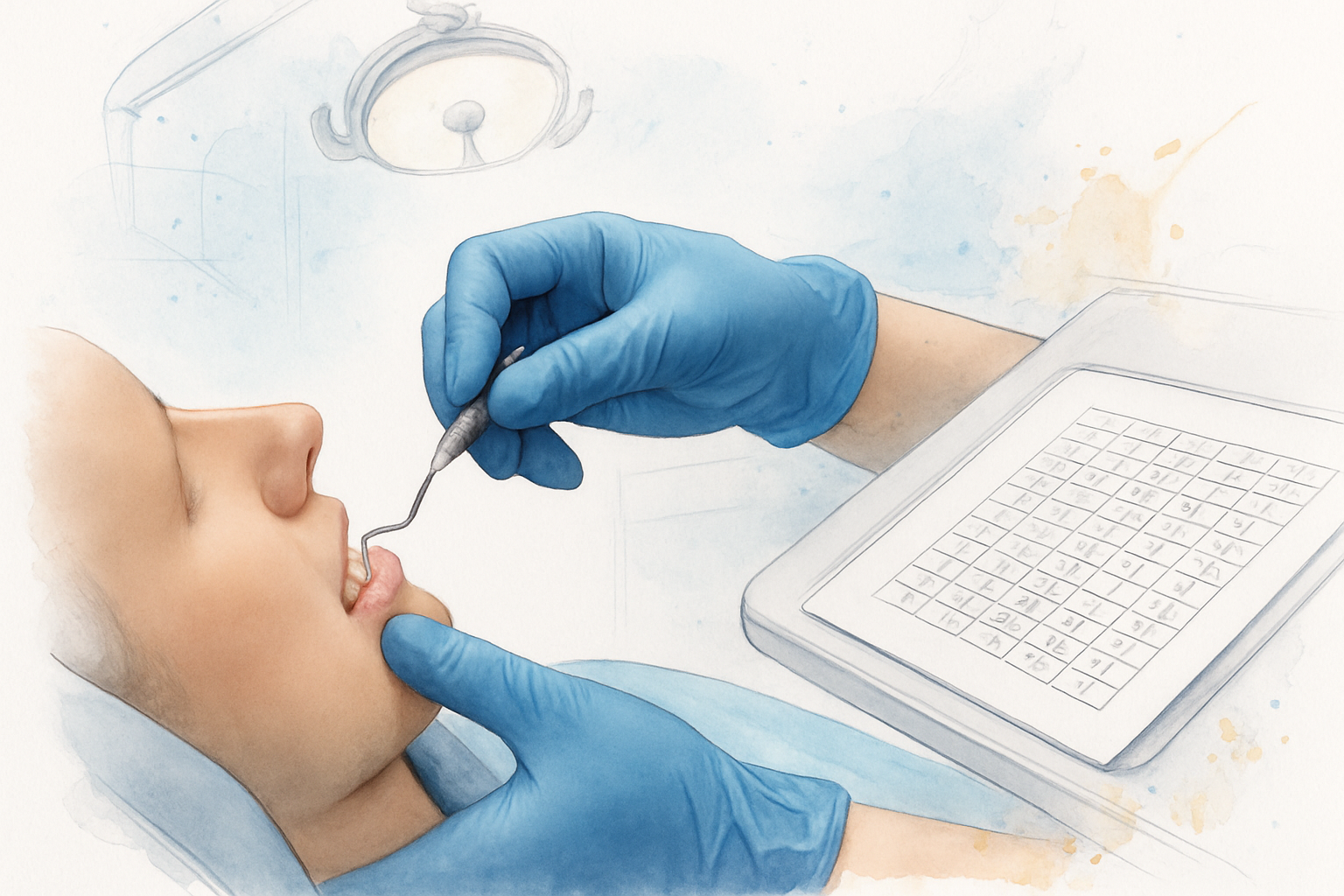
Why the Schedule Changes From Six Months to Three or Four
This is the part patients push back on most. If six months was fine before, why not now?
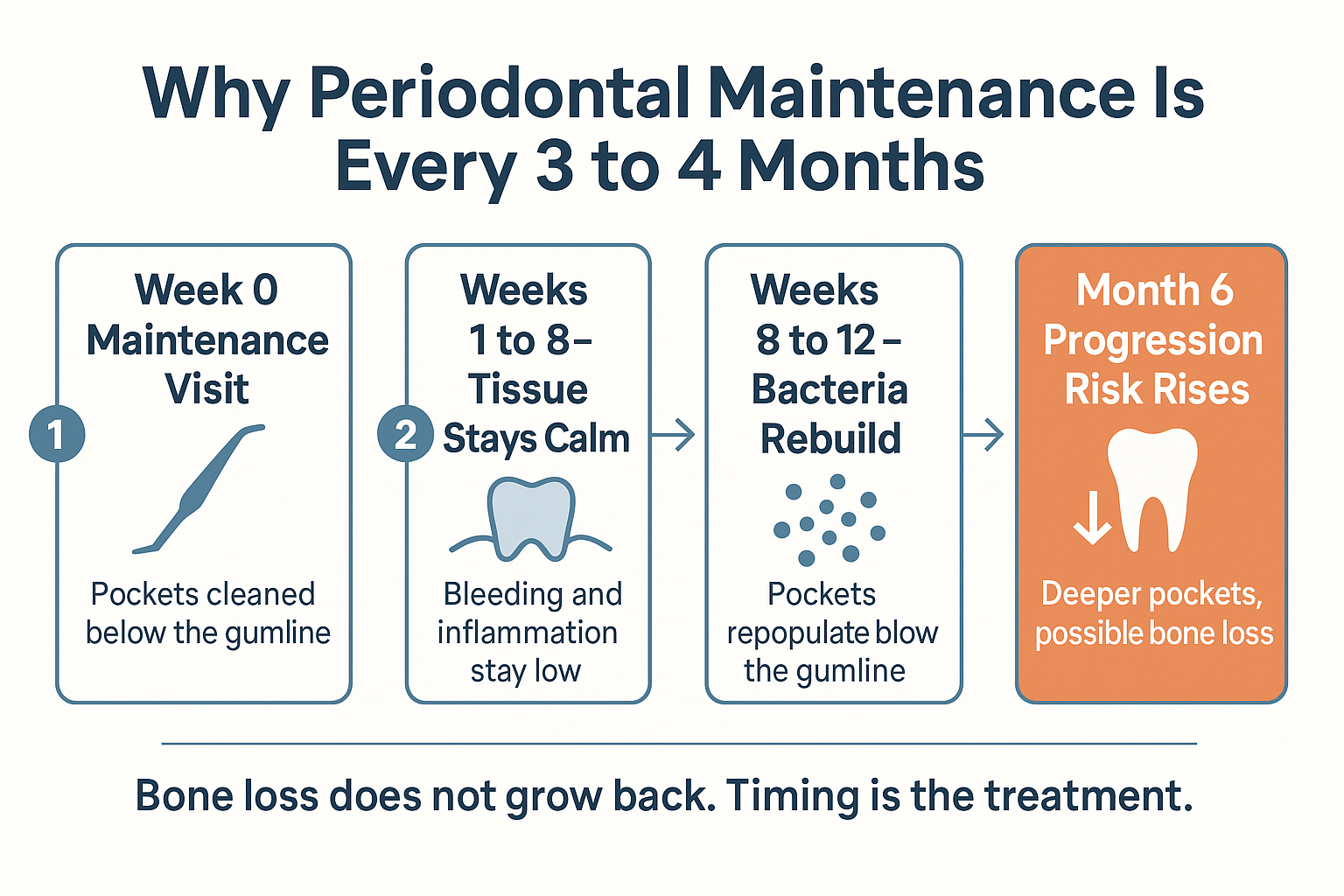
Because the pockets refill. Research on treated periodontal pockets shows that the harmful bacteria begin repopulating within roughly 9 to 12 weeks after a thorough cleaning. That timeline is where the three to four month interval comes from. It is not a scheduling preference.
A six month gap gives that bacterial community three or four extra months to rebuild, re-inflame the tissue, and start working on bone again. Patients who drift back to a six month rhythm after gum therapy show measurably more disease progression over time. Not a disaster overnight, but a slow loss you cannot get back, since bone does not regrow on its own.
The National Institute of Dental and Craniofacial Research covers the progression well if you want the clinical background.
One more local wrinkle. A lot of my patients in Norterra and Vistancia are on medications for blood pressure or dry mouth, and our summer stretch of 110 degree days makes dehydration worse. Less saliva means less natural rinsing of those pockets. That is a real factor in how fast things come back.
Side by Side: Prophylaxis vs. Periodontal Maintenance
Here is how the two appointments actually compare once you look past the chair and the bib.
| What Changes | Regular Cleaning (Prophylaxis) | Periodontal Maintenance |
|---|---|---|
| Who it is for | Healthy gums, no bone loss | Patients who completed gum disease treatment |
| Where cleaning happens | Above the gumline and shallow crevice | Below the gumline, inside remaining pockets |
| Pocket measurements | Screened periodically | Full charting at every visit |
| Typical interval | Every 6 months | Every 3 to 4 months |
| Billing code | D1110 | D4910 |
| Chair time | Shorter, more routine | Longer and more methodical |
| How long it continues | Ongoing prevention | Ongoing for most patients, long term |
What Happens Between Maintenance Visits
This shows why the calendar matters more than most patients expect after gum therapy.
The Insurance Part Nobody Warns You About
Insurance questions are the number one reason people stall before booking. I get it, and this one catches patients off guard.
Periodontal maintenance bills under D4910, not the standard cleaning code D1110. Plans do not always treat them the same way. What varies:
- Coverage percentage. Some plans pay preventive cleanings at 100% but classify maintenance under basic services at a lower percentage.
- Frequency limits. A plan may allow two cleanings a year but only cover a set number of maintenance visits.
- Annual maximum. Maintenance visits often apply against your yearly cap, where routine cleanings sometimes do not.
- Alternating rules. A few plans want maintenance and prophylaxis alternated, which rarely matches what the mouth actually needs.
One caller asked whether there is a cap on dental insurance and how that even works. Reasonable question, and the answer depends entirely on the plan document, not on us.
My advice is simple. Before your next visit, call the number on your card and ask specifically about D4910 frequency and coverage level. Our office manager can help you read the response. Just do not assume it is handled the same as the cleaning you had for the last twenty years.
What the Appointment Actually Feels Like
This is not a rushed visit, and it should not feel like one. A proper maintenance appointment is slow and deliberate, tooth by tooth, quadrant by quadrant.
Our hygienists chart every pocket before any instrument touches a root surface. Then they work the areas that measured deeper, using hand instruments and ultrasonic scaling with water irrigation. Anesthetic is available if certain spots are tender, and most patients do not need it.
One patient wrote that our hygienist “did an amazing job” and was “kind, gentle and thorough.” That is the standard I want on every maintenance visit, because attention to the gumline is exactly what separates this appointment from a polish and a wave goodbye.
You will also get a straight answer about your numbers. If a 5 millimeter pocket became a 4, I will tell you. If a 4 became a 6, I will tell you that too, and we will talk about why. Patients coming from corporate offices along the Happy Valley corridor often tell me nobody ever showed them their chart. That changes here.
If you want more background on what gets found during the evaluation stage, what a periodontal screening finds that a regular cleaning misses covers that side of it. And if it has been years since your last visit, here is what to expect at your first visit back.
Frequently Asked Questions About Periodontal Maintenance
Can I ever go back to a regular cleaning?
Sometimes, but it is less common than people hope. If pockets shrink back to 3 millimeters or less, bleeding stops, and the tissue stays stable across several visits, moving back to a prophylaxis can be reasonable. The bone that was already lost does not return, so many patients stay on maintenance long term to protect what is left.
What does periodontal maintenance cost compared to a regular cleaning?
It generally runs higher than a standard cleaning because it takes more time, more instrumentation, and full charting. Costs vary by how many quadrants are involved, your insurance coverage, and how deep the pockets are. Call our office at 623-267-8088 for a straight number for your situation rather than working off an online average.
Does it hurt?
For most patients, no. Working below the gumline can feel more sensitive than a routine polish, especially where there is recession. Local anesthetic or a topical gel is available anytime, and we would rather use it than have you tense up for forty minutes.
What happens if I just skip to a six month schedule anyway?
Nothing dramatic in the first week. The problem is cumulative. Deeper pockets get four extra months of undisturbed bacteria twice a year, and over several years that usually shows up as more bleeding, more pocket depth, and loose teeth that were fine before.
Do I need this before getting implants or cosmetic work?
Almost always, yes. Active gum inflammation is one of the biggest risk factors for implant failure, and whitening or crowns on unstable gums is building on a shaky foundation. Stabilizing the gum tissue first protects everything you spend afterward.
Questions About Your Maintenance Schedule?
If you were told you need periodontal maintenance and nobody explained why, I am happy to walk you through your own numbers and what they mean. We see patients from North Glendale, Arrowhead Ranch, Norterra, North Peoria, and across the Upper West Side of Phoenix, with evening and Saturday times available for people who cannot step away midday. You can reach the office at 623-267-8088 or find more at beyonddentalcare.com.