
Direct Answer: A thorough new patient dental exam covers digital X-rays, gum pocket measurements, an oral cancer screening, and a bite check, then ends with a written plan. Plan on about 60 to 90 minutes.
A good share of the messages that come through our website start the same way. Someone moved here last month, or relocated over the summer, and they need a dentist. One patient told us she had reached out to a couple of other offices near her and never heard back at all.
If you just landed in Stetson Valley, Arrowhead Ranch, Norterra, or North Peoria, picking a dental office is one more line on a long list. And the first appointment is the one that tells you whether you found a long-term dental home or another rushed chair.
So here is what a genuinely thorough first exam covers, why some of it takes longer than you might expect, and what you should be holding in your hand when you walk out.
What to Expect at a New Patient Dental Exam, Beyond the Cleaning
Most people book a first visit thinking of it as “a cleaning.” The cleaning is the part you feel. The exam is the part that actually determines your care for the next several years.
A full new patient exam should include all of the following:
- Digital X-rays. These set your baseline. Bone levels, decay between teeth, old fillings and crowns, root tips, anything hiding under the gumline.
- A periodontal evaluation. Six measurements around every tooth, called probing depths. This is how early gum disease gets caught.
- An oral cancer screening. A look and feel exam of the soft tissue in your cheeks, tongue, floor of the mouth, lips, and throat.
- A bite evaluation. How your teeth meet when you close and slide. Bite problems show up as wear, cracks, and sore jaw muscles years before you connect the dots.
- A review of existing work. Every crown, filling, and bridge you already have, with an honest read on how much life is left in it.
The periodontal numbers are the ones patients underestimate most. Early gum disease often causes no pain at all, which is exactly why measuring beats guessing. One caller described it simply as her gums giving her a hard time, and by then it had usually been building for a while.
Why the Exam and the Cleaning Are Sometimes Two Separate Visits
This one surprises people, so I want to be clear about it up front. Sometimes the right move is to do the exam and X-rays first, then bring you back for the cleaning.
Here is why. Until the probing depths are recorded and the X-rays are read, nobody knows what kind of cleaning you actually need. A routine cleaning and a deep cleaning below the gumline are two different appointments with different time blocks.
Splitting the visit usually happens when:
- Probing depths come back deeper than normal in several areas
- It has been a few years since your last visit and there is heavy buildup
- The X-rays show bone loss that changes the treatment approach
- You are on a tight schedule and the full appointment will not fit
Plan on roughly 60 to 90 minutes for a first appointment either way. If you are coming back after a long gap, lean toward the longer end. Evening and Saturday availability exists for exactly this reason, because most working adults in the Happy Valley corridor cannot give up a mid-morning weekday.
What Each Part of the Exam Is Actually Looking For
It helps to know what the person holding the instruments is checking at each step. This is the short version.
| Part of the Exam | What It Checks | What It Catches Early |
|---|---|---|
| Digital X-rays | Bone levels, decay between teeth, roots, old restorations | Cavities you cannot see or feel yet |
| Periodontal charting | Pocket depth around each tooth, bleeding, recession | Gum disease before it becomes visible or painful |
| Oral cancer screening | Soft tissue of the lips, cheeks, tongue, throat | Sores or color changes worth watching or referring |
| Bite evaluation | How upper and lower teeth meet and slide | Wear patterns, cracking, clenching and grinding damage |
| Restoration review | Condition of current crowns, fillings, bridges | Leaking margins before the tooth underneath fails |
How a First Visit Usually Flows
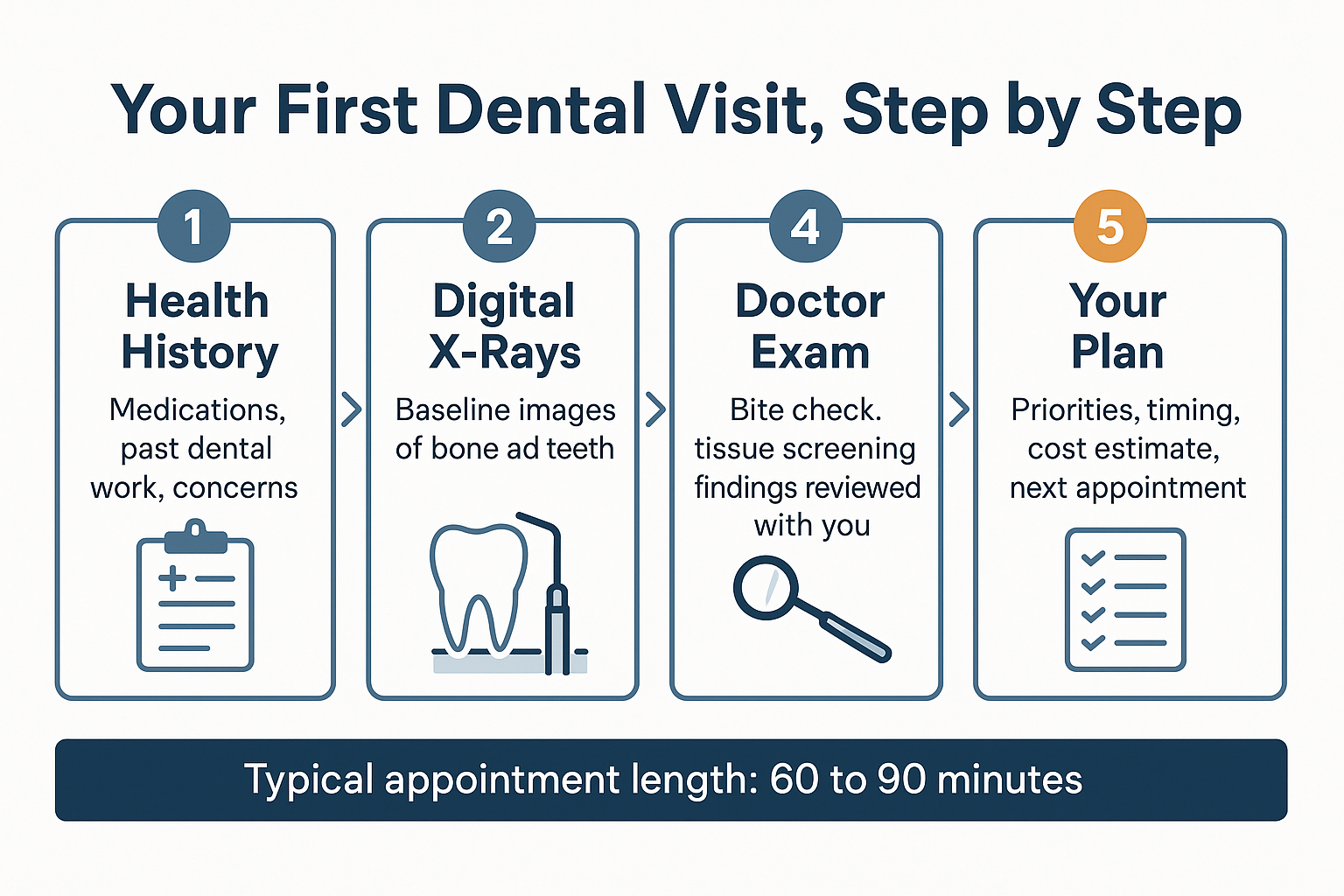
Most new patient appointments move through the same five stages, in roughly this order.
A Good Exam Should Feel Like a Conversation
There is a version of this appointment where a dentist walks in, looks around your mouth for ninety seconds, calls out a string of tooth numbers to an assistant, and leaves. You find out what is wrong with you from the front desk on the way out.
I think that is a failure of the visit, not a shortcut. Findings should be shown to you, not announced at you. Photos of the tooth in question, the X-ray on the screen next to you, the pocket depths read out loud so you know which areas are trending in the wrong direction.
Patients here tend to describe it in those terms. One review put it as “no sales pitches, just honest conversation about needs.” Another said the exam was thorough and “explained everything so clearly.”
That matters most when there is a decision in front of you. Watch a small spot for six months or restore it now. Repair or replace. If you want a sense of how that reasoning works, how a dentist decides between a crown and a filling walks through the same thought process.
If Dental Anxiety Is the Reason You Have Been Putting This Off
Say it out loud when you book. It changes how the appointment is run.
One person who reached out to us led with the fact that she is afraid of dentists but wants to keep her teeth healthy, then added that she loved that there is an office dog. That is a completely reasonable way to pick a practice, and it is more common than people think. Nerves about seeing a new dentist usually trace back to one bad experience years ago.
A few things help more than anything else:
- Being told what is happening before it happens, not during
- Someone checking in with you every few minutes
- No lecture about the gap since your last visit
- Permission to raise a hand and stop
And yes, Mr. Woodford is real. He is our comfort dog, he knows his job, and a fair number of reviews mention him before they mention anything clinical. A patient who wrote that no one judged her for staying away a while also called him the icing on the cake.
What You Should Walk Out With
By the end of a first visit, you should have three things in hand.
A clear picture of where you stand. Not a vague “everything looks fine,” but the actual state of your gums, your bone levels, and any watch areas.
A prioritized plan, if anything needs attention. What is urgent, what can wait six months, and what is purely elective. Sequencing matters as much as the list itself.
A cost and coverage breakdown before you commit. Fees vary widely by plan and by what is actually needed, so nobody should quote you a number before the exam. Many dental plans cover preventive visits at a higher percentage than restorative work, and a pre-treatment estimate can be sent to your insurer before you schedule anything. Ask for both in writing.
If the cleaning was split off, you leave with that second appointment already on the calendar. From there, how often you actually need to come back depends on what the periodontal numbers looked like, not on a blanket six month rule.
Starting over with a new practice should not feel like a leap. It is one appointment, most of it is looking and measuring, and you get to decide what happens next.
Frequently Asked Questions About a New Patient Dental Exam
How long does a first dental exam take?
Usually 60 to 90 minutes. The X-rays and the gum measurements take longer than most people expect, and a first visit also includes health history and time to go over findings with you.
Do I need to have my old X-rays sent over?
It helps, and we will request them if you tell us where you were seen. That said, most offices take a fresh set anyway at a first visit, because older images may not show what has changed. If you have had recent X-rays elsewhere, mention it when you book so nothing is duplicated unnecessarily.
Will I get a cleaning at my first appointment?
Often yes, but not always. If the periodontal charting shows deeper pockets or there is significant buildup, the right cleaning may be a longer appointment that gets scheduled separately.
What if I have not been to a dentist in several years?
You are in a large group. Plenty of patients here had gone three years or more before coming in. The exam is the same either way, it just tends to find more to talk about, and the plan gets sequenced so you are not doing everything at once. If you are overdue for a cleaning, that first visit back is mostly information gathering.
Do you check insurance before the appointment?
Insurance questions are the single most common thing callers ask about, so it is worth handling before you arrive. Have your plan name and member ID ready when you call and coverage can typically be confirmed on the spot.
Is the exam different for seniors?
The core steps are the same, but the emphasis shifts. There is more attention on existing crowns and bridges, bone levels, dry mouth from medications, and root surface decay, which becomes more common as gums recede.
Thinking About Starting With a New Practice?
New patient exams are open to teens, adults, and seniors across North Glendale, Arrowhead Ranch, Stetson Valley, Norterra, and the wider Upper West Side Phoenix area, including evening and Saturday times. If you want to ask what a first visit would look like for your situation before booking anything, Beyond Dental Care can be reached at 623-267-8088 or at beyonddentalcare.com. Mr. Woodford will be here either way.