
Direct Answer: Start by confirming the practice accepts new patients and takes your insurance plan. Then look at technology, availability, and whether the environment feels like a long-term fit — not just a quick fix.
Moving across town is one thing. Moving to a whole new corner of the Phoenix metro — places like Arrowhead Ranch, Stetson Valley, Norterra, or Vistancia — means rebuilding your entire list of local providers. A dentist is near the top of that list, especially if you’re due for a cleaning or have treatment already in progress.
The two questions almost every person asks when they call a new dental office are simple: Are you accepting new patients? And do you take my insurance? This article answers both of those directly, and then walks through what actually separates a dental practice worth committing to from one you’ll end up leaving in a year.
If you’ve just relocated to the Northwest Phoenix area or your insurance recently changed through work, this guide is built around your situation — not a generic checklist.
The Two Questions You Should Ask First — And Why They Matter
Before you read reviews or check photos of the office, you need two pieces of information: whether the practice is taking new patients, and whether they work with your current dental plan.
These aren’t formalities. A practice that is at capacity may take months to schedule your first appointment, and one that doesn’t accept your plan could leave you paying out-of-pocket for care you expected to be covered.
When you call, ask specifically:
- “Are you currently accepting new patients?” — not just “do you take new patients” in general, but right now.
- “Do you accept [plan name]?” — give them the exact insurance carrier and plan name, not just the company. Delta Dental PPO and Delta Dental Premier, for example, reimburse differently, and some offices only accept one.
- “Am I responsible for any services you’re out-of-network for?” — important if you’re on an HMO or a narrow network plan.
If your insurance just switched through a new employer — a common trigger for switching providers — this is the right time to establish care with an office that actually fits your current coverage. Don’t wait until something hurts.
For working adults in North Peoria or Hillcrest Ranch, it’s also worth asking about scheduling: evening and Saturday availability can make the difference between actually keeping your appointments and letting months slip by.

How to Transfer Your Dental Records — It’s Easier Than You Think
One reason people delay finding a new dentist after a move is the assumption that transferring records is complicated or that they’ll have to start completely over. Neither is true.
Your dental records — including X-rays, charting, treatment notes, and periodontal measurements — belong to you. Your previous office is required to release them, usually within 30 days of a written request, though most offices process transfers much faster than that.
Here’s what the process typically looks like:
- You sign a records release form — your new practice can usually email or fax this to your old one on your behalf.
- Digital X-rays transfer instantly — most practices now use digital radiography, meaning your images can be sent as files rather than physical films.
- Treatment history and periodontal records come with it — so your new dentist knows what work has been done, what was planned, and where your gum health stands.
If your previous X-rays are less than 12 months old, a new practice often won’t need to retake them right away — which saves you both time and exposure. This is especially worth knowing if you had a comprehensive dental exam recently at your last office.
The short version: transferring records is a phone call and a signature. It’s not a reason to put off establishing care with a new provider.
What to Look For in a New Dental Practice
This infographic breaks down the four factors that actually separate a dental practice worth staying with long-term from one that feels transactional.
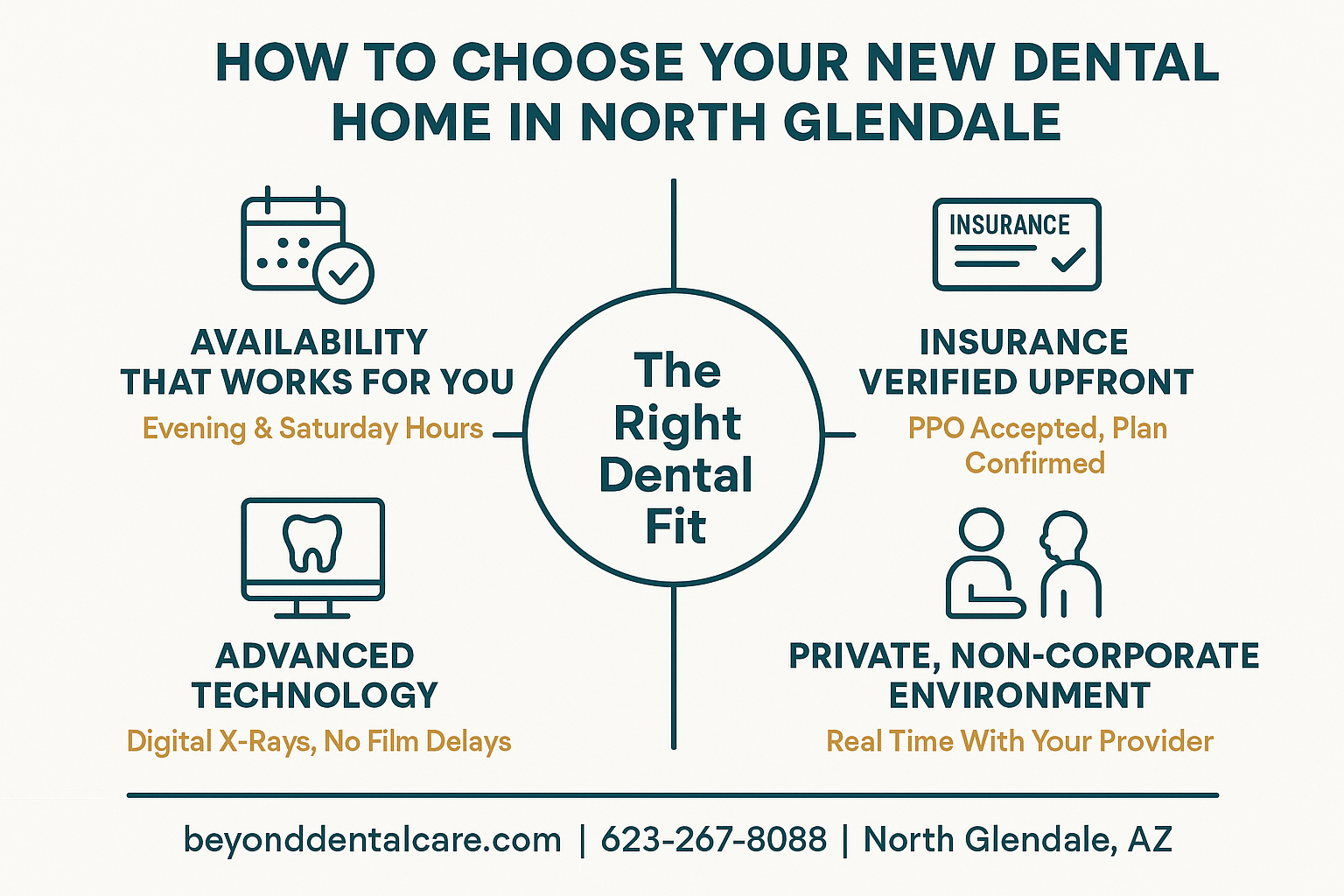
What Actually Separates One Dental Practice From Another
Once you’ve confirmed insurance and availability, the harder question is: what kind of practice do you actually want to be a patient at?
For people coming from Cibola Vista, Arrowhead Lakes, or North Canyon Ranch, the options in the Northwest Phoenix corridor range from large corporate dental chains to small private offices. The experience inside those two models is genuinely different.
Corporate dental offices tend to rotate providers, move patients quickly through appointments, and focus heavily on volume. That setup can work for a one-time cleaning, but it’s not well suited for someone who wants a provider who knows their history and takes time to explain what they’re seeing.
A private practice — one that is physician-owned and not managed by an outside corporate entity — operates differently. The dentist builds relationships with their patients over years, not appointments. Treatment recommendations come with explanations. And when something unexpected shows up on an X-ray, you’re not rushed out the door while someone else is already being seated.
Beyond that, look at the technology in the office. Digital X-rays reduce radiation exposure and produce images that can be reviewed instantly on screen — meaning the dentist can show you exactly what they’re seeing in real time. Practices that still use film-based X-rays are working with older systems that make record transfers slower and diagnostic review less precise.
For adults managing busy schedules in Stetson Hills or Norterra, evening availability matters more than most people realize. Missing a dental appointment because you can’t leave work early is one of the most common ways preventive care falls through the cracks — and skipping regular visits has real consequences that compound over time.
One other detail worth noting: comfort during appointments. Some practices have made intentional choices about the patient environment — small things like a calm atmosphere, staff who explain each step, and even comfort measures like an on-site therapy dog. These aren’t luxury add-ons. For patients who feel anxious about seeing a new dentist — which is very common — that experience of dental anxiety is real and worth planning around.
Private Practice vs. Corporate Dental Chain: A Side-by-Side Look
Not every difference between practice types is obvious from a website. This comparison covers what patients in the Northwest Phoenix area typically experience on both sides.
| Factor | Private Practice | Corporate Chain |
|---|---|---|
| Provider consistency | Same dentist at every visit | Rotating providers are common |
| Appointment pace | Time built in for questions | High-volume, faster turnover |
| Technology investment | Varies; often current and upgraded | Varies by chain and location |
| Insurance flexibility | Typically accepts multiple PPOs | May be limited to in-network only |
| Evening/weekend hours | Varies; some private offices offer both | Often limited to business hours |
| Treatment explanations | Usually part of the appointment | May be rushed or minimal |
| Record continuity | Full history with one provider | May not transfer between locations |
What Your First Appointment Should Actually Cover
A lot of people assume the first appointment at a new dentist is just a cleaning. It should be more than that.
A proper new patient visit — sometimes called a comprehensive dental exam — includes a review of your health history, updated X-rays if yours are outdated, a periodontal evaluation to assess gum health, an oral cancer screening, and a real conversation about anything the dentist finds.
The periodontal evaluation in particular is one that gets skipped more often than it should. If you haven’t had one recently, this overview of what a periodontal evaluation involves explains why it matters and what the measurements actually mean.
If your new practice is only offering a cleaning on the first visit without any exam component, that’s a sign they may not be approaching your care as a long-term relationship. A good first appointment sets a baseline — so everything that comes after it has context.
Frequently Asked Questions About Finding a New Dentist in North Glendale
How do I know if a dental office actually accepts my insurance plan?
Call the office directly and give them the full name of your plan — not just the insurance company. Ask whether they are in-network with your specific plan, because the same insurer often has multiple networks with different reimbursement rates. You can also call the member services number on the back of your insurance card and ask for a list of in-network providers near your zip code.
Do I need new X-rays when I switch dentists?
Not necessarily. If your previous X-rays are less than 12 months old and the images are diagnostically usable, a new practice may be able to work from those. Request that your old office transfer the digital files when you sign a records release. Your new dentist will decide during the exam whether updated images are needed.
What if I’m in the middle of treatment at my old dentist when I move?
Transfer your records as soon as possible and let the new office know what treatment was underway — whether it was a filling, a crown in progress, or something else. Any competent practice can pick up where the previous provider left off. Waiting too long to establish care mid-treatment can create gaps that make the situation more complicated.
How often should I be seen once I establish with a new dentist?
For most adults, twice a year covers preventive care well. But that’s not universal. Some patients with a history of gum disease or higher cavity risk need to be seen more frequently — this breakdown of how often adults should really see a dentist explains the reasoning behind different schedules.
Is it okay to ask about services like clear aligners or whitening at the first appointment?
Absolutely. A first comprehensive exam is the right time to bring up anything you’ve been thinking about — cosmetic improvements, alignment concerns, whatever is on your mind. The exam gives the dentist the information they need to tell you what’s realistic and in what order treatment would make sense.
What if I’m nervous about seeing a new dentist for the first time?
That’s more common than most people admit. A good practice will give you time to explain your concerns before anything starts. Choosing a private office with a calm environment — rather than a high-volume chain — tends to make a measurable difference. Some practices also have comfort measures in place specifically for anxious patients.
Ready to Establish Care in the Northwest Phoenix Area?
Beyond Dental Care is a private practice located at 6615 W. Happy Valley Rd, Suite B103-104 in Glendale, AZ, serving patients from North Glendale, Arrowhead Ranch, Stetson Valley, Norterra, Vistancia, and the broader Upper West Side Phoenix corridor. Dr. Dariene Lazore, DMD, and the team are currently welcoming new adult and teen patients, with evening and Saturday appointments available for working schedules. If you’ve recently relocated or your insurance just changed, you can call 623-267-8088 or visit beyonddentalcare.com to ask about availability and confirm your plan is accepted before booking.