
So, you're wondering how long a dental filling takes? It’s a great question. Most of the time, you can expect to be in and out of the dentist's chair in between 20 to 60 minutes for a normal filling. The exact time really comes down to how big your cavity is and which tooth needs fixing.
Your Quick Answer to Dental Filling Times
Think of a cavity like a small pothole in your tooth that needs a smooth repair. A dental filling does just that. It patches up the hole to protect the tooth from more trouble. But just like every pothole is different, so is every cavity. That's why the time it takes can change.
A couple of key things affect how long your appointment will be. The biggest factors are how big the cavity is and where it is in your mouth. Fixing a small spot on an easy-to-reach front tooth is a much quicker job than fixing a larger area on a molar in the back. Those back teeth are simply harder to see and work on, so they need a bit more time and care from your dentist.
Understanding the Timeline
Most fillings are finished somewhere between 20 minutes and one hour. The size and spot of the decay are what really decide the schedule. Small, simple cavities might only take 20-30 minutes. A medium-sized one could need about 30-45 minutes. For larger cavities, you might be looking at 45-60 minutes or even a little longer.
Let’s break it down to give you a clearer idea:
- Small Cavities: These are the fastest fixes. You’ll likely be done in about 20-30 minutes.
- Medium Cavities: For a slightly larger area of decay, your visit might last around 30-45 minutes.
- Large Cavities: When there's more decay, your dentist needs more time to clean and fix the tooth. This can make the appointment last 45-60 minutes.
To help you see this, we've put together a handy table.
Estimated Time for Your Dental Filling
This table shows about how long your appointment might be based on the cavity's size and where it is.
| Cavity Size | Tooth Location | Estimated Time |
|---|---|---|
| Small | Front Tooth | 20-30 minutes |
| Small | Molar (Back Tooth) | 30-40 minutes |
| Medium | Front Tooth | 30-40 minutes |
| Medium | Molar (Back Tooth) | 40-50 minutes |
| Large | Front Tooth | 45-55 minutes |
| Large | Molar (Back Tooth) | 50-60+ minutes |
Remember, these are just estimates! Every case is different. But this should give you a good idea so you can plan your day without surprises. If you want to learn more, you can explore more about how dentists estimate procedure times and see why this changes.
A Simple Walkthrough of the Filling Process
Ever wonder what’s really happening in your mouth during a filling? Thinking about the process step-by-step can make the whole thing feel less scary and a lot easier. The procedure is like a skilled mechanic fixing a tiny pothole—carefully cleaning it out and patching it up so it’s smooth and strong again.
Understanding what happens during your 20 to 60-minute appointment helps take the mystery out of your visit. This simple flow shows your journey from check-in to a fixed smile.
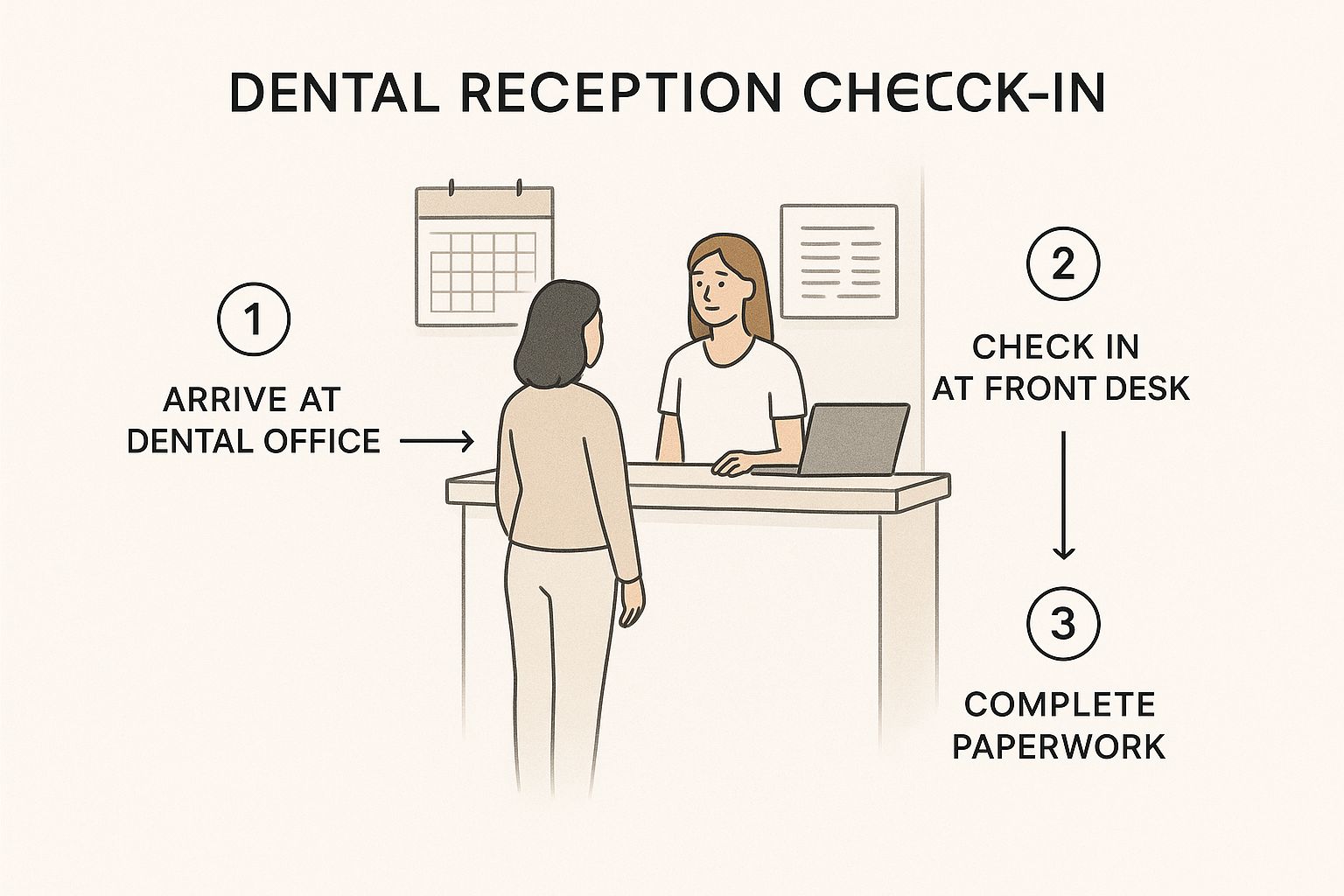
This image shows that a calm, organized room is the first step to a successful and easy dental appointment.
From Numbing to Polishing
Fixing your tooth follows a few clear, simple steps. Your comfort is always the most important thing, so your dentist won't start until you're completely ready.
-
Getting the Area Numb: First, your dentist will use a local anesthetic to numb the tooth and the gums around it. This makes sure you won't feel any pain, only some light pressure from the tools.
-
Cleaning Out the Decay: Once the area is numb, the dentist uses a small drill and other tools to gently remove the decayed part of the tooth. This step is key to stopping a cavity from getting worse.
-
Preparing the Tooth: After all the decay is gone, the tooth is cleaned and prepared for its new filling. The surface is shaped just right so the filling material will stick securely.
-
Placing and Shaping the Filling: Next, the dentist carefully puts the filling material into the prepared space. For composite (tooth-colored) fillings, it’s put on in layers. Each layer is hardened with a special blue light.
-
The Final Polish: The very last step is to shape and polish the new filling. Your dentist will check your bite to make sure it feels comfortable and natural. The goal is for the filling to blend in so well you forget it's even there.
By breaking down the process into these steps, you can see that everything has a clear purpose. It’s a careful, step-by-step repair designed to get your tooth healthy again quickly and well.
Knowing what to expect can also help you talk to your dental team. If you're looking for a team that puts patient comfort and clear talk first, you can learn more about the great dental filling services in Glendale, AZ that focus on a gentle, patient-first style.
What Makes Your Filling Appointment Longer or Shorter
Not every dental filling appointment takes the same amount of time, and that's a good thing. Some road repairs are quick patches, while others need more work. In the same way, the details of your tooth will decide how long your dental filling takes. Several key factors help your dentist plan a timeline that’s made just for you.
Think of it this way—your appointment is custom-made for what your tooth needs. A tiny cavity is a much simpler fix than one that’s been growing for a while. That naturally changes your time in the chair.
Cavity Size and Depth
The biggest factor in your appointment time is the size and depth of the cavity. If we find a small, shallow spot of decay on the tooth's surface, it's pretty easy to clean out and fill. This kind of repair is often quick, usually taking around 20-30 minutes.
On the other hand, if a cavity is deep or has spread wide across the tooth, your dentist needs to be more careful. They have to remove all the decay without hurting the tooth’s structure. A larger area simply needs more material and more time to shape and polish, which can make the appointment longer.
A larger filling is like fixing a bigger piece of a puzzle. It needs more attention to detail to make sure it fits perfectly and works right. That's why your dentist takes the time to get it just right.
Location of the Tooth
Where the damaged tooth is in your mouth plays a big role. A cavity on one of your front teeth is usually much easier for the dentist to see and reach. This clear view allows for a quicker, more efficient procedure.
Molars, those big teeth in the back, are a different story. Their location makes them harder to reach and see clearly. Working on these teeth requires more care and precision. This often makes the appointment time longer to make sure the job is done perfectly.
The Number of Fillings
It probably goes without saying, but the number of fillings you get in one visit will affect the total time. If you have a few small cavities in the same part of your mouth, it’s often much easier to fix them all at once. This saves you from having to make multiple trips back to the office.
While doing multiple fillings at once will make the appointment longer, it’s almost always faster than scheduling separate visits for each one. Your dentist can numb the whole area at once and work on the teeth one after another, which really smoothes out the process for you.
How Filling Materials Affect Your Appointment Time
The type of material used to fix your tooth isn’t just about how it looks. It’s a big factor in how long your dental filling takes. It’s a bit like choosing paint for a wall. Some paints dry very fast, while others need more time and care. The same idea is true for dental fillings.
Not all materials are put in and set the same way. This directly affects your time in the dental chair. Knowing a little about the options helps you understand the process and talk with your dentist about what’s best for your tooth and your schedule. This is a key part of understanding restorative dentistry and how we make your smile healthy again.

Comparing Common Filling Types
The two most common materials you'll hear about—composite resin and amalgam—are applied in very different ways. These differences are the main reason one appointment might be a bit longer than another.
-
Composite Resin (Tooth-Colored Fillings): This popular material is matched to the color of your natural teeth. Your dentist puts it on in thin layers, like an artist painting. After each layer, a special blue light is used to harden it instantly. This process can add a few extra minutes but gives you that natural look.
-
Amalgam (Silver Fillings): Amalgam is a very strong and lasting metal mix. It’s mixed and then packed into the prepared tooth all at once. Unlike composite, it doesn't need to be layered or hardened with a light. This can sometimes make the placement part of the appointment a bit faster.
The choice of material is always a balance between looks, strength, and how long the procedure takes. A composite filling might take a little longer to place, but most people like it for its natural look, especially on teeth that show when you smile.
The setting time for different materials also changes. For example, composite and ceramic fillings are hardened with a special light in just seconds for each layer. Amalgam fillings, on the other hand, take about 24 hours to get to their full strength after you leave the office. You can find more about these material differences on Healthline.com and see how they let dentists customize your treatment.
Modern Tools That Make Fillings Faster
If it’s been a while since your last dental visit, you might be surprised by how much has changed. Modern dentistry is always improving to make treatments like fillings quicker and more comfortable. The tools and methods used today are a huge part of that. They have a direct impact on how long a dental filling takes—often shortening your time in the chair.
One of the biggest improvements is how we find cavities. With tools like digital X-rays and tiny cameras, we can spot decay much earlier than before. Catching a cavity when it’s small means the fix is simpler, faster, and easier on you. If you've been wondering if that little spot on your tooth is a problem, it's always best to get it checked. Our guide can help you understand the early signs if you think you have a cavity.
Faster Filling Techniques
It’s not just about finding cavities sooner; the materials we use to fill them have gotten a major upgrade, too. Dentists now have "bulk-fill" composites, which are a real game-changer, especially for larger fillings. In the past, the filling material had to be put on in many thin, separate layers, which took time. These new composites, however, can be placed in larger, single amounts.
This new way cuts down on the procedure time without losing quality. In fact, studies have shown this method can reduce the total procedure time by nearly 60% while also creating a better, smoother final surface. You can learn more about how these materials speed up dental fillings on latimes.com.
These modern tools and materials all work together to create a much better experience. The goal is simple: fix your tooth's health as well as possible while being mindful of your time and comfort.
What to Expect After Your Appointment Ends
Alright, the hard part is over! Once your new filling is perfectly in place and you're out of the chair, the recovery process begins. It's a pretty easy ride, but there are a few things to keep in mind.
For the next few hours, you’ll probably notice your cheek, tongue, and gums feel pretty numb from the anesthetic. This is totally normal and usually wears off within 2 to 4 hours. Just be a little careful not to accidentally bite the inside of your cheek or tongue while you can't feel it—it happens more often than you'd think!

It’s also common to have some mild tooth sensitivity for a day or two. You might feel a little sting when you eat or drink something hot or cold. This is just your tooth getting used to its new filling, and that feeling should go away on its own pretty quickly.
Eating and Drinking After Your Filling
The big question: when can you eat? The answer really depends on what kind of filling you got.
- Composite (tooth-colored) fillings: These are the modern white fillings that are hardened instantly with a special blue light. That means as soon as the numbness is gone, you're good to go.
- Amalgam (silver) fillings: These older fillings need a bit more time to fully harden. It's best to avoid chewing on that side of your mouth for about 24 hours to let it set properly.
No matter which type of filling you have, it's a good idea to start with soft foods like yogurt, soup, or a smoothie. This helps you avoid putting too much pressure on the new filling right away.
A smooth, comfortable recovery is a huge part of the whole experience. The care you get during and after your visit makes all the difference. That's why it really helps to know how to choose a great dentist who puts your comfort first from start to finish.
Common Questions About Dental Fillings
It’s completely normal to have a few questions before any dental appointment. Getting clear answers can make all the difference, helping you walk into your visit feeling relaxed and ready. Let’s go over some of the most common things people ask about dental fillings.
Does Getting a Dental Filling Hurt?
The short answer is no, getting a filling shouldn’t hurt at all. Your comfort is the first priority. So, the very first thing the dentist does is numb the tooth and the entire area around it.
You might feel some light pressure or the vibrations from the tools, but you won't feel any pain during the procedure itself. Once the numbness wears off later, it’s common to have a little soreness or sensitivity, but that feeling goes away very quickly.
Can I Get More Than One Filling at Once?
Yes, you definitely can. If you have a couple of cavities in the same part of your mouth, it’s actually easier for the dentist to take care of them all in a single appointment. This approach saves you from having to schedule multiple trips to the office.
Of course, the visit will take a bit longer than it would for just one filling. Your dentist will always make a plan with you beforehand, so you know exactly what to expect.
Fixing multiple fillings in one session is a great way to make your dental care easier. Your dentist can numb the whole area just once and work on each tooth, making the process smoother for you.
How Long Should I Wait to Eat After My Filling?
That depends on the type of material used for your filling.
- Tooth-colored composite fillings are set instantly with a special blue light right in the chair. You can eat and drink as soon as the numbness wears off.
- Silver amalgam fillings need a little more time to fully harden. It’s best to avoid chewing on that side of your mouth for about 24 hours to let the material get to its full strength.
Your dentist will give you specific, easy-to-follow instructions based on your procedure before you leave.
At Beyond Dental Care, we believe that a patient with information is a comfortable patient. If you have more questions or you’re ready to book an appointment, our team is here to provide the excellent, patient-first care you deserve. Visit us online to learn more.