
Direct Answer: Teeth shift back because bone and gum fibers need months to settle around new positions. Wearing a retainer after clear aligner treatment, for years and not weeks, is what holds the result.
A patient sent us a message through the website that I think about often. Paraphrased and anonymized, it read: “I am starting the last week of my aligners. Do I need to make an appointment to go over what I need to do after next week?”
That is one of the most useful questions a person can ask, and it almost never gets answered clearly online. People spend months focused on the result, then reach the final tray with no plan for the week that follows.
I want to fix that here. This is about retainers after clear aligner treatment: why teeth drift, how the retainer options actually compare, and what the finish line looks like for patients across North Glendale, Stetson Valley, and Norterra.
Retention Is the Last Phase of Treatment, Not an Accessory
Here is the part that surprises people. Moving teeth is the shorter half of the job. Holding them is the longer half, and it starts the day the last tray comes out.
When a tooth moves, the bone and the gum fibers around it do not move at the same speed. The tooth arrives at its new spot first. The periodontal ligament, the surrounding bone, and the elastic gum fibers spend months reorganizing behind it.
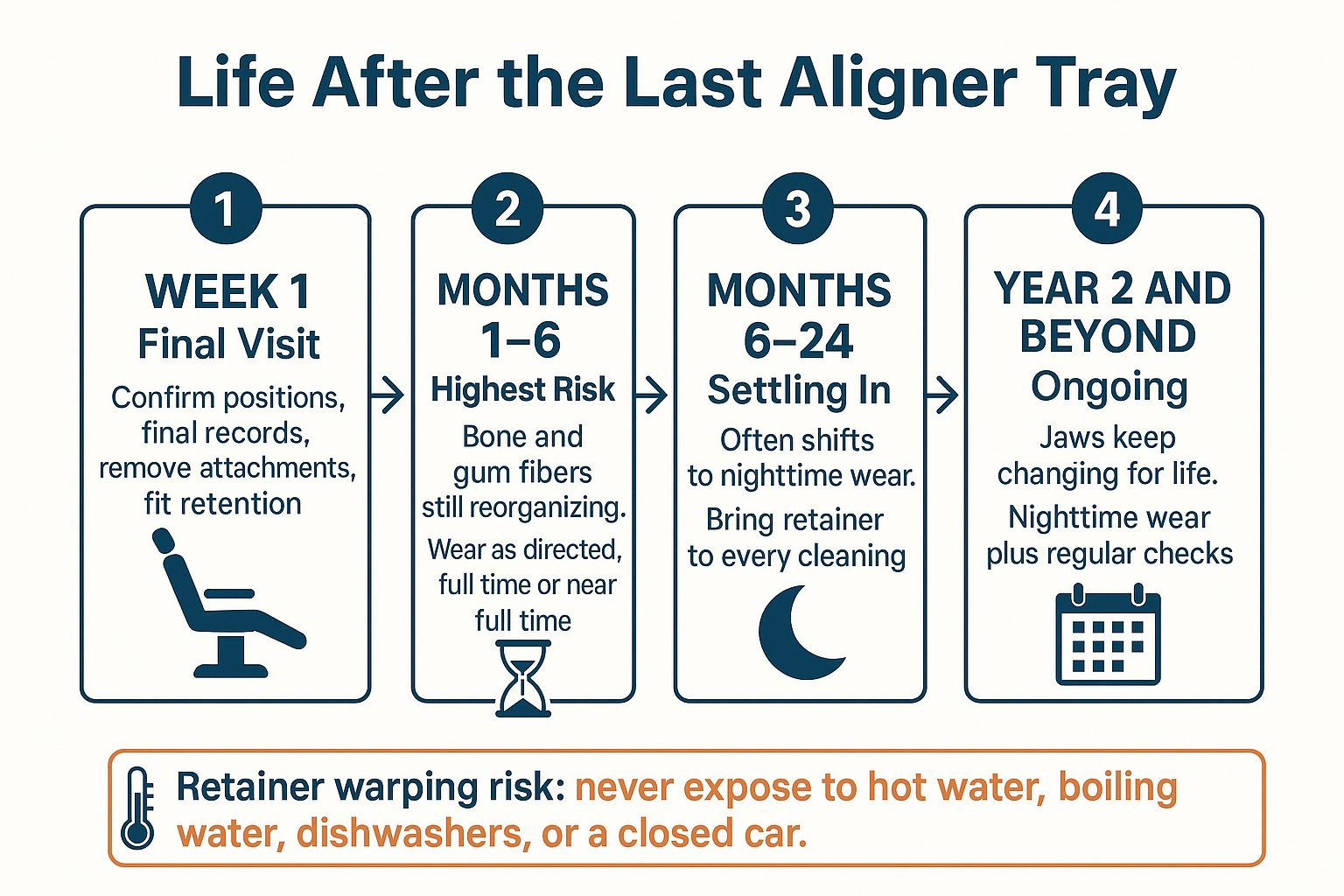
That lag is why the first six to twelve months after your final tray are the highest risk window. The teeth are in place, but the support around them has not caught up yet.
There is also a second, slower force that never stops. Jaws keep changing across a lifetime, which is why lower front teeth crowd in people who never had orthodontic care at all.
So when I talk about retention, I am talking about two different jobs:
- Short term: giving tissue and bone time to stabilize around the new positions
- Long term: offsetting the normal drift that happens to everyone with age
- Ongoing: catching small movement early, before it becomes visible in the mirror
A Cochrane review of orthodontic retention strategies is blunt about it: without a retention phase, teeth tend to migrate back toward where they started, and stability depends on wearing retention over a long period. Nearly everyone who finishes orthodontic treatment needs some form of it.
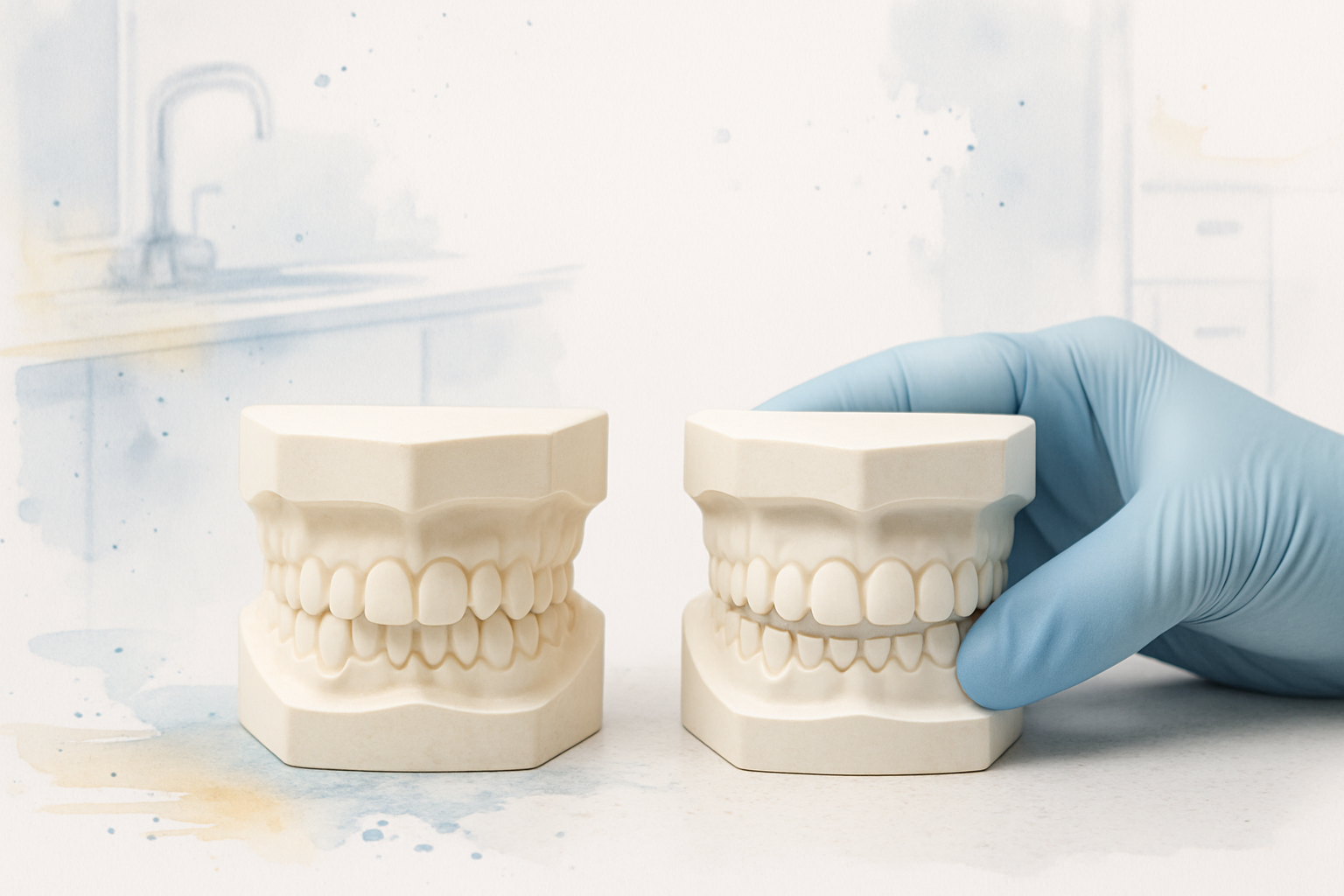
The Retainer Options, Compared Honestly
There is no single best retainer. There is a best fit for how a specific person lives, and I would rather explain the trade-offs than declare a winner.
Clear removable retainers look almost identical to the aligners you just finished. They are nearly invisible and easy to live with, and they work exactly as well as you wear them. Compliance is the whole story.
Hawley style retainers use an acrylic body with a visible wire across the front. They are tougher, they last longer, and some patients simply do not want the wire showing.
Bonded retainers are a thin wire cemented behind the front teeth. They work around the clock with zero compliance required, which is a real advantage for teens.
One comparison of retention protocols found fixed retainers held tooth positions better than removable Hawley or clear designs. But bonded wires are not a set-and-forget solution. They can allow small unwanted movement, and they can debond quietly without the patient noticing.
That is why I check bonded wires at routine cleanings. A wire that popped loose three months ago has already given teeth three months to wander.
Retainer Types at a Glance
Use this to frame the conversation, not to make the decision alone. Your bite, your history, and your habits all shift the answer.
| Retainer Type | How It Works | Main Trade-Off |
|---|---|---|
| Clear removable | Thin transparent tray worn on a set schedule, usually full time at first, then nights | Only works if you actually wear it, and it can be lost or warped |
| Hawley style | Acrylic plate with a visible wire arch across the front teeth | More durable and adjustable, but noticeably more visible |
| Bonded wire | Thin wire cemented behind the front teeth, in place 24 hours a day | No compliance needed, but can debond quietly and needs regular checks |
| Combination | Bonded wire on the lower front teeth plus a removable retainer on top | Two things to maintain, but covers both arches well |
Retainer Care in a Phoenix Summer Is Not a Small Detail
This is where living in the Valley genuinely changes the advice. A clear retainer is thermoplastic, which means heat reshapes it.
A retainer left on a dashboard or in a closed car off Happy Valley Road in July will warp. Once the shape is off, the fit is off, and a poorly fitting retainer either stops holding or starts pushing.
The same rule applies to cleaning:
- No hot water. Rinse and clean with cool or lukewarm water only.
- Never boil it to sanitize it. That destroys the fit.
- Never put it in the dishwasher. Heat plus detergent ruins the plastic.
- Do not wrap it in a napkin at a restaurant. That is the single most common way retainers get thrown away.
I tell patients to keep the case in a bag or a pocket, not a cup holder. If a retainer suddenly feels tight after a week away, that is worth a call rather than forcing it.
What the First Two Years of Retention Look Like
Here is the general arc most patients follow after the last tray, so you can picture the commitment before you get there.
What the Finish Line Looks Like With CandidPro Clear Aligners
CandidPro treatment runs largely on remote check ins through the ProMonitoring app. You scan from your kitchen, the plan gets reviewed, and you come in far less than traditional orthodontics would require.
That rhythm is convenient. It also creates the exact confusion behind the message I quoted at the top, because patients get used to not coming in and are not sure whether the end involves a visit at all.
It does. A final appointment is short but it does real work:
- Confirming the teeth landed where the plan actually intended, not just close to it
- Final records so there is a documented endpoint to compare against later
- Removing any attachments still bonded to the teeth
- Fitting retention before there is time for movement to start
That last point is the one I would underline. Retention fitted the same week the last tray comes out is far easier than retention fitted a month later, after teeth have already begun to settle backward.
Timing matters for teens especially. If your teenager wraps up over the summer, remember that Glendale Union High School District classes start August 10, 2026. Setting the wear routine before the school schedule takes over is worth doing deliberately. If you are still weighing treatment for a teen versus an adult in the household, the differences in the process are worth reading about first, and adults over 60 are candidates more often than they expect.
Whitening After Alignment: Why Order Matters
This question comes up at almost every finish appointment. Straighten first, whiten second, and there are real reasons for that order.
Newly aligned teeth are exposed to light and stain differently than they were when they overlapped. Surfaces that were hidden for years are now visible, and they may not match the shade of the rest.
A professional whitening plan built around the finished positions is simply more predictable than one built around the old ones. One parent put it plainly in a review: “Wonderful place, took my daughter to straighten her teeth. The doctor is the best of the best, even helped my daughter whiten her teeth after taking off her braces” – Welmo.
Two details that trip people up:
- Whitening trays and retainers are not the same appliance. They are made for different jobs and should not be swapped.
- Crowns, bonding, and tooth colored fillings do not lighten the way natural enamel does. That gap is the most common source of disappointment, and it is worth understanding before you start.
If you are deciding between approaches, the difference between in-office and take-home whitening results is mostly about concentration, supervision, and how long the result holds.
Frequently Asked Questions About Retainers After Clear Aligners
How long do I have to wear my retainer?
Honestly, indefinitely. Most people wear it full time or near full time for the first several months, then move to nights. Jaws keep changing across a lifetime, so nighttime wear is a long-term habit, not a phase you graduate from.
Can I just keep wearing my last aligner tray as a retainer?
It is not built for that. Aligner trays are made to apply force and move teeth, and the plastic is thinner and wears through faster. A retainer is made to hold, not push, and it is built for daily use over years.
What if I stopped wearing mine and now it feels tight?
Do not force it. Tightness means teeth have already moved, and jamming a retainer back in can cause soreness or damage. Bring it in and let us look. Sometimes a new retainer solves it, and sometimes a short round of movement is needed first.
How much does a replacement retainer cost?
It depends on the type, whether one arch or both are involved, and whether records need updating. Retainer costs vary widely across the Phoenix market, so call the office at 623-267-8088 for an exact number rather than working from a general range.
Do I need to bring my retainer to my cleanings?
Yes, every time. It takes about thirty seconds to check the fit, and it is the easiest way to catch a warped retainer or a bonded wire that has quietly come loose.
Thinking About What Comes After Your Last Tray?
Retention only works when someone is checking it year after year, at the same visits where we already look at your gums and cleanings. Dr. Dariene Lazore, DMD reviews every CandidPro plan alongside a licensed orthodontist, and evening hours Monday through Thursday make a quick retainer check realistic for adults commuting off Happy Valley Road. If you have questions about where you stand, our office is at 623-267-8088 or beyonddentalcare.com.