
Direct Answer: The choice between a crown and a filling depends on how much healthy tooth structure remains. If less than roughly half of the tooth is intact, a filling is usually not strong enough to hold.
One of the most common questions patients ask before sitting down in the chair is some version of this: ‘Do I really need a crown, or can you just fill it?’ It is a fair question, and it deserves a straight answer rather than a vague explanation about insurance or treatment codes.
Patients across North Glendale, Arrowhead Ranch, and Stetson Valley ask this regularly, and the honest answer is that it is a clinical decision, not a preference. The choice hinges on how much healthy tooth structure remains after damage or decay is removed, and whether what is left can hold a restoration under the daily forces of biting and chewing.
This article walks through how that call gets made, what each option actually does inside the mouth, and why waiting to decide can sometimes cost more than acting on a recommendation early.
When a Filling Is the Right Call
A filling works when the cavity or damage is small to moderate and the surrounding tooth walls are still thick and strong enough to support the restoration. The walls of the tooth carry the load every time you bite down, so their condition matters as much as the size of the decay itself.
Tooth-colored composite fillings are placed in a single visit. They bond directly to the remaining tooth surface and blend naturally with the surrounding enamel, which is why most patients in North Peoria and Norterra prefer them over older silver-colored options. If you have older metal restorations, the article on silver fillings aging over time explains what to watch for as they age.
Fillings generally last 5 to 15 years depending on the material used, where the tooth sits in the mouth, and how much bite pressure that area takes. Back molars see far more force than front teeth, so a filling in a molar often has a shorter lifespan than one placed on a premolar.
But there is a threshold where a filling stops being a good answer. When decay has consumed more than roughly half of the tooth’s width, or when the remaining walls are already thin and showing early cracks, placing a filling can actually make things worse. A filling packed into a structurally weak tooth acts like a wedge. Over time, it concentrates stress at the thin walls and increases the risk of those walls splitting apart.
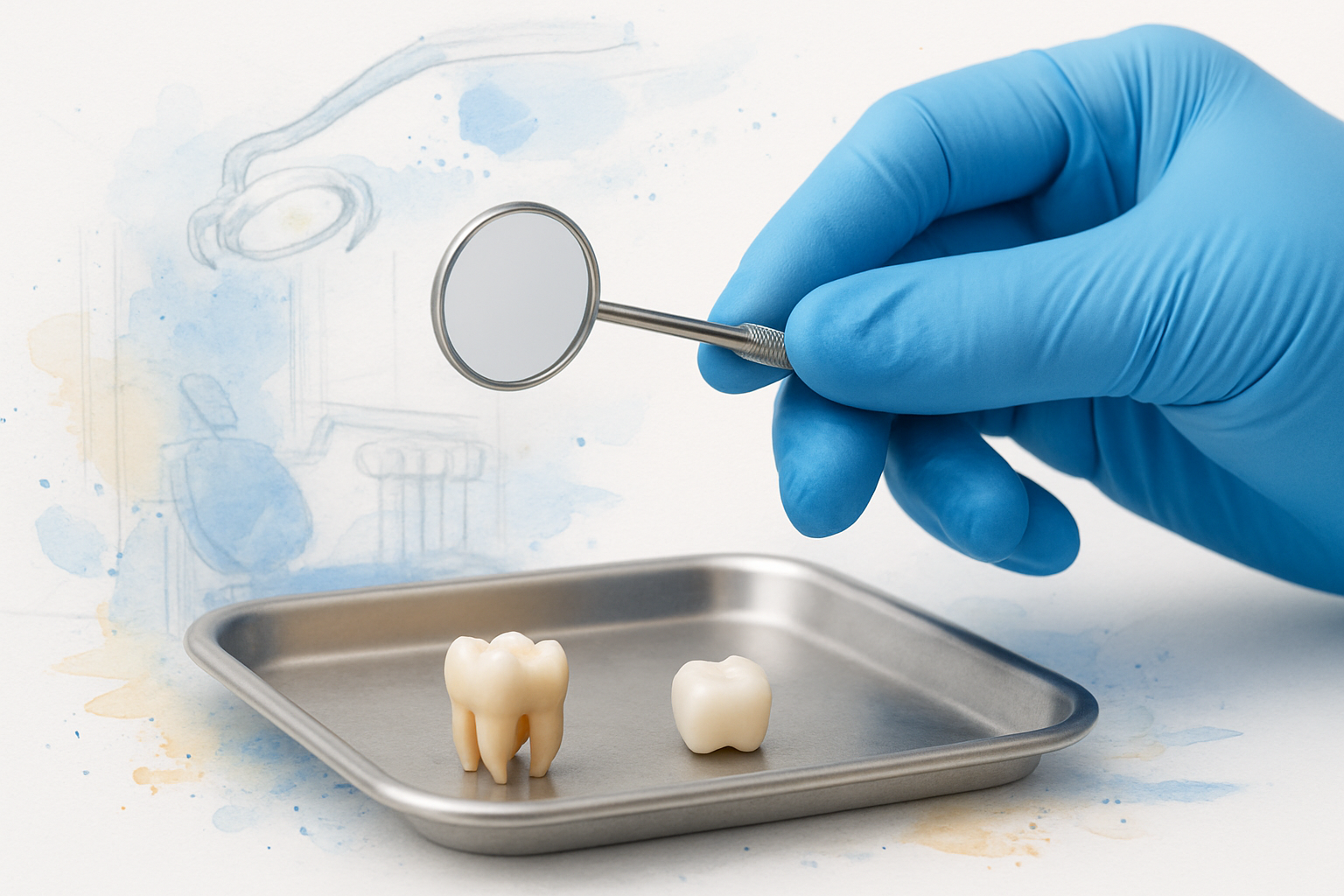
When a Crown Becomes Necessary
A crown wraps around the remaining tooth structure like a protective cap. Rather than filling a void inside the tooth, it redistributes bite forces across the full outer surface, which takes pressure off the weakened walls entirely.
There are several specific situations where a crown is the right answer rather than a larger filling:
- A deep crack that runs down the tooth wall, which a filling cannot stabilize
- A previous large filling that has failed or developed new decay along its margins
- A tooth that has lost more than roughly half its original width to decay or fracture
- After root canal therapy on a back tooth, because removing the pulp leaves the tooth more brittle and prone to splitting under chewing pressure
Root canal situations deserve a specific note. Once the nerve tissue is removed from a molar or premolar, the tooth loses much of its internal moisture and becomes significantly more fragile. The American Dental Association notes that crowning a posterior tooth following root canal therapy is standard of care precisely because an uncrowned tooth is at high risk of fracture. A crown after root canal is not upselling. It is completing the treatment.
Crowns typically last 10 to 15 years or longer with proper home care and regular professional cleanings. The longevity depends on fit, bite alignment, and whether the patient grinds their teeth at night.
Filling vs. Crown: A Side-by-Side Look
The differences between fillings and crowns go beyond just cost. Here is a quick comparison of what matters most when evaluating which restoration fits your situation.
| Factor | Tooth-Colored Filling | Dental Crown |
|---|---|---|
| Best for | Small to moderate decay with strong surrounding walls | Large decay, cracks, failed fillings, or post-root canal teeth |
| How it works | Bonds inside the cavity; walls support the restoration | Wraps the entire visible tooth; crown carries the load |
| Typical lifespan | 5 to 15 years depending on location and material | 10 to 15 years or longer with proper care |
| Number of visits | Usually one visit | Typically two visits with a temporary in between |
| Cost range | Generally lower; varies by tooth location and size | Higher; varies by material, tooth, and insurance coverage |
| Risk if delayed | Decay can spread; walls may crack | Tooth may fracture beyond repair, requiring extraction |
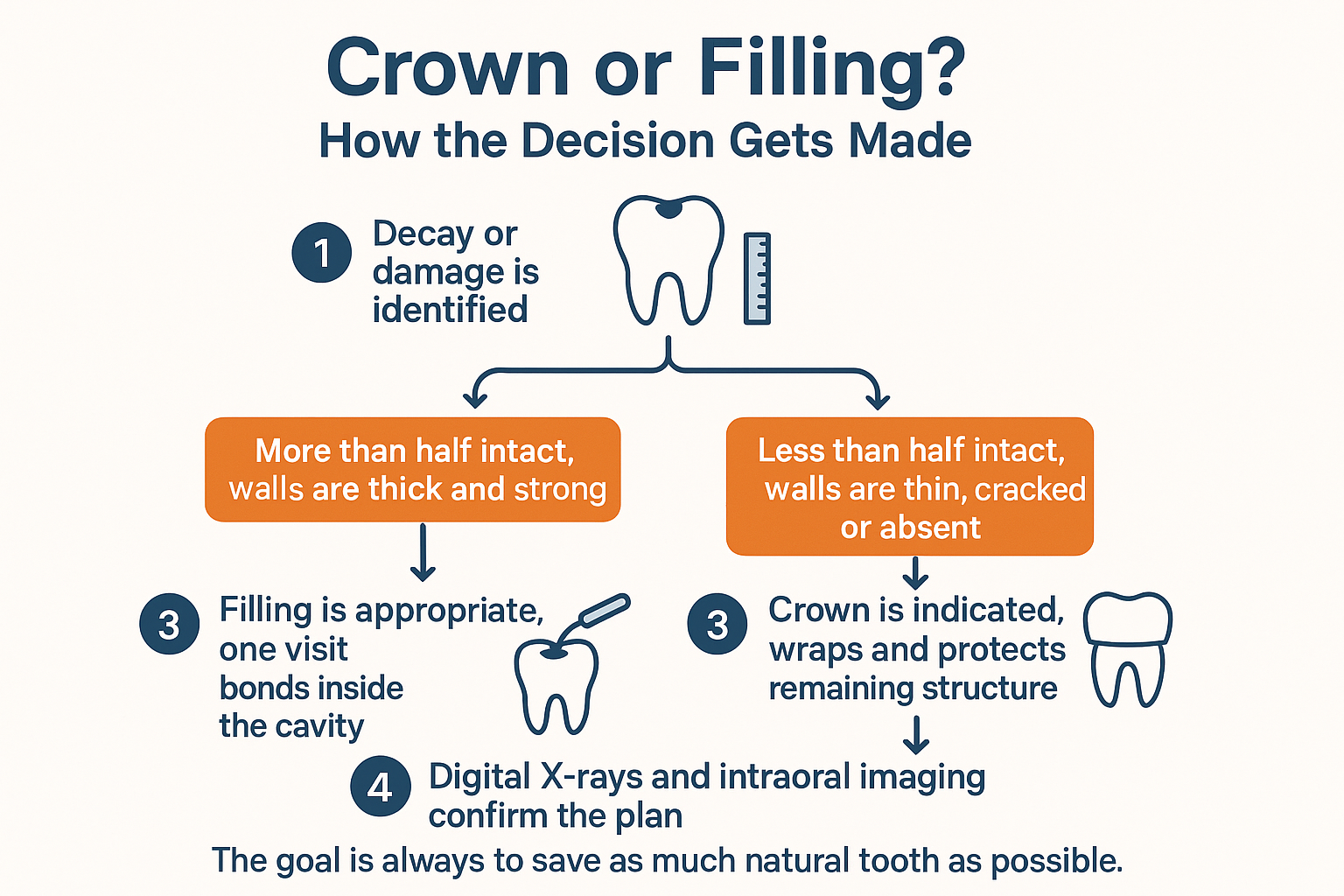
The Clinical Decision Path: Filling or Crown?
This infographic traces the key questions a dentist works through when evaluating whether a tooth needs a filling or a crown.
What Waiting Usually Costs
Patients in Cibola Vista and Stetson Hills sometimes leave an appointment with a crown recommendation and decide to wait a few months to think it over. That is understandable. Crowns are a bigger investment, and nobody wants to spend money they are not sure they need to spend.
But waiting has a pattern. A tooth that already has thinned walls or a developing crack does not stay stable. Bite forces work on it every day. Within a few months, that tooth may crack further, or the old filling underneath may allow decay to spread to the root. At that point, the conversation shifts from ‘crown’ to ‘crown plus root canal’ or, in the worst cases, ‘extraction and implant.’
If you want to understand what implant costs look like when a tooth cannot be saved, the article on what really drives the price of a dental implant breaks that down clearly. The short version is that replacing a tooth is almost always more involved and more costly than saving one. And that is not a scare tactic. It is just the math.
A dentist recommending a crown when structure genuinely requires it is not pushing unnecessary treatment. A dentist recommending a conservative filling when that is all the tooth needs is equally important. Both decisions serve the same goal: keeping the tooth functional for as long as possible.
How Imaging Changes the Conversation
One reason patients sometimes feel uncertain about a crown recommendation is that they cannot see what the dentist is seeing. That is a real problem, and it is worth addressing directly.
At Beyond Dental Care, digital X-rays and intraoral imaging are part of every evaluation. Dr. Dariene Lazore, DMD, uses these tools to show patients the actual condition of their tooth on-screen before recommending a course of treatment. Multiple reviewers have cited this approach specifically, with one patient noting she received ‘the risk and benefits of each and costs up front with no pressure.’
When a patient can see the crack running along a tooth wall, or the shadow beneath an old filling that signals decay at the margin, the recommendation makes sense immediately. It is not guesswork. It is a clinical finding with visual evidence behind it.
This also matters for patients who are coming back to the dentist after a long gap. Teeth that have gone years without an evaluation often have multiple issues developing quietly. Seeing those findings on-screen at the start of a visit makes the treatment plan feel collaborative rather than handed down.
If you want to understand what a thorough evaluation actually involves before any treatment is recommended, the article on what happens at a comprehensive dental exam walks through the full process.
Frequently Asked Questions About Crowns and Fillings
My tooth doesn’t hurt. Do I still need a crown?
Yes, in many cases. A tooth can have a significant crack or deep decay without causing pain until the nerve becomes involved. By the time a tooth hurts consistently, the damage is often more advanced. Pain is not a reliable gauge of how much structure remains.
Can a crown be placed over an existing filling?
It depends on how much natural tooth structure is left beneath that filling. If the remaining walls are still solid, a crown can be placed over what is there. If decay has developed under the old filling or the walls have thinned, the dentist may need to address that before placing the crown. The imaging done at your exam will clarify what is actually underneath.
How long does it take to get a crown placed?
Typically two visits. The first appointment involves removing decay, shaping the tooth, taking impressions or a digital scan, and placing a temporary crown. The second visit, usually a few weeks later, seats the permanent crown. You leave the first visit with a functioning temporary so the tooth is protected in between.
Is a crown always needed after a root canal?
For back teeth, yes, almost always. Molars and premolars take the heaviest bite forces in the mouth. Removing the pulp leaves those teeth significantly more brittle, and an uncrowned molar is at real risk of fracturing under normal chewing. Front teeth that have had root canals are sometimes an exception, but that decision is made case by case based on how much tooth structure remains.
What if my dentist recommends a crown but I only want a filling?
That is worth a conversation, not a standoff. Ask the dentist to show you the imaging and explain specifically why a filling is not sufficient. A dentist who can walk you through the structural reasoning on-screen is giving you the information you need to make a real decision. If the remaining walls are genuinely too thin to support a filling, placing one anyway increases the risk of the tooth fracturing later, which usually leads to a more involved repair.
Have a Tooth That Needs a Closer Look?
If you have been told you may need a crown, or if an old filling has been bothering you, the clearest next step is an evaluation with imaging so you can actually see what is happening. Beyond Dental Care serves patients across North Glendale, Arrowhead Ranch, Stetson Valley, Norterra, and the surrounding Upper West Side Phoenix corridor, with evening and Saturday appointments available for busy schedules. Call 623-267-8088 or visit beyonddentalcare.com to schedule your visit with Dr. Dariene Lazore, DMD.