
Direct Answer: A return dental visit after a long gap starts with updated X-rays, a periodontal evaluation, and an exam before any cleaning — giving your dentist a clear picture of where things stand so they can build a realistic plan forward.
The most common thing people say when they call a dental office to book a new patient appointment isn’t about tooth pain or a broken filling. It’s some version of: ‘I haven’t been in a while.’ That one phrase covers a lot of ground — a year, three years, sometimes longer — and the person saying it is usually not in crisis. They’re just ready to get back on track.
If that’s where you are right now, this article is written specifically for you. Not because something is wrong, but because the uncertainty of not knowing what you’re walking into is often what keeps people from making the call in the first place. What actually happens at that visit? Will anyone make you feel bad about the gap? What if the news isn’t good?
Those are fair questions. And the answers are more reassuring than most people expect. Arizona ranked 43rd in the country for dental visit rates in 2024, with only about 63% of adults reporting a dental visit in the past year — compared to 67.5% nationally. The gap in your dental history is far more common than you think, especially across the Northwest Phoenix suburbs where busy schedules and stretched calendars make it easy for months to quietly become years.
The Judgment You’re Anticipating Probably Won’t Come
One of the biggest fears people carry into a return visit — bigger than pain, bigger than cost — is the fear of being made to feel bad. Patients who’ve described this anxiety online often use words like shame or embarrassed before their first return appointment. And almost every single one of them reports afterward that it wasn’t like that at all.
A dental office that works with adults all day, every day, has seen every kind of gap. A six-month lapse, a two-year lapse, a decade-long gap following a difficult life period — none of it is unusual, and none of it warrants a lecture. What a good clinician actually cares about is where things stand right now, not why you weren’t here sooner.
That shift in framing matters. The clinical team’s job is to build an accurate picture of your oral health so they can give you useful guidance. The exam, X-rays, and periodontal screening that start a return visit aren’t there to document your absence — they’re there because the dentist genuinely cannot make good recommendations without that baseline information. Why people feel nervous about seeing a new dentist covers this dynamic in more detail if the anxiety piece feels familiar.
What the Visit Actually Looks Like, Step by Step
For someone returning after 18 months or more, a first visit follows a specific clinical sequence that’s worth knowing ahead of time. Understanding the order of events makes it feel far less like something being done to you and more like a process with a clear purpose.
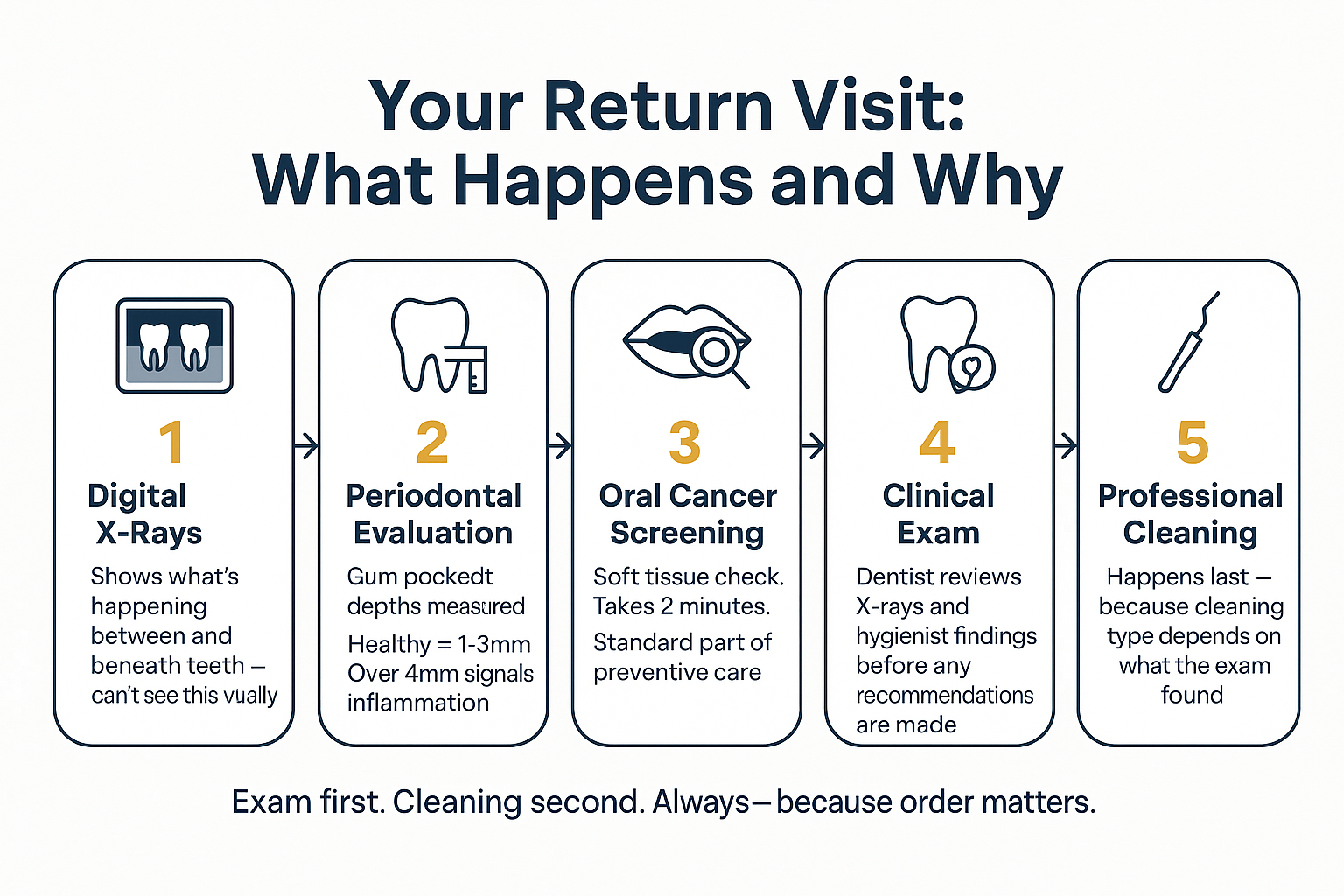
A thorough return visit typically unfolds in this order:
- Updated digital X-rays — These give the dentist a current view of what’s happening between and beneath the teeth, where visual inspection alone can’t reach.
- Periodontal evaluation — A hygienist measures the depth of the gum pockets around each tooth. Healthy pockets measure 1–3 millimeters. Readings of 4mm or more can indicate gingivitis or early periodontal disease — often without any symptoms the patient noticed.
- Oral cancer screening — A quick but important check of the soft tissues in and around the mouth. It takes about two minutes and is simply part of responsible preventive care.
- Clinical exam by the dentist — Dr. Lazore reviews the X-rays and hygienist findings together with a direct clinical examination before any treatment recommendations are made.
- Professional cleaning — This happens after the exam, not before, because the cleaning protocol depends on what the exam found.
That last point surprises some people. But the sequence is standard and makes clinical sense: a patient with early gingivitis may need a different type of cleaning than someone with healthy gums, and the only way to know which is which is to do the exam first.
For a fuller picture of what this visit looks like from a clinical standpoint, What happens at a comprehensive dental exam? walks through each component in plain terms.

The Real Clinical Picture After a Long Gap
Here’s what the hygienist is actually looking for when someone comes back after an extended absence — and why it matters to understand before you arrive.
Tartar buildup (the clinical term is calculus) accumulates continuously on tooth surfaces, and once it hardens below the gumline, brushing and flossing cannot remove it. Only professional instrumentation can. For patients who’ve been away 18 months or more, this buildup is almost always present to some degree — that’s not a criticism of home care, it’s just biology.
When tartar sits undisturbed for long periods, it creates an environment where the gum tissue can become inflamed and begin to pull away from the teeth. The pocket depth measurements taken during a periodontal evaluation show how far that process has progressed. In early stages, a thorough cleaning and better home care habits are often enough to reverse the inflammation. More advanced cases may involve a deeper cleaning procedure — but the exam findings determine that, not an assumption made in advance.
The important thing to take from this: finding something doesn’t automatically mean extensive treatment. A well-run return visit separates what genuinely needs attention from what can be monitored over time. Several patients at Beyond Dental Care have specifically noted in their reviews that the practice walked them through options for waiting versus treating — with the risks and costs of each laid out plainly, without pressure. That’s what a good treatment conversation looks like.
For more context on what periodontal disease actually involves and how it’s assessed, When was the last time you had a periodontal evaluation? is a good read before your visit.
What Happens at a Return Visit — The Clinical Sequence
This breakdown shows the standard order of events during a return dental visit after a gap of 18 months or more, and why each step happens when it does.
Gap Length and What It Typically Means for Your Visit
The length of time since your last visit generally shapes what the hygienist finds and what the initial appointment involves. This is a general guide — individual findings vary.
| Time Since Last Visit | What’s Likely Present | Typical First-Visit Scope |
|---|---|---|
| 6–12 months | Light tartar buildup, gums usually healthy | Standard cleaning, X-rays, exam |
| 12–24 months | Moderate buildup, possible early gingivitis | Full periodontal evaluation, may require extra cleaning time |
| 2–4 years | Heavier calculus, likely some gum inflammation | Periodontal probing, possible deep cleaning discussion depending on pocket depths |
| 4+ years | Significant buildup, possible bone changes | Extended exam, phased treatment plan with clear urgent vs. monitor breakdown |
The Treatment Plan Conversation: What ‘No Pressure’ Actually Looks Like
One of the most common fears people bring into a return visit — especially those who’ve had bad experiences at corporate dental chains — is the expectation of walking out with a treatment plan that reads like a car repair estimate. Five things listed, one number at the bottom, and a front desk person asking how you’d like to pay.
A well-structured care conversation doesn’t work that way. The exam findings get sorted into a few honest categories:
- Needs attention now — Active decay, significant infection, or gum disease that will worsen without treatment
- Worth monitoring — Early-stage issues where watchful waiting is clinically reasonable
- Good news — Areas that look healthy and just need maintenance
When those categories are explained clearly, with the reasoning behind each, the patient gets a realistic roadmap rather than a single overwhelming number. They can ask questions. They can understand what happens if they wait on something versus address it now. That’s a conversation, not a sales pitch.
For patients who haven’t seen a dentist in years and are also thinking about cosmetic improvements — whitening, straightening, or other changes — the most useful first step is still the exam. What to ask before starting any cosmetic dental treatment explains why foundational oral health always needs to come first before any aesthetic work is planned.
Practical Notes for North Glendale and Arrowhead Ranch Patients
For working adults across North Glendale, Arrowhead Ranch, Stetson Hills, and the Norterra corridor, the most common reason a dental visit gets postponed isn’t anxiety — it’s scheduling. A mid-week morning appointment means taking time off work, arranging school pickup differently, and shifting a full day around. That friction adds up, and the visit keeps getting pushed.
Beyond Dental Care offers evening and Saturday appointments, which removes that barrier for most adult schedules. A Saturday morning visit in the Arrowhead area doesn’t require a single day of PTO.
And for patients where dental anxiety is genuinely part of the picture — not just inconvenience but real, longstanding fear of the dental office — the practice has something that shows up repeatedly in patient reviews: Mr. Woodford, the office’s comfort dog. Multiple patients who described themselves as anxious or fearful dental patients mentioned him specifically as the reason they finally followed through on booking. That’s not a gimmick. For patients with a real fear response, having a calm animal in the room during an exam can meaningfully reduce the physiological stress of the visit.
If you’re also trying to figure out how to cover the cost of a return visit and any follow-up care, Can you use HSA for dental? covers exactly what qualifies under most health savings account plans.
Frequently Asked Questions About Returning to the Dentist After a Gap
Will the dentist or hygienist say something about how long it’s been?
They may note it briefly for clinical purposes — understanding your history helps them read the exam findings accurately. But a professional dental team is not going to lecture you or make you feel bad. Most patients who come in bracing for judgment report afterward that it never came. The visit is focused on where things stand now, not on why you weren’t there sooner.
Is a return visit after years away going to be painful?
It depends on what’s found. If there’s significant tartar buildup below the gumline or inflamed gum tissue, the cleaning may be more sensitive than a routine visit. A good hygienist will tell you what to expect before starting and can adjust their approach based on your comfort. For most people returning after a 1–3 year gap, a standard cleaning with some extra time is all that’s needed.
What if they find a lot of problems? Am I going to walk out with a huge treatment plan?
Not necessarily — and even if multiple things are found, a good care plan breaks them into what genuinely needs attention now versus what can be watched over time. You should leave the appointment with a clear understanding of priorities, approximate costs, and realistic timelines. If a practice hands you a long list without any of that context, that’s a conversation worth having before you commit to anything.
How long will the first return visit take?
Plan for 60 to 90 minutes for an initial return visit that includes X-rays, a periodontal evaluation, an oral cancer screening, the clinical exam, and a cleaning. If the findings are more complex, the dentist may recommend scheduling the cleaning separately so there’s enough time to do it properly. That’s not a bad sign — it just means the practice is being thorough rather than rushing.
I’ve been brushing and flossing regularly. Does that mean things are probably fine?
Home care matters a lot, but it can’t remove tartar once it hardens below the gumline — and it can’t detect things like early decay between teeth, changes in bone density, or soft tissue changes that an oral cancer screening would catch. Regular home care is genuinely valuable, but it’s not a substitute for a clinical exam. How often should adults really see a dentist? covers why professional monitoring is still necessary even with a solid home routine.
What if I’m also interested in whitening or straightening once I’m back on track?
That’s a reasonable thing to bring up during your visit. The honest answer is that cosmetic work almost always comes after the foundation is solid — healthy gums, no active decay, and a treatment plan in place for any existing issues. Once that baseline is established, options like professional whitening or CandidPro Clear Aligners are worth discussing at a follow-up appointment.
Ready to Get Back on Track?
If you’ve been putting off a return visit and you’re ready to actually do it, Beyond Dental Care sees patients across North Glendale, Arrowhead Ranch, Stetson Hills, Norterra, and the broader Northwest Phoenix area — with evening and Saturday appointments available for adult schedules. You can reach the practice at 623-267-8088 or visit beyonddentalcare.com to learn more before you book.