
Direct Answer: Silver amalgam fillings expand and contract with temperature over years, which can stress the surrounding tooth. Most don’t need immediate replacement, but older fillings do warrant regular monitoring.
If you had dental work done before the early 2000s, there is a reasonable chance you have at least one silver amalgam filling somewhere in the back of your mouth. Tens of millions of Americans do. And for most of that time, nobody gave those fillings a second thought, they went in, they held, and life moved on.
But the conversation around amalgam has picked up noticeably in 2026. The European Union formally prohibited the manufacture and import of dental amalgam as of July 1, 2026, and the FDA has issued updated guidance recommending that certain higher-risk groups reconsider amalgam when alternatives are available. For patients across North Glendale, Arrowhead Ranch, and the broader Northwest Phoenix area, many of whom have had those same fillings for twenty or thirty years, this is worth understanding clearly.
This article is not about alarming anyone. It is about what aging amalgam actually does inside a tooth over time, what the current guidance means for different patients, and what a routine preventive visit can tell you that social media posts simply cannot.
What Silver Fillings Are Made Of, and Why It Matters
Dental amalgam is not pure silver. It is an alloy made up of roughly 50 percent mercury by weight, combined with silver, tin, and copper. That composition is what makes it strong and workable, mercury binds the metal particles together into a stable, durable material that dentists have placed for over 150 years.
The mercury in a set amalgam filling behaves differently than mercury in its free form. When the filling is intact, most researchers and regulatory bodies have considered the exposure minimal for healthy adults. But the FDA’s current guidance does identify specific groups who should avoid amalgam when possible:
- People with neurological conditions such as Alzheimer’s disease or Parkinson’s disease
- Patients with kidney dysfunction
- Individuals with a known sensitivity or allergy to mercury or other amalgam components
- Pregnant women and nursing mothers
- Children under six
For many seniors in communities like Stetson Hills, Vistancia, and Norterra, this is directly relevant. Older adults are more likely to have aging amalgam restorations in place, and some are in health categories that place them squarely in the FDA’s higher-risk group. If that applies to you, it is worth raising with your dentist at your next visit, not as an emergency, but as part of an honest conversation about your personal health picture.
You can read the FDA’s current guidance on dental amalgam directly on their site for the full list of recommendations.
The Physical Problem With Metal Fillings Over Time
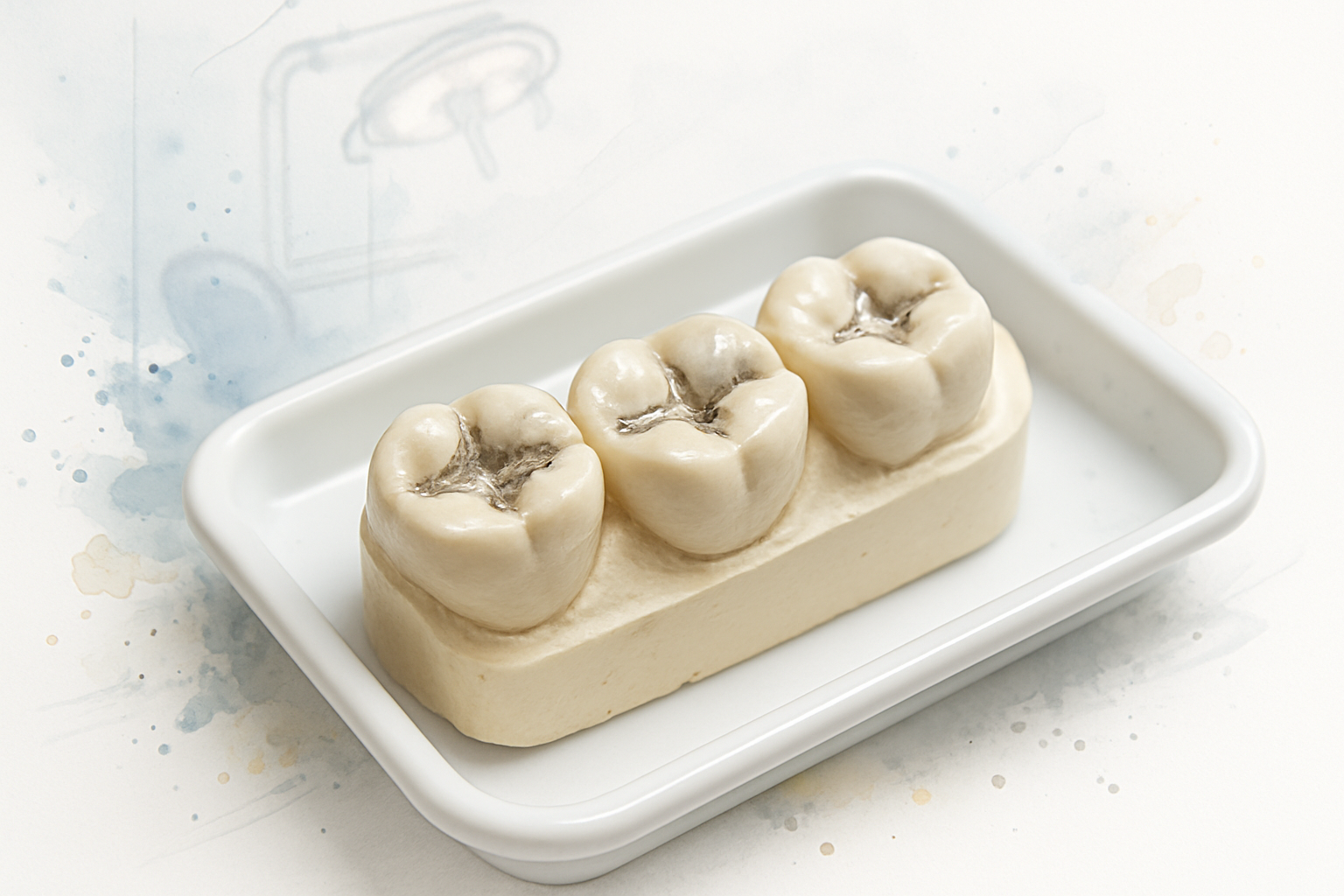
Setting aside the mercury question entirely, there is a purely mechanical reason why older amalgam fillings deserve attention. Metal expands when it heats up and contracts when it cools down. Every hot cup of coffee, every cold drink, every meal creates a small stress cycle inside the tooth, the filling moves slightly, and the surrounding enamel has to absorb that movement.
Over years and decades, this cycle can produce hairline cracks in the tooth structure around the filling. These cracks are often invisible to the naked eye and will not show up on a standard exam without careful clinical evaluation. A tooth can look intact from the outside while a crack quietly propagates inward.
This does not mean every old filling is a ticking problem. Many amalgam restorations placed in the 1980s and 1990s are still performing well. But the behavior pattern is real, and it explains why dentists who use advanced digital X-ray technology and thorough exams are better positioned to catch these changes before they become fractures.
A preventive dental visit that includes updated digital X-rays gives your provider a baseline to monitor those restorations over time. Catching a marginal failure or early crack before it reaches the nerve is exactly what regular preventive care is built to do, and it is far less involved than treating a fractured tooth after the fact.
Amalgam vs. Composite Resin: What Changes When You Replace a Filling
If an older silver filling does need replacement, tooth-colored composite resin is the standard modern alternative. Here is how the two materials compare on the factors patients ask about most.
| Factor | Silver Amalgam | Tooth-Colored Composite |
|---|---|---|
| Material | Mercury, silver, tin, copper alloy | Plastic and glass resin bonded to tooth |
| Appearance | Dark silver/gray, visible when mouth opens | Matched to tooth color, not visible |
| Temperature behavior | Expands and contracts with heat/cold | Much lower thermal expansion rate |
| Tooth removal required | More healthy tooth structure removed to hold filling | Bonds directly, less removal needed |
| FDA higher-risk guidance | Avoid for certain health conditions | No mercury, no related guidance |
| Longevity | Very durable; many last 15-20+ years | Durable; typically 10-15 years with good care |
When an Amalgam Filling May Need Attention
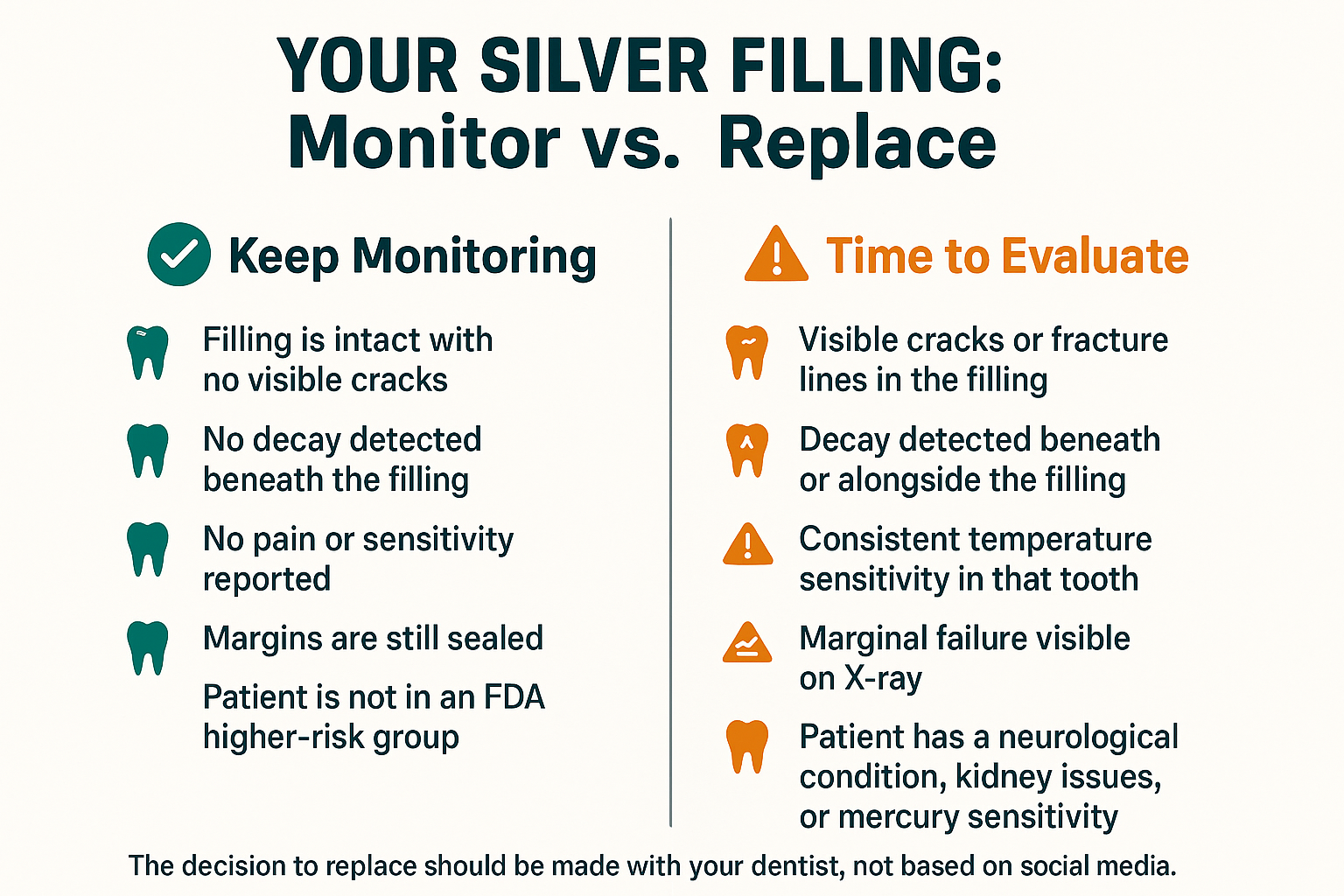
Not every silver filling needs to be replaced. This infographic outlines the specific signs that move a filling from ‘monitor it’ to ‘time to act.’
Should You Have Your Silver Fillings Removed?
This is the question I hear most often when this topic comes up with patients. And the honest answer is: it depends on the filling, the tooth, and your personal health situation.
The FDA’s current position is that existing amalgam fillings in good condition should generally not be removed unless there is a clinical reason to do so. The reason for that caution is straightforward, drilling out a filling temporarily releases mercury vapor at higher levels than the filling produces just sitting in place. If the filling is stable and the surrounding tooth is healthy, removal may create more exposure than leaving it alone.
That calculus changes when the filling itself is the problem:
- The filling is cracked or deteriorating
- There is decay beneath the filling that needs to be addressed
- The marginal seal has failed, allowing bacteria to enter
- The tooth has developed a fracture related to the filling’s expansion cycles
In any of those situations, replacement makes clinical sense regardless of the material involved. What I would caution against is making that decision based on social media posts promoting amalgam removal as a detoxification procedure. That framing is not supported by the clinical evidence, and it can lead patients toward an intervention that carries its own short-term exposure risk.
If you are in one of the FDA’s higher-risk categories, or if you simply want to understand what your older restorations look like today, a thorough exam with updated digital X-rays is where that conversation starts.
What Composite Fillings Actually Feel Different
When patients at Beyond Dental Care have had older amalgam replaced with tooth-colored composite, one of the most common things they mention is how different the tooth feels, not just cosmetically, but in terms of temperature sensitivity.
This makes physical sense. Composite resin does not conduct temperature the way metal does. You are not sending a cold signal directly from your iced drink into the center of the tooth the same way a metal filling would. The thermal expansion cycle that stresses surrounding enamel over years is also significantly reduced.
And because composite bonds directly to the tooth structure, the preparation requires removing less healthy enamel than the original amalgam placement did. Amalgam restorations require undercuts, physical retention shapes cut into the tooth to hold the filling mechanically. Composite does not need those because the resin adheres chemically. That is a meaningful difference in how much natural tooth you preserve.
For patients in Arrowhead Lakes, Hillcrest Ranch, or Cibola Vista who have been carrying the same metal fillings for two or three decades, this is worth knowing when the time does come for a restoration update. The material science has moved considerably since those fillings were placed.
Frequently Asked Questions About Silver Fillings and Aging Amalgam
My silver filling has been in my tooth for 25 years. Is that a problem?
Not automatically. Many amalgam fillings placed in the 1980s and 1990s are still intact and functioning. The concern is not age by itself, it is what age combined with thermal cycling and normal wear can do to the tooth structure around the filling. A current set of digital X-rays and a clinical exam will tell your dentist far more than the number of years alone.
Should I be worried about mercury in my fillings?
For most healthy adults with intact fillings, the FDA has not recommended removal. But the FDA does identify specific higher-risk groups, including people with neurological conditions like Alzheimer’s or Parkinson’s, those with kidney problems, and people with mercury sensitivity, who should discuss amalgam avoidance with their provider. If you fall into one of those categories, bring it up at your next visit rather than waiting.
What actually happens when an old filling starts to fail?
Several things can go wrong as an amalgam filling ages. The margins, the edge where filling meets tooth, can begin to break down, letting bacteria work their way underneath. The filling itself can crack. And the tooth enamel around it can develop hairline fractures from years of thermal expansion and contraction. Most of these changes are not painful in the early stages, which is why they are best caught on X-rays and clinical exam rather than waiting for symptoms.
If I replace a silver filling, what goes in instead?
Tooth-colored composite resin is the standard modern alternative. It bonds directly to the tooth, requires less removal of healthy tooth structure than amalgam did, matches your tooth color so it is invisible, and does not have the same thermal expansion behavior as metal.
I saw posts online saying I should have all my amalgam fillings removed for health reasons. Is that legit?
The short answer is: be skeptical. The FDA’s position is that removing intact, stable amalgam fillings is not routinely recommended because the drilling process temporarily increases mercury vapor exposure above what the sitting filling produces. Claims about detoxification through amalgam removal are not supported by current clinical evidence. If there is a specific health reason relevant to you, that is a conversation to have with your dentist, not something to decide based on a social media post.
How do I know if my old fillings need to be looked at?
A routine preventive visit with updated digital X-rays is the practical answer. Many filling issues develop without any pain signal at all. Coming back to the dentist after a long gap covers what to expect if it has been a while since your last exam, there is no judgment involved, just a clear picture of where things stand.
The Practical Takeaway for Patients With Older Restorations
The point is not alarm. If you have silver fillings that have been quietly doing their job for twenty years, you do not need to clear your schedule and panic. What you do need is a clear baseline.
A thorough preventive dental exam that includes updated digital X-rays gives your dentist a snapshot of how those restorations are holding up right now, whether the margins are sealed, whether the surrounding enamel looks stable, and whether there are any signs of decay working its way underneath. That snapshot is also what makes future monitoring meaningful. Without a current baseline, small changes are hard to track.
For patients in North Glendale, Stetson Valley, and the surrounding communities who are in the FDA’s higher-risk categories, this conversation has an extra layer of relevance. Knowing what you have, what condition it is in, and whether your health history changes the calculus on amalgam is exactly the kind of personalized treatment planning that a private dental practice is built to provide.
And if you are someone who has been putting off a visit because it has been a few years, or because you were not sure how to raise the amalgam question, that is a completely normal place to be. Quite a few patients mention feeling anxious about going back after a gap, or worried about being judged for the condition of older dental work. Neither of those concerns should keep you from getting a clear picture of where your oral health stands today.
Ready to Know Where Your Restorations Actually Stand?
If you have older silver fillings and have not had a thorough exam with updated X-rays recently, Beyond Dental Care serves patients across North Glendale, Arrowhead Ranch, Stetson Valley, and the surrounding Northwest Phoenix communities with personalized, unhurried care from Dr. Dariene Lazore, DMD. To schedule a comprehensive dental exam, call 623-267-8088 or visit beyonddentalcare.com.