
Direct Answer: A dental implant price reflects four to five separate components, imaging, the post, the abutment, the crown, and sometimes bone grafting. What separates quotes is the quality of materials, technology, and follow-up care built into each one.
I hear some version of the same question almost every week from patients across North Glendale, Arrowhead Ranch, and Vistancia: they’ve called around, collected a handful of implant quotes, and now they’re staring at numbers that range from under $1,500 to well over $5,000, and they have no idea what explains the gap. That confusion is completely reasonable, because most dental offices quote a single number without explaining what’s inside it.
An implant isn’t one procedure. It’s a multi-stage surgical and restorative treatment with several distinct components, each carrying its own cost and its own quality variables. When you understand what those pieces are and what drives their price, you stop comparing apples to apples and start comparing the actual treatments.
This article breaks down exactly what goes into an implant quote, what quality differences explain the price spread, and how to think about the long-term value of a treatment that, when done well, can last the rest of your life.
The Real Components Inside Every Implant Quote
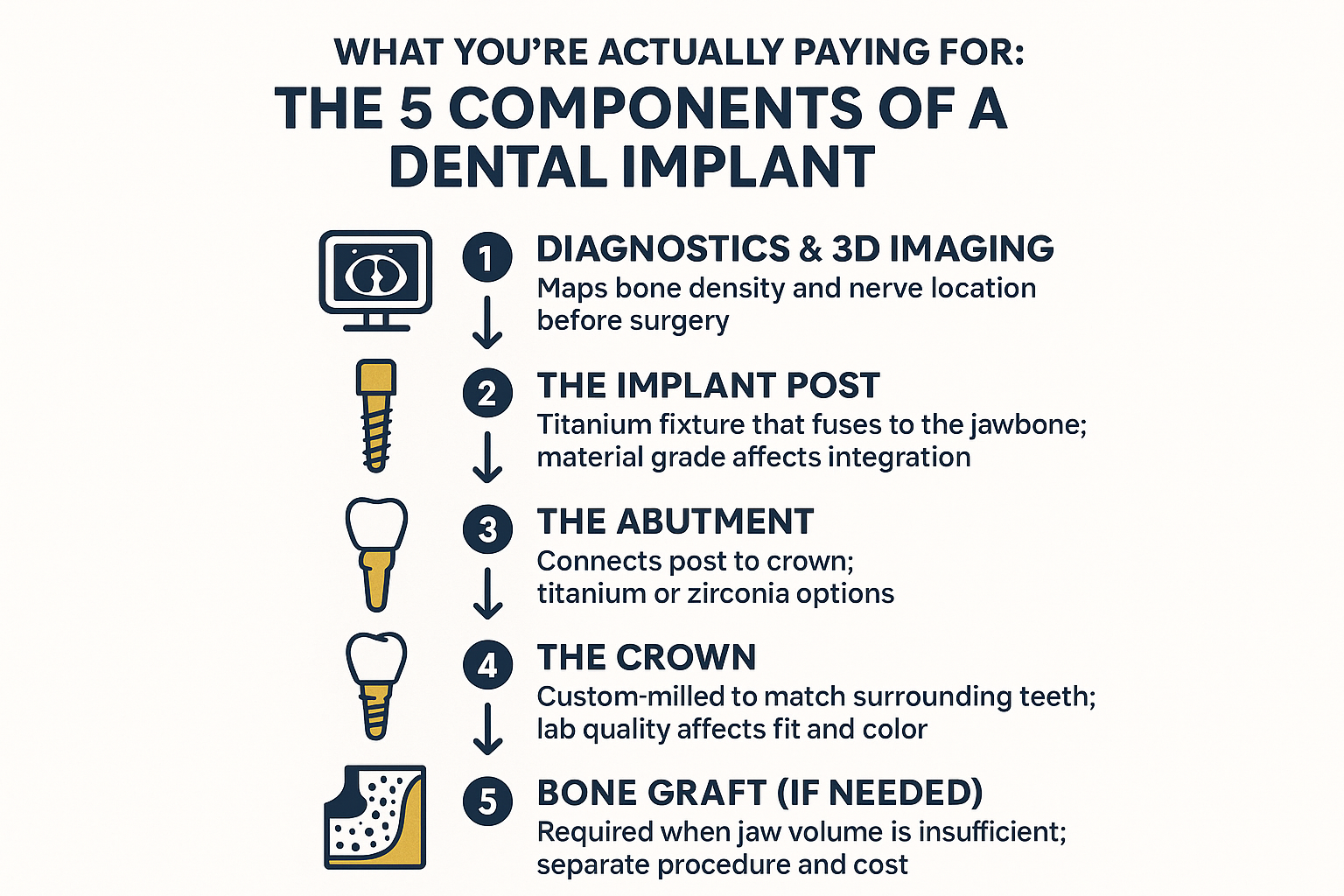
A complete implant restoration is typically made up of four to five separate line items. When a practice quotes you a single number, those items are bundled in. When they’re not, the quote looks lower, until you get to the invoice.
Here’s what a full implant treatment actually includes:
- Diagnostics and 3D imaging, A CBCT cone beam scan maps your bone density, nerve location, and sinus proximity before a single incision is made. This isn’t optional for safe implant placement; it’s the foundation of the entire plan.
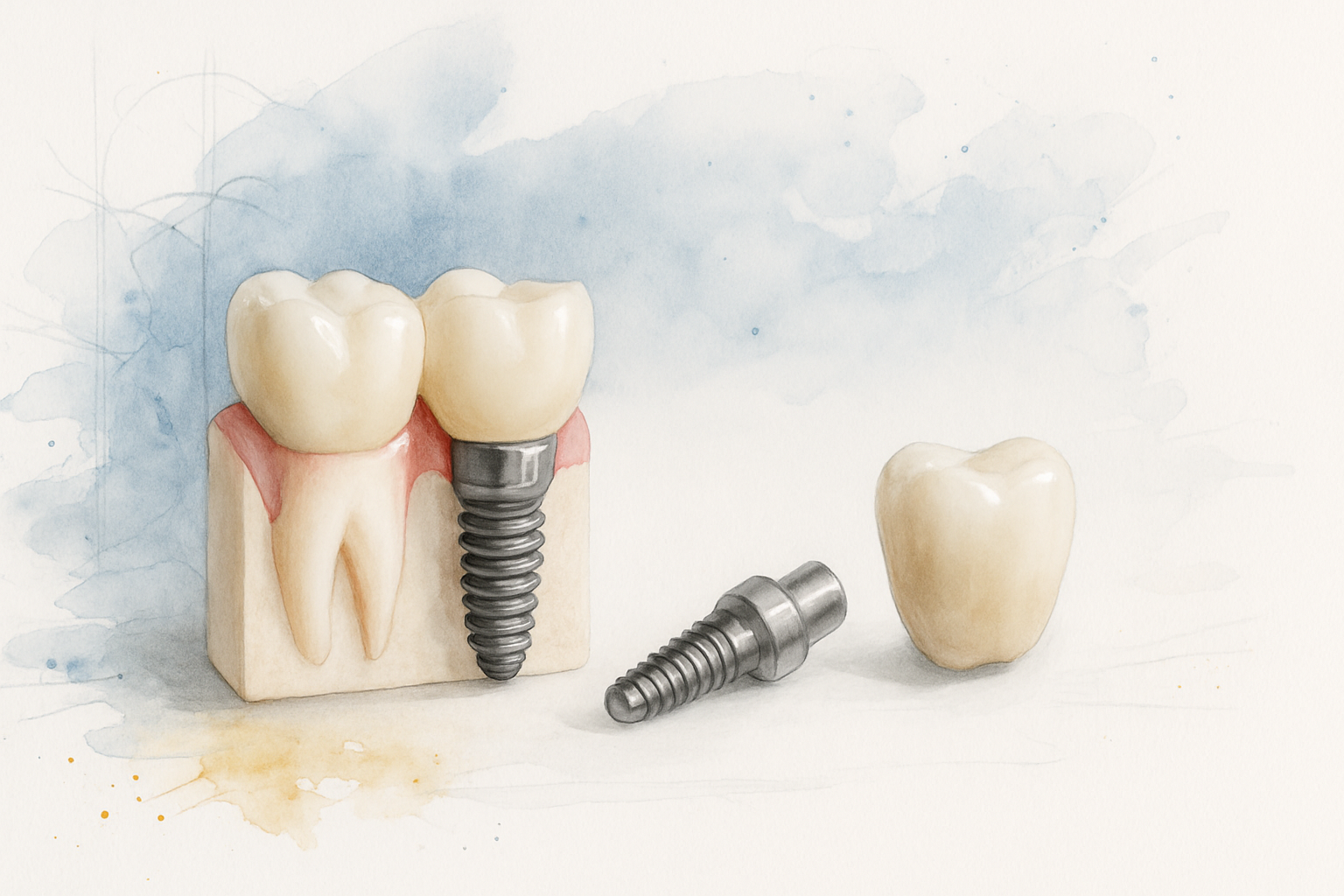
- The implant post, The titanium screw that integrates with your jawbone. Post quality, thread design, and surface coating affect how reliably osseointegration occurs.
- The abutment, The connector piece between the post and the crown. Material choices here (titanium vs. zirconia) affect both aesthetics and long-term gum health.
- The crown, The visible tooth, custom-fabricated to match your surrounding teeth. Milled in a quality lab vs. a low-volume lab makes a measurable difference in fit and color accuracy.
- Bone grafting, If you’ve had a tooth missing for a while or lost bone due to infection, grafting is often needed before the post can be placed. This is a separate procedure with its own cost, and it’s one of the most common reasons a quote changes after imaging.
When you get a quote that seems unusually low, the first question worth asking is which of these components is included, and which ones will appear as add-ons later. Learning what the imaging alone reveals is one of the most useful things you can do before committing to any provider.
What Quality Differences Actually Look Like in Practice
Price differences between providers aren’t just about markup. They reflect real differences in how the treatment is planned and executed, and those differences show up in outcomes.
Four things separate a quality implant treatment from a lower-cost one:
Imaging precision. A practice using a full CBCT scan can see exactly where your inferior alveolar nerve runs, how much bone volume you have, and whether there are any anatomical factors that would complicate placement. A practice skipping that step is working with less information, and that’s a risk that gets passed on to you.
Sterilization standards. Implant surgery is an open surgical procedure. The sterilization protocols a practice follows matter in a way that a routine cleaning doesn’t require. One reviewer who came to us after a long gap noted specifically that the office looked “very clean and sterile”, and that detail isn’t cosmetic. It’s clinical.
Material sourcing. Implant posts and crowns are not commoditized products. Reputable manufacturers like Straumann, Nobel Biocare, and Zimmer publish clinical data on their osseointegration rates. Off-brand components exist at lower price points, but the long-term track record isn’t the same.
Structured follow-up. An implant is a multi-stage treatment that unfolds over months. The value of having a single, experienced team handle planning through final restoration, rather than splitting care between a surgeon, a separate restorative dentist, and a lab you’ve never met, is hard to overstate. Continuity means someone is accountable at every stage.
For patients who are also weighing what implants look like compared to other tooth replacement options, the implants vs. dentures comparison for seniors walks through that decision with real specificity.
The Five Cost Components of a Dental Implant
This breakdown shows every piece that makes up a complete implant restoration, and why each one matters to the final outcome.
The Cross-Border Question, and What It Actually Costs You
Patients in the Northwest Phoenix corridor, from Stetson Hills to Norterra to North Peoria, openly compare local implant pricing against dental tourism in Mexico. I understand why. When quotes here can run anywhere from roughly $3,000 to $6,000 for a complete single-tooth implant depending on components and provider, and border clinics advertise similar procedures for a fraction of that, the math looks obvious.
But an implant isn’t a one-visit procedure. It’s a months-long treatment with multiple appointments across the surgical and restorative phases. When something goes wrong, a post that doesn’t integrate, a crown that doesn’t fit, an infection that develops weeks after placement, the question becomes who is going to manage that complication, and at what cost.
Local follow-up care for a procedure done out of the country often falls to a domestic provider who wasn’t involved in the original treatment, has no records, and may charge full out-of-pocket rates to correct someone else’s work. That’s not a hypothetical. It’s a pattern that shows up in practices across the Phoenix area regularly.
The American Academy of Implant Dentistry provides public guidance on evaluating implant providers that’s worth reading before making any decision about where to have this done.
For patients thinking through the full timeline of what a domestic implant process involves, this breakdown of how long implants actually take covers each stage honestly.
What’s Typically Included vs. Added On, By Quote Type
When comparing quotes from multiple providers, knowing what’s typically bundled versus billed separately helps you read the real number behind each offer.
| Component | Often Bundled In Full-Price Quotes | Often Billed Separately in Low-Price Quotes |
|---|---|---|
| CBCT / 3D Imaging | Yes | Sometimes, check explicitly |
| Implant Post (name-brand) | Yes | May be off-brand or unspecified |
| Abutment | Yes | Sometimes listed as add-on |
| Crown (lab-fabricated) | Yes | Yes, but lab quality varies |
| Bone Graft | Only if pre-diagnosed | Rarely included; added after imaging |
| Follow-up Appointments | Typically included | May be charged per visit |
For Seniors: How to Think About Timing and Benefit Years
For patients in Arrowhead Lakes, Cibola Vista, and the broader senior population across the Upper West Side Phoenix corridor, cost is rarely the only consideration, timing is. Most dental plans cap their annual maximum somewhere between $1,000 and $2,000, which rarely covers a full implant in a single calendar year.
But because implant treatment happens in stages across months, there’s often a real opportunity to coordinate the phases across two benefit years. Bone grafting and the surgical placement of the post might happen in the fall, with the abutment and crown completed after January 1st when the deductible and annual maximum reset. That kind of planning isn’t always advertised, but it’s a legitimate way to reduce out-of-pocket exposure without compromising the quality of care.
This is worth having a direct conversation about at your consultation, not as a workaround, but as straightforward treatment coordination. The detailed walkthrough of implants after 65 covers how the staging works and what patients in that age group should expect at each phase.
And for anyone wondering about bone loss or whether they’re even a candidate before scheduling a consult, what imaging actually reveals about candidacy is the right place to start.
The Math That Changes When You Think Per-Year Instead of Upfront
The number that shows up on a treatment plan is the upfront cost. But it’s not the only way to think about what you’re spending.
Published clinical data puts long-term implant survival rates near 95 to 98% over ten-year follow-up periods, with many implants functioning well into the 20-year range and beyond when placed well and maintained properly. Compare that to a dental bridge, which typically needs replacement every 10 to 15 years and requires the adjacent healthy teeth to be permanently altered in the process.
When you divide a $4,500 implant cost over 25 years of function, you’re looking at roughly $180 per year for a permanent, fixed replacement that doesn’t affect neighboring teeth. That’s a different number than the invoice. And it’s a calculation worth making before deciding that a lower upfront quote automatically means a better value.
For more context on what drives longevity in implants, and what patients can do to protect that investment, the honest look at how long implants actually last is worth reading before or after your consultation.
Frequently Asked Questions About Dental Implant Pricing
Why does one office quote $1,800 and another quote $5,500 for what sounds like the same procedure?
The components inside those quotes almost certainly differ. The lower number may exclude 3D imaging, use an unspecified implant brand, or not include the abutment and crown as a bundle. Always ask each provider to itemize what’s included, diagnostics, post, abutment, crown, and whether grafting has been accounted for. Once you’re comparing identical scopes, the gap usually narrows, and whatever remains reflects real differences in technology, materials, and follow-up care.
Will my dental insurance cover any part of this?
Some plans cover a portion of the crown or the bone graft, and some cover diagnostic imaging. Very few plans cover the implant post itself as of 2026, though coverage is expanding slowly. Your annual maximum, typically $1,000 to $2,000, is the limiting factor in most cases. The best approach is to get a pre-authorization estimate from your insurer before the procedure, so you know exactly what they’ll apply.
Is it really risky to get an implant done in Mexico to save money?
The procedure itself may be performed well, many border clinics employ trained surgeons. The issue is continuity. An implant spans multiple appointments over months, and complications, failed integration, crown fit problems, infection, don’t always appear immediately. When they do, you need a local provider who has your records, knows your case, and can manage the situation. That follow-up access has real value that doesn’t show up in the original quote comparison.
Can I spread out the cost of an implant across two insurance years?
Often, yes. Because implant treatment happens in stages, typically bone grafting, then post placement, then the crown, it’s sometimes possible to schedule the early surgical phase in the fall and complete the restoration after January 1st, when your deductible and annual maximum reset. This takes coordination with your dental team, but it’s a legitimate planning option that can meaningfully reduce what you pay in any single calendar year.
Does bone grafting always add to the cost?
Only when it’s needed. Not every patient requires a graft, it depends on how long the tooth has been missing and how much bone volume remains. A 3D CBCT scan is the only way to know before the procedure starts. If grafting is needed and wasn’t in the original quote, it will appear as a separate line item. This is one reason getting imaging done early in the planning process matters, it eliminates surprises.
How do I know if a provider’s materials are good quality?
Ask specifically which implant system they use. Brands like Straumann, Nobel Biocare, and Zimmer publish clinical outcome data and have decades of peer-reviewed research behind them. If a provider can’t or won’t name the implant manufacturer, that’s worth noting. The crown should come from a reputable dental lab, and the materials (zirconia vs. porcelain-fused-to-metal) should be explained as part of the treatment plan conversation.
Ready to Get a Clear Picture of What Your Implant Would Actually Cost?
Patients across North Glendale, Arrowhead Ranch, Stetson Valley, and the surrounding Northwest Phoenix area come to Beyond Dental Care because Dr. Dariene Lazore and her team take the time to explain exactly what’s included in a treatment plan, no bundled surprises, no pressure, and no guessing about what you’re comparing. With advanced digital imaging on-site and a single private-practice team managing the process from initial evaluation through final restoration, the practice handles implant consultations the way this kind of decision deserves. If you’re ready to understand what a complete implant treatment would look like for your specific situation, call the office at 623-267-8088 or visit beyonddentalcare.com to request a consultation.