
When a dental emergency hits on a weekend, the first 30 minutes are absolutely critical. It’s easy to panic, but your immediate actions can make all the difference in managing pain and preventing the problem from getting worse.
The goal right now is to stay calm and stabilize the situation. This usually starts with simple, effective first-aid like a cold compress for swelling or a warm salt water rinse to keep things clean.
Your First 30 Minutes During a Dental Emergency

A sudden, throbbing toothache or a cracked tooth can bring a great weekend to a grinding halt. When it happens, the first instinct is often panic. But take a deep breath—having a clear plan is your best defense. Your top priority is to figure out what’s going on without accidentally making it worse.
Before you even think about searching for an emergency dentist, take a moment to assess the damage. Is there any bleeding? Is a tooth loose, chipped, or completely knocked out? Knowing the specifics will help you provide the right immediate care and explain the situation clearly when you call a professional.
Immediate First-Aid Actions
No matter the specific emergency, a few first-aid steps almost always help. Think of these as your go-to moves to get some temporary relief and protect your tooth while you figure out your next steps for a dental emergency weekend situation.
- Rinse Gently: Mix about a half teaspoon of salt into a glass of warm water and swish it around your mouth gently. This isn't just an old wives' tale; it cleanses the area, helps dislodge any debris, and can reduce the risk of infection.
- Manage Swelling: Grab a cold compress or an ice pack wrapped in a thin towel and hold it against your cheek near the painful spot. Do this for about 20 minutes at a time. It's a fantastic way to numb the pain and keep swelling down.
- Control Pain: If you're not allergic and it’s safe for you, an over-the-counter pain reliever like ibuprofen can be a lifesaver. Just be sure to swallow the pill—never place aspirin directly on your tooth or gums, as it can cause a nasty chemical burn on the tissue.
Handling Specific Scenarios
Sometimes, the problem is much more specific, like a tooth getting knocked out completely. In these cases, time is truly of the essence.
A knocked-out permanent tooth has the best chance of being saved if it’s put back in the socket within 30-60 minutes. Acting fast and correctly is everything.
If a tooth gets knocked out, find it right away. Pick it up by the crown (the part you chew with), and whatever you do, don't touch the root.
If it's dirty, give it a quick, gentle rinse with milk or a bit of water—but don't scrub it or use any soap. Try to gently place it back into its socket. If that's not possible, keep it moist. The best options are a small container of milk or tucked inside your cheek against your gums.
Taking these steps will help stabilize things, giving you the breathing room and clarity you need to find professional help.
Managing Common Weekend Dental Problems at Home
Not every dental issue that crops up on a Saturday morning requires a mad dash to an after-hours clinic. Knowing how to handle the more common problems at home can save you a lot of pain and stress, helping you figure out what’s a true dental emergency and what can safely wait until Monday.
You’d be surprised how often this happens. While most dental emergencies occur during the week, a significant number don’t. In fact, about 27.4% of emergency room visits for non-traumatic dental problems happen over the weekend. You can dig into the full findings on emergency department usage for dental care to see just how common this scenario is.
The infographic below gives you a solid game plan for any weekend dental mishap.
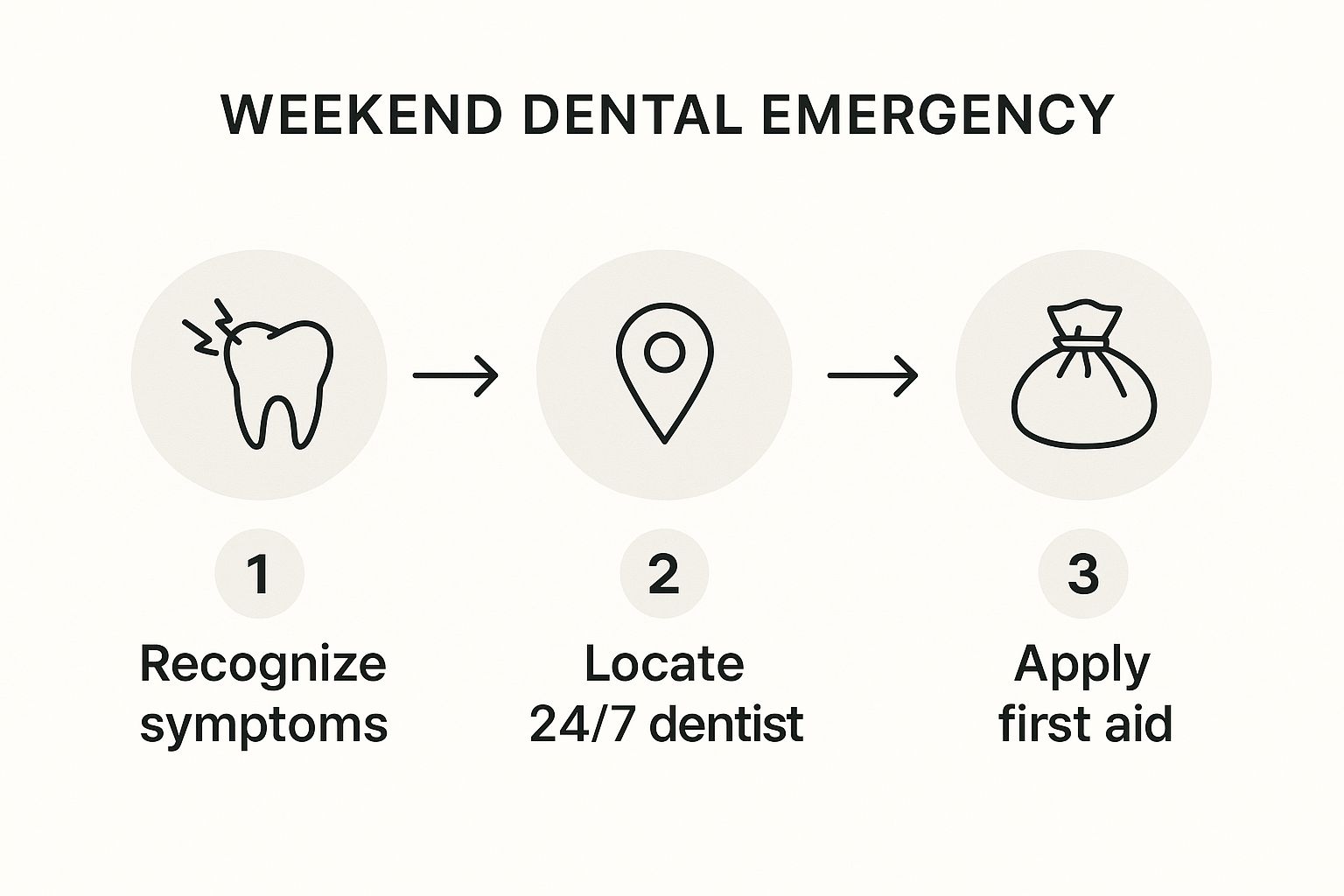
It really boils down to three things: recognize the symptoms, find care when needed, and use first aid to manage the situation in the meantime. It’s a clear path forward when you're feeling stressed.
When you can’t get to a dentist right away, a little know-how goes a long way. Here’s a quick reference table for some of the most common issues you might face.
Weekend Dental Emergency First Aid
| Emergency Situation | Immediate First Aid Steps | What to Avoid |
|---|---|---|
| Lost Filling or Crown | Rinse with warm salt water. If you have the crown and it's intact, use temporary dental cement or a dab of toothpaste to place it back on the tooth for protection. | Chewing on that side of your mouth. Using super glue. |
| Chipped/Cracked Tooth | Rinse your mouth with warm water. Apply a cold compress to your cheek to reduce swelling. Cover sharp edges with sugar-free gum or dental wax. | Biting down on hard foods. Ignoring it if the pain is severe. |
| Knocked-Out Tooth | Handle the tooth by the crown only. Gently rinse with milk (not water). Try to place it back in the socket and bite down on clean gauze. If not possible, store it in a small container of milk or in your cheek. | Touching the root. Scrubbing the tooth or wrapping it in tissue. Letting it dry out. |
| Severe Toothache | Rinse with warm salt water. Gently floss to remove any trapped food. Take over-the-counter pain relievers (like ibuprofen). Apply a cold compress. | Placing aspirin directly on the tooth or gums. Ignoring a fever or swelling. |
This table is your go-to guide for those first critical moments, but remember, these are temporary fixes designed to buy you time until you can see a professional.
A Lost Filling or Crown
It’s a classic weekend spoiler. You’re enjoying a meal, and you bite down on something unexpectedly hard. A quick investigation reveals a filling or crown has popped out. The key is not to panic.
Your first move should be to gently rinse the area with warm salt water. If you have the crown and it looks to be in one piece, you can try to temporarily put it back in place. Pharmacies sell over-the-counter dental cement for this exact purpose, but in a pinch, a tiny bit of toothpaste can work. This is purely a temporary shield to protect the exposed tooth until you get to the dentist.
Chipped or Cracked Tooth
A weekend pickup game or a simple accident can easily lead to a chipped tooth. If the chip is minor and you’re not in pain, you can probably wait until your regular dentist is open. Rinse your mouth out with warm water to keep it clean.
If the broken edge feels sharp, cover it with a piece of sugar-free gum or some dental wax (you can find this at most drugstores). This will keep it from cutting your tongue or cheek. Just be sure to avoid chewing on that side of your mouth.
Important Takeaway: The real difference-maker here is pain. A small, painless chip is one thing, but a crack causing severe pain or sensitivity could mean the nerve is exposed. That’s a situation that needs more immediate attention.
Knocked-Out Permanent Tooth
This is one of the most serious weekend dental emergencies, and the clock is ticking. A permanent tooth has the best shot at being saved if it’s handled properly and put back in its socket within 30 to 60 minutes.
Follow these steps precisely:
- Handle with Care: Pick up the tooth by the crown (the white, chewing part). Never, ever touch the root. The cells on the root are incredibly delicate and crucial for reattachment.
- Clean It (Gently!): If the tooth is dirty, give it a quick, gentle rinse with milk. Don't use soap, and absolutely do not scrub it or wrap it in a tissue.
- Keep It Moist: The ideal place for the tooth is right back in its socket. If you can, gently push it back into place and hold it there by biting down on a clean cloth or piece of gauze. If that’s not possible, put it in a small container of milk or tuck it inside your cheek. Do not use water, as it will damage the root cells.
As soon as you’ve done this, your next call should be to an emergency dentist. Taking these first aid steps correctly buys you precious time and dramatically boosts the chances of saving your tooth.
How to Find an Emergency Dentist on a Weekend

The biggest challenge of a dental emergency weekend is often the search itself. When you're in pain, the last thing you want is to play detective, hunting for an open clinic. Thankfully, if you know where to look, you can find after-hours care quickly and get the relief you desperately need.
It all starts with a focused online search. Vague terms won't get you very far, so you need to be specific. Your goal is to find a dentist who can see you now, not just a list of practices that are closed until Monday morning.
Fine-Tuning Your Online Search
Using precise language is the secret to cutting through the noise and getting relevant results. Instead of just searching for "dentist," try these much more effective phrases:
- "Emergency dentist near me open now"
- "24-hour dentist [Your City]"
- "Weekend dental clinic near me"
- "Saturday dentist open" or "Sunday dentist open"
These searches tell Google exactly what you need, filtering out all the standard clinics with regular weekday hours. Once you have a short list, start making calls immediately. Don't just trust the hours posted online—they can easily be outdated.
Another great place to look is your dental insurance provider's website or app. Most insurance companies have a provider directory with a filter for "emergency services" or "24-hour care." This can point you straight to an in-network dentist who is ready for urgent situations and help you get a handle on potential costs.
Pro Tip: Don't forget about your regular dentist's office. Many practices have an after-hours voicemail message with a dedicated number for emergency calls or a referral to a trusted on-call partner. I've found this is often the fastest route to getting help.
Asking the Right Questions on the Phone
Once you get a clinic on the line, you need to figure out—fast—if they're the right fit. The last thing you want is to waste time traveling to an office that can't actually help you. Come prepared with a handful of key questions.
Essential Questions to Ask Before You Go:
- Availability: "Are you accepting new emergency patients right now?"
- Cost: "What is the fee for an emergency consultation and X-ray?"
- Payment: "What are your payment options? Do you take credit cards or offer any payment plans?"
- Insurance: "Do you accept [Your Insurance Provider]?"
- Capability: "I have a [knocked-out tooth, severe abscess, etc.]. Are you equipped to handle that today?"
Asking these questions saves you precious time and avoids frustrating surprises later. A clinic's willingness to answer them clearly and patiently is a great sign that you're in capable hands. Remember, their job is to help you through this stressful ordeal, and that starts with the very first phone call.
It’s the weekend, you’ve got a raging toothache or a freshly cracked tooth, and panic starts to set in. Where do you even go? It can be tough to figure out if you need an emergency dentist or if this is serious enough for a trip to the hospital's emergency room.
Knowing the difference is key—not just for getting the right care, but for saving yourself a massive headache and an even bigger bill. While a dental emergency weekend definitely calls for fast action, the ER is only the right choice in very specific, and frankly, scary situations.
Here’s the hard truth: most hospital emergency departments just aren't set up for real dental work. They don't have dentists on staff and lack the specialized tools needed for a filling, root canal, or extraction. An ER visit will likely get you some antibiotics or pain medication, but you'll almost always be told to see a dentist ASAP. You end up with a costly bill and no real fix for your problem.
Red Flags That Signal an ER Visit
So, how do you know when a hospital visit is the right call? Certain symptoms are more than just a dental problem—they’re signs of a medical emergency that started in your mouth. These are the red flags that mean you should head to the nearest ER immediately.
Don't wait. These are potentially life-threatening issues that need a doctor, not a dentist.
- Uncontrolled Bleeding: If you have bleeding from your mouth that won’t stop, even after applying firm, steady pressure for 10-15 minutes.
- Difficulty Breathing or Swallowing: This is a major warning sign. If you have significant swelling in your face, jaw, or gums that’s making it hard to breathe or swallow, it could mean a severe infection is spreading and closing off your airway.
- High Fever with a Toothache: A high temperature combined with a terrible toothache and facial swelling points to a serious infection, like an abscess, that might have entered your bloodstream.
- Serious Facial Trauma: If you’ve been in an accident and think your jaw might be broken or dislocated, that’s a job for the ER.
A study looking at global trends during the COVID-19 pandemic found something interesting. While critical dental emergencies held steady, less urgent cases dropped by over 50%. It suggests that when things get really bad, people know they need help. You can read the full research on dental emergency patterns here.
When to Stick with an Emergency Dentist
For almost everything else, an emergency dentist is exactly who you need to see. These situations are painful and stressful, no doubt, but they aren't life-threatening and are best handled by a professional who can actually fix the tooth.
Call an Emergency Dentist (Not the ER) For These Scenarios:
- Severe Toothache (without fever/major swelling): That intense, throbbing pain from what you suspect is a deep cavity or abscess needs a dentist's touch.
- Knocked-Out Tooth: Time is critical here. A dentist is the only one who can potentially save and reimplant the tooth.
- Lost Crown or Filling: This leaves the sensitive inner parts of your tooth exposed and needs to be sealed up by a dentist.
- Cracked or Broken Tooth: Unless it was caused by major trauma that also affected your jaw, a chipped or broken tooth is squarely in a dentist's territory.
Think of it like this: The ER’s job is to stabilize you and handle life-threatening issues like major infections and trauma. The emergency dentist’s job is to save your tooth and fix the dental problem for good. Making the right call saves you time, money, and gets you the proper care you actually need.
Getting Ready for Your Weekend Emergency Dental Visit
You’ve found a clinic that can see you for a dental emergency weekend appointment. That's a huge relief. Now, taking just a few minutes to get organized can make a world of difference.
Walking into an unfamiliar office while you're in pain is stressful enough. Being prepared helps the visit go smoothly, allowing the dental team to focus on what matters most: diagnosing the problem and getting you out of pain quickly.
Before you rush out the door, gather a few key pieces of information. This isn't just about paperwork; it's about giving the dentist a complete picture of your health so they can provide the safest and most effective care.
What to Bring to Your Appointment
Think of this as your emergency "go-bag." Having this information on hand prevents delays and helps the dental team make informed decisions, which is especially critical when they're seeing you for the first time.
Here's what you should have ready:
- A List of Current Medications: Don't forget anything! This includes all prescriptions, over-the-counter drugs like aspirin, and even vitamins or herbal supplements. Dosages are crucial, as some medications can affect treatment options like anesthesia or antibiotics.
- Your Medical History: Be prepared to talk about major health conditions (like heart problems or diabetes), allergies (especially to latex or medications like penicillin), and any past surgeries.
- Dental Insurance Information: Keep your insurance card handy. Even if the clinic is out-of-network, they'll need this information to help you with your claim. If you're uninsured, be ready to discuss payment options upfront.
- Your Regular Dentist’s Contact Info: The emergency dentist will likely want to coordinate with your primary dentist for any necessary follow-up care.
The COVID-19 pandemic really drove home how vital it is to be ready for urgent dental care. With routine appointments postponed, many minor issues spiraled into more painful, complex emergencies. This highlights the importance of not delaying care when you feel something is wrong.
Understanding the Process and Costs
A weekend emergency visit isn't like your regular check-up. The main goal is to address the immediate crisis—to get you out of pain and stabilize the issue.
Often, the treatment you receive will be a temporary fix. For instance, if you need a root canal, the emergency dentist might perform the first stage to relieve the excruciating pain, but you'll need to see your regular dentist to complete the procedure.
Expect the cost to be higher than a standard appointment. This is due to after-hours staffing and the urgent nature of the service. It's always a good idea to ask for a cost estimate over the phone to avoid any surprises.
It's also reassuring to know that emergency providers are prepared for any situation. Many have advanced certifications like Basic Life Support and CPR training for dentists, ensuring you're in capable hands. By coming prepared and knowing what to expect, you can reduce your anxiety and focus on getting the relief you desperately need.
Answering Your Top Weekend Dental Emergency Questions
When a dental problem strikes on a weekend, the pain and stress can be overwhelming. On top of that, you're probably swimming in questions. What will this cost? Can it wait until Monday? What happens if I can't find anyone?
A dental emergency weekend is confusing. Let's clear things up by tackling the most common questions we hear from patients in this exact situation. Knowing what to expect empowers you to make the right call for your health.
How Much Does a Weekend Emergency Dental Visit Cost?
This is usually the first question on everyone's mind, and for good reason. The truth is, the cost of a weekend emergency visit can vary quite a bit. It really depends on your location, the specific dentist, and, most importantly, what kind of treatment you need.
You should expect to pay more than you would for a standard weekday appointment. That's just the nature of after-hours service. A basic consultation and an X-ray might run you anywhere from $150 to $400, but more complex procedures will be pricier. For instance, an emergency root canal to get you out of pain or a necessary extraction will carry a higher fee.
Key Takeaway: Don't be afraid to ask for a cost estimate over the phone before you head in. If you don't have insurance, it’s also a good time to ask about payment plans. Many dental insurance policies do cover a portion of emergency care, so it’s always a good idea to have your policy details handy.
Can I Just Wait Until Monday to See My Regular Dentist?
This is a judgment call, and it all comes down to the severity of your symptoms.
For something minor, like a tiny chip in a tooth that isn't sharp or a lost filling that isn't causing any pain, you can probably hold off until your regular dentist’s office opens.
However, some symptoms are red flags telling you not to wait. Delaying care in these cases can lead to much bigger problems, like a spreading infection or even losing a tooth that could have been saved.
Seek Immediate Care If You Experience:
- A severe, throbbing toothache that over-the-counter pain medication won't touch.
- A suspected abscess, which often looks like a pimple on your gums.
- Significant swelling in your face, jaw, or gums.
- A tooth that has been knocked out completely.
- Uncontrolled bleeding from your mouth.
When in doubt, especially if you're in a lot of pain or your symptoms are getting worse, it's always better to be safe and seek care right away.
What if I Cannot Find Any Emergency Dentist Open Near Me?
This is an incredibly frustrating and scary scenario. You’ve searched online, called your own dentist's office hoping for an after-hours referral on their voicemail, and even tried dental hotlines with no success. What now?
It's time to re-evaluate. Look at your symptoms again to determine if a trip to the hospital ER is your next best step. If you have signs of a serious, systemic infection—like a high fever along with facial swelling—or if you've had a major facial injury, go to the nearest emergency room.
ER doctors can't perform dental work like fillings or root canals, but they can provide critical care. They can prescribe antibiotics to fight infection and give you strong pain relief to stabilize your condition until you can get to a dentist.
Will an Emergency Dentist Pull My Tooth?
The primary goal of any good emergency dentist is to get you out of pain and, whenever possible, save your natural tooth. Extraction is always treated as a last resort, never the first option.
The first thing the dentist will do is diagnose the problem, which usually involves a thorough look and an X-ray. If the tooth can be saved—maybe with the first stage of a root canal or even a sturdy temporary filling—they will almost always recommend that path.
Pulling the tooth will only be on the table if it's too broken or infected to be repaired, or if removing it is the only way to stop a severe infection from spreading. You will always be part of that conversation; the dentist will lay out all the options so you can make an informed decision together.
At Beyond Dental Care, we understand that dental emergencies are stressful, especially on a weekend. Dr. Dariene Lazore and our compassionate team are here to provide exceptional, patient-focused care when you need it most. If you're in Glendale, Arrowhead Ranch, or the surrounding communities and need urgent assistance, don't hesitate to reach out. Visit us at https://beyonddentalcare.com to learn more about our emergency services.