
When you're facing tooth loss, the choice between dental implants and dentures feels monumental. The core difference really comes down to one thing: permanence. Dental implants are a fixed solution, designed to become a permanent part of your jaw, just like a natural tooth root. Dentures, on the other hand, are a removable and more accessible option that rests on top of your gums.
Understanding Your Tooth Replacement Options
Losing a tooth can affect everything from your confidence when you smile to your ability to enjoy a steak dinner. Thankfully, modern dentistry offers incredible ways to restore your smile. While both dental implants and dentures get the job done, they take very different approaches, leading to unique daily experiences and long-term health outcomes.
Choosing the right path isn't just about filling a gap. It's about understanding how each option will integrate with your body, your lifestyle, and your goals for your oral health. One becomes a seamless part of your natural anatomy, while the other serves as a custom-made, but separate, prosthetic.
The Fundamental Divide
The biggest distinction lies in how each solution is supported. Dental implants are surgically placed directly into the jawbone. Through a remarkable process called osseointegration, the implant actually fuses with the bone, creating an incredibly strong and stable foundation. This is why they function almost identically to a natural tooth.
Dentures, however, are custom-molded to rest on your gum tissue. They are held in place by a combination of natural suction, special adhesives, or even the surrounding muscles of your face. This fundamental difference in structure is what dictates everything from stability and chewing power to the long-term health of your jaw.
Key Insight: The most significant long-term difference is how each option affects your jawbone. Implants stimulate the bone, preventing the deterioration that naturally occurs after tooth loss. In contrast, the absence of a tooth root beneath dentures can lead to gradual bone loss over time.
Dental Implants vs Dentures At a Glance
To make the comparison even clearer, it helps to see the key features side-by-side. Think of this as a quick-reference guide to the most important factors you'll want to consider.
| Feature | Dental Implants | Dentures |
|---|---|---|
| Placement | Surgically placed into the jawbone | Rest on top of the gums |
| Permanence | Fixed and permanent solution | Removable for cleaning and sleep |
| Stability | Excellent; does not move or slip | Can shift; may require adhesive |
| Chewing Power | Restores nearly 100% of natural bite force | Significantly reduced chewing ability |
| Jawbone Health | Stimulates and preserves bone density | Does not prevent jawbone loss |
| Maintenance | Brush and floss like natural teeth | Requires daily removal for cleaning |
| Upfront Cost | Higher initial investment | Lower initial cost |
| Lifespan | Can last a lifetime with proper care | Typically replaced every 5–7 years |
This at-a-glance view really highlights the trade-offs. You're essentially choosing between a permanent, fully integrated solution and a more traditional, removable appliance.
While the conversation around dental implants vs. dentures often starts with cost, the real decision involves weighing factors like daily convenience, long-term health, and your overall quality of life. Understanding these foundational differences is the first step toward making a choice for your smile with confidence at Beyond Dental Care.
The Treatment Journey: What to Expect
When you're weighing dental implants against dentures, understanding the treatment process itself is a huge factor. The two paths couldn't be more different—not just in the timeline and number of visits, but in how invasive they are. Your decision here affects the months leading up to your new smile, not just the final result.
The journey for a dental implant is a carefully staged surgical process that requires real patience and a commitment to healing. In contrast, creating dentures is a non-invasive process focused on getting a precise, comfortable fit, and it's usually much faster. Let's walk through what you can realistically expect from each.
The Dental Implant Procedure, Step by Step
Getting a dental implant is a testament to careful planning and the body's amazing ability to heal. The entire process unfolds over several months and multiple appointments, all designed to ensure a rock-solid, permanent outcome.
Here’s what that journey typically looks like:
- Initial Consultation and 3D Imaging: Your first stop is a detailed exam. We'll use advanced 3D scans, like a CBCT (Cone-Beam Computed Tomography), which lets your dentist get a crystal-clear picture of your jawbone density and map out the perfect spot for the implant.
- Implant Placement Surgery: This is a straightforward outpatient procedure. Your dentist will make a small incision in your gum to access the jawbone and then place the titanium implant post. This post is designed to act as a brand-new tooth root.
- Osseointegration and Healing: This is the most critical and longest phase, taking anywhere from three to six months. During this time, your jawbone actually grows around and fuses to the titanium post. This natural process, called osseointegration, creates an incredibly strong foundation for your new tooth.
- Abutment Placement: Once osseointegration is complete, we attach a small connector piece called an abutment to the implant post. Sometimes this requires a quick, minor procedure to expose the top of the implant.
- Final Crown Attachment: After your gums have healed around the abutment, we take impressions to create your custom-made crown. This final restoration—your new tooth—is then securely attached, and your smile is complete.
This visual shows how all the pieces come together to create a single, complete dental implant.
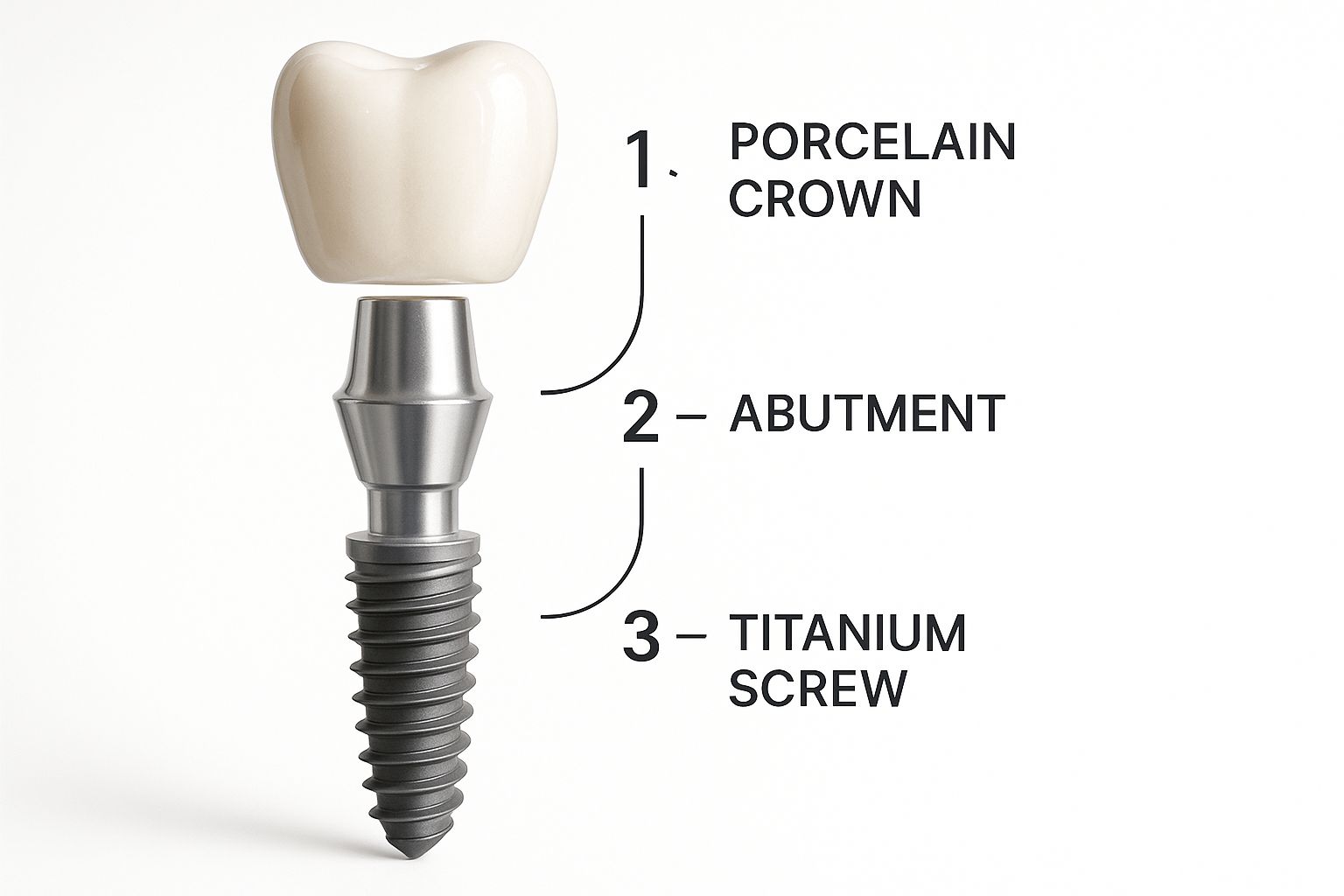
As you can see, the three parts—the implant post, the abutment, and the crown—work together perfectly to mimic the structure and function of a natural tooth.
The Denture Creation Process
Getting dentures is a much quicker and entirely non-surgical experience. Here, the focus is all about crafting a prosthetic that fits your mouth comfortably and looks completely natural.
A key differentiator in the treatment journey is the absence of a surgical component for dentures. This makes it a more accessible option for patients who may not be candidates for surgery or who need a faster tooth replacement solution.
The process usually involves a series of appointments over just a few weeks:
- Impressions and Molds: Your dentist will take precise impressions of your upper and lower arches. These molds are the blueprint for creating a model of your mouth.
- Bite Registration: You’ll be asked to bite down on soft wax rims. This step is crucial for recording how your upper and lower jaws relate to each other, ensuring your new dentures align for a proper bite.
- Wax Try-In: Next, a wax mock-up of the final denture, complete with the artificial teeth, is created. You get to try this in to check the fit, comfort, and look. This is the stage where we make adjustments to tooth shape, color, and position until you're happy.
- Final Fitting: Once you and your dentist approve the wax try-in, the final denture is made. At your last appointment, the finished prosthetic is placed, and we'll make any minor adjustments needed to ensure it feels secure and comfortable.
Even though the denture journey is faster, it’s important to expect an adjustment period. Learning to speak and eat with your new appliance takes a little time. Your dentist will give you plenty of guidance on care and may schedule follow-up visits to fine-tune the fit as your gums adapt. At Beyond Dental Care, we make sure this process is smooth and supportive from start to finish.
How Each Option Impacts Your Daily Life
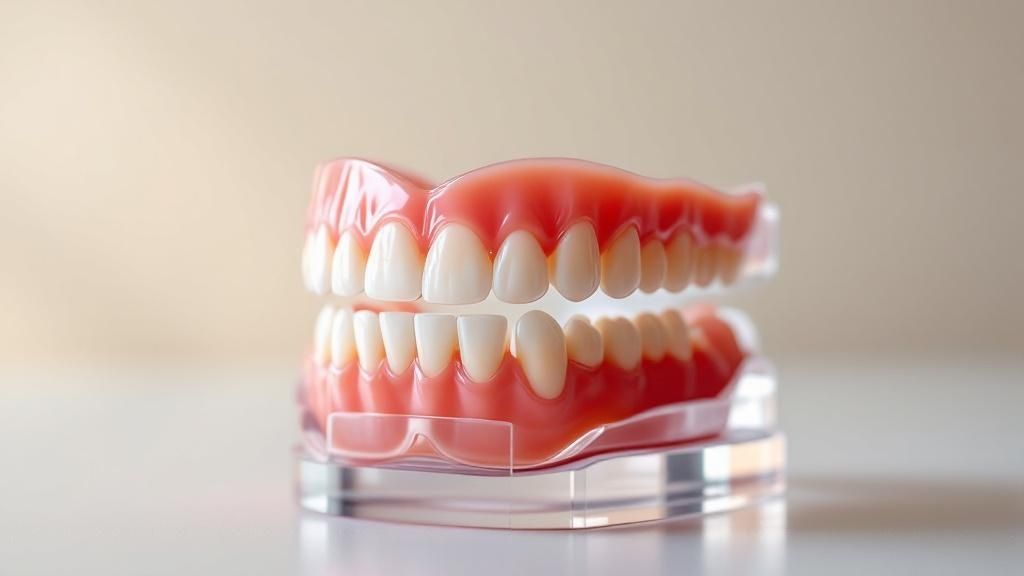
Choosing between dental implants and dentures goes far beyond the clinical chair. Your decision will directly shape your day-to-day life—from the foods you can enjoy to how confident you feel in a social setting. It’s a choice that weaves into how you eat, speak, and interact with the world every single day.
For patients who choose implants, life often feels like it's back to normal. Because an implant is anchored directly into your jawbone, it functions with the same stability and strength as a natural tooth. This means no more second-guessing whether you can bite into a crisp apple or enjoy a steak dinner with friends.
This rock-solid stability translates into a major confidence boost. You can speak, laugh, and eat without that nagging worry that a prosthetic might slip or make an awkward clicking sound. It's a true "set it and forget it" solution that lets you focus on living your life, not on your teeth.
Eating and Speaking Without Limitations
The difference in daily function is most obvious at the dinner table. With dental implants, your bite force is restored to nearly 100% of its natural capacity. This opens up a world of dietary freedom that many patients thought they had lost for good.
On the other hand, dentures require a period of adjustment and some ongoing caution. While today’s dentures are incredibly well-crafted, they rest on top of the gums and lack the root-like anchor of an implant. This means that hard, sticky, or particularly chewy foods can be a real challenge and might need to be avoided.
The core difference in daily life is psychological. Implant patients often report forgetting they even have a replacement tooth, while denture wearers are always conscious of having a removable appliance in their mouths.
Speaking can also present an initial learning curve with dentures. Some people notice a slight lisp at first or find they need to speak a bit more slowly to keep the denture from shifting. While this usually improves with practice, it’s a hurdle that implant wearers simply don't have to face.
The Real-World Impact on Confidence and Social Life
Beyond just the physical acts of eating and speaking, your choice has a profound impact on your self-esteem. The security of dental implants provides a level of confidence that is hard to overstate. There are no daily routines involving messy adhesives or soaking cups, and maintenance is as simple as brushing and flossing just like your natural teeth.
This sense of permanence is a huge driver behind the growing popularity of implants. The high success rate—reported to be between 95% and 98%—coupled with their long-term durability of over 25 years with proper care, only reinforces this confidence. As technology like 3D imaging advances and awareness of oral health grows, implants are becoming the preferred option for many. You can discover more insights about implant durability and success rates on schwimmerdental.com.
For denture wearers, the experience is different. It involves building a new daily ritual.
- Morning Routine: Applying adhesive to get a secure fit for the day.
- During the Day: Being mindful of food choices to avoid dislodging the prosthetic.
- Nightly Routine: Removing, cleaning, and soaking the dentures overnight.
This isn’t to say one is definitively better—it’s about what fits your lifestyle and priorities. For some, the affordability and non-invasive nature of dentures make these daily adjustments a worthwhile trade-off. For others, the freedom and seamless integration of dental implants are what matter most. The dental implants vs dentures debate ultimately comes down to which daily reality you prefer to embrace for your long-term well-being. At Beyond Dental Care, we can help you navigate this very personal decision.
Long-Term Health and Jawbone Preservation
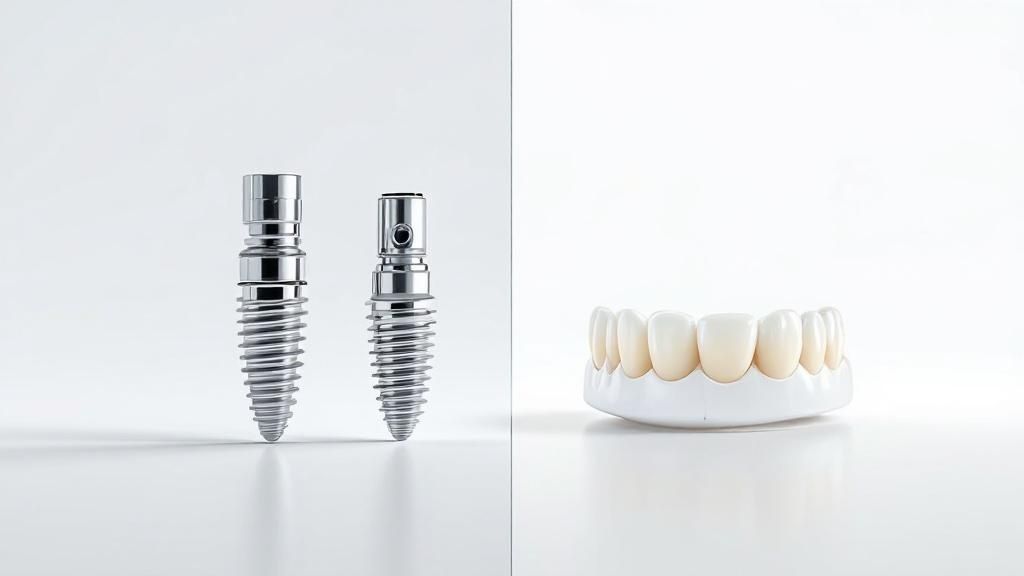
When you're choosing how to replace a tooth, it's easy to focus on the immediate results. But the decision you make today has huge effects on your oral health for years, even decades. This is where the dental implants vs dentures debate gets serious, because your choice directly impacts the health of your jawbone, the shape of your face, and what your future dental care will look like.
The core difference comes down to how each option interacts with your jaw. Your natural tooth roots do more than just anchor your teeth; they constantly stimulate the jawbone, telling your body to keep it strong and dense. Once a tooth is gone, that stimulation stops, and the body starts to absorb the bone tissue it no longer thinks is needed.
How Implants Protect Your Jawbone
A dental implant is the only replacement that truly mimics a natural tooth root. After being placed surgically, the titanium post fuses directly with your jawbone in a process called osseointegration. This bond re-establishes the vital stimulation that was lost when the tooth was removed.
This isn't just a minor detail—it's the key to stopping long-term bone loss. By keeping your jawbone dense and healthy, dental implants preserve your natural facial structure. Without that underlying support, the jaw shrinks, leading to that sunken, aged look often associated with missing teeth.
The Most Critical Long-Term Benefit: Think of a dental implant as a proactive investment in your health. It doesn't just fill a space; it actively protects the bone underneath, helping you avoid future complications and maintain your natural facial contours.
Caring for implants is refreshingly simple. Since they're fixed in place and act like real teeth, you just treat them like the rest of your smile—brush, floss, and get regular check-ups at a trusted practice like Beyond Dental Care.
The Reality of Jawbone Resorption with Dentures
Dentures are an effective and accessible solution for many people, but they just can't offer the same protection for your jawbone. A traditional denture simply rests on top of the gums, providing no direct stimulation to the bone beneath. As a result, the bone slowly but surely continues to dissolve away.
Over the years, this gradual bone loss changes the shape of your jaw. It's why dentures that once fit snugly start to feel loose and unstable. To manage this, denture wearers need to come in for periodic adjustments, called relines, to reshape the prosthetic to fit their changing jaw.
Eventually, the jaw changes so much that the denture has to be completely replaced, a step that's usually necessary every 5 to 7 years. This endless cycle of adjustments and replacements is a direct result of not having that essential jawbone stimulation.
Comparing Long-Term Maintenance and Upkeep
The daily and long-term care routines for these two options are worlds apart. One blends seamlessly into your life, while the other requires a whole separate maintenance protocol.
A Look at the Different Care Routines:
- Dental Implants: No special care needed. You brush and floss them just like your natural teeth, without ever having to remove them or use special soaking chemicals.
- Dentures: Must be taken out every day for cleaning. This means brushing them to clear away food and plaque, then soaking them overnight in a special solution to keep them disinfected and prevent them from drying out and warping.
This difference really highlights the gap between an integrated, permanent solution and a removable appliance. The dental prosthetics market is projected to grow from USD 12.57 billion in 2025 to USD 18.79 billion by 2030, and much of that growth comes from patients seeking more permanent, hassle-free solutions like implants. You can learn more about this trend and its key drivers on globenewswire.com.
Ultimately, your choice has lasting consequences. An implant becomes a permanent, healthy part of your body, while a denture will always be a separate device that requires constant management as your jaw slowly and inevitably changes.
A Realistic Look at Cost and Long-Term Value
When you’re weighing dental implants vs. dentures, the first thing that usually comes up is the price tag. Let's be upfront about it: dental implants have a significantly higher initial cost, often running from $3,000 to $6,000 for a single tooth. That number can feel intimidating, especially when you see how much more accessible dentures seem at first.
But here’s the thing: only looking at the initial cost is like comparing the price of buying a house to a single month's rent. It doesn’t give you the full picture. The real story unfolds when you look at the total cost over a lifetime.
Breaking Down the Upfront Investment
Think of a dental implant as a one-and-done investment in your oral health. The higher price covers the surgical expertise, the premium materials like titanium, and the creation of a permanent tooth that's meant to last a lifetime. With proper care, it becomes a fixed part of you.
Dentures, on the other hand, have a much friendlier starting price, which makes them a great option if you need a solution now or are on a tighter budget. But that first payment is just the beginning. The financial commitment to dentures is an ongoing one that lasts as long as you wear them.
Key Financial Takeaway: It helps to frame your decision as an investment choice. Dental implants are a capital investment in your permanent oral health. Dentures are more like an operational expense with recurring costs that never really end.
The Hidden Costs of Dentures Over Time
While dentures look like the budget-friendly choice initially, the costs really start to add up over the years. These aren't just small, occasional expenses—they are consistent costs you'll need to plan for.
Ongoing Denture Expenses Include:
- Adhesives and Creams: To feel secure, many people who wear dentures rely on daily adhesives. This becomes a steady monthly purchase.
- Specialized Cleaning Solutions: Dentures need to be removed and soaked every day in special cleaning tablets or solutions to keep them hygienic and prevent damage.
- Repairs and Relines: Your jawbone naturally shrinks without the stimulation of tooth roots, causing dentures to loosen over time. This means you'll need professional relining every 1-2 years and complete replacement every 5-7 years, with each service carrying its own cost.
These ongoing expenses are a huge part of the long-term financial picture. What starts as the more affordable option can, over a decade or two, start to catch up to the cost of implants, all without providing the same health benefits or day-to-day function. It's no surprise the global market for dentures is projected to hit USD 3.36 billion by 2030, largely because of their initial affordability. However, as noted in market analyses on platforms like mordorintelligence.com, these out-of-pocket costs and competition from implants present real challenges for patients.
Implants: An Investment Against Future Problems
The true value of a dental implant goes far beyond just replacing a tooth. Because they preserve your jawbone, they help you sidestep future problems—and costs—linked to bone loss. You avoid the gradual changes to your facial structure and eliminate the need for endless denture adjustments and replacements.
From a financial standpoint, implant maintenance is also much simpler. You won't be buying any special creams, soaks, or adhesives. All you need are the same toothbrush and floss you'd use for natural teeth, plus your regular dental check-ups. This doesn't just save you money; it saves you the daily hassle of a complicated care routine.
Ultimately, the choice comes down to what makes more sense for you financially. Do you prefer a lower upfront cost with smaller, recurring expenses for life? Or a larger, one-time investment for a permanent solution that protects your health and simplifies your daily life? Here at Beyond Dental Care, we can walk you through these financial realities to find the path that best aligns with your budget and your vision for your future smile.
Which Tooth Replacement Option Is Right for You?
Deciding between dental implants and dentures is a big step. It's about more than just filling a gap—it’s about matching a solution to your specific health needs, budget, and lifestyle. There's no single "best" choice here, only the option that's truly best for you. This decision really comes down to a few clear, situational trade-offs.
To help you think through this, let's walk through some real-world scenarios. This will make it easier to see where you might fit in the dental implants vs dentures discussion.
When Dental Implants Are the Clear Choice
For many of our patients, the ultimate goal is simple: restore their smile so completely they can forget they ever lost a tooth. If that sounds like what you're after, dental implants are almost certainly the superior choice.
Think about these situations:
- For the Active, Social Person: If you have a busy life and don't want to think twice before ordering at a restaurant, speaking in a meeting, or laughing with friends, an implant offers unmatched confidence. There are no adhesives, no worries about slippage, and zero dietary restrictions.
- For the Long-Term Thinker: If your main priority is protecting your oral health for decades, an implant is a proactive investment. Implants are the only solution that stimulates the jawbone, which prevents the bone loss that can change your facial structure over time.
- For Those Who Value Simplicity: If you appreciate a low-maintenance daily routine, an implant fits right in. You just brush and floss it like your natural teeth, skipping the daily ritual of removing, soaking, and cleaning a separate prosthetic.
Key Recommendation: Dental implants are for anyone who puts permanence and seamless function above all else. They are a one-time solution designed to last a lifetime, giving you the ultimate peace of mind.
When Dentures Make Practical Sense
While implants offer incredible benefits, dentures are still a valuable and highly practical solution for many people. They provide a clear path to a restored smile, especially when implants aren't a feasible option.
Dentures might be the right fit for you in these cases:
- Significant Bone Loss Without Grafting: If you've already experienced extensive jawbone deterioration and you either aren't a candidate for or don't want to undergo bone grafting surgery, dentures can restore your smile where an implant can't be placed.
- Need for an Immediate, Budget-Friendly Option: Dentures come with a much lower upfront cost and can be made relatively quickly. If your budget is a primary concern or you need to replace a tooth without a long wait, dentures offer an accessible and effective way to get your complete smile back.
- Certain Health Considerations: For patients with specific medical conditions that might complicate surgery or slow down healing, removable dentures provide a non-invasive alternative to bring back both function and appearance.
Ultimately, the right choice is the one that aligns with your personal circumstances. By understanding these specific scenarios, you can move forward with confidence, knowing you’re selecting the option that best serves your health and your life. To talk about your individual situation, schedule a consultation at Beyond Dental Care today.
Common Questions About Implants vs. Dentures
Even after you’ve weighed the pros and cons, you probably still have a few questions rolling around in your head. When it comes to the dental implants vs. dentures debate, the best choice often hinges on the little details of your health, lifestyle, and what you expect from your new smile. This is where we clear up those lingering doubts.
We’ll tackle the most common questions we hear from patients every day. Getting these final points sorted out is key to making a choice you’ll feel confident about for years to come.
Can Anyone Get Dental Implants?
This is a big point of confusion, and the short answer is no, not everyone is a perfect candidate right out of the gate. For a dental implant to succeed, it needs a solid foundation. That means you must have enough healthy jawbone to anchor the titanium post securely. Your overall health matters, too, as it plays a huge role in healing.
Some situations require a closer look or extra steps before we can move forward.
- Jawbone Health: If you've already experienced significant bone loss—which is common after losing a tooth—a bone graft might be necessary first to build the area back up.
- General Health: Conditions like uncontrolled diabetes, certain autoimmune disorders, or a history of radiation therapy to the head and neck can interfere with the healing process and how the implant fuses to the bone (a process called osseointegration).
A thorough consultation, complete with 3D imaging, is non-negotiable. This detailed assessment is the only way to know for sure if an implant has what it needs to become a permanent, successful part of your smile.
This first step is crucial. It helps us head off potential complications and sets the stage for a lifetime of stability.
Do Dentures Feel Like Real Teeth?
It’s a practical question, and the honest answer is no, they don't feel exactly like natural teeth. While today’s dentures are miles ahead of what your grandparents wore—custom-crafted for a comfortable fit and a natural look—there’s always an adjustment period. The biggest difference is that dentures rest on your gums, whereas implants are anchored in your bone.
This fundamental difference changes how things feel day-to-day. You'll notice a new sensation when you chew because the pressure is distributed across your gums instead of through a tooth root. It also takes a little practice to get used to speaking and eating, as you learn to use your facial muscles to help keep your dentures securely in place.
How Long Do Dental Implants Last Compared to Dentures?
When it comes to durability, the two options are in completely different leagues. Dental implants are designed to be a permanent fix. If you care for them properly—just like you would your natural teeth with good brushing, flossing, and regular dental check-ups—the implant itself can last a lifetime. The titanium post fuses with your jawbone and can't get a cavity.
Dentures, on the other hand, have a much shorter life cycle. Because they don't stop the gradual jawbone loss that occurs after teeth are lost, the shape of your mouth will change over the years. This means dentures need to be relined or completely replaced every 5 to 7 years to ensure they still fit properly and function well.
Making the right choice for your oral health is a significant decision. At Beyond Dental Care, we are committed to guiding you through every step with expert advice and personalized care. Schedule your consultation today to explore your options at Beyond Dental Care.