
Direct Answer: In 2024, the ADA stopped recommending lead aprons for dental x-rays because shielding can block the beam and cause retakes. Imaging frequency depends on your clinical history, not a set schedule.
You settle into the chair, the hygienist lines up the sensor, and then it hits you. Nobody put the heavy lead apron on you. For years that apron and the thyroid collar were part of the ritual, so when they vanish, it feels like something got skipped.
I get this question a lot from adults across North Glendale and the Upper West Side of Phoenix, especially people whose last set of images was five or ten years ago. It is a fair question, and it deserves a straight answer instead of a shrug.
So here is what actually changed, how often images are really needed, and what your insurance has to do with any of it.
Why the lead apron disappeared from dental x-rays
In 2024, an expert panel from the American Dental Association Council on Scientific Affairs, working with support from medical physicists at the FDA, recommended that lead aprons and thyroid collars no longer be used for dental imaging. That was not a cost-cutting move. It came out of a review of how modern equipment actually works.
Two things drove the change:
- Today’s machines aim a narrow, tightly controlled beam at a small area, so scatter outside that area is very low.
- Digital sensors need far less radiation than the film that older machines used.
The other half of the reasoning is the part patients rarely hear. A collar or apron can get in the way of the beam or the sensor, which cuts off part of the picture and forces a retake. A retake means a second exposure, so the shield that was supposed to reduce exposure can end up increasing it.
You can read the updated ADA recommendations on radiography safety directly if you want the source rather than my summary of it.
One thing that did not change: the guidance still calls for using the lowest radiation setting that will produce a usable image, and for taking images only when there is a clinical reason. The shield went away. The caution did not.
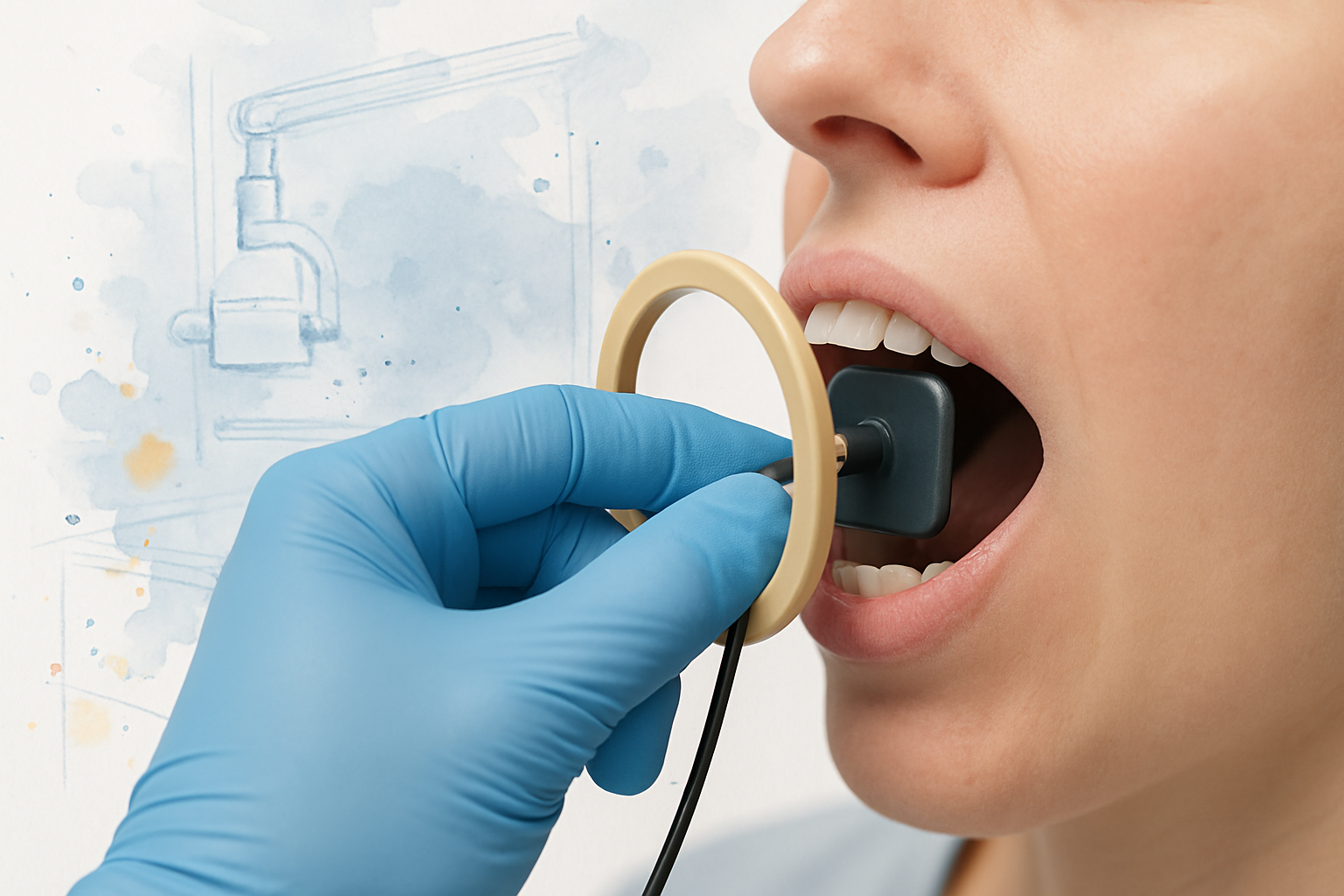
How often do you actually need dental x-rays?
This is the real question hiding under the safety question. And the honest answer is that images are not automatically taken at every cleaning.
The interval depends on what is going on in your mouth:
- Your decay history, including whether you have had new cavities recently
- Whether your gum and bone levels have been stable or are changing
- How many fillings, crowns, and bridges are already in there
- Whether anything new has shown up: pain, sensitivity, swelling, a chipped edge, a tooth that feels loose
- How long ago the last usable set was taken, and whether those files can be pulled up
A 40-year-old with no cavities in fifteen years and stable gums is on a very different schedule than someone with a mouth full of older restorations. Kids and teens with active decay often need images more often, because a molar can change a lot in a year.
Here is the distinction most patients have never been told. ADA and FDA guidance says the decision to take new images should rest on your clinical need, not on how often your dental plan happens to allow it. A plan that permits a set every twelve months is not a prescription.
So ask. Good questions sound like: What are you looking for in this set? What has changed since my last images? Can we use the ones from my previous dentist instead? Any office worth staying with will answer all three without getting defensive. It is the same instinct that serves you well at a thorough new patient exam.
What different dental images actually show
Not all x-rays are the same, and the type your dentist recommends tells you something about what they are checking. Here is a plain-language breakdown.
| Image type | What it shows | When it usually comes up |
|---|---|---|
| Bitewing | The crowns of upper and lower back teeth where they touch, plus early decay between them | Routine checks on decay-prone areas a mirror cannot reach |
| Periapical | One or two full teeth from the crown down through the root tip and surrounding bone | A specific tooth hurts, or there is a suspected infection at the root |
| Full mouth series | Every tooth and the bone around it, in a set of individual images | A first visit with a long gap in care, or planning restorative work |
| Panoramic | One wide view of both jaws, sinuses, and jaw joints | Wisdom teeth, jaw concerns, or a broad overview before a referral |
The questions worth asking before any set of images
If you remember nothing else from this article, remember these five questions. They put you in the conversation instead of just in the chair.
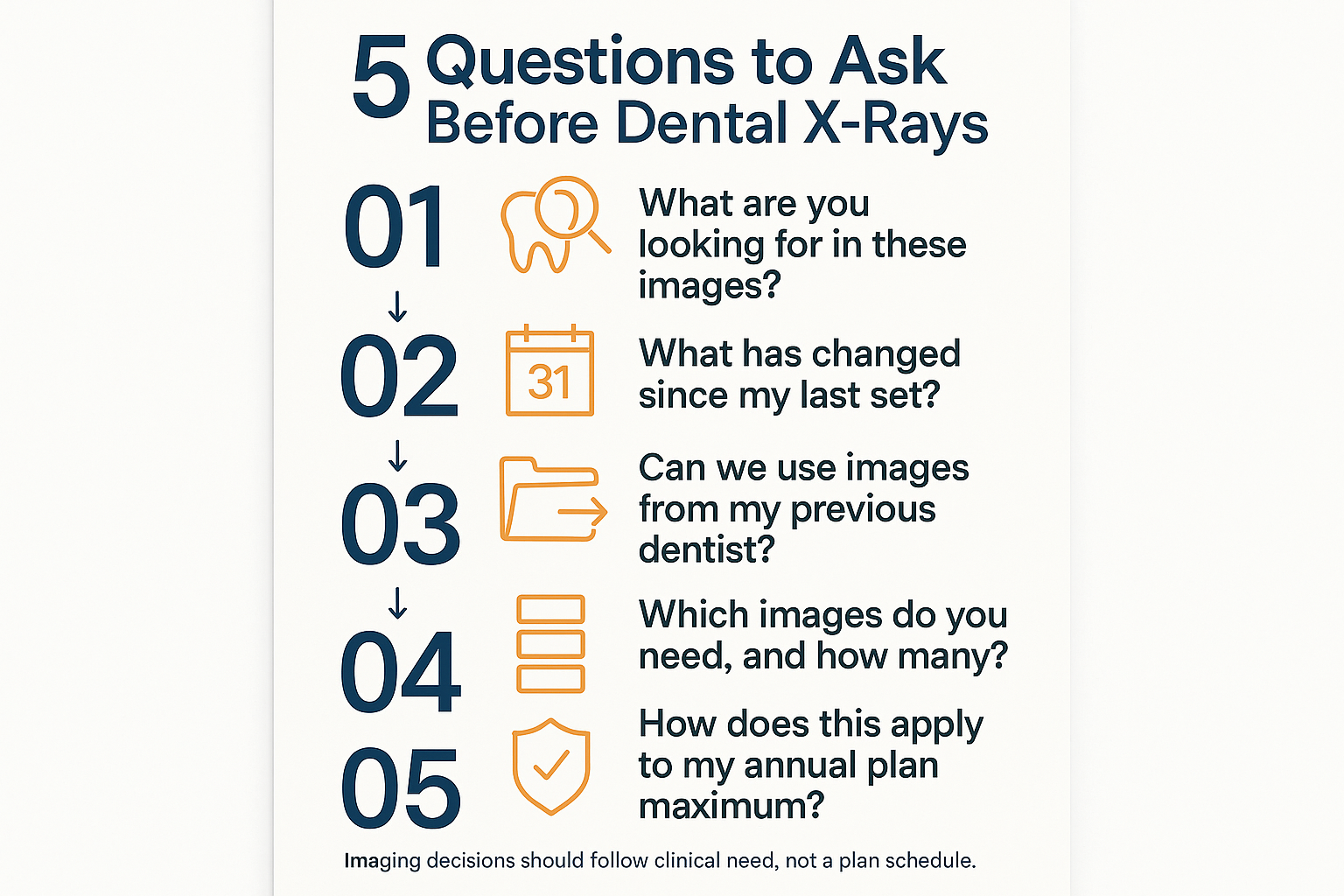
Where insurance fits in, without any made-up numbers
Insurance confusion is the number one reason people stall before booking anything at a dental office. Our call logs make that obvious, and imaging sits right in the middle of it.
One caller who had never used dental benefits before put it plainly: she wanted to know if there was a cap, and how the whole thing even worked. That is a very common place to be starting from.
In plain terms, most dental plans do two things with imaging:
- They cover a defined set of images at set intervals, often described in the plan as a frequency limitation
- Those images draw down the same annual maximum that your fillings, crowns, and other treatment come out of
That second point surprises people. Imaging is not a separate free bucket sitting off to the side. It shares the pot.
I am not going to quote you a number, because plans in the Northwest Phoenix market vary enormously and yours may be nothing like your neighbor’s in Arrowhead Ranch. Call your plan directly, or ask the front desk to verify your coverage before the visit rather than after. If you are self-pay, ask what the imaging portion of a new patient visit involves, the same way you would think through the cost of a cleaning and exam without insurance. There is also an in-office membership plan that takes 20% off treatment for patients without insurance, which is worth asking about.
Moving your x-rays from one office to another
This comes up constantly with people relocating into Stetson Valley, Norterra, Vistancia, and Arrowhead Ranch. You already had images taken somewhere. You should not have to pay for them twice.
The process is less complicated than people expect:
- You sign a records release authorizing your previous office to send your files
- The old office emails or transfers the digital image files to the new one
- The new office reviews them before or during your first appointment
The part that trips people up is timing. Give it at least a week or two before your first visit. Records requests sit in someone’s inbox, and if the files arrive while you are already in the chair, they are not much help.
This matters for specialists too. Endodontists and periodontists routinely ask for existing images before an appointment, and having them in hand can save a step.
And remember, the 2024 recommendations specifically encourage using images from previous exams where possible. So that one signature can genuinely spare you a repeat set. If you are still sorting out where to land, our guide on choosing a new dental home after a move walks through what else to ask.
What images catch that a visual exam never will
A mirror and a light are limited tools. There is a lot they simply cannot reach.
Images are how we see:
- Decay starting between teeth, where the surfaces touch and no instrument can look
- Bone levels around the roots, which is how gum disease progression gets tracked
- Infection sitting at the tip of a root, often before it hurts
- The condition of an older filling underneath, including breakdown at the margins
Here is the practical part. You can ask to see your own images on the monitor and have the findings pointed out tooth by tooth. That is not a special request. It should be standard.
One local patient’s review noted that she was told about her results but was not shown the images or visuals behind them. That gap is exactly what makes people uneasy about imaging in the first place, and it is fair feedback. Seeing the dark spot yourself turns a recommendation into something you understand, which is also why a preventive visit catches problems before they get expensive instead of after.
How we handle imaging here
Digital sensors, the lowest usable setting, and enough time in the appointment that nobody is rushing the positioning. Technique matters more than people realize, because a well-placed sensor means one exposure instead of two.
One patient put it better than I can: “The dental hygienist did an amazing job taking x-rays without leaving your gums feeling sore.” That comes from taking an extra ten seconds instead of jamming a sensor into place.
Dr. Dariene Lazore, DMD reviews images with patients on the screen, and if something is being recommended, the reasoning gets explained. Weekday hours run until 7pm Monday through Thursday, with Friday and Saturday by request, so working adults along the Happy Valley Road corridor do not have to burn a vacation day for a cleaning.
Frequently Asked Questions About Dental X-Ray Safety and Frequency
Is it safe to get dental x-rays without a lead apron?
Yes. The 2024 ADA recommendation, developed with support from FDA medical physicists, is that lead aprons and thyroid collars are no longer needed for dental imaging. Modern machines aim a narrow beam, digital sensors need less radiation, and shielding can actually block part of the image and force a retake.
Do I have to get x-rays at every cleaning?
No. Imaging intervals depend on your decay history, gum stability, existing fillings and crowns, and whether anything has changed. If a set is recommended, ask what it is checking for.
Can I use x-rays from my old dentist instead of getting new ones?
Often yes, and current guidance encourages it. You will need to sign a records release so the previous office can send the files. Request them a week or two before your appointment so they arrive in time to actually be useful.
Do dental x-rays count against my insurance maximum?
In most plans, yes. Covered images typically draw from the same annual maximum as the rest of your treatment, and plans also limit how often they will pay for a set. Verify the specifics with your own plan, since coverage across the Northwest Phoenix area varies widely.
What if I do not want x-rays taken at all?
You can always ask questions and say no. Just know that without images, some conditions cannot be diagnosed at all, and a dentist may not be able to move forward with certain treatment safely. It is worth having the conversation rather than declining silently.
Have questions about your own imaging history?
If you are due for a visit somewhere in North Glendale, Stetson Valley, Norterra, or North Peoria and you are not sure whether new images are needed, that is a reasonable thing to ask about before you ever sit down. Beyond Dental Care can be reached at 623-267-8088, and more about how the practice approaches imaging and preventive care is at beyonddentalcare.com.