
Direct Answer: From the first consultation to the final crown, dental implants typically take 6 to 12 months — sometimes longer if bone grafting is needed. The healing intervals between stages are what make the result last.
The number one question I hear from patients who are seriously considering dental implants — especially in the Arrowhead Ranch and Vistancia communities where we see a lot of adults planning ahead for major dental work — is some version of: how long is this actually going to take? The answer isn’t simple, and I think that’s why so many people feel confused after their first Google search.
Most implant timelines you see online say something vague like “several months.” That’s technically true, but it skips over the parts that actually matter: what happens at each stage, why there are waiting periods, and how your specific health picture affects the schedule. Those details are what help you plan your life around treatment — not a generic timeline.
This article walks through the full implant process stage by stage, with honest time ranges at each step. I’ll also address what changes for patients whose healing may move differently, including older adults managing health conditions. By the end, you’ll have a realistic picture of what the process looks like and what questions to ask before you start.
What the Implant Timeline Actually Looks Like, Stage by Stage
The single biggest misunderstanding I see patients walk in with is this: they think “the implant” is the whole tooth replacement — the visible white crown. It’s not. The implant is the titanium post that gets placed into your jawbone. The crown — the part that looks like a tooth — comes at the very end, after the post has fused with the bone over several months.
Understanding that separation is the key to understanding the timeline. Here’s how the stages break down:
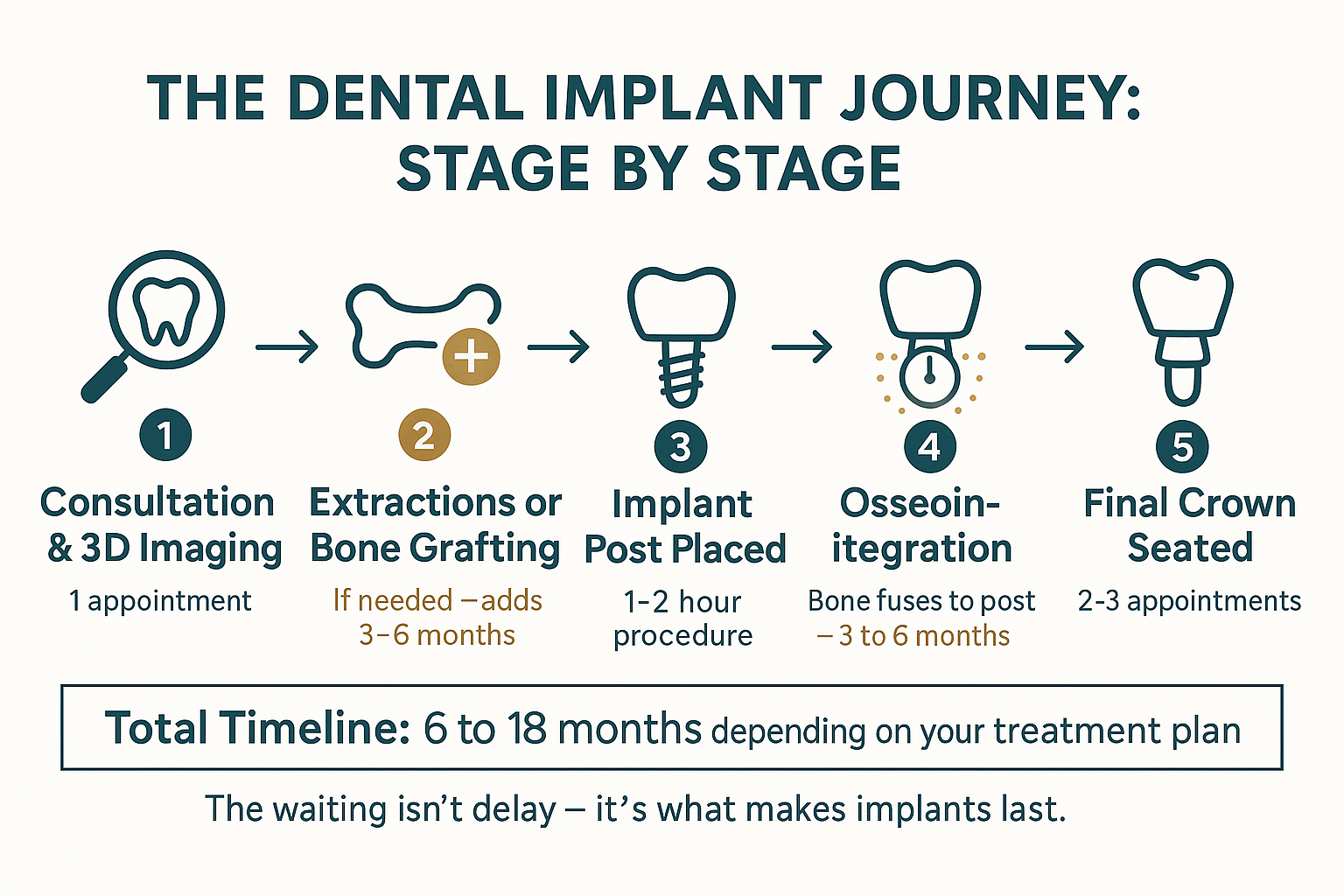
- Consultation and 3D imaging: This is where everything starts. A thorough exam — including a cone-beam CT scan — maps your bone volume, nerve position, and bite. This appointment typically takes about an hour. If you’re a candidate, you’ll leave with a clear treatment plan. Timeframe: 1 appointment, with a short wait if lab scans need to be reviewed.
- Extractions or bone grafting (if needed): Not every patient needs this step, but many do — especially if a tooth has been missing for a while or was lost to infection. A bone graft adds time because the graft site has to heal before an implant can be placed. Timeframe: 3 to 6 months of healing if grafting is required.
- Implant placement: The titanium post is placed into the jawbone during a surgical appointment. This is typically done under local anesthesia and takes 1 to 2 hours depending on the case. Timeframe: 1 appointment, plus the healing period that follows.
- Osseointegration — the healing interval: This is the period where the post fuses with the bone. It’s not a delay in your treatment. It is the treatment. This biological process is what gives implants their stability and durability that makes them last decades. Rushing it risks failure. Timeframe: 3 to 6 months, depending on the patient.
- Final crown placement: Once the implant has integrated, impressions are taken and the permanent crown is designed, fabricated, and seated. Timeframe: 2 to 3 appointments over 2 to 4 weeks.
Total from start to finish: typically 6 to 12 months. Cases involving bone grafting or slower healing can extend to 14 to 18 months.
Why the Waiting Period Is the Most Important Part of the Process
I want to spend a moment on osseointegration, because patients often think of the healing phase as inconvenient downtime between appointments. It’s actually the opposite.
When a titanium post is placed into the jawbone, the bone cells gradually grow around and bond to the surface of the implant over the following months. This is the same biological process that makes implants so different from other tooth replacement options — it’s not mechanical retention, it’s actual bone integration. An implant that has fully integrated will typically hold up to normal chewing forces for the rest of a patient’s life, which is why implant longevity compares so favorably to bridges or dentures.
Skipping or shortening this phase isn’t possible without significantly raising the risk of implant failure. So when a treatment plan says “come back in four months,” that four months isn’t bureaucratic — it’s the mechanism that makes the whole thing work.
For patients exploring tooth replacement more broadly, comparing implants to dentures often comes down to this question: are you willing to go through a longer process in exchange for a result that functions like a natural tooth and doesn’t require adhesives or removal?
Dental Implant Timeline at a Glance
Here’s a quick reference for each stage of the implant process, with typical timeframes. Keep in mind these are general ranges — your individual plan may vary based on bone health, healing speed, and whether preparatory steps are needed.
| Stage | What Happens | Typical Timeframe |
|---|---|---|
| Consultation & 3D Imaging | Exam, CT scan, treatment planning | 1 appointment |
| Extractions (if needed) | Removal of failing teeth | 1 appointment + 4–8 weeks healing |
| Bone Grafting (if needed) | Graft placed to build up bone volume | 3–6 months healing |
| Implant Post Placement | Titanium post placed into the jawbone | 1–2 hour appointment |
| Osseointegration | Post fuses with the jawbone | 3–6 months |
| Crown Placement | Final tooth restoration seated | 2–3 appointments over 2–4 weeks |
| Total (straightforward case) | No grafting needed | 6–9 months |
| Total (with bone grafting) | Grafting required before placement | 12–18 months |
The Dental Implant Journey: Stage by Stage
This visual breaks down the full implant process in sequence so you can see exactly where you are at each point in treatment.
For Seniors: How Health and Medications Can Shift the Timeline
I want to address this directly, because it’s something that doesn’t get enough honest coverage in generic implant content.
For patients in their 60s, 70s, and beyond — many of whom come to us from communities like Stetson Hills, North Peoria, and Cibola Vista — the implant process is absolutely achievable. But the timeline sometimes looks different, and the treatment plan needs to reflect that.
Several factors can affect osseointegration speed or require additional evaluation before placement:
- Bone density: Natural bone loss over time can mean bone grafting is more commonly needed in older patients before placement is possible.
- Medications: Certain medications — including some osteoporosis drugs, blood thinners, and corticosteroids — can affect healing or require a coordinated approach with your physician before any surgical dental procedure.
- Systemic conditions: Diabetes and other conditions that affect circulation or immune function can slow the integration process. This doesn’t eliminate candidacy, but it does mean the treatment plan needs to account for it.
- Dry mouth: Common in older adults due to medications, dry mouth raises infection risk during healing and is worth addressing proactively.
The right approach to all of this isn’t a one-size-fits-all timeline — it’s a personalized treatment plan built around your specific health picture. A thorough consultation that includes a review of your medications and health history is the starting point, not an afterthought.
If you’ve been weighing implants against other options, this comparison of implants and dentures for patients over 65 walks through the decision in plain language and may help clarify which direction makes sense for your situation.
Why Starting the Consultation Now Actually Matters
Because the implant process spans multiple visits over several months — sometimes the better part of a year — the consultation is not just an information appointment. It’s the starting gun.
For patients in the Norterra, Arrowhead Lakes, and North Canyon Ranch areas who are thinking about implants for 2026, there are real practical reasons to start that conversation soon rather than later:
- Dental benefit years often reset in January. Starting treatment now means you may be able to stage procedures across two benefit years and reduce out-of-pocket costs. HSA funds can also apply to implant procedures — worth knowing if you have an active account.
- Travel and family schedules are easier to plan around when you know your treatment map in advance. Implant appointments are spaced months apart — which is actually convenient once you have the calendar mapped out.
- Preparatory work takes time. If you need an extraction or bone graft before the implant can be placed, that adds months to the front of your timeline. Waiting to start means waiting longer to finish.
The consultation itself is low-pressure. It’s a conversation, an exam, and a scan — then a clear picture of what your specific process would look like. Everything from there is your decision to make at your own pace.
If you’re still in research mode and want to understand what sets different implant options apart before your first appointment, this breakdown of implant types is a good next read.
Frequently Asked Questions About the Dental Implant Timeline
Is the osseointegration period really necessary, or can it be shortened?
It’s necessary. Osseointegration is the biological process of your jawbone bonding to the titanium post, and it simply takes the time it takes — typically 3 to 6 months. Some newer protocols allow for earlier loading in very specific cases, but shortcutting this phase in an inappropriate candidate significantly raises the risk of implant failure. A well-integrated implant is built to last decades. That’s worth the wait.
Do I have to come in every week during the healing phase?
No. The osseointegration period involves very few appointments — often just one or two check-ins to monitor healing. Most patients say this phase is the easiest part of the process.
What if I need bone grafting — how much does that add to the timeline?
A bone graft typically adds 3 to 6 months to the front of your timeline. The graft site needs to consolidate and heal before the implant post can be placed with confidence. It’s a meaningful extension, which is one of the strongest reasons to start the consultation process sooner rather than later.
I’m in my 70s and take several medications. Am I still a candidate for implants?
Possibly, yes — but it requires a thorough evaluation. Age alone doesn’t disqualify someone from implants. What matters is bone volume, overall health, and how any medications you take may interact with the surgical and healing process. Some medications require coordination with your physician before proceeding. A detailed health history review is part of every implant consultation at Beyond Dental Care, and the treatment plan is built around your specific situation — not a generic template.
Can I use my dental insurance or HSA toward implant treatment?
HSA and FSA funds can generally be applied to implant procedures. Dental insurance coverage for implants varies widely by plan — some cover a portion, many don’t. What many patients don’t realize is that staging treatment across two benefit years can reduce out-of-pocket costs meaningfully. The team at Beyond Dental Care can help you understand what your plan covers before you commit to anything.
What does the final crown look like — will it be obvious it’s an implant?
The final crown is designed to match the color, shape, and size of your surrounding teeth. Done well, an implant-supported crown is essentially indistinguishable from a natural tooth — both to you and to anyone looking at your smile.
Ready to Know Exactly What Your Implant Timeline Would Look Like?
The best way to get a clear answer isn’t another article — it’s a conversation and a scan. At Beyond Dental Care, Dr. Dariene Lazore and the team guide every patient through each phase of implant treatment from that first consultation to the final crown, using advanced 3D imaging at each step. Reviewers consistently describe the experience as calm, organized, and personal — and for a process that spans months, that continuity matters. If you’re considering implants and want to understand your specific timeline and options, reach out to the practice at 623-267-8088 or visit beyonddentalcare.com to start that conversation.