
Direct Answer: Comfort-focused dental care means unhurried appointments, clear communication throughout, and a team that never makes you feel judged — regardless of how long it’s been since your last visit.
Somewhere around seventy percent of people avoid going to the dentist because of fear or anxiety — not because they don’t care about their teeth, but because a past experience left a mark. That number isn’t surprising to anyone who works in dentistry. What is surprising is how rarely that fear gets taken seriously.
For many adults across North Glendale, Arrowhead Ranch, and Stetson Valley, the avoidance isn’t about laziness. It’s about walking into an office and feeling rushed, unheard, or quietly judged for however long it’s been. Those feelings are real, and they keep people away far longer than they intended to stay gone.
This article breaks down what comfort-focused dental care actually looks like in practice — the specific things that make an anxious patient feel safe enough to come back, and what to look for when you’re trying to find the right dental home.
Why Dental Fear Doesn’t Go Away on Its Own
Dental anxiety tends to compound over time. A patient who had a painful filling at seventeen avoids the dentist for two years. Two years becomes five. By the time they’re in their forties, they’re managing mild gum disease they didn’t know was developing — and now they’re embarrassed about the gap and nervous about what might be found.
This is one of the most common patterns in a private dental practice. Patients who come back after a year or more away almost always expect to be lectured. They brace for it before the appointment even starts.
But the gap itself is rarely the problem. The problem is what went unaddressed during it. A good provider focuses on where things stand today and builds a plan forward — not a timeline of what should have happened sooner. If you’ve been wondering what to expect when coming back to the dentist after a long gap, that pattern of no-judgment, forward-focused care is exactly what the process looks like.
The other thing worth understanding: dental fear is not irrational. It’s usually based on something real — a provider who didn’t communicate, a procedure that hurt more than expected, or an office that felt transactional rather than attentive. Recognizing the source of the fear is the first step toward finding a practice where it doesn’t have to run the visit.

What Comfort-Focused Care Actually Looks Like in the Room
The phrase gets used a lot, but it’s worth being specific about what it means when a practice actually delivers on it.
Unhurried appointments are the foundation. When a patient feels like the provider has fifteen other rooms to get to, anxiety spikes. A team that moves at the patient’s pace — pausing when needed, checking in without being asked — changes the entire experience. One patient who reviewed the practice described nearly dozing off during a root canal. That doesn’t happen in a rushed office.
Explain-as-you-go communication is the second piece. Dr. Dariene Lazore, DMD, is known for walking patients through what she’s observing and why, in plain language — not clinical shorthand. Several patients have specifically mentioned that she “explained everything so clearly” and used “language that patients understand.” For anxious patients, the unknown is almost always worse than the reality. Knowing what’s happening and why removes a large part of the fear.
The third element is harder to manufacture: a team that genuinely doesn’t judge. One patient shared this in a recent review:
“No one judged me for not having been to the dentist for a while — something I was very anxious about.”
That single detail — knowing the team won’t make you feel bad for the gap — is what allows someone who’s been avoiding care for years to finally walk through the door and stay calm once they’re inside.
The practical things that matter in a comfort-focused visit:
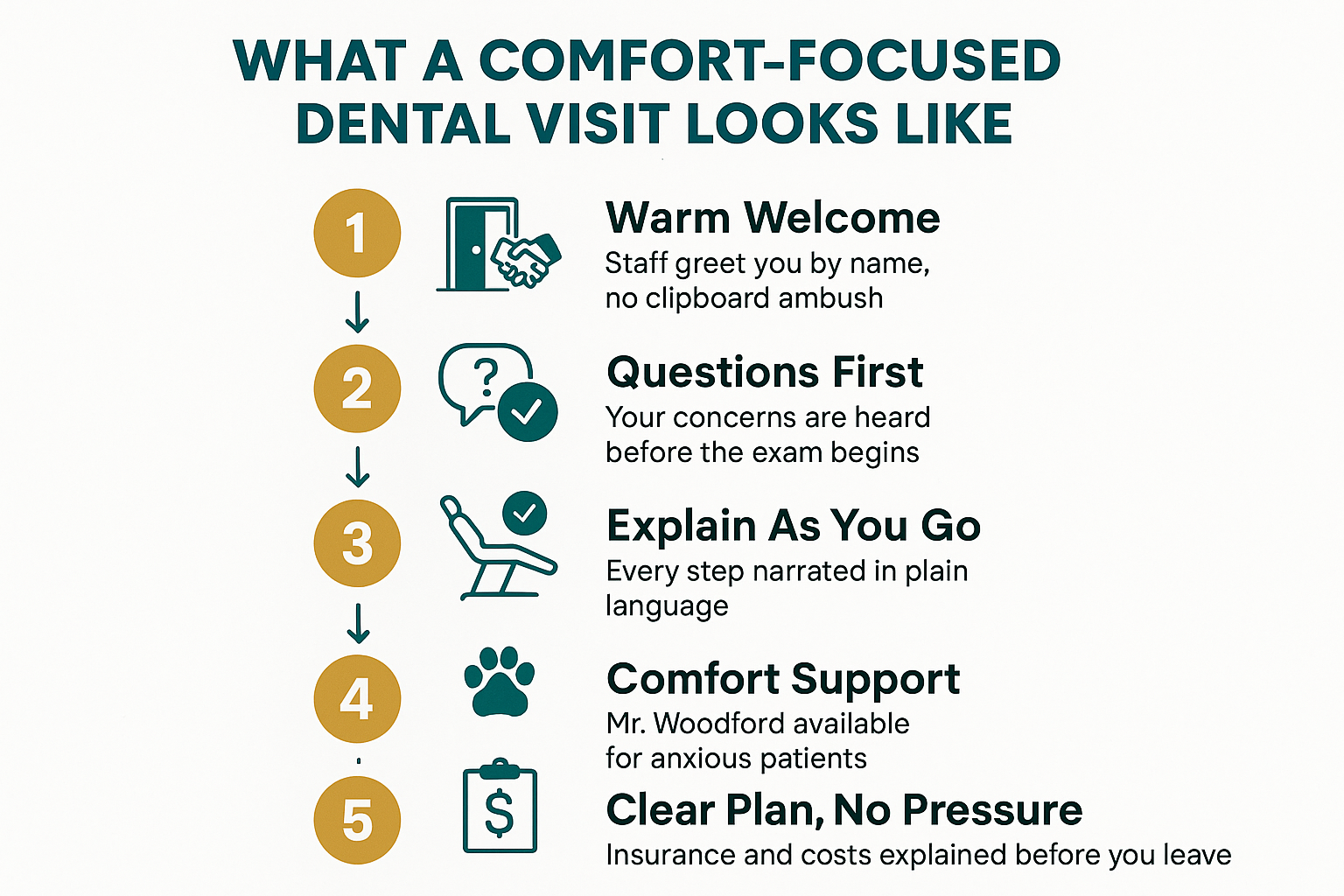
- A warm greeting before anything clinical happens
- Staff who ask how you’re doing and actually wait for the answer
- Clear explanation before each step of a procedure
- Regular check-ins during longer treatments
- Pricing and insurance explained clearly, without pressure, before you leave
The Anatomy of a Comfort-Focused Dental Visit
This breakdown shows what separates a comfort-focused appointment from a standard one — at each stage of the visit.
Mr. Woodford: Why an Emotional Assistance Dog Is More Than a Nice Touch
Beyond Dental Care has an emotional assistance dog named Mr. Woodford on site — and prospective patients specifically ask about him when they call or reach out to inquire about how the office handles fearful patients.
That detail matters. It’s not a marketing gimmick. For patients with genuine anxiety, a calm animal presence can lower cortisol measurably. And the fact that patients are already asking about him before their first appointment tells you something about how they’re processing the decision to come in.
One patient who had lived with anxiety-driven avoidance for years wrote:
“Mr. Woodford was there to offer a comforting, calm and reassuring paw, which made my visit exceptional.”
Another noted that her teenage daughters specifically look forward to seeing him at each visit.
For adults in Vistancia or Norterra who have been putting off care for months — or years — knowing there’s something that immediately reduces the clinical feel of the room is often the small detail that gets them to book. It signals something real about the practice’s overall approach: that patient experience is considered at every level, not just procedurally.
Comfort-Focused Practice vs. Standard Dental Office: What’s Different
This comparison covers the specific differences that anxious patients tend to notice most.
| What Anxious Patients Experience | Standard Office | Comfort-Focused Practice |
|---|---|---|
| Appointment pacing | Moves quickly through the schedule | Unhurried; patient sets the pace |
| Communication during procedures | Minimal — provider focuses on the work | Explain-as-you-go in plain language |
| Returning after a gap | Possible judgment or lecture about frequency | No judgment; forward-focused plan only |
| Emotional support | Clinical setting only | Emotional assistance dog on site |
| Cost and insurance conversation | Often rushed or at checkout | Explained clearly, with time for questions |
| Evening/weekend access | Weekdays only in many offices | Evening and Saturday appointments available |
Coming Back After a Long Gap — What That First Appointment Actually Involves
If it’s been a while, the first appointment back is typically a comprehensive dental exam — digital X-rays, a periodontal evaluation, an oral cancer screening, and a thorough clinical assessment. The goal is to understand exactly where things stand so the provider can build a realistic, personalized treatment plan.
What it is not: a session of catching up on everything you should have done. A provider focused on long-term oral health isn’t interested in making you feel behind. They’re interested in mapping a path forward that fits your actual situation.
For patients in Stetson Hills or Arrowhead Lakes who haven’t been seen in a year or more, a few things are worth knowing going in:
- Gum health is the most time-sensitive piece — early gum disease is largely reversible, but it does require consistent follow-up care
- X-rays may show early decay that doesn’t cause symptoms yet — finding it early is almost always better and less involved than treating it later
- A written care plan with clear priorities helps you make informed decisions without feeling overwhelmed
The exam is also where a practice like Beyond Dental Care gets to demonstrate its approach. Patients who are wondering why people feel nervous about seeing a new dentist often find that much of the anxiety fades once they experience an exam where nothing is rushed and everything is explained. The reality of the appointment is almost always less daunting than the anticipation of it.
Frequently Asked Questions About Dental Anxiety and Comfort-Focused Care
What if I haven’t been to the dentist in several years — will the staff make me feel bad about it?
A comfort-focused practice won’t. Returning after a gap of a year, two years, or longer is more common than people realize, and a good team treats it as a starting point, not a failure. The visit focuses on where your oral health stands today and what makes sense going forward — not on building a case for what should have happened sooner.
Does having a dog in the office actually help with dental anxiety?
For many patients, yes — and the response is often immediate. A calm animal presence lowers the clinical feeling of the room before anything procedural even begins. Patients with genuine fear have specifically credited Mr. Woodford with making their visit feel manageable when they expected to be tense the entire time.
What does ‘explain-as-you-go’ communication actually mean during a procedure?
It means the provider narrates what they’re doing and why before each step — not in clinical language, but in plain terms a patient can actually follow. “I’m going to apply a numbing gel before the injection” or “You’ll feel some pressure here but no sharp pain” are the kinds of cues that make a real difference. Knowing what’s coming next removes a significant part of what makes anxious patients tense.
Are evening and weekend appointments actually available, or is that a scheduling myth?
Beyond Dental Care offers evening and Saturday appointments specifically to accommodate adults with busy weekday schedules. If getting time off work is part of what’s been keeping you away, that barrier is worth revisiting.
I’ve had bad experiences at other dental offices. How do I know this one will be different?
The most honest answer is: read the reviews and listen for specificity. Generic five-star praise tells you less than a review where someone describes nearly falling asleep during a root canal, or credits the team with finally helping them complete treatment they’d been too afraid to finish. Specific outcomes from real patients are the clearest signal available before your first visit.
What if I need significant dental work — will I be pressured into treatment at the first appointment?
Comfort-focused care means the treatment plan is presented clearly, with priorities explained, and you have time to ask questions and make decisions at your own pace. Nothing in dentistry is so urgent that a patient should feel pressured in the exam room. The goal is an informed decision, not a same-day sale.
Ready to Find a Dental Home That Meets You Where You Are?
If dental anxiety has been keeping you away — whether it’s been six months or six years — Beyond Dental Care serves patients across North Glendale, Arrowhead Ranch, Norterra, Vistancia, and the broader Upper West Side Phoenix area with exactly the kind of unhurried, judgment-free care described here. Dr. Dariene Lazore and her team are accepting new patients, and evening and Saturday appointments are available for those who can’t step away during the week. You can reach the practice at 623-267-8088 or visit beyonddentalcare.com to learn more or request an appointment.