
Direct Answer: Dental implants preserve jawbone and function like natural teeth, while dentures are removable and less invasive upfront. The right choice depends on your bone health, budget, and long-term goals.
Most seniors comparing implants and dentures expect the conversation to be about money. And cost does matter — but the decision is more layered than most people realize when they first start researching.
What actually drives the comparison is what each option does — or doesn’t do — for your jaw, your diet, and your daily life over the next ten to twenty years. Patients across North Glendale, Vistancia, and Arrowhead Ranch are increasingly asking this question with more nuance than previous generations did, because they’re planning longer retirements and want answers that hold up over time.
This guide focuses on the three angles that matter most: how each option performs day to day, what happens to your jawbone over time, and how to think about the total cost picture — including how to stage treatment around your dental benefits.
What Daily Life Actually Looks Like With Each Option
The functional differences between implants and dentures show up most clearly at the dinner table and in the bathroom mirror.
With conventional dentures, most patients deal with:
- Removing them nightly for soaking and cleaning
- Applying adhesive before wearing them each day
- Avoiding harder or stickier foods that can dislodge or crack them
- Occasional slipping during speaking or chewing, especially as the jaw changes shape over time
With dental implants, the daily routine is close to what you had with natural teeth. You brush, floss around the implant, and go about your day. There’s nothing to remove, no adhesive, and no restricted food list once healing is complete.
Chewing strength is where the difference is most dramatic. Implants fuse directly with the jawbone, so they transmit biting force the same way a natural root does. Dentures sit on top of the gum and typically deliver a fraction of that force — estimates from clinical research commonly range from 20 to 30 percent of natural biting strength for conventional full dentures.
For seniors who want to eat freely — whole apples, steak, nuts — that difference matters. Patients who have made the switch from dentures to implants frequently describe the change as significant, often noting they had quietly been avoiding foods for years without fully recognizing it.
The Bone Loss Problem Most Patients Don’t Hear About Until Later
When a tooth is lost, the jawbone that once surrounded its root no longer receives stimulation from chewing. Without that signal, the bone begins to resorb — essentially shrinking over time.
This is one of the most clinically significant differences between implants and dentures, and it’s one that tends to surprise patients who aren’t told about it early. Dentures do not stop bone loss. They rest on top of the gum and provide no stimulation to the underlying bone. Over years, this can cause the jaw ridge to flatten, which is why many long-term denture wearers find their fit worsening even when the denture itself hasn’t changed.
Implants are the only tooth replacement option that stimulates and preserves bone. The titanium post integrates with the jaw through a process called osseointegration, which essentially signals the bone to maintain its density. A well-placed implant doesn’t just replace the tooth — it replaces the root function that was keeping bone structure intact.
For seniors in their late 60s or 70s planning ahead, this has real implications. Significant bone loss over a decade can limit future implant candidacy, complicate denture fit, and in some cases affect facial structure. Understanding how long dental implants actually last is part of understanding why the bone preservation factor matters so much in long-term planning.
The Middle Ground Options Many Seniors Don’t Know Exist
The implants-versus-dentures conversation doesn’t have to be all-or-nothing. There are hybrid approaches that combine the stability of implants with the coverage of a full arch restoration — and for many seniors, these options change the entire calculation.
Implant-retained dentures (sometimes called snap-on or overdentures) use two to four implants to anchor a full denture in place. The denture still comes out for cleaning, but it snaps securely onto the implants rather than resting on the gum with adhesive. Chewing strength improves significantly compared to conventional dentures, and slipping during speech is largely eliminated.
Implant-supported bridges use a small number of strategically placed implants to support a fixed bridge that doesn’t come out at all. This is different from a removable overdenture — the restoration stays in place the way natural teeth do.
For patients who aren’t implant candidates for every missing tooth position — due to bone volume, health considerations, or cost — these middle-ground options often deliver most of the functional and bone-preservation benefits of full implants at a more manageable total investment. Understanding the difference between implant types is a useful starting point before any consultation.
Implants vs. Dentures vs. Implant-Retained Dentures: A Side-by-Side Look
This comparison covers the key factors most seniors are weighing when they start researching tooth replacement options.
| Factor | Conventional Dentures | Implant-Retained Dentures | Full Dental Implants |
|---|---|---|---|
| Bone preservation | No — bone loss continues | Partial — slows loss where implants are placed | Yes — bone stimulation maintained |
| Chewing strength | Low (≈20–30% of natural) | Moderate to good | Closest to natural teeth |
| Daily removal required | Yes | Yes (for cleaning) | No |
| Adhesive needed | Usually yes | No | No |
| Upfront cost | Lower | Moderate | Higher |
| Long-term durability | Needs relining/replacement every 5–10 years | Implants last long; overdenture may need replacement | Implant can last decades with proper care |
| Candidacy factors | Most patients qualify | Requires adequate bone at implant sites | Requires bone evaluation; grafting sometimes needed |
The Long-Term Cost Picture: Why the Total Adds Up Differently Than Expected
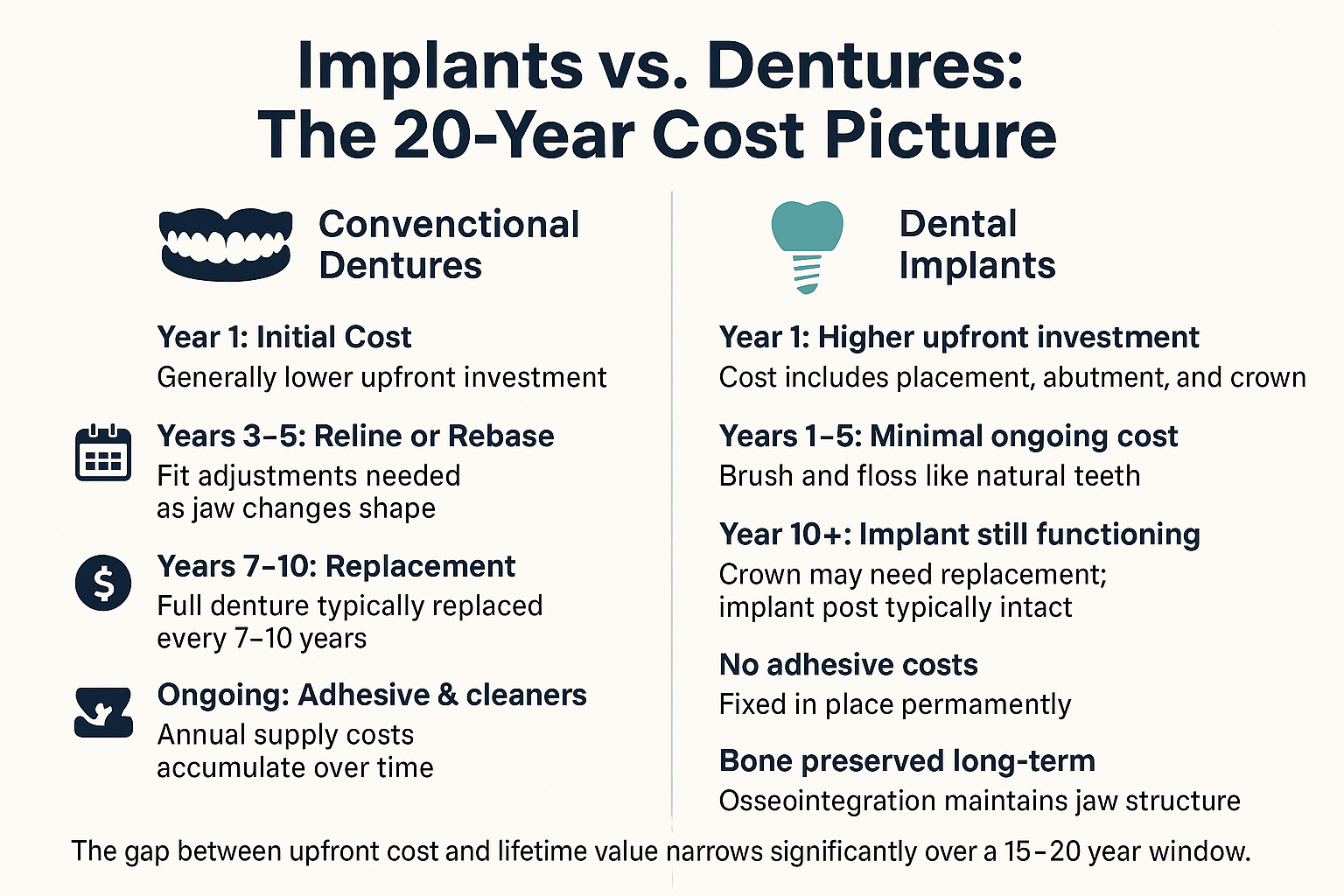
This infographic walks through how the cost comparison between dentures and implants shifts when you account for the full lifespan of each option.
How to Think About Dental Benefits When the Treatment Is Large
One of the most common questions seniors researching this decision ask is whether their dental coverage is worth using for something beyond routine cleanings — and if so, how.
Most dental plans operate on an annual benefit maximum, typically somewhere between $1,000 and $2,500 per year, though plans vary widely. For major restorative work like implants, that ceiling gets reached quickly. But there’s a planning strategy that many patients don’t hear about until they’re already sitting in a treatment chair: staging treatment across benefit years.
If a treatment plan includes multiple components — extractions, bone grafting, implant placement, and a final crown — a dentist can often sequence those steps so that some fall in one calendar year and others in the next, allowing two annual maximums to apply instead of one. This doesn’t change the total cost, but it changes how much of that cost insurance absorbs.
A few things worth knowing about how most plans handle implants:
- Many plans cover the crown portion of an implant but classify the implant post itself as a non-covered benefit
- Some plans have waiting periods for major services — typically 6 to 12 months for new enrollees
- Medicare does not cover routine dental care, though some Medicare Advantage plans include dental riders that vary considerably by plan
- AARP supplemental dental plans (which several callers in the Northwest Phoenix area have asked about) typically operate independently from medical Medicare and have their own annual limits
If you’re trying to understand how HSA funds can apply to dental treatment, that’s worth reviewing separately — it’s one of the most underused tools for retirees covering out-of-pocket dental costs.
The right approach is to bring your insurance card and a list of questions to your consultation, so the treatment plan can be built around your benefit structure from the start — not retrofitted to it afterward.
Frequently Asked Questions: Implants or Dentures After 65
Am I too old for dental implants?
Age alone is not a disqualifying factor. What matters is bone density, overall health, and whether conditions like uncontrolled diabetes or certain medications might affect healing. Many patients in their 70s and 80s are excellent implant candidates. A thorough evaluation — including digital imaging to assess available bone — is the only way to know for certain.
How long do dentures actually last before they need to be replaced?
Most conventional dentures need professional relining every 2–3 years as the jaw changes shape, and full replacement is typically needed every 7–10 years. Because bone loss continues under dentures, the timeline can accelerate for patients who’ve had them for a long time.
Is the implant procedure painful?
Patients are numbed during the procedure itself and typically describe the experience as far less uncomfortable than they anticipated. Post-placement soreness for a few days is normal and manageable. Reviewers at practices like Beyond Dental Care frequently note they were surprised by how calm and manageable the experience was.
What if I don’t have enough bone for implants?
Bone grafting can rebuild volume in areas where resorption has occurred. It adds time to the overall treatment process — typically several months of healing before implant placement — but it expands candidacy for many patients who were initially told implants weren’t possible. Whether grafting is right for you depends on how much volume has been lost and where.
Can I get implants to stabilize my existing dentures, or do I need to start over?
In some cases, existing dentures can be retrofitted to work with implants — but it depends on the condition of the current denture and how well it fits. New implant-retained dentures are often fabricated from scratch to ensure proper fit and function with the implant anchors. A dentist with experience in full-arch implant solutions can evaluate what’s feasible.
How do I know which option is actually right for me without just guessing?
You don’t have to guess — a comprehensive treatment consultation that includes digital X-rays, a bone density assessment, and a review of your health history gives you an actual picture to work from. The decision almost always becomes clearer once you have real data about your jaw and a personalized plan on paper.
Ready to Get a Clear Answer for Your Situation?
Beyond Dental Care, located on West Happy Valley Road in North Glendale, offers comprehensive treatment planning that covers both implant and denture options — from digital diagnostics through final restoration — under one roof. Dr. Dariene Lazore takes the time to walk through every option clearly and without pressure, which is exactly what patients across Stetson Valley, Norterra, and Arrowhead Ranch have consistently said they needed before making this kind of decision. To schedule a consultation, call 623-267-8088 or visit beyonddentalcare.com.