
Let's get right to it. When people ask how long dental implant recovery takes, they're usually asking about two very different things. The initial, noticeable recovery from the surgery itself is surprisingly quick—about one to two weeks. But the real magic, the part where the implant becomes one with your jawbone, takes anywhere from 3 to 6 months.
Think of it like building a new house. The foundation has to be poured and given plenty of time to set and cure before you can start putting up walls. Rushing that crucial step would be a disaster, and the same goes for your dental implant.
Your Dental Implant Recovery Timeline Explained
Understanding the recovery timeline isn't about circling a single date on your calendar. It's about knowing you'll move through a few distinct healing stages, each with its own purpose, typical symptoms, and aftercare instructions. When you know what to expect, the whole process feels much more manageable, and you can be confident you’re taking the right steps at the right time.
The journey starts with the immediate surgical recovery, which is often much faster and easier than most people imagine. It's the deeper, invisible healing that follows which takes the most time—and is without a doubt the most important part of getting a successful, long-lasting result.
To help you visualize this journey, here is a quick overview of the key recovery stages, what you can expect to feel, and what you should be focusing on during each phase.
Dental Implant Recovery Stages at a Glance
| Recovery Phase | Typical Duration | What to Expect | Key Aftercare Focus |
|---|---|---|---|
| Immediate Post-Op | Days 1 – 3 | Peak swelling, minor bleeding, and manageable discomfort. | Rest, cold packs, pain management, and a liquid/soft food diet. |
| Initial Gum Healing | Weeks 1 – 2 | Swelling and discomfort rapidly decrease. Gums are visibly healing. | Sticking to soft foods, gentle oral hygiene, avoiding strenuous activity. |
| Osseointegration | Months 3 – 6 | You'll feel completely normal, with no pain or symptoms at the implant site. | Living normally while your jawbone fuses with the implant. |
| Final Restoration | Post-Osseointegration | Ready for the final step! The abutment and crown are placed. | Enjoying your new, fully functional tooth and maintaining good oral hygiene. |
This table provides a great snapshot, but let's dive a little deeper into what's happening behind the scenes.
The Two Major Healing Phases
Your entire recovery really boils down to two main parts: the initial healing you can see and feel, and the long-term bone integration you can't. The first phase is all about your gum tissue. This is what you'll notice day-to-day, and most of our patients are pleasantly surprised by how quickly they feel better and can get back to light activities.
The second, longer phase is called osseointegration. This is the incredible biological process where your jawbone literally grows around and fuses to the titanium implant post. This is what creates that rock-solid anchor for your new tooth. You won't feel a thing while it's happening, but it's the silent hero of your entire implant journey.
This distinction is key: Feeling "recovered" after a week or two is totally normal, but the implant itself isn't ready for biting and chewing just yet. Patience during osseointegration is what ensures your implant will be a successful, lifelong solution.
This infographic breaks down the major milestones, from the initial post-surgery discomfort all the way to that final, complete bone fusion.
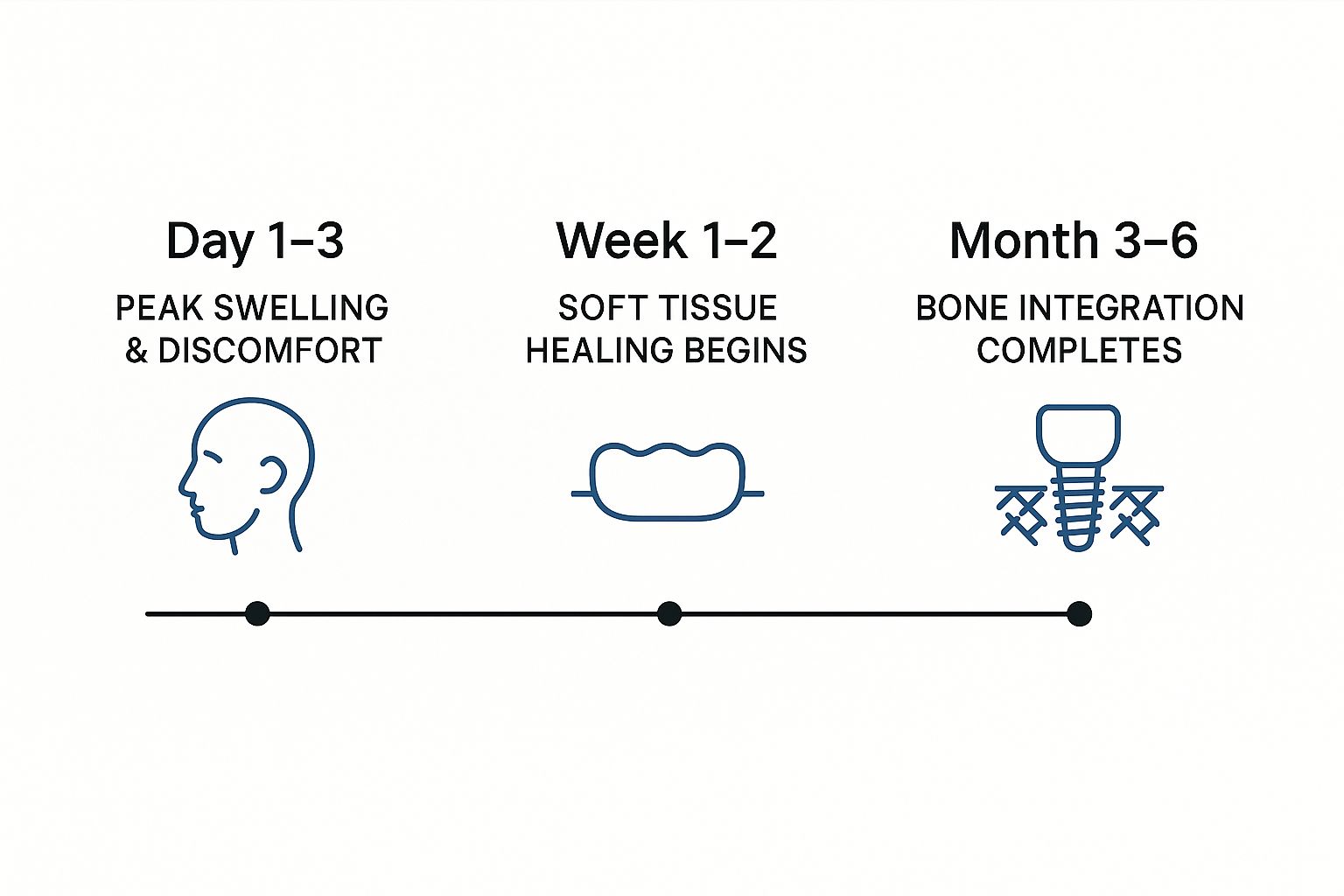
As you can see, the most noticeable symptoms are front-loaded into the first few days. After that, the most critical healing happens quietly over the next several months, setting the stage for an implant that becomes a permanent, reliable part of your smile.
From Surgery to Full Function
Most patients are over the immediate effects of surgery within just 3 to 4 days as that initial inflammation goes down. But the full journey, from surgery day to a fully stable implant, generally takes 3 to 6 months because of that all-important osseointegration phase. This time is absolutely necessary to make sure the implant can handle the daily pressures of chewing. You can get a more in-depth look at this recovery timeline to see why every stage matters.
Here’s a simple breakdown of what you can expect:
- Days 1-3: This is when you'll see the most swelling, a little bit of oozing or minor bleeding, and some discomfort. Your only jobs are to rest up, use cold packs on your cheek, and take any pain medication as prescribed.
- Weeks 1-2: You'll start feeling much more like yourself. Swelling will be almost gone, and your gums will be well on their way to healing. Sticking to soft foods is critical here, but you can usually get back to work and other non-strenuous daily routines.
- Months 3-6: This is the quiet waiting period of osseointegration. You'll feel completely back to normal, but your jawbone is working hard behind the scenes, locking that implant into place and creating a powerful foundation for your new tooth.
Navigating the First Two Weeks After Surgery
The first two weeks after your dental implant surgery are easily the most active and critical part of your recovery. Think of this time as laying the essential foundation for the implant's long-term success. Your body is putting in some serious work to heal the soft tissues, and how carefully you follow instructions now will directly impact how smoothly the rest of the process unfolds.
While the full journey of how long to recover from dental implants can take several months, this initial fortnight really sets the tone for everything to come. Your goals are pretty straightforward: manage the swelling, keep any discomfort in check, and most importantly, keep the surgical site clean and completely undisturbed. Nail these, and you're paving the way for the deeper bone healing that follows.
Your First 48 Hours
The first 24 to 48 hours demand the most attention and care. It’s absolutely essential to rest and avoid any kind of strenuous physical activity. This is when swelling usually hits its peak, so applying a cold pack to your cheek in 15-minute intervals can work wonders for reducing inflammation and providing some much-needed relief.
You might notice some minor bleeding or oozing, which is perfectly normal. Your main job is to be gentle and let your body start its natural healing process without any interruptions.
Crucial Tip: Do not use straws, smoke, or spit forcefully. These actions create suction in your mouth that can dislodge the blood clot forming at the surgery site. This clot is vital for proper healing, and losing it can lead to a painful complication called a dry socket.
The Soft Food Diet
For the first week or two, what you eat is one of your best tools for protecting the new implant. You’ll want to stick exclusively to soft, lukewarm foods that don’t require much, if any, chewing.
- Nutrient-Packed Smoothies: A fantastic way to get your vitamins without disturbing the healing area.
- Creamy Soups: Go for blended varieties to make sure there are no chunks that could cause irritation.
- Mashed Potatoes and Yogurt: These are classic comfort foods for a reason—they're easy to eat and gentle on your mouth.
- Scrambled Eggs: An excellent source of protein to help your body repair itself.
Steer clear of anything hard, crunchy, spicy, or extremely hot. These can easily disrupt the healing tissues and cause unnecessary discomfort.
Week One and Two Milestones
By the time you reach the end of the first week, you should start to see a real difference in swelling and pain. You can begin to ease back into light daily activities, but hold off on any heavy exercise for a bit longer. Gentle oral hygiene, like rinsing with a prescribed solution or warm salt water, becomes key to preventing infection.
This early healing window is more important than you might think. Research shows a significant number of early implant failures occur within the first few months. In fact, one analysis found that nearly a third (32.3%) of immediate implant failures happened inside the initial 4-month healing window. This really highlights why a good start is so crucial for long-term success. You can discover more about these long-term survival statistics and see for yourself why this early phase matters so much.
By following your surgeon’s aftercare instructions to the letter, you create the perfect environment for your new implant to heal properly and thrive for years to come.
The Science of Healing: What is Osseointegration?
While you'll probably start feeling back to normal within a week or two, the most important part of your recovery is happening silently, deep inside your jawbone. This amazing biological process is called osseointegration, and it's the absolute, non-negotiable key to making your dental implant a permanent, stable part of you. This is where science and your body work together to create a lasting solution for your missing tooth.
Think of it like a new tree setting down its roots. At first, the roots are small and haven't taken hold. But over time, they grow deeper and spread out, gripping the soil until they become a powerful, unshakeable anchor. Your titanium implant is like that new root, and your jawbone needs to literally grow into and fuse with its surface to form an incredibly strong, natural bond.
Why Does Osseointegration Take So Long?
This fusion isn't a quick fix; it's a gradual, organic process that simply can't be rushed. Your body sees the biocompatible titanium post as something it can bond with and starts depositing new bone cells directly onto it. This natural construction project takes time, typically between 3 to 6 months, to fully complete.
Trying to speed this up would be like building a house on a foundation of wet cement. It would never work. The implant wouldn't have the rock-solid stability it needs to handle the daily pressures of biting and chewing. Your patience during this phase is what truly guarantees the long-term success of your new tooth.
Osseointegration is what makes dental implants the gold standard. It's the unique process that allows an implant to act just like a natural tooth root, giving it a level of stability that old-school bridges and dentures just can't replicate.
How You Can Help This Vital Healing Phase
Even though osseointegration happens on a microscopic level, your day-to-day habits play a huge role in helping or hindering it. Giving your body the right support during this time is critical for ensuring that fusion happens perfectly and your implant journey is a predictable success.
Here’s how you can create the perfect healing environment:
- Focus on Nutrition: A balanced diet packed with vitamins and minerals, especially calcium and Vitamin D, gives your body the raw materials it needs to build new bone. Think of it as supplying the best building blocks for a very important construction job.
- Keep Pressure Off the Implant: This one is critical. You absolutely must avoid chewing directly on the implant area until your dentist gives you the all-clear. Any premature force can disturb the delicate new bone growth and stop the fusion process in its tracks.
- Don't Skip Your Follow-Up Appointments: These check-ins are how your dentist keeps an eye on the healing. They'll often use X-rays to see how the osseointegration is progressing and make sure everything is on track. It's the best way to spot any potential bumps in the road early on.
Factors That Influence Your Healing Speed

While the standard 3 to 6-month timeline for full recovery is a great guideline, it’s not set in stone. Every patient’s healing journey is unique, and several key factors can significantly influence how long you take to recover from dental implants. Understanding these variables helps set realistic expectations and empowers you to give your body the best shot at a speedy recovery.
Think of it like planting a new tree. The health of the soil directly impacts how quickly and strongly the roots take hold. In the same way, your overall health creates the environment for your new implant to thrive.
Your Personal Health Profile
Your body's natural ability to repair itself is hands down the most important factor in how quickly you'll heal. Certain health conditions and lifestyle choices can either help or hinder the critical process of osseointegration.
Here are the big ones to consider:
- Smoking or Vaping: This is one of the biggest roadblocks to a smooth recovery. Nicotine constricts your blood vessels, which chokes off the supply of oxygen and nutrients your surgical site desperately needs. This can seriously delay bone fusion and even increase the risk of implant failure.
- Systemic Conditions: Chronic conditions like uncontrolled diabetes or autoimmune disorders can put the brakes on your body's natural healing response. The good news? If you have these conditions well-managed, the impact on your recovery is often minimal.
- Oral Hygiene: Coming into surgery with healthy gums and a jawbone free of infection gives your implant a clean, stable foundation to heal in. It’s like starting a race from the front of the line.
Beyond these clinical factors, your general well-being plays a huge role. Getting enough quality rest is crucial for any kind of healing; looking into strategies for a restful night's sleep can make a real difference.
Procedural and Anatomical Factors
The specifics of your implant procedure also have a major say in your recovery timeline. Not all implant surgeries are created equal—some are straightforward, while others are more complex and naturally require more healing time.
Key Insight: A simple, single-implant placement in a healthy jaw will almost always heal faster than a complex case that involves multiple implants or preparatory work like bone grafting.
Common procedural variables that can extend your healing time include:
- Bone Grafting: If you didn't have enough natural jawbone to securely anchor an implant, a bone graft was likely needed first. This means your body has two jobs: heal the graft and integrate the implant. This preparatory step can add several months to your overall recovery.
- Implant Location: The jawbone isn't the same density all over. Implants placed in the front of the mouth, where the bone tends to be a bit softer, might need a little extra time to fuse compared to those placed in the dense, sturdy bone at the back of the jaw.
- Number of Implants: It just makes sense—placing a single implant is a much less involved surgery than placing several at once. A full-arch restoration, for example, is a more extensive procedure that will naturally come with a longer initial recovery period.
To help you see how these different elements can affect your personal timeline, we've put together a quick comparison table.
How Different Factors Influence Implant Recovery Time
| Influencing Factor | Standard Recovery Impact | Potential Extension | Patient Action |
|---|---|---|---|
| Smoking | Significantly slows blood flow and nutrient delivery to the surgical site. | 2-3 months or more; increased risk of failure. | Quit smoking at least 1 month before and throughout the healing process. |
| Unmanaged Diabetes | High blood sugar impairs immune response and slows bone integration. | 1-2 months or more; higher infection risk. | Work with your doctor to stabilize blood sugar levels before surgery. |
| Bone Grafting | Requires a separate healing phase before the implant can be placed. | 3-6 months before implant placement can even begin. | Follow all post-grafting instructions meticulously to ensure success. |
| Multiple Implants | More extensive surgery causes greater initial trauma and swelling. | 1-2 months longer for initial soft tissue healing. | Be extra diligent with aftercare, rest, and nutrition. |
This table illustrates why your dentist provides a personalized recovery estimate. By understanding these factors, you can be an active partner in your own healing process and set yourself up for the best possible outcome.
The Final Step: Attaching Your New Tooth

This is the moment you’ve been patiently waiting for. After months of quiet healing while the implant fused with your jawbone, it’s finally time to attach your new, custom-made tooth. It’s the rewarding finale where your implant transforms from a hidden foundation into a beautiful, fully functional part of your smile.
During this exciting visit, your dentist will attach two key pieces that complete the puzzle:
- The Abutment: Think of this as a small, sturdy connector. It’s placed right on top of the implant post and acts as the secure base for your new crown.
- The Crown: This is the part everyone will see—the tooth-shaped cap. It has been meticulously crafted to match the exact color, shape, and size of your natural teeth, ensuring it blends in seamlessly.
Defining Full Recovery
Your dentist will take great care to ensure the crown fits perfectly. They’ll make any tiny adjustments needed to give you a comfortable bite and a flawless appearance. Once it’s secured in place, you’ve reached what most of us consider "full recovery." This isn't just about the absence of pain; it's about getting your confidence back completely.
Full recovery means being able to eat your favorite steak, speak clearly without a second thought, and smile for photos without hesitation. The journey of understanding how long to recover from dental implants culminates right here, in this moment of restored function and beauty.
With your new tooth securely in place, the focus shifts from healing to simple, lifelong maintenance. Protecting this incredible investment is surprisingly straightforward. It just requires the same care you give your natural teeth—diligent brushing, flossing, and keeping up with your regular dental check-ups.
These simple habits are the key to ensuring your implant stays healthy and strong for decades. And the long-term success rates are truly impressive. Extensive studies show that implants have outstanding survival rates, with 96.8% still functioning perfectly after 10 years and 94.0% after 15 years. You can explore the full findings on implant longevity to see just how durable this solution is. Your commitment to good oral hygiene ensures you remain part of that success story.
Answering Your Questions About Implant Recovery
Even with a perfect surgery and a clear recovery timeline, it's completely normal to have questions about what your day-to-day life will actually look like. Knowing the practical side of things helps put your mind at ease. We get it.
Let's walk through some of the most common questions our patients ask so you can feel confident and prepared for your own healing journey.
When Can I Get Back to Work?
This one almost always comes down to what you do for a living.
If you have a desk job or a role that isn't physically demanding, you can probably plan on being back at it within 2-3 days. That's usually enough time for the initial swelling and soreness to peak and begin to fade.
On the other hand, if your job involves heavy lifting, constant bending, or any strenuous activity, you'll need to give your body more time. That kind of exertion can spike the blood pressure in your head, leading to uncomfortable throbbing and even bleeding at the implant site. For physically demanding jobs, we strongly recommend planning for a full week off.
Key Takeaway: Your body is your best guide, and your surgeon is your best advisor. Pushing yourself too hard, too soon is one of the easiest ways to complicate your healing. A few extra days of rest is a tiny investment for a successful implant that will last a lifetime.
What Are the Warning Signs of a Problem?
Your recovery should be a story of steady, gradual improvement. So, it’s just as important to know what isn't normal. Spotting a potential issue early is the key to protecting your new implant.
You should call our office right away if you notice any of these signs:
- Pain that gets worse, not better: Discomfort should be at its peak around day two or three, then slowly get better. If it suddenly gets more intense, that’s a red flag.
- Swelling that increases after day three: Just like pain, swelling should top out in the first 48-72 hours. If it starts getting worse after that, something might be wrong.
- A fever that won't go away: A slight, low-grade fever isn't unusual right after surgery. But if it sticks around or starts climbing, it could signal an infection.
- Pus or any discharge from the implant site: This is a clear sign of infection and requires immediate attention from your dental team.
- The implant feels loose: The implant itself is anchored in your bone and should feel completely solid. Any wiggling or movement is not normal and needs to be checked out.
When in doubt, always call. It’s far better to be safe and get reassurance than to wait and hope a problem goes away on its own.
What Can I Eat After My Surgery?
Your diet is a huge part of a successful recovery. For the first week or so, the goal is simple: be gentle with the surgical area and avoid putting any pressure on your new implant.
For the first week, your diet should be made up of soft, lukewarm foods—basically, anything you don’t have to chew. Some great choices include:
- Smoothies (just remember, no straws!)
- Yogurt or cottage cheese
- Mashed potatoes
- Creamy or puréed soups
- Applesauce
As you move into the second week, you can start reintroducing semi-solid foods that don't require much work, like oatmeal, scrambled eggs, or soft pasta. It is absolutely crucial that you avoid chewing directly on the implant site until your dentist gives you the all-clear. This usually happens after your final, permanent crown is placed.
Is It Normal to Have Pain After Getting an Implant?
Yes, absolutely. Feeling some pain and discomfort for the first few days is a completely normal part of the process. Your body just went through a surgical procedure, and it needs time to heal. Some soreness is to be expected.
Most of this discomfort can be easily managed with over-the-counter pain medication like ibuprofen, or with a prescription from your surgeon. The key is that the pain should get a little bit better each day. If you find it’s getting worse instead of better, that’s your cue to give your dental team a call.
At Beyond Dental Care, we believe that a well-informed patient is an empowered one. We are here to guide you through every single step of your dental implant journey with clear, compassionate advice you can trust. If you're considering dental implants and want a team that puts your comfort and success first, we invite you to learn more about our patient-centered approach.