
When it comes to dental cleanings, most people have heard the standard advice: go every six months. This twice-a-year visit has long been the gold standard for maintaining a healthy smile. But it's best to think of this as a starting point, not a one-size-fits-all rule that works for everyone.
The Six-Month Rule And Your Personal Cleaning Schedule

Think of the six-month dental cleaning like routine maintenance on your car. A standard oil change every 5,000 miles keeps a healthy car running smoothly, stopping small issues from turning into major, expensive repairs down the road. In the same way, a professional cleaning twice a year is often perfect for people with good oral health who are diligent about their at-home care.
This recommendation isn't just a random number. It’s based on the biological timeline of what’s happening inside your mouth. Even if you’re a rockstar with your daily brushing and flossing, plaque—that sticky, bacterial film—is going to build up. In just a few weeks, that soft film can harden into tartar (also called calculus), a stubborn substance your toothbrush simply can't remove.
Tartar's rough, porous surface becomes a magnet for even more plaque, kicking off a cycle that can lead to cavities and gum inflammation. The six-month interval is specifically designed to have a professional hygienist step in and disrupt this cycle before it causes real damage.
Why One Size Doesn’t Fit All
But just like a high-performance car needs more frequent tune-ups, your personal health profile is what really dictates your ideal dental cleaning schedule. A few key factors will influence how often you should be in our chair:
- Gum Health: If you have a history of gingivitis or more advanced periodontitis, more frequent visits are almost always necessary to keep it under control.
- Oral Hygiene Habits: How effective are you, really, with your daily brushing and flossing? This plays a huge role.
- Lifestyle Choices: Habits like smoking can have a massive impact on your gum health and your body’s ability to heal.
- Overall Health: Certain conditions, like diabetes, can affect your body's ability to fight off infections, including those that start in your mouth.
Professional dental cleanings are widely recommended to keep your mouth healthy and prevent disease. Plaque hardens into tartar relatively quickly, which is why you need a professional to remove it. You can explore more details by reviewing this summary on dental care recommendations to grasp the fundamentals.
To give you a clearer picture, here’s a quick summary of how we generally approach cleaning schedules based on a patient’s risk level.
General Dental Cleaning Frequency Guidelines
| Risk Profile | Recommended Cleaning Frequency | Primary Goal |
|---|---|---|
| Low Risk | Every 6-12 Months | Maintain good health and prevent future issues. |
| Moderate Risk | Every 4-6 Months | Manage existing conditions like gingivitis or heavy plaque. |
| High Risk | Every 3-4 Months | Actively treat and control periodontal disease or other serious conditions. |
Ultimately, a one-size-fits-all approach just doesn't work in modern dentistry, where our focus is on truly personalized care. Understanding this is the first step toward building a cleaning schedule that truly protects your unique smile and helps you avoid more serious problems. Your dentist is your partner in figuring out the perfect frequency for your specific situation.
The Science Behind Regular Dental Cleanings

To really get why consistent dental visits are so critical, we have to zoom in and look at the microscopic world happening inside your mouth every single day. It all starts with plaque—that soft, sticky film of bacteria that’s always forming on your teeth.
When you brush and floss, you’re breaking up and clearing away most of this plaque. The thing is, no at-home routine is ever perfect, and a little bit always gets left behind. In as little as 24 to 72 hours, that leftover plaque starts soaking up minerals from your saliva, hardening into a substance called calculus, which you probably know as tartar. Tartar isn’t something you can just brush away; it's tough, stubborn, and clings to your teeth.
The Problem With Tartar Buildup
A great way to think about tartar is to picture barnacles on the hull of a ship. A few small ones might not seem like a big deal at first. But over time, they build up, creating a rough, colonized surface that just invites more barnacles to attach, slowing the ship down and eventually starting to corrode the hull itself.
That’s exactly what tartar does in your mouth. Its rough, porous surface is the perfect real estate for more plaque to latch onto and thrive. This growing colony of bacteria then releases acids that eat away at your tooth enamel, which leads to cavities. At the same time, the bacteria irritate your gums, causing your body to trigger an inflammatory response.
This initial inflammation is what we call gingivitis. It's the earliest and most reversible stage of gum disease. The signs are often subtle—maybe some redness, a little swelling, or seeing a bit of pink on your toothbrush. If you ignore it, the condition can advance into something far more serious and, unfortunately, irreversible.
This whole cycle, from soft plaque to destructive tartar, is precisely why the question of how often you should get a dental cleaning is so important. A professional cleaning is the only way to hit the reset button. For anyone who wants to get into the nitty-gritty of this, exploring the deeper principles of oral hygiene can offer some fantastic insights.
Why Professional Tools Are Necessary
During a professional cleaning, your dental hygienist uses specialized tools to gently and safely remove that hardened tartar from above and just below your gumline. This process is called scaling, and it’s something you simply can’t do on your own at home.
Here’s why it’s a game-changer:
- It stops gum disease in its tracks: By removing the tartar, we get rid of the main irritant causing gum inflammation. This allows your gums to heal and reattach firmly to your teeth where they belong.
- It prevents cavities: Scraping away the bacterial colonies living in tartar removes the source of the acid attacks that cause tooth decay in the first place.
- It protects your overall health: Believe it or not, the bacteria from advanced gum disease can get into your bloodstream and have been linked to other health problems throughout the body.
Regularly removing this buildup is your absolute best defense against needing more complex and costly procedures down the road. Without it, you're running the risk of escalating problems that could eventually need urgent care. Should that ever happen, knowing where to find an emergency dentist in Glendale is crucial. When you understand this biological timeline, it becomes crystal clear that consistent cleanings are a foundational investment in your long-term health.
Factors That Customize Your Cleaning Frequency
While the six-month rule is a solid baseline for many people, it doesn't tell the whole story. The truth is, your ideal cleaning schedule is a highly personalized number that we calculate based on your unique health profile and risk factors. Think of it like a recipe—the base ingredients are the same, but the amounts change depending on the final result you're after.
This diagram breaks down the main things your dentist will look at.
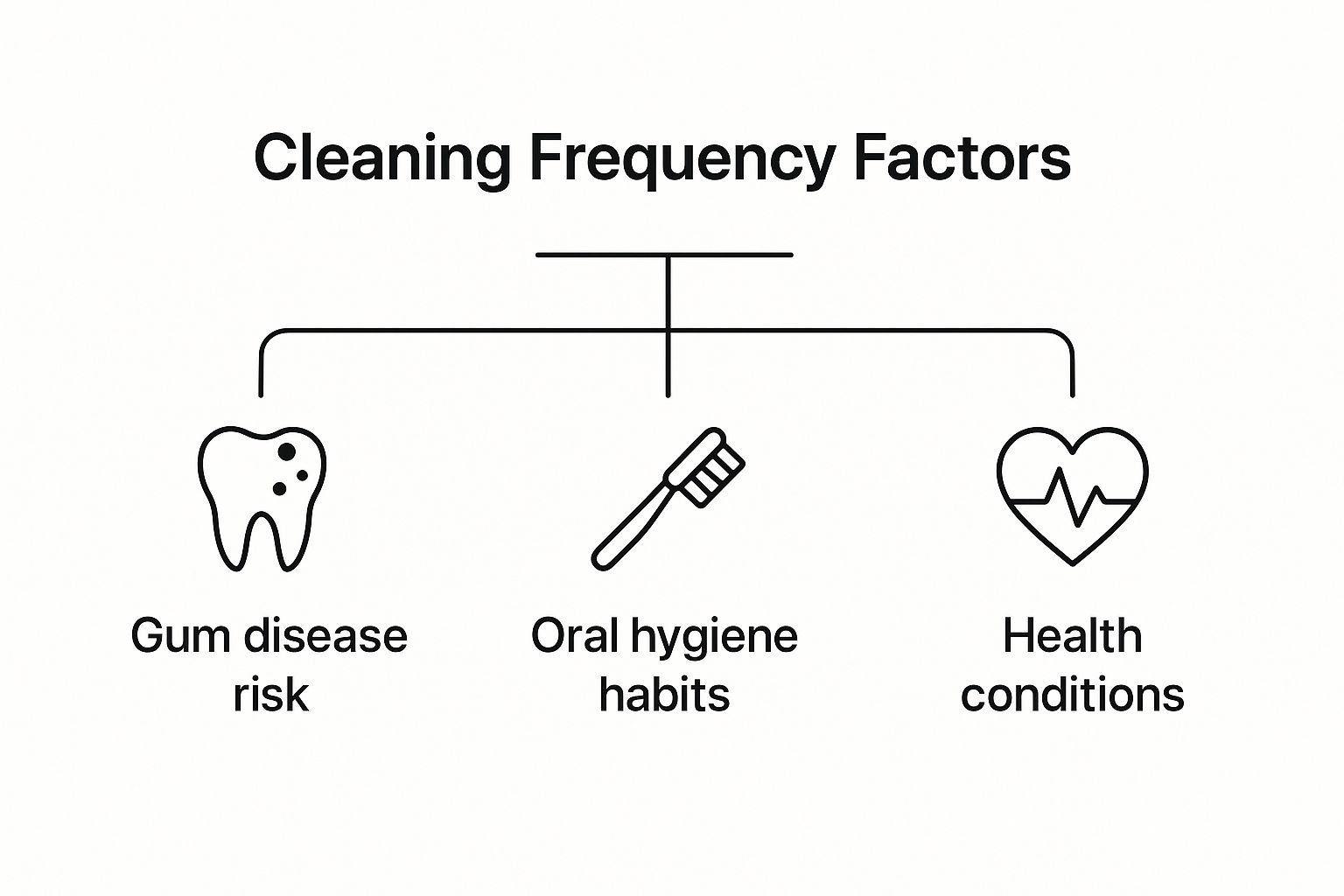
As you can see, your history with gum disease, your daily habits, and your overall health are the three pillars that hold up your personalized cleaning schedule.
Your History with Gum Disease
The single biggest factor that influences how often you should get a cleaning is your history with gum disease. If you've ever been diagnosed with gingivitis or its more advanced cousin, periodontitis, you’re automatically in a higher-risk category. It’s just a fact.
Periodontitis creates deep pockets between your gums and teeth that are simply impossible to clean effectively at home. Bacteria love to hide out in these pockets, and more frequent professional cleanings are the only way to disrupt these colonies and stop the disease from getting worse.
For these patients, a three or four-month schedule isn't just a friendly suggestion; it’s a critical part of a treatment plan to manage the condition and prevent tooth loss.
Lifestyle Choices and Daily Habits
Your daily routines play a huge role in how quickly plaque and tartar build up. Certain habits can put the process into overdrive.
- Tobacco Use: Smoking or using other tobacco products is one of the most serious risk factors for gum disease. It messes with the blood flow to your gums, which slows down healing and makes it harder for your body to fight off infections.
- Diet: A diet loaded with sugar and carbs is like a buffet for the harmful bacteria in your mouth. These bacteria produce acids that wear away your enamel and irritate your gums, making more frequent cleanings a necessity.
- At-Home Care: How well you brush and floss every day is paramount. If your technique is off or you're not consistent, professional cleanings need to happen more often to pick up the slack.
Overall Health and Medical Conditions
Your oral health and your overall systemic health are directly linked. Certain medical conditions create challenges that often require more frequent dental cleanings to keep things in check.
For instance, people with diabetes often have a tougher time fighting off bacterial infections, including those in the gums. Uncontrolled blood sugar can make gum disease worse, creating a destructive cycle. Likewise, anyone with a compromised immune system or even certain genetic predispositions might be more susceptible to aggressive plaque buildup. It's also important to know when you might need an emergency dentist in North Glendale, AZ, as this is a key part of your total health plan.
This is why we always do a thorough review of your medical history at every exam. By understanding your complete health picture, we can create a cleaning schedule that offers the absolute best protection for your smile.
When You Might Need Cleanings More Often

For some people, a standard six-month cleaning just isn't enough to keep their smile stable and healthy. In these situations, coming in more often isn’t just a precaution—it becomes a critical part of a targeted treatment plan. We might recommend you visit every three or four months to actively manage specific health conditions and stop them from getting worse.
Think of it like this: a standard cleaning is preventative maintenance, like a routine oil change for your car. A more frequent schedule is like ongoing physical therapy for your gums. It's a proactive, therapeutic approach designed to get existing issues under control and protect your health for the long haul. Several common scenarios call for this higher level of professional care.
Periodontal Maintenance After Gum Disease
The number one reason for a stepped-up cleaning schedule is a history of gum disease, also known as periodontitis. Once you’ve battled this condition, your mouth is permanently changed. You're often left with deeper pockets between your gums and teeth where harmful bacteria can easily hide and recolonize—areas that are simply impossible for you to clean effectively at home with a toothbrush and floss.
For these patients, a three-month cleaning schedule is the gold standard. We call this periodontal maintenance.
These appointments are more than just a typical cleaning. They are specialized visits focused on disrupting bacterial growth in those deep pockets before it can cause more bone loss or infection. This interval is critical because it takes about 90 days for bacteria to multiply to a level that can cause real destruction.
By coming in every three months, we consistently reset the clock. This keeps the disease in a state of remission and gives you the best shot at protecting your teeth for life.
Navigating Orthodontics Like Braces
Having braces is another situation that demands more attention from your hygienist. All those brackets and wires create a maze of nooks and crannies where food particles and plaque love to get trapped. This makes brushing and flossing effectively a real challenge, dramatically increasing your risk for cavities and gum inflammation.
To counteract this, your dentist or orthodontist will almost certainly recommend cleanings every three to four months while you have braces. This helps to:
- Remove buildup from around the brackets and under the wires where your brush can't reach.
- Prevent white spots (decalcification) from forming on the teeth.
- Keep gums healthy and reduce the swelling that can interfere with tooth movement.
Health Conditions That Impact Oral Health
Your body’s overall health is deeply connected to what's happening in your mouth. Certain systemic conditions can weaken your body's natural defenses, making you more vulnerable to oral infections and requiring more diligent professional care. This is where having a dedicated professional to turn to, like an emergency dentist in North Glendale, AZ, becomes a vital part of your support system.
People with compromised immune systems, uncontrolled diabetes, or certain cardiovascular diseases often benefit from more frequent cleanings. This proactive approach helps manage oral bacteria, reduces overall inflammation in the body, and supports your total wellness by ensuring your mouth isn’t adding to other health problems.
What to Expect During Your Professional Cleaning
Walking into a dental appointment can sometimes feel a bit mysterious, but knowing exactly what’s going to happen can ease any anxiety and show you the true value of the visit. A professional dental cleaning is a pretty straightforward process, and understanding each step helps demystify the experience and puts you in the driver's seat of your oral health.
Your visit will kick off with a quick but thorough examination. Your hygienist will take a look around, checking for any obvious signs of common problems like cavities or gum inflammation, also known as gingivitis. This initial check gives them a roadmap for your cleaning, letting them know if there are any specific spots that need a little extra attention.
The Cleaning and Polishing Process
Next up is the main event, which happens in a few key stages. The first is called scaling. This is where your hygienist uses specialized tools to gently remove hardened plaque (tartar) and any soft plaque from the surfaces of your teeth and just along the gumline. This is the crucial part of the cleaning that you simply can't do at home—only professional instruments can safely scrape away that stubborn tartar buildup.
Once the scaling is done, your teeth are ready to be polished. Using a slow-speed rotating tool with a soft rubber cup, the hygienist applies a slightly gritty paste to buff your teeth. This does more than just remove surface stains from things like coffee or tea; it leaves your teeth feeling incredibly smooth and looking shiny.
This smooth surface isn’t just for looks. A polished tooth makes it harder for new plaque to stick, giving you a head start in keeping your teeth clean after you leave the office.
Finally, most cleanings wrap up with a professional flossing session and a fluoride treatment. The hygienist will expertly floss between your teeth, clearing out any leftover debris from the polishing paste. The fluoride, often applied as a gel or a varnish, is a protective mineral treatment that helps fortify your tooth enamel, making it more resistant to the acid attacks that lead to cavities.
Every step is intentionally designed to give your oral health a complete reset, making your decision on how often you should get a dental cleaning a powerful part of your overall wellness routine.
Got Questions About Dental Cleanings? We’ve Got Answers.
Even when you understand why your cleaning schedule is what it is, practical questions always seem to pop up. It’s totally normal. Trying to figure out insurance, costs, and the difference between various types of cleanings can feel like a maze, but getting straight answers is the key to managing your oral health with confidence.
Let's tackle some of the most common things we hear from patients.
One of the biggest questions we get is, "My teeth feel fine, can I just skip this cleaning?" It’s a tempting thought, but it's a mistake we see all too often. The most serious problems, like the early stages of gum disease or small cavities, usually don't cause any pain or have obvious symptoms.
Think of it like this: your toothbrush and floss are great for daily upkeep, but professional cleanings are what remove the hardened, stubborn tartar buildup that you just can't reach. Skipping that essential step gives hidden problems the green light to get worse, often leading to more complicated and expensive treatments down the road.
What's the Difference Between a Regular and a Deep Cleaning?
This is a frequent point of confusion, and it’s a great question because they are two completely different procedures designed for different situations.
- Regular Cleaning (Prophylaxis): This is all about prevention. If your gums are healthy, a regular cleaning keeps them that way by removing plaque and tartar from above the gumline. It's routine maintenance for a healthy mouth.
- Deep Cleaning (Scaling & Root Planing): This is a therapeutic treatment for when you have active gum disease. It’s more involved because we need to clean below the gumline, smoothing the roots of the teeth to help infected gums heal and reattach.
Another hot topic is insurance. Most standard dental plans will cover two cleanings per year. However, if your dentist recommends a more frequent schedule for a specific medical reason—like periodontal maintenance to manage gum disease—some plans will provide additional coverage. The best move is always to check your specific policy.
If you're curious about what healthy teeth and gums should look like after a cleaning, this informational image provides a great visual. Having a clear picture of these details empowers you to make smart decisions and truly own your oral health.
At Beyond Dental Care, we're firm believers in creating a care plan that is 100% about you and your unique needs. If you have more questions about what cleaning schedule is right for you or you’re ready to experience our patient-first approach, we’d love to connect. Schedule your appointment today by visiting us at https://beyonddentalcare.com.