
The secret to a calm dental visit often starts long before you even sit in the chair. It really boils down to preparation and choosing an environment where you feel safe and heard. Simple things, like scheduling your visit for a low-stress time and being open about your fears from the get-go, can make a world of difference. This isn’t about ignoring the anxiety; it’s about taking back control so you feel prepared, not panicked.
Building a Foundation of Calm Before Your Visit
If the thought of a dental appointment makes your heart race, you’re in very good company. This is an incredibly common feeling, and the numbers back it up. A major global analysis of over 72,000 adults found that about 11.2% suffer from high dental fear, and another 2.6% live with a severe dental phobia.
So, if you’re nervous, know that you are far from alone. This is exactly why laying a foundation of calm before you even walk through the clinic door is one of the most powerful things you can do.
Find a Dentist Who Understands Anxiety
Not all dental practices are created equal, especially when it comes to managing patient comfort. Start by looking for a practice that openly talks about its experience with anxious patients. Check their website or patient reviews for mentions of a “gentle approach,” “sedation options.” These are all good signs they’re equipped to help.
Once you have a potential office in mind, don’t be shy about calling them. A quick chat can reveal everything. Try asking a few direct questions:
- “I get pretty anxious about dental work. How do you help patients feel more comfortable?”
- “Would it be possible to stop by for a quick tour or a brief meet-and-greet before I book an actual appointment?”
- “Do you explain what you’re doing during procedures? And is it okay for me to signal for a break if I feel overwhelmed?”
Their response will tell you a lot. A team that’s patient, understanding, and happy to accommodate you is exactly what you’re looking for. A rushed or dismissive answer is a clear red flag.
Strategic Scheduling and Preparation
The day and time you book your appointment can genuinely set the tone for the entire visit. Try to avoid cramming it into a hectic workday or scheduling it right before a big, stressful event. Instead, aim for a time when you naturally feel more relaxed, like a quiet morning or an afternoon with nothing else on the agenda.
It’s a lot like getting ready for any other wellness appointment. Just as you’d find tips for preparing for a relaxing experience before a massage, applying that same mindset here can help you walk in with a much calmer state of mind.
Getting a feel for the office ahead of time can also work wonders to demystify the experience. Hop on their website and look for photos of the team and the treatment rooms. Seeing friendly faces and the space beforehand makes it all feel more familiar and less intimidating on the day of your appointment. It’s a simple trick to combat the fear of the unknown.
Mental Techniques for a Calmer Mindset

When appointment day finally rolls around, your mindset is your most powerful ally. You’ve done all the physical prep work, so now it’s time to shift your focus inward. Honestly, learning how to relax at the dentist often comes down to managing the conversation happening inside your own head.
The good news? You don’t need to be a meditation guru to find your center in the waiting room. A few simple, proven mental exercises can dramatically lower your stress levels and make the entire experience feel much more manageable.
Master Your Breathing
When we’re anxious, our breathing becomes shallow and quick, which just screams “panic!” to our nervous system. But you can hit the brakes on this anxiety loop with some intentional breathing. One of the absolute best methods is the 4-7-8 technique.
It’s super discreet, so you can do it anywhere—in the waiting area or even once you’re in the dental chair. Here’s how it works:
- Breathe in quietly through your nose for a count of 4.
- Hold that breath for a slow count of 7.
- Exhale completely through your mouth, making a gentle “whoosh” sound, for a count of 8.
Just repeating this cycle three or four times is enough to physically calm your nervous system and signal to your body that it’s time to relax.
Harness the Power of Visualization
Here’s a cool trick: your mind can’t really be in two places at once. Visualization takes advantage of this by whisking you away somewhere peaceful, even while your body is at the dentist’s office.
Try closing your eyes and picturing a place where you feel completely safe and happy. Maybe it’s a quiet beach with warm sand, a cozy cabin next to a crackling fire, or a peaceful walk through a forest. The key is to engage all your senses. What do you see? What can you hear or smell? The more vivid you make it, the more powerful the distraction becomes.
Key Takeaway: Your imagination is a powerful tool for managing in-the-moment anxiety. By creating a detailed mental escape, you actively shift your brain’s focus away from the dental environment and toward a place of tranquility and comfort.
This kind of guided imagery is a lot like storytelling. If you want to build up more of these mental resilience skills, you might find it helpful to explore resources like a complete guide to bedtime stories for adults with anxiety and stress, which uses similar principles of narrative escape to calm the mind.
Use Affirmations and Strategic Distractions
Negative thoughts can spiral out of control in a hurry. You can fight back with positive affirmations—and these aren’t just fluffy, wishful thinking. They’re intentional statements designed to reframe your entire mindset.
So, instead of letting “I can’t handle this” run on a loop, try repeating phrases like:
- “I am in a safe place with professionals who will take care of me.”
- “I am in control, and I can ask for a break at any time.”
- “This is temporary and is for my long-term health.”
Sometimes, though, your brain just needs something else to latch onto entirely. That’s where a good distraction toolkit comes in handy. Plan ahead and bring a few things with you:
- An Audio Escape: Get a captivating podcast, an audiobook, or a long playlist of your favorite music ready to go. Noise-canceling headphones are a game-changer here, as they can block out triggering sounds like the dental drill.
- Fidget Tools: A small, quiet fidget toy or a simple stress ball can do wonders. The physical act of squeezing or fiddling with something gives all that nervous energy a place to go.
When you combine these mental strategies, you’re building a solid defense against anxiety. You can pick and choose whatever technique feels right in the moment, empowering yourself to stay centered and calm through your entire visit.
How to Communicate Effectively with Your Dentist

So much of dental anxiety comes down to one thing: feeling like you’re not in control. It’s often not the procedure itself, but the sense of being passive in the chair that ramps up the stress. But here’s the good news—effective communication completely flips that script. It turns you from a patient into an active partner in your own care.
Your dental team genuinely wants you to be comfortable, but they can’t read your mind. Opening up about your fears isn’t being difficult; it’s giving them the exact information they need to make the experience a good one for you. It’s about building a team environment right there in the treatment room.
Establish a Simple Stop Signal
Before any work starts, agree on a non-verbal “stop” signal with your dentist or hygienist. This is a game-changer. It puts control right back in your hands. A simple gesture, like raising your left hand, is all it takes.
Just knowing you can pause the procedure at any time, for any reason, is incredibly empowering. It breaks the cycle of fear that you’ll be “stuck” if things feel like too much. You can pause, take a breath, and say, “I’m okay, I just needed a second.”
The most relaxing dental visits happen when there’s a foundation of trust and clear communication. A simple, agreed-upon signal ensures you feel heard and respected, giving you the confidence that your comfort is the top priority.
This kind of proactive communication is critical, especially when you consider how common dental anxiety is. One study of over 11,000 adults revealed that nearly 12% suffer from high dental anxiety, often stemming from a bad experience in the past. That same research confirmed that clear patient-provider communication is one of the best tools for improving comfort. You can learn more about these dental anxiety findings and how to manage them.
Ask Questions and Voice Your Triggers
Fear thrives in the unknown. The strange sounds, the unfamiliar tools—it can all feed into your anxiety. Don’t be afraid to ask for a quick “show and tell.”
A simple question like, “Could you explain what that instrument does before you use it?” can demystify the entire process.
It’s also incredibly helpful to name your specific triggers. Your fears are unique to you, and telling your dentist exactly what bothers you allows them to adapt their approach.
It’s not just about pointing out problems; it’s about working together on solutions. This kind of collaborative talk helps your dental team give you the best care possible while ensuring you feel safe and respected.
Struggling to find the right words? It’s completely normal. Sometimes, just having a few phrases ready can make all the difference.
Helpful Phrases for Your Dental Appointment
Use these simple phrases to communicate your needs and anxieties, helping your dental team provide a more supportive experience.
| Your Feeling or Concern | What You Can Say |
|---|---|
| General Anxiety | “I’m feeling pretty anxious today. Could we go a little slower?” |
| Fear of Needles | “I have a big fear of needles. Can we use extra topical numbing gel?” |
| Feeling Claustrophobic | “I sometimes feel claustrophobic. Is it okay to take a short break to sit up?” |
| Sound Sensitivity | “The sound of the drill is a major trigger for me. I’m going to use my headphones.” |
| Fear of the Unknown | “Could you explain what you’re about to do? It helps me feel more prepared.” |
| Needing a Break | “I think I just need a minute to catch my breath.” |
When you share what you’re feeling, you’re not just venting your fears—you’re opening the door for your dentist to truly help you learn how to relax at the dentist and have a much better experience.
Practical Tools for In-Chair Comfort

Once you’re settled in the dental chair, the game changes. All the mental prep is done, and now it’s about in-the-moment physical comfort. Knowing how to relax at the dentist isn’t just about what you think; it’s about what you feel.
A few simple, tangible tools can make a huge difference in grounding you and keeping stress at bay during treatment. These aren’t complicated strategies. They are small, intentional actions that make the environment work for you, not against you.
Try Progressive Muscle Relaxation
Anxiety doesn’t just live in your head—it creates very real tension throughout your body. Progressive Muscle Relaxation (PMR) is a fantastic and subtle technique to fight back. It’s a simple process of tensing and then fully releasing different muscle groups, one by one. This helps you pinpoint where you’re holding stress and consciously let it go.
You can do this discreetly right there in the dental chair. Start with your feet. Curl your toes tightly for about five seconds, then release the tension completely. Feel the difference. Next, move up to your calves, tensing and releasing. Continue this all the way up your body—thighs, stomach, hands, arms, and even your shoulders. You’ll be amazed at how much tension you were clenching without even noticing.
Control Your Sound Environment
For many people, the sounds of a dental office are the number one trigger. That whirring polisher or the high-pitched sound of a drill can instantly put your nervous system on high alert. The good news? You can take back control of your auditory space.
Noise-canceling headphones are a true game-changer. They don’t just muffle the sound; they actively block out the most anxiety-inducing frequencies. Before you come in, load up your phone with a long podcast, an engaging audiobook, or a calming playlist. This creates a personal bubble of sound that’s entirely yours and keeps the dental noises out.
Expert Tip: Just give your dental team a quick heads-up. Something simple like, “I’ll be listening to music to help me relax,” lets us know to use a light tap on your shoulder if we need to get your attention.
Use Weight and Sensory Comforts
Sometimes, the key to calming down is simply feeling physically grounded and secure. This is where sensory tools can provide a surprising amount of comfort.
A weighted blanket is an amazing tool for this. The gentle, firm pressure it applies is known as Deep Pressure Stimulation, which has a scientifically proven calming effect on the nervous system. It feels like a safe, comforting hug. Many modern, patient-focused dental offices, like ours here at Beyond Dental Care, offer these—you just have to ask!
Other small comforts can also add up to a much better experience:
- Aromatherapy: A tissue with a small dab of lavender essential oil can give you a calming scent to focus on.
- Neck Pillow: Don’t hesitate to ask for a neck pillow. It prevents stiffness and helps your body physically relax into a more natural position.
- Stress Ball: Squeezing a stress ball is a perfect way to give your nervous energy a physical outlet, stopping it from building up inside you.
By layering these practical tools, you build a fortress of comfort that can completely transform your experience in the dental chair.
Understanding Your Sedation and Anesthetic Options
Knowing your options for managing pain and anxiety is a huge step toward feeling more in control at the dentist’s office. For so many people, the fear of discomfort is a major hurdle. The good news is that modern dentistry offers several safe and effective ways to ensure you stay calm and comfortable through your whole procedure. This isn’t about “toughing it out”; it’s about creating a genuinely relaxed experience.
If you feel this way, you’re far from alone. Recent global estimates show that dental anxiety affects roughly 15.3% of adults, with many experiencing high levels of fear. This wide range shows just how personal and complex anxiety can be, making tailored solutions like sedation incredibly important. You can discover more insights about these dental anxiety findings and see just how common these feelings are.
Levels of Sedation Explained
Choosing the right option starts with understanding what’s available. Each type of sedation offers a different level of relaxation, and the best one for you really depends on your anxiety level and what kind of treatment you’re having.
- Nitrous Oxide (“Laughing Gas”): This is the mildest form of sedation and a great starting point for many. You simply breathe the gas through a small, comfortable mask over your nose and will feel relaxed—even a little euphoric—within minutes. You stay completely conscious and can talk to us, but that nagging anxiety just melts away. Best of all, the effects wear off just as quickly once the mask is removed, so you can even drive yourself home afterward.
- Oral Sedation: For a deeper state of relaxation, we can prescribe a pill to take about an hour before your appointment. While you’ll still be awake, you will feel extremely drowsy and calm. It’s so effective that many patients have little to no memory of the procedure afterward. Because of the drowsiness, you will definitely need someone to drive you to and from your appointment.
This decision tree can help you match a simple coping strategy to your anxiety level.
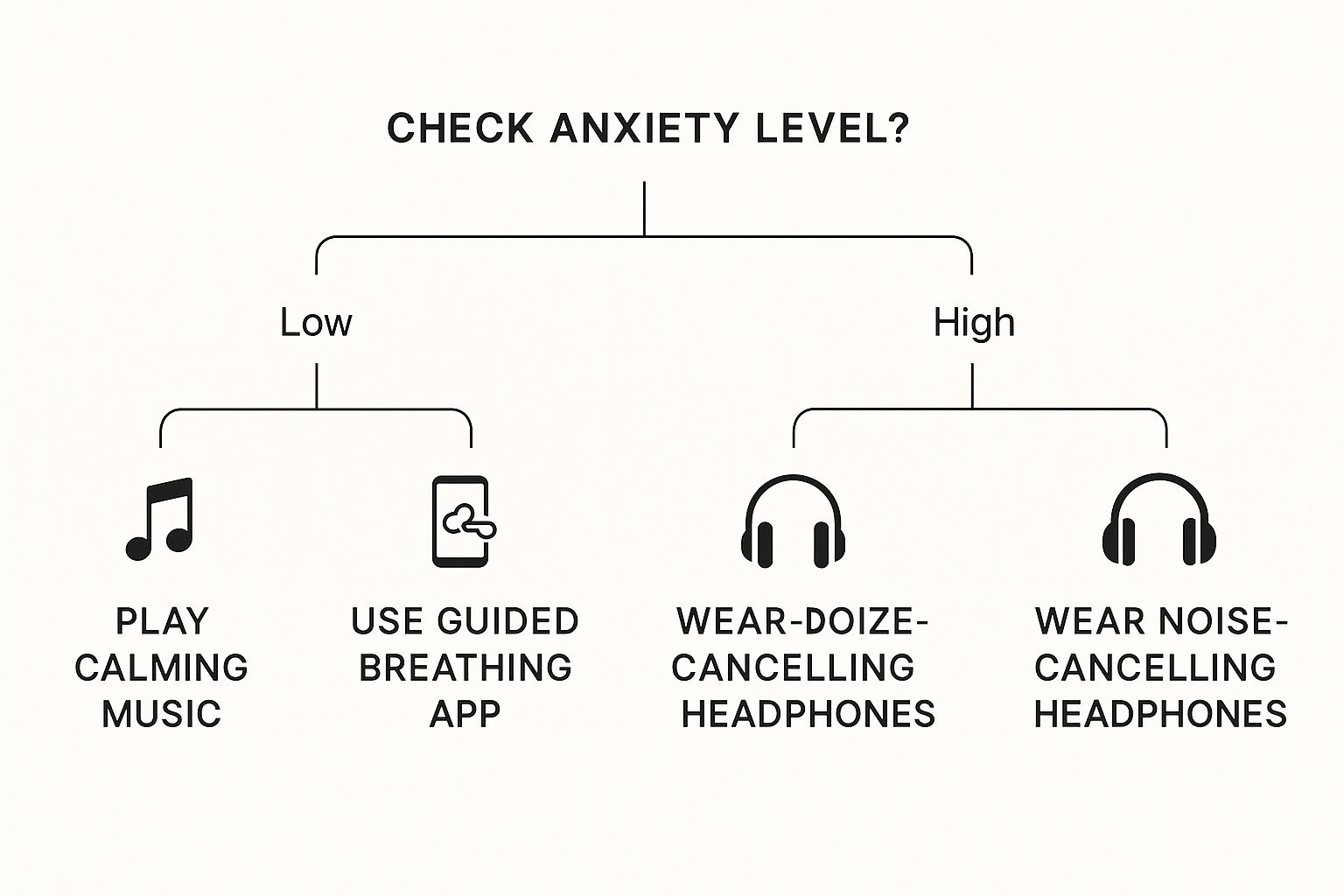
As the image shows, even for mild anxiety, taking a proactive step like playing music can make a real difference.
Advanced Options and Local Anesthetics
For more significant anxiety or for longer, more complex procedures, IV sedation is a highly effective choice. It’s administered directly into your bloodstream, which gives the dentist precise control to adjust the level of sedation instantly. This puts you in a “twilight sleep” where you’re on the verge of sleep but can still respond if needed.
Key Insight: Sedation isn’t just for major surgery. It’s a tool to make any procedure, from cleanings to fillings, more manageable for anxious patients. Empower yourself by discussing these options with your dentist.
Finally, let’s talk about local anesthetics. The “shot” itself is often a source of fear, but today’s techniques have dramatically improved comfort. We always apply a strong topical numbing gel to the gum tissue first, so most people barely feel the injection. Plus, advances in anesthetic formulas mean the numbing effect is profound and long-lasting, guaranteeing a pain-free treatment.
Having an open, honest conversation about these choices with your dentist is the best way to figure out how to relax at the dentist and find the approach that works for you.
Answering Your Top Dental Anxiety Questions
Even with the best preparation in the world, it’s completely normal for specific worries to pop up as your appointment gets closer. Honestly, knowing you’re not alone in these concerns—and that there are real, practical answers—can bring a huge sense of relief.
It’s time to tackle some of the most common questions and fears that hold people back. Getting straight answers helps pull back the curtain on the whole process, giving you the confidence to move forward.
What If I’m Too Scared to Even Make an Appointment?
This is incredibly common. If your fear is so overwhelming that picking up the phone feels impossible, the key is to start smaller. Your first step doesn’t have to be booking a full-blown cleaning; it can just be doing a little research.
Start by looking for dentists in your area who specifically mention experience with anxious patients on their websites. You can learn a lot just by reading their patient reviews—it helps build a sense of trust before you even have to speak to anyone.
From there, try sending an email to the office to explain your situation. Many dental teams are more than happy to start the conversation this way. You could also ask a trusted friend or family member to help you make that first call. Sometimes, just having a little backup is all it takes to get over that initial hurdle.
Can I Use Headphones During My Treatment?
Absolutely! In fact, most dentists I know actually encourage it. Popping in your headphones is a fantastic way to distract yourself, block out the sounds of the dental office, and just settle into your own peaceful space.
The only thing to remember is to give the dental team a quick heads-up beforehand. A simple, “Hey, I find it helps me relax if I listen to music, is that okay?” is perfect. That way, they know they might need to give you a gentle tap on the shoulder if they need to get your attention.
Pro Tip: Get a long playlist or a full podcast episode ready to go before you sit down in the chair. This keeps you from having to fuss with your phone during the procedure, so you can stay completely immersed and relaxed.
How Can I Overcome a Bad Past Experience?
The single most effective way to stop a bad memory from controlling your future dental visits is to address it head-on. The real power here comes from reclaiming your sense of control.
When you meet a new dentist, be upfront about what happened. You don’t need to go into dramatic detail, but saying something like, “I had a bad experience in the past where I felt rushed and not in control, and it’s made me pretty anxious,” gives your new dental team crucial context.
This is where establishing that “stop” signal we talked about earlier becomes so important. Knowing you have the undisputed power to pause everything at any moment actively overwrites that old, negative memory. You’re creating a new experience where you are firmly in command, which can completely change your perspective and help you finally feel safe again.