
Direct Answer: Splitting a multi-visit treatment plan so one phase finishes before December 31 and the rest starts after January 1 lets you draw on two annual maximums instead of one.
Every fall I get a version of the same question from patients across North Glendale and Arrowhead Ranch. One patient already had her plan on the books, two crowns and a partial, and she wrote in asking, “Can you just let me know what order makes the most sense with insurance?”
She wasn’t asking what was wrong with her teeth. She already knew. She was asking about the calendar.
That is who this article is for. If you have a treatment plan sitting in front of you and you are trying to figure out what to do before December 31 and what to push to January, here is how I think through it.
Why the December 31 Deadline Exists at All
Most dental plans run on a calendar year. Your benefits start fresh January 1 and close out December 31.
Each plan has an annual maximum, which is the most it will pay toward your care in that year. Market data commonly puts that number somewhere in the $1,000 to $2,000 range, though your own plan could sit above or below that. Your plan documents or your HR benefits summary will tell you the exact figure.
Here is the part that catches people. The unused portion does not carry forward. If your plan pays out $400 of a $1,500 maximum this year, the other $1,100 disappears on January 1. It does not stack.
Three things reset at the same time:
- The annual maximum goes back to full
- The deductible starts over, so you pay it again
- Any frequency limits (like two cleanings per year) restart
I want to be clear about the framing here. This is not a reason to rush into treatment you do not need. It is simply the reason sequencing exists in the first place. When a plan has a ceiling and a hard end date, the order of your appointments starts to matter.
The Two-Benefit-Year Split
This is the core of the whole thing, so I want to spend real time on it.
When a treatment plan runs several thousand dollars across multiple visits, it can often be phased. One portion completes before December 31. The remainder starts after January 1. That draws on two separate annual maximums instead of one.
For a patient looking at two crowns and a partial, that might mean the crowns go this year and the partial goes next year. Or the reverse. The split depends on the teeth, not the math.
And that is the part I want to be honest about. When I sit down with a patient to decide which phase goes first, clinical urgency almost always wins over the dollar figure. Some things do not wait:
- An infected tooth or an abscess
- A crown that has failed and left the tooth exposed
- A fracture that is getting worse with every bite
- Active gum infection that is costing you bone
Other things genuinely can wait a few weeks without harm. A worn but stable restoration you have had for fifteen years is usually in that group. So is an elective cosmetic change.
The second honest caveat: this only works when the treatment actually divides into stages. A single crown is one case. You cannot start half of it in December and finish the other half in March for benefit reasons. But two crowns and a partial are three separate procedures, and that is a plan that can be split cleanly.
What Splits Cleanly and What Does Not
Not every treatment plan can be phased across two benefit years. This is roughly how I sort them.
| Treatment | Can it split across benefit years? | What drives the answer |
|---|---|---|
| Two or more crowns on different teeth | Usually yes | Each crown is its own procedure and its own claim |
| A single crown | No | Prep and seat belong to one case; the claim files when it is seated |
| Crowns plus a partial denture | Usually yes | The partial depends on the crowns being finished first, which sets the order |
| Implant placement and the final crown | Often yes by nature | Healing time between stages can already span months |
| Root canal on a painful tooth | No, and it should not | Infection does not follow a benefit calendar |
| Deep cleaning by quadrant | Sometimes | Depends on disease severity and how your plan counts quadrants |
The Timing Rules Nobody Puts in Writing
This is where most fall planning falls apart, and it has nothing to do with insurance rules. It has to do with lab turnaround.
Crowns, bridges, and partials are made by an outside dental lab. There is a gap between the appointment where we prepare the tooth and take the impression or scan, and the appointment where we seat the finished restoration. If you want the detail on that, I walked through each step of the crown process in a separate article.
What that means in practice: a case started in the third week of December frequently does not seat until January. And most plans process the claim based on the seat date, not the prep date. So the work you thought you were squeezing into this year lands in next year’s benefits.
Waiting periods matter too. A plan you started mid-year often holds major work for six to twelve months before it pays anything toward crowns, bridges, or partials. If you enrolled in July, December may be too early regardless of how the rest of the calendar looks.
So here is my honest recommendation:
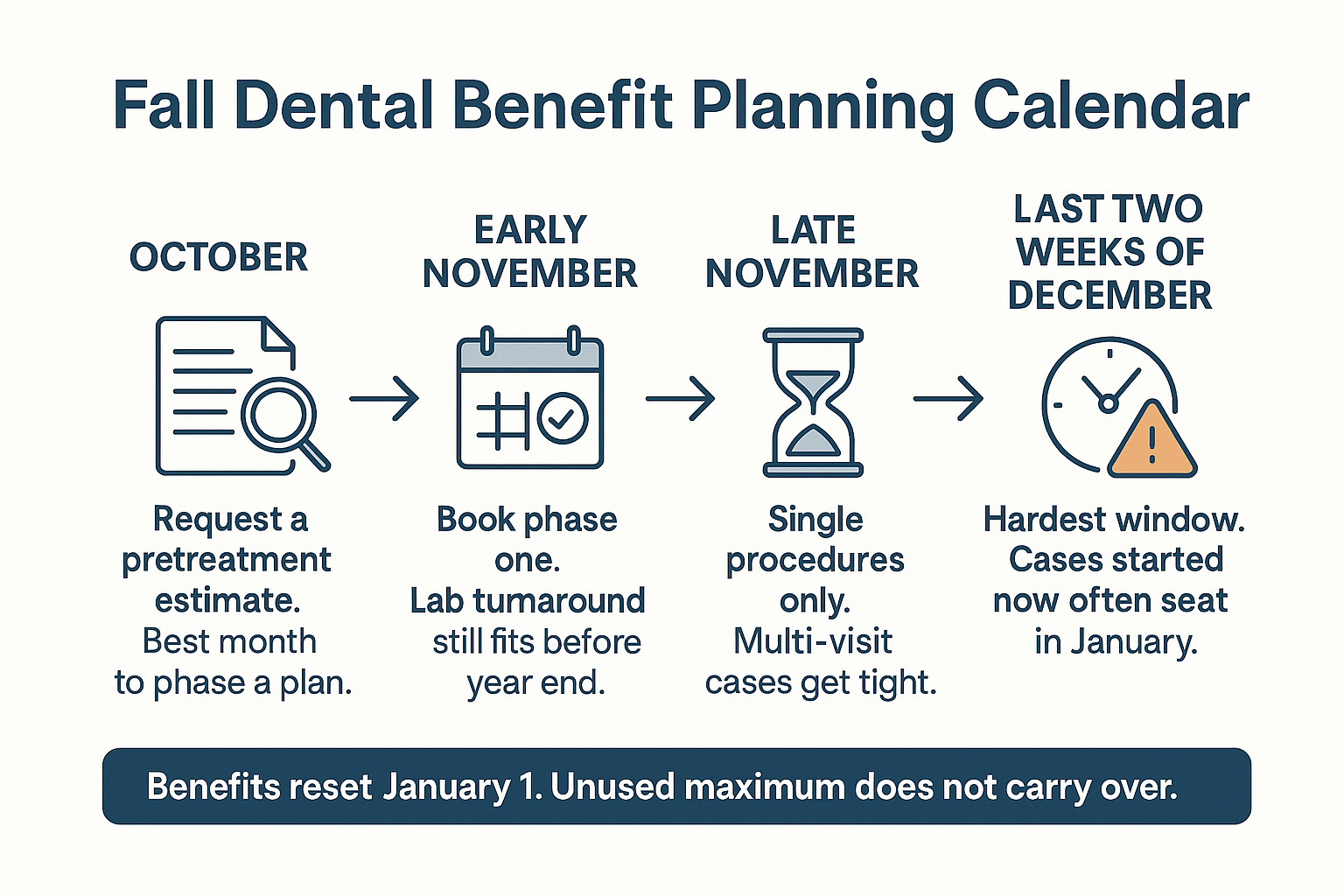
- October and early November is when this planning actually works
- Late November is still workable for a single-phase case
- The last two weeks of December are the hardest window on any dental schedule
That final stretch is packed with people doing exactly what you are trying to do. Chairs fill first, then lab slots, then everything gets tight.
The Fall Planning Calendar at a Glance
Here is the same timing advice laid out month by month, so you can see where your window actually sits.
The Pretreatment Estimate Turns Guesswork Into a Number
One patient asked us to send her plan a pretreatment estimate before her next cleaning, so the numbers were already on the table when she and I talked through options. That is the single smartest move in this whole process, and almost nobody knows to ask for it.
Most dental plans let an office submit a proposed treatment plan in advance. The plan reviews it and sends back a written breakdown of what it expects to pay and what you would owe.
Here is what it does and does not do:
- It does show you the plan’s expected payment, procedure by procedure
- It does apply your remaining maximum and your deductible status
- It does not function as a payment guarantee, because coverage still depends on your eligibility at the time of service
- It does not commit you to anything
Turnaround varies by carrier, but a two to four week wait is common. Some plans come back faster. That timing is exactly why I push people to request one in October.
If the estimate comes back and the numbers are different than you expected, an October request leaves room to adjust the sequence. A December request usually does not.
Two Groups This Hits Hardest in the Happy Valley Area
Around here, two specific groups run into this every single year.
Winter residents. People who arrive in the Northwest Valley around November often carry a dental plan from another state, and they frequently show up with treatment they deferred over the summer. Then they head home again by April. That compresses the entire phasing window to about five months, which sounds like plenty until you factor in lab time and a possible waiting period.
If you fall in that group, the first appointment matters more than usual. We need the full picture and a pretreatment estimate early, because there is no catching up in March.
Families using winter break. Households in the Deer Valley Unified attendance area often save treatment that needs recovery time for the late-December school break. It makes complete sense for the family calendar, and it collides head-on with the busiest two weeks on any dental schedule.
One more local note. Phoenix has no weather barrier in this window. Nothing gets canceled for snow, and nobody is stuck at home. Fall and winter are the most available months of the year here, not the least, which is exactly why the December rush builds the way it does.
What If You Do Not Have Dental Insurance?
A steady share of the questions I get come from people who just moved to the area or are switching from a plan they never actually used. One caller put it plainly: she had never used dental benefits before and wanted to know whether there is a cap and how that even works.
If you are self-pay, the December 31 deadline may still apply to you, just through a different door:
- FSA dollars face their own December 31 deadline, with only a limited carryover amount that the IRS sets each year. You can read the current rules in the IRS guide to tax-favored health plans.
- HSA funds do not expire the same way. They roll forward, so there is no year-end pressure on that money.
- In-office membership plans are a separate path entirely, built for patients without insurance. Ours provides 20% off treatment, with no annual maximum sitting over the top of it.
I am not going to quote treatment prices in an article, because the number depends on the tooth, the material, and what the x-rays show. Our front desk will give you real figures for your own plan. If you want a sense of what shapes the baseline, I covered what drives the cost of a cleaning and exam without insurance separately.
How the Money Conversation Should Actually Go
The thing that makes phased treatment work is not a clever billing trick. It is having the whole coverage breakdown explained to you clearly, before you agree to anything.
That means you should leave knowing which procedures are urgent, which can wait, what your plan is expected to cover for each one, and what the order would look like either way. And you should not feel pushed toward treatment you did not need.
One patient described her first visit with us this way: “She explained it so well, answered all of my questions and didn’t make me feel rushed at all.” That is the standard I want every one of these conversations to hit.
If your current plan discussion has never included a sequencing option, it is fair to ask for one. Any office can submit a pretreatment estimate, and any dentist can tell you which part of your plan is genuinely time-sensitive.
Frequently Asked Questions About Sequencing Dental Treatment Around the Annual Maximum
Is it too late to start phasing my treatment if it’s already December?
Not always, but the options narrow fast. A single procedure that does not need a lab, like a filling or a cleaning, can often still be scheduled. A crown or partial started in mid-to-late December usually seats in January, which means the claim lands in next year’s benefits anyway. If you are in that spot, the better play is often to book the first phase for early January and plan the rest around a full year of benefits.
Does my dentist decide the order, or does my insurance?
Your dentist does. Insurance only decides what it pays and when. The clinical order comes from what the teeth actually need, and an infected or failing tooth gets treated first regardless of what the benefit calendar says.
How long does a pretreatment estimate take to come back?
It varies by carrier, but two to four weeks is a common range. That is why requesting one in October leaves room to change the plan, and why requesting one in mid-December usually does not.
My plan started in the summer. Can I still get a crown covered this year?
Maybe not. Many plans apply a waiting period of six to twelve months before they pay toward major work like crowns, bridges, and partials. Check your plan documents for the major services waiting period before you build a December schedule around it.
Do clear aligners count against the same annual maximum?
Usually no. Orthodontic coverage typically sits under a separate lifetime maximum rather than the annual one, which changes the planning completely. I broke that down in a separate article on how orthodontic benefits work.
What if my treatment cannot be split at all?
Then it cannot, and forcing it would be the wrong call. In that case the conversation shifts to whether the treatment is urgent enough to do now and how to handle the portion your plan will not cover. That is a straightforward conversation to have, and it should happen before you are in the chair.
Thinking through a multi-phase plan this fall?
Dr. Dariene Lazore, DMD, plans phased treatment for households across North Glendale, Arrowhead Ranch, and Norterra, and the front desk can request a pretreatment estimate from your plan whenever you are ready to see real numbers. Weekday hours run to 7pm Monday through Thursday, so the conversation does not have to cost you a workday. Questions can go to 623-267-8088 or beyonddentalcare.com.