
Direct Answer: Book your new-patient exam and X-rays in the first two weeks after you arrive, schedule multi-visit work like crowns for December and January, and leave a three to four week buffer before you fly home.
You land in the Northwest Valley the first week of November. You fly home the second week of April. And somewhere in your head is a list of dental work you have been putting off since last spring.
The Phoenix metro takes in an estimated 300,000 to 400,000 seasonal residents each winter, adding roughly $1 billion to the state economy. Peoria, Vistancia, Sun City, and Arrowhead carry a heavy share of that. I see a steady run of these folks every year from November on.
What almost nobody writes down for you is the scheduling math. Five months sounds like plenty of time until you find out a crown takes two appointments weeks apart. So here is how I think about sequencing treatment inside a fixed window.
Why Winter Here Is the Best Dental Window You Get All Year
In cold-weather markets, winter is when appointments fall apart. Ice, snow days, and closed roads knock out whole weeks of a schedule.
Here it works the other way. October through March is the easiest stretch of the Phoenix year to physically get to a dental chair, with daytime highs generally in the 65 to 90 degree range. Nothing about the weather is going to cancel your visit.
The practical side matters too. Our chairs are open Monday through Thursday until 7pm, with Friday and Saturday by request, so a dental appointment does not have to eat a whole day of golf, pickleball, or grandkid duty.
There is one calendar quirk worth knowing. Most dental plans reset their annual maximum on January 1, which lands right in the middle of a typical seasonal stay. If you have a plan with an unused balance, that reset can mean two separate benefit years inside one five-month visit, which is a real advantage for larger treatment plans.
Sequencing Treatment Inside a Fixed Window
The single most common mistake I see is waiting until February to come in for a first exam. By then, some options are off the table.
In your first two weeks here, get the diagnostic work done. That means:
- A new-patient exam with Dr. Dariene Lazore, DMD
- Digital X-rays, or a review of records forwarded from your dentist back home
- A periodontal evaluation, so gum health is measured and not guessed at
- A written treatment plan with the sequence and the fees laid out
That plan is the whole point. It tells you what fits this season, what should wait, and what order things go in. If you have never had one done this thoroughly, here is what a first visit with a new dentist actually covers.
December and January are your working months. Fillings, periodontal therapy, a crown prep and a crown seat, a root canal followed by a restoration. This is when the multi-visit work belongs.
A crown is the clearest example. There is a prep appointment, then a lab turnaround, then a seat appointment typically a few weeks later. A November start date gives you room for a remake if the fit is not right. A March start date does not, which is why the crown process itself is worth understanding before you pick a date.
Leave the last three to four weeks alone. No new multi-visit treatment. Use that stretch for follow-ups, a final cleaning, and any adjustment that turns up.
A Month-by-Month Look at a November to April Stay
This is the general rhythm I use when planning treatment for a patient who is here for the season. Your plan depends entirely on what the exam finds.
| Timing | What Belongs Here | Why |
|---|---|---|
| First 2 weeks after arrival | Exam, digital X-rays, periodontal evaluation, written plan | Everything else depends on knowing what is actually going on |
| Late November to December | Cleanings, fillings, crown prep, start of periodontal therapy | Enough runway left for second appointments and any redo |
| January | Crown seats, root canal restorations, phase two periodontal care | New benefit year opens on January 1 for most plans |
| February to early March | Shorter single-visit work, whitening, follow-ups | Multi-visit treatment gets risky this late |
| Final 3 to 4 weeks | Final check, adjustments, records to take home | Buffer for anything unexpected before your flight |
Implants: The Honest Timeline
Deferred tooth replacement is the most common thing this audience walks in with. A tooth came out two winters ago and nothing has been done since.
Implant treatment runs on months, not weeks. There is placement, then a healing period while bone integrates with the implant body, then the final restoration on top. That healing does not compress to fit a travel calendar, and I will not pretend otherwise.
What that means practically is a two-season plan, and it works well. A fall or early-winter consultation with imaging leads to a January decision, placement while you are still here, and the final restoration next season when you come back.
Sometimes a step gets coordinated with your dentist back home, and that is a normal conversation, not a complication. What matters is that somebody owns the plan and the records move with you. If you are weighing this for the first time, the full start-to-finish implant timeline is worth reading before your consultation, along with what the imaging reveals about candidacy.
The consultation itself is the piece people skip. A fall appointment is what makes a January decision possible instead of a rushed March one.
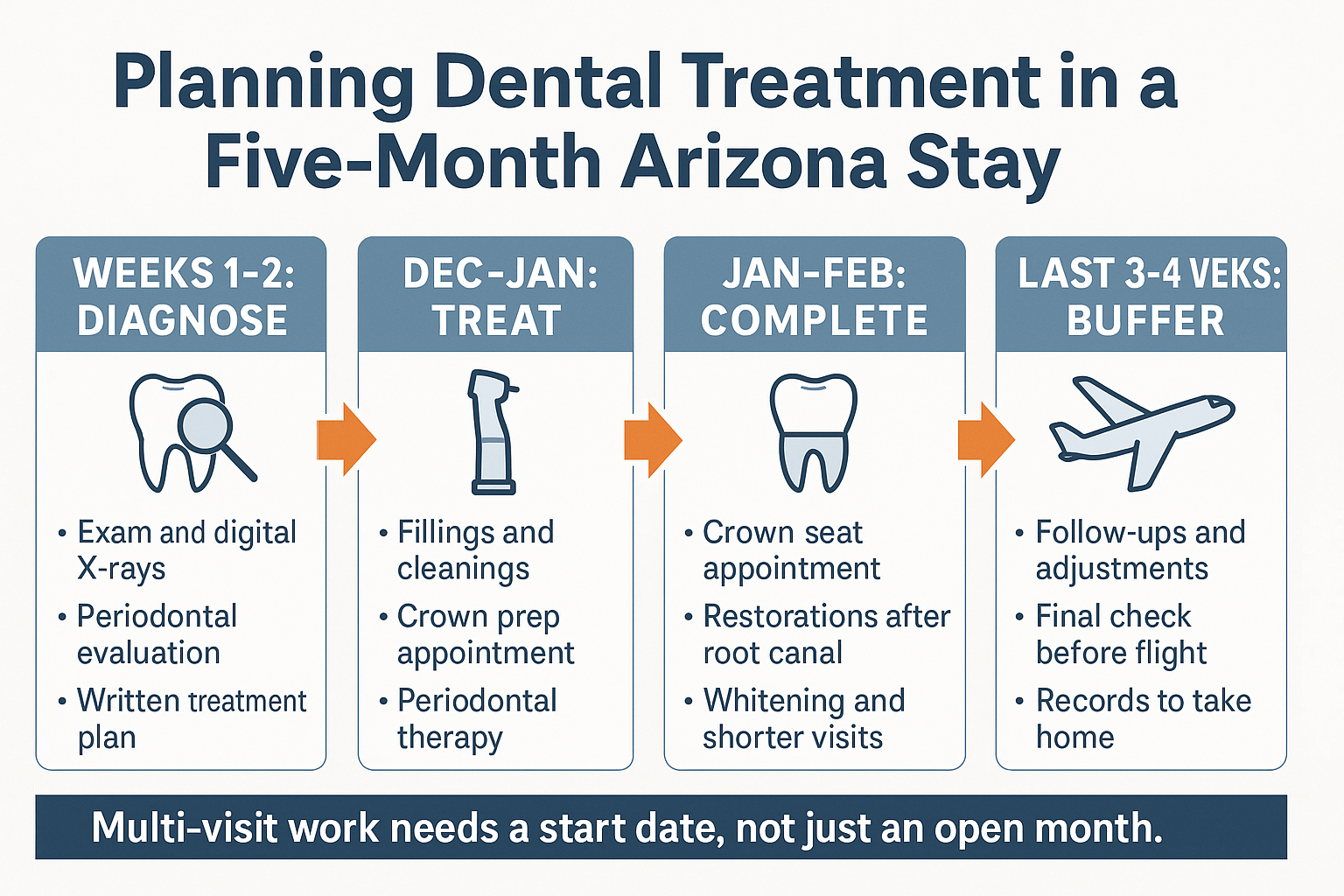
The Five-Month Treatment Window at a Glance
Here is the same sequencing logic in one view, from arrival to departure.
The Insurance and Records Questions That Stall People
This is the first thing most seasonal callers ask about, and it is the most common reason a first call ends without an appointment. Medicare and AARP supplemental coverage come up constantly, and so do plans written in other states. Our front desk has verified out-of-state plans plenty of times.
The general pattern in plain language:
- PPO-style plans usually travel across state lines. You can typically use them wherever you are, though your share of the cost depends on network status.
- HMO and DHMO plans are geographically limited. They assign you to a specific provider or network, and that network is where you came from.
- Original Medicare does not cover routine dental work. Medicare’s own coverage page spells out the narrow exceptions, and many people are surprised by how narrow they are.
So the useful question is not “do you take my carrier.” It is “is my plan a PPO, and is this office in-network with it.” Those two answers together tell you what you need to know.
One more thing that saves a whole visit: email your home dentist before you fly out and ask them to send recent X-rays and chart notes. Records transfers between offices are routine paperwork, and having them in hand means we are not re-imaging things that were imaged four months ago. If you want the background on how often X-rays are actually needed, that has changed in recent years.
When One of You Has Coverage and the Other Does Not
Split households are the norm in this group, not the exception. One spouse is on a retiree plan, the other is paying out of pocket, and both want to be seen on the same trip into town.
We get requests like this in writing regularly. One recent note read: “we are in Lake Havasu and will be in Glendale for our doctor appointments at that time. anytime the day before or the day after would be good as well.”
That is a normal ask, and it is easier to accommodate when you send dates early. Stacking two people into back-to-back slots on a day you are already driving in is worth the phone call.
For the spouse without coverage, there is an in-office membership plan that takes 20 percent off treatment. For what any specific procedure would actually run, call the office and ask. Fees depend on the tooth, the material, and the condition it is in, and I would rather quote you accurately than generally. What shapes the cost of a cleaning and exam without insurance explains the factors involved.
If Something Breaks Mid-Stay
A crown comes off on a caramel over Thanksgiving. A filling drops out. Swelling starts on a Sunday night. Holiday weeks are exactly when a lot of offices are dark.
The path here is short: call 623-267-8088 and ask for a same-day appointment. Hours run Monday through Thursday until 7pm, with Friday and Saturday by request.
The emergency exam and X-ray is $99 flat, which is the posted fee, not an estimate. You will know what the visit costs before you sit down.
What we treat in that slot includes toothaches, chipped and broken teeth, knocked-out teeth, abscesses, lost fillings and crowns, emergency root canals, loose teeth, and painful swelling. If you are unsure whether a dental problem belongs at an urgent care instead, this breaks down when the ER is and is not the right call.
What Seasonal Patients Are Really Shopping For
After a few winters of this, I think what you actually want is simpler than a service list. You want an office that answers the phone, remembers you next November, and keeps your chart where it can be found.
This is a private, non-corporate office on West Happy Valley Road, led by Dr. Dariene Lazore, DMD, holding a 4.92-star Google rating across more than 214 reviews. There is a comfort dog named Mr. Woodford on site, and one chart for every age in a household, which matters when the kids and grandkids show up in March.
One patient who had recently relocated put the bar about where I would put it: “we just moved and had a couple other offices not even respond!” – Tom B.
That is the low bar a lot of seasonal residents run into. Getting a call back and a real appointment time should not feel like a win.
Frequently Asked Questions About Dental Care for Seasonal Winter Residents
How late in the season can I still start a crown?
Generally, a crown needs a prep appointment and a seat appointment a few weeks apart, so starting in February is usually fine and starting in late March usually is not. Call with your departure date and we can tell you straight whether it fits or whether a temporary solution makes more sense until next season.
Can I use my dental insurance from another state here in Arizona?
Often yes, if it is a PPO-style plan. HMO and DHMO plans tie you to a network in your home area and typically will not travel. Have your card handy when you call and ask specifically whether your plan is a PPO and whether this office is in-network with it.
What should I do before I fly out to make my first appointment go faster?
Email your dentist at home and ask them to send your recent X-rays and chart notes to the office here. Then call ahead with your arrival date and your insurance card in front of you. Those two steps save you a visit and a lot of back and forth.
Can implant treatment be split across two winters?
That is often the most realistic approach. Healing between placement and the final restoration takes months and will not compress to match a travel calendar, so a fall consultation, winter placement, and a next-season restoration is a common sequence. Your candidacy and timeline depend entirely on imaging and bone health.
I have no dental insurance at all. Is there an option besides paying full fee?
There is an in-office membership plan that takes 20 percent off treatment for patients without dental insurance. Ask about it when you call, and ask for fees on the specific work you are considering so there are no surprises.
Planning Your Season in the Northwest Valley?
If you will be in North Glendale, Arrowhead, Norterra, North Peoria, or Vistancia this winter, new-patient appointments can be arranged at 623-267-8088 or at beyonddentalcare.com. Bringing your arrival and departure dates to that first call is the fastest way to find out what realistically fits your stay.