
Direct Answer: Most dentists wait until tooth movement is finished and the teeth have settled, often about 1 to 3 months, before whitening after clear aligners. Gums, sensitivity, and white spots get checked first.
Somewhere around the second to last tray, the conversation in my chair changes. Patients stop asking whether the front teeth have moved far enough and start looking closely at color instead of position.
A patient messaged us through the website not long ago saying she was starting the last week of her aligners and wondering whether she needed an appointment to go over what came next. Half of that question is about keeping teeth where they landed, and that one has its own article.
This one stays on the cosmetic side. Here is when whitening after clear aligners actually fits, what I look at before saying yes, and how to order things if crowns or bonding are already on your list.
Why I Wait Before Whitening After Clear Aligners
The general professional preference is to hold off on any bleaching until active tooth movement is finished and the teeth have had time to settle. Published survey work on orthodontic patients found that most clinicians advise against whitening during active treatment and prefer waiting roughly 1 to 3 months after appliances come off.
That range shows up in the research on whitening and orthodontic timing, and it lines up with what patients describe in real life. Teeth that just moved can feel tender, and gum tissue is still tightening around the new positions.
At that post-treatment visit, here is what I am actually looking at before I clear anyone for whitening:
- Tenderness left over from the final few trays
- Gum tissue that is still adjusting around newly positioned teeth
- Chalky white spots near the gumline that need time and a hygiene reset first
- A history of cold sensitivity, since whitening gel can amplify it
- Any decay, worn edge, or aging filling that should be handled before cosmetic work
None of that is a fixed rule for every person. It is normal clinical judgment, and the answer for a 16-year-old in Stetson Valley who finished in eight months is not always the answer for an adult who wore trays for two years.
Why a Newly Straight Smile Can Look Patchy
This is the part almost nobody explains, and it catches people off guard. When teeth were crowded or overlapped, the surfaces that were hidden did not pick up stain the same way as the surfaces facing out.
So you finish treatment, the crowding is gone, and suddenly you can see a lighter stripe where one tooth used to sit behind another. Nothing changed chemically. You are simply seeing enamel that has been shielded from years of coffee, black tea, red wine, and the iced drinks that move through every drive-thru along Happy Valley Road.
A cleaning takes care of some of it. Surface stain and film come off, and plenty of patients decide that is enough once the polish is done.
When it is not enough, whitening usually evens things out because the gel works across the whole visible surface rather than one spot. But I want to see the smile after a cleaning and after the tissue has calmed down, because judging shade on day one of retainer wear is judging a moving target.
Can You Just Use Your Aligner Trays as Whitening Trays?
Patients ask me this on their own, usually with a half-smile, because it seems efficient. The honest answer is no, and the reason is in how the two appliances are built.
A custom whitening tray is made with reservoirs to hold gel against the enamel and a scalloped trim that keeps the gel off gum tissue. An active aligner is built to grip teeth and move them, so the trim runs right up onto the gums and there is no space designed for anything but the tooth.
Load gel into an aligner without direction from your dentist and two things tend to happen. The gum tissue gets irritated where the plastic traps gel against it, and the result comes out blotchy because coverage is uneven.
There is also the retainer question. Once you are finished, your retainer is doing a job every night, and putting bleach in it without being told to is not a shortcut worth taking.
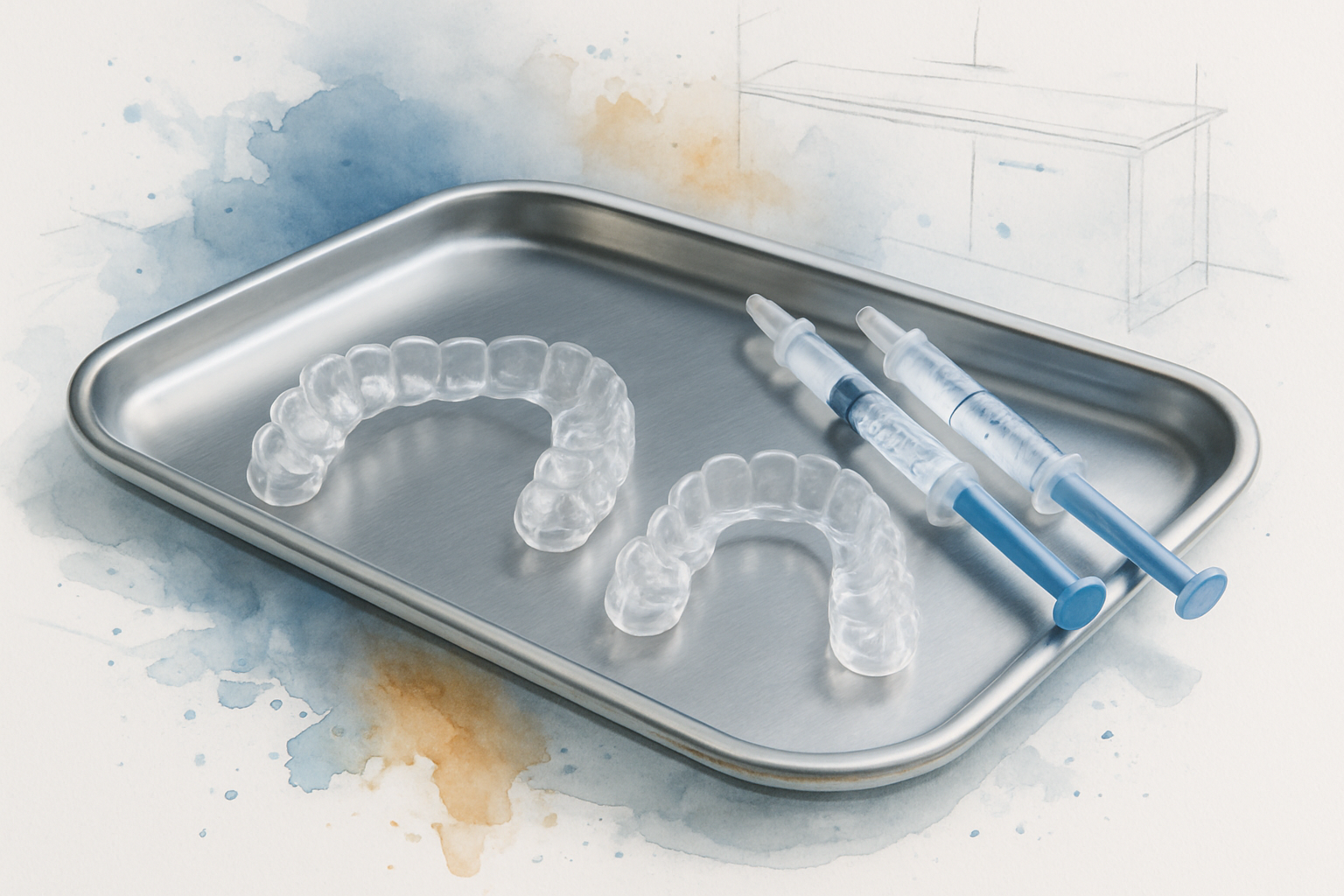
Aligner Tray vs. Whitening Tray: What Each One Is Built For
Three different appliances, three different jobs. Here is how they compare.
| Clear aligner tray | Custom whitening tray | In-office whitening | |
|---|---|---|---|
| Built to | Move teeth on a planned schedule | Hold gel against enamel | Apply a stronger gel under supervision |
| Edge at the gumline | Runs onto the gum to grip the tooth | Scalloped to keep gel off tissue | Gums isolated by the clinical team |
| Space for gel | None designed in | Reservoirs shaped for it | Not applicable |
| When it is used | During active treatment | After movement is finished and settled | After movement is finished and settled |
| Who controls the shade | Not applicable | Dentist plans number of applications | Dentist plans number of applications |
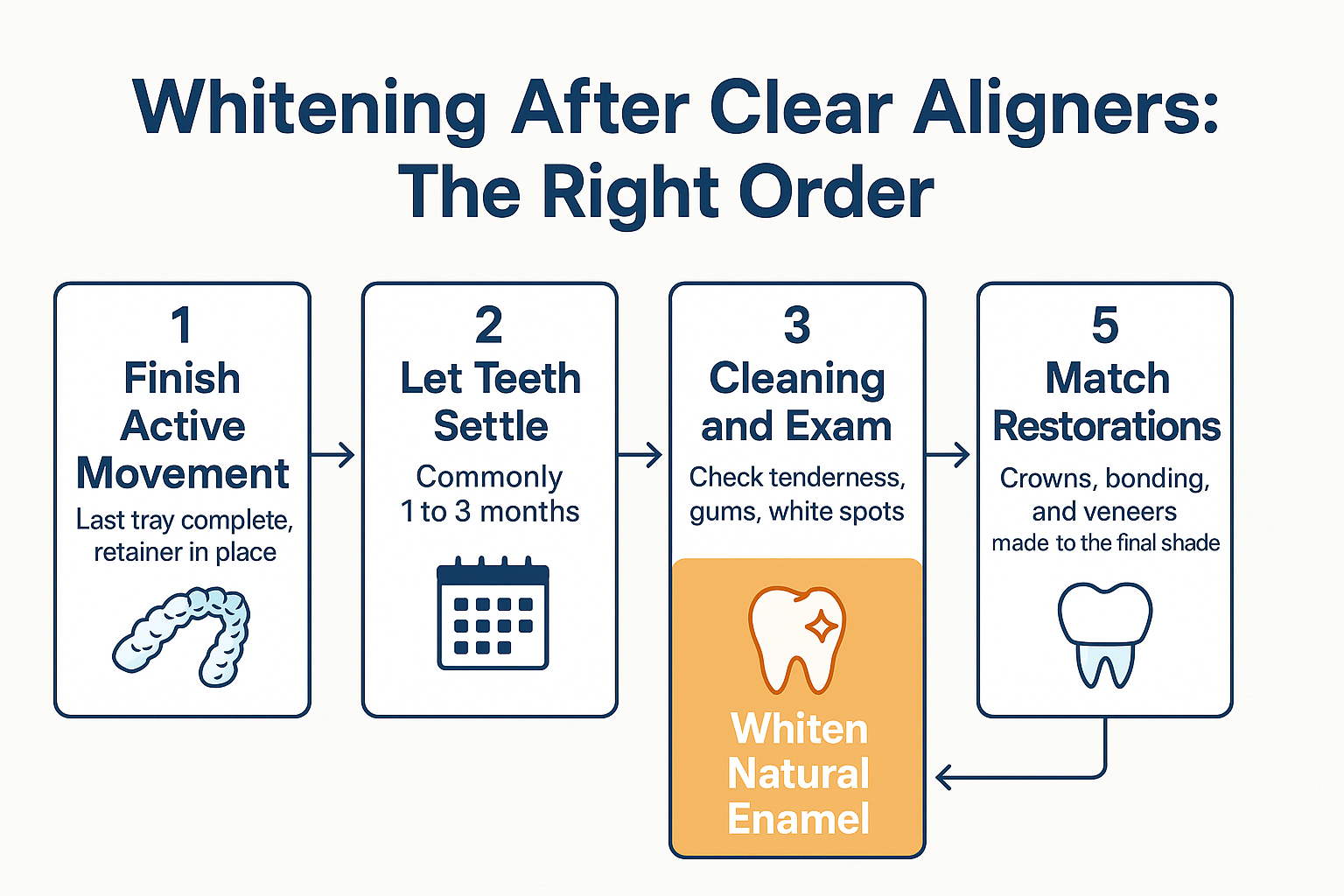
The Order That Actually Works
Sequencing is where most of the regret happens. This is the order I walk patients through after their final tray.
Sequencing When Crowns, Bonding, or Veneers Are Coming
One patient wrote in describing worn front teeth, planned crowns, bonding to close a lower gap, whitening, and possibly veneers, and asked whether she could skip the straightening and just restore the front teeth. Fair question, and a common one.
The part that matters most for this article is the order. Natural enamel responds to whitening. Crowns, bonding, and porcelain do not. Once a restoration is made, its color is set.
So shade is normally settled before new restorations are matched. Whiten first, let the color stabilize, then have the crown or the bonding built to that finished shade. Reverse the order and you end up with restorations that look right for a few months and then read dark against the teeth around them.
If you already have crowns or fillings in the smile zone, this article covers that situation in detail.
Timing It Around the Calendar in North Glendale
Timing is rarely just clinical. Teens across North Glendale and Stetson Valley who finish treatment in late summer are thinking about how the smile photographs, and Glendale Union High School District classes start August 10, 2026. Working backward from a school photo date usually means finishing trays well before the end of June.
Adults in Arrowhead Ranch, Norterra, and North Peoria tend to plan around November family photos and holiday gatherings. That is a comfortable runway if the final tray comes off in August or September.
It also helps to keep whitening in proportion. Delta Dental of Arizona reported that 83% of adult dental visits in the state were preventive in 2024, compared with only 9% cosmetic. Whitening works best as the finishing step inside a long-term oral health plan, not as a standalone purchase.
On cost, I would rather explain what drives it than throw a number at you. The main factors are:
- In-office whitening versus custom take-home trays, or a combination of both
- How many applications are planned to reach and hold the shade you want
- Whether desensitizing steps are added for patients with a sensitivity history
Elective whitening is commonly outside what dental plans cover, so exact figures should come from the office rather than a blog. If you are weighing the two methods, this comparison of in-office and take-home whitening covers how the results hold up over time.
One Practice From First Tray to Final Shade
There is a practical advantage to having the same dentist handle both halves of this. Dr. Dariene Lazore, DMD, follows the tooth movement through CandidPro Clear Aligners and the ProMonitoring remote check-ins, so by the time shade comes up she already knows which teeth moved the furthest and which ones reported sensitivity along the way.
That continuity is why the answer to “should I whiten now?” is rarely a flat yes or no in my chair. It is a look at your tissue, your enamel, and what else you have planned.
One patient put it simply after finishing: “My teeth are SO white now.” Another review that stuck with me described the visit as honest conversation with no sales pitches, which is the tone I try to keep whenever a patient asks about elective work.
Frequently Asked Questions About Whitening After Clear Aligners
How long after my last aligner tray can I whiten?
Survey work on orthodontic patients shows most clinicians prefer waiting roughly 1 to 3 months after appliances come off. That gives tenderness time to fade and lets gum tissue settle around the new tooth positions. Your own timeline depends on how much movement happened and what your exam shows.
Will whitening make my teeth more sensitive right after aligners?
It can, because recent movement already leaves some teeth reactive. That is one of the main reasons for the waiting period. If you have a history of cold sensitivity, there are ways to adjust the approach, and this article walks through what changes.
Why do some of my teeth look lighter than others now that they are straight?
Surfaces that were hidden by crowding never took on stain the same way as the surfaces facing out. Once alignment exposes everything evenly, that difference becomes visible. A cleaning handles part of it, and whitening usually evens out the rest.
Can I put whitening gel in my aligner or my retainer?
Not without direction from your dentist. Those trays are trimmed to grip teeth, not to hold gel off your gums, and the usual result is irritated tissue and blotchy color. Custom whitening trays are made differently on purpose.
Does dental insurance cover whitening?
Whitening is elective, so it is commonly outside what dental plans cover. Costs vary based on whether you do in-office treatment, custom take-home trays, or both, and how many applications are planned. The office can give you exact numbers for your case.
Should teens wait longer than adults?
Not necessarily longer, but the exam matters more. Teens who finished aligner treatment sometimes have white spot areas from hygiene during treatment, and those need time and better home care before any gel goes on. That call gets made tooth by tooth.
Thinking About Shade Once Your Trays Are Done?
If you are finishing aligner treatment somewhere across North Glendale, Arrowhead Ranch, Stetson Valley, or North Peoria and want to talk through timing before you buy anything, that conversation is worth having in person. Beyond Dental Care keeps weekday hours until 7pm, with Friday and Saturday appointments available by request, for adults working around full schedules. Questions can go to 623-267-8088 or beyonddentalcare.com.