
Direct Answer: Yes, but whitening agents only work on natural enamel, crowns, fillings, and veneers won’t change shade. The right plan whitens your natural teeth first, then updates any visible restorations to match.
This question comes up in our office more than almost any other whitening question. A patient wants a noticeably brighter smile, but they also have a crown on a front tooth, a couple of composite fillings in visible spots, or a veneer they got years ago. They want to know if whitening will work, and whether it will make things look worse instead of better.
The short answer is that whitening is absolutely possible, but the planning matters a lot. Getting the order wrong can leave you with a patchy result that is harder to fix than if you had mapped it out from the start.
If you are in the Norterra, Stetson Hills, or Arrowhead Ranch area and you are thinking through a bigger cosmetic plan that involves both restorations and whitening, this article is written for you.
Why Don’t Crowns and Fillings Respond to Whitening Gel?
Whitening agents, whether professional-grade or over-the-counter, work by using peroxide to oxidize pigment molecules embedded in the porous structure of natural tooth enamel. That porosity is what allows the active ingredient to penetrate and break up staining compounds.
Crowns, porcelain veneers, composite fillings, and bonding material are not porous enamel. They are manufactured dental materials with a fixed color baked in at the time they were made. A whitening gel sitting on a composite filling or a porcelain crown is essentially doing nothing to that surface. The shade stays exactly where it was.
This is not a flaw in the whitening process. It is just the chemistry involved. The American Dental Association’s guidance on tooth whitening acknowledges this distinction, noting that whitening products are not effective on restorations.
What this means practically: if you have a crown on a front tooth and you whiten your natural teeth two or three shades lighter, that crown is going to stand out. Your surrounding teeth will be noticeably brighter while the crown stays at its original, older shade. For some people that mismatch is barely noticeable. For others, especially if the restoration sits right in the smile zone, it becomes the first thing they see in photos.
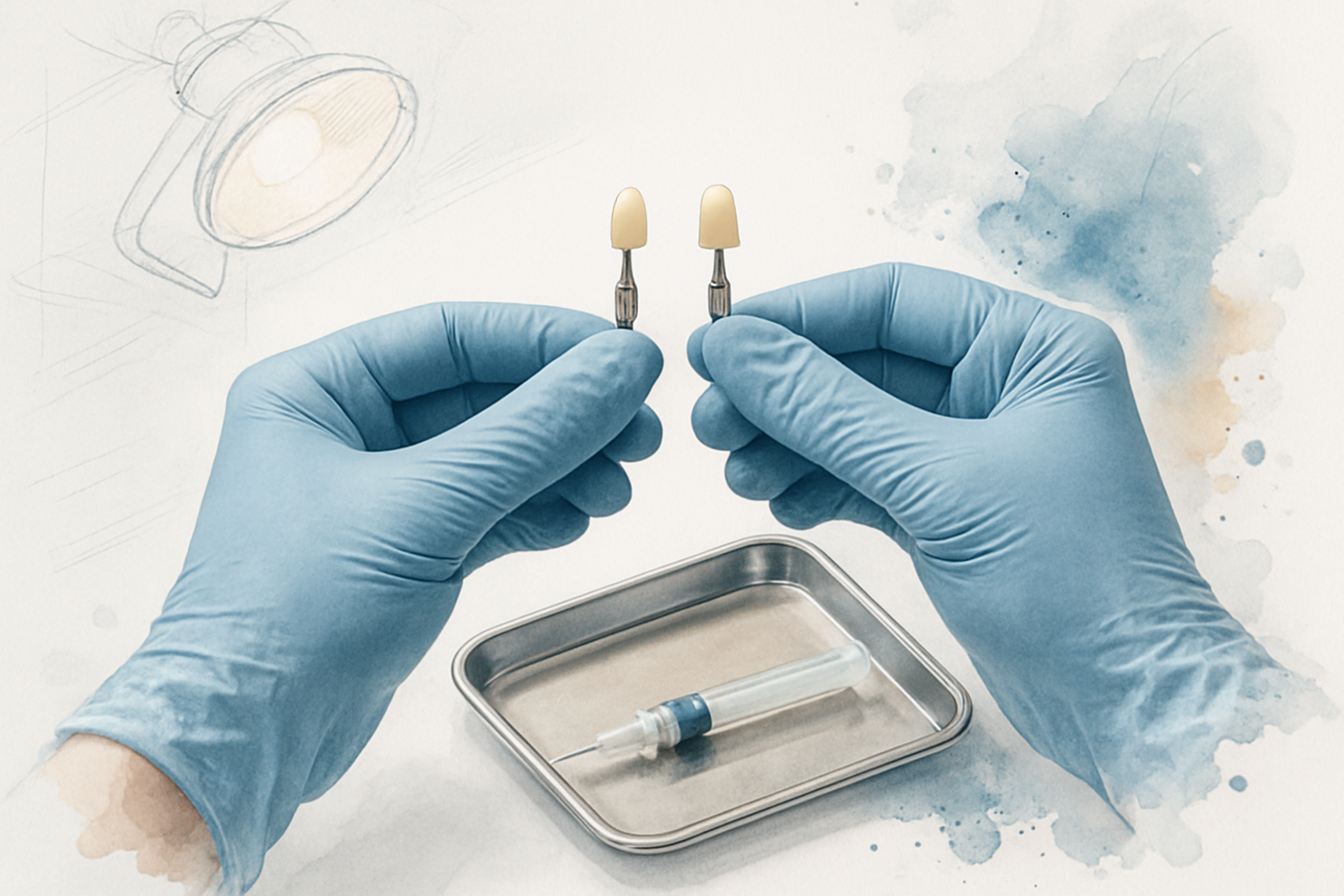
What Is the Right Order If You Have Both Restorations and Want to Whiten?
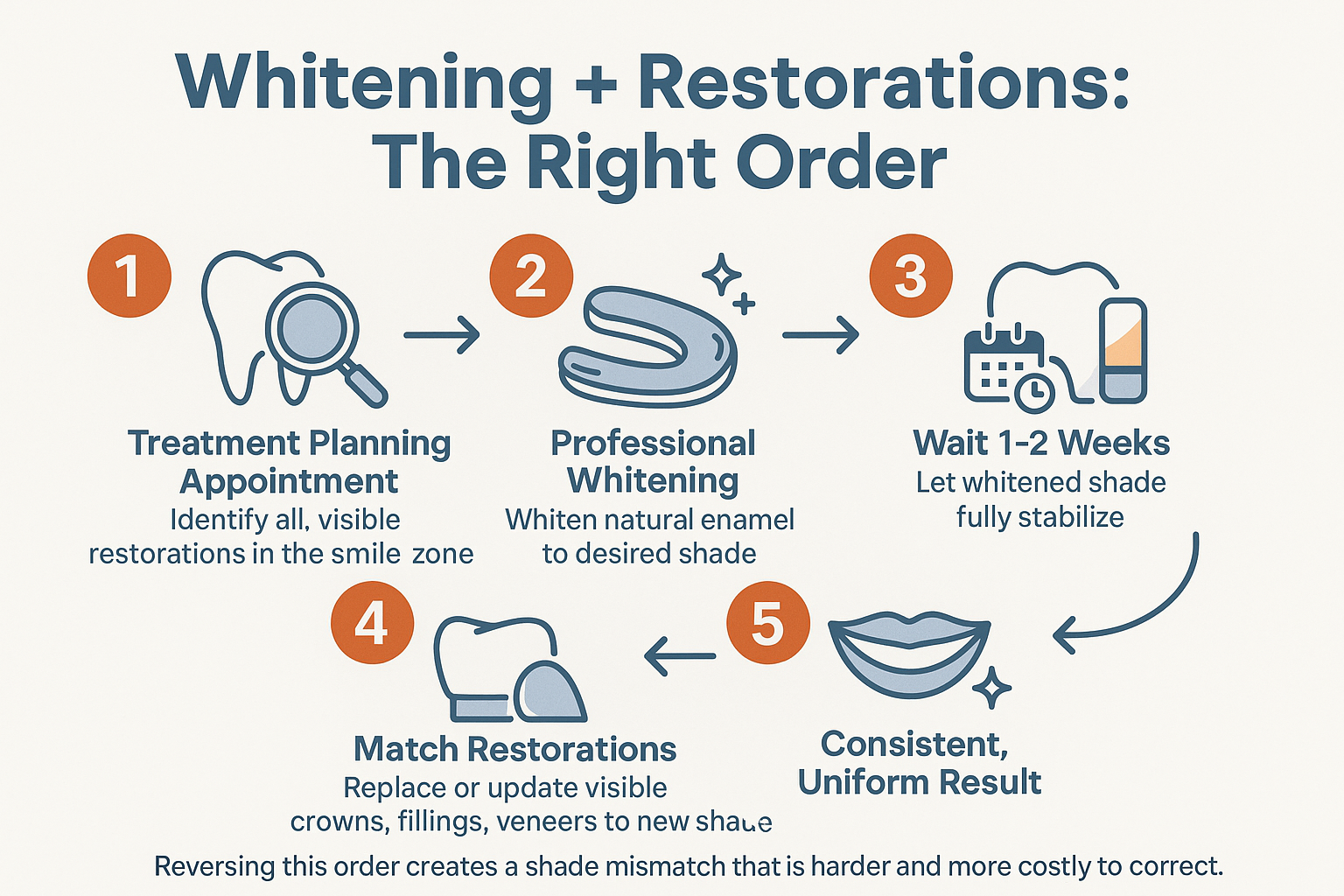
The correct clinical sequence is whiten first, then replace or update visible restorations to match. Here is why that order matters.
Your natural teeth will shift shade during whitening, and that new shade needs time to stabilize before anyone can accurately color-match a restoration to it. Most dentists recommend waiting one to two weeks after completing whitening before fabricating or replacing any crown, veneer, or visible filling.
If you do it in reverse, get the restoration made first, then whiten, you end up in exactly the problem described above. The restoration was matched to your old tooth color, your natural teeth are now lighter, and you are back to a mismatch.
We had a patient reach out through our website after a previous provider had already placed new front crowns at her original shade, and she was asking whether whitening was still an option. It can be, but it requires a more careful conversation, because the goal becomes brightening the natural teeth as close to the crown shade as possible rather than going as light as she originally wanted.
The cleaner path is always to discuss the full picture at a treatment planning appointment before either procedure starts. If you are thinking about whether a crown or filling is the right next step for a damaged tooth, that is the right moment to bring up whitening goals at the same time.
For patients planning a broader cosmetic treatment, say, crowns on front teeth, some bonding to close gaps, and whitening to finish, the sequence might look like this:
- Complete professional whitening and let the shade settle for 1-2 weeks
- Confirm the final shade with your dentist
- Proceed with crown prep, veneer fabrication, or composite work matched to the new lighter shade
- Evaluate any older restorations in the smile zone that may need to be replaced to match
The Correct Treatment Sequence: Whitening With Existing Restorations
This overview maps the step-by-step planning order for patients who want whitening results when dental restorations are already part of the picture.
Does Whitening Hurt More If You Already Have Sensitivity?
Sensitivity during whitening is real, and it comes up constantly when patients call to ask about the process. Existing sensitivity, from gum recession, worn enamel, or exposed dentin, does not automatically disqualify someone from whitening, but it is absolutely worth assessing before you start.
This is one place where professional whitening has a clear advantage over store-bought trays. When you are in a clinical setting, your dentist can look at the condition of your gums, check for any recession that might leave root surfaces exposed to the gel, and assess enamel thickness before any product touches your teeth. A take-home kit from a pharmacy has no built-in checkpoint for any of that.
For patients who do have some sensitivity, there are ways to manage it, lower-concentration formulas, shorter application times, and desensitizing treatments applied before or after. The goal is still visible results, just handled thoughtfully.
If sensitivity is already on your mind, this article on whitening with sensitive teeth breaks down what changes and what still works. And if you want a broader look at the tradeoffs between in-office and take-home options, this comparison covers which results actually last.
How Common Dental Materials Respond to Whitening
Before starting any whitening plan, it helps to know exactly which materials in your mouth will change and which will not.
| Material | Responds to Whitening? | What to Expect |
|---|---|---|
| Natural tooth enamel | Yes | Lightens with peroxide-based whitening agents |
| Porcelain crown | No | Shade stays fixed at original lab color |
| Composite filling | No | Does not oxidize or lighten |
| Porcelain veneer | No | Color is set during fabrication, not changeable |
| Dental bonding | No | Resin material is non-porous, unaffected by gel |
| Tooth-colored inlay/onlay | No | Ceramic or composite, fixed shade like a crown |
What About Older Silver Fillings in the Back Teeth?
If your visible amalgam fillings are in the back of your mouth, molars, premolars, they are usually not a whitening concern at all. Most people’s smile zone extends only to the first few teeth visible when they smile or speak, so a filling on a second molar is rarely going to create a color contrast anyone would notice.
The conversation gets more relevant when older restorations sit right in the visible front zone. And it is worth knowing that amalgam fillings age in ways that can affect surrounding tooth structure over time. If you have silver fillings and you are not sure what stage they are at, this breakdown on what happens as amalgam ages is worth a read before your next appointment.
For patients doing a broader cosmetic plan that includes whitening and eventually updating older restorations, mapping out which fillings are in visible positions is part of the planning conversation.
Frequently Asked Questions About Teeth Whitening With Crowns or Fillings
Will my crown look darker after I whiten my teeth?
It will not get darker on its own, but if your natural teeth lighten significantly, the crown will appear relatively darker by comparison. How noticeable that is depends on how much lighter your natural teeth go and where the crown sits in your smile. A crown on a back molar is rarely a problem. One on a front tooth usually requires a plan.
I want crowns on my front teeth and I also want to whiten. Which comes first?
Whitening comes first. Complete the whitening process, wait 1-2 weeks for the shade to stabilize, then have the crowns fabricated and matched to the new lighter color. If you reverse the order, the crowns get made at your old shade and your newly whitened teeth will look lighter than the restorations, which creates the exact mismatch you were trying to avoid.
Can whitening damage my existing fillings or crowns?
Professional whitening at the concentrations used in a dental office does not damage sound restorations. That said, if a filling or crown already has marginal breakdown, cracks, or is nearing the end of its lifespan, it is a good idea to have those assessed before starting whitening. Your dentist can flag anything worth addressing first.
I have some sensitivity already. Is whitening still realistic for me?
Often yes, but it depends on the cause and severity. Gum recession, worn enamel, or exposed dentin are all factors a dentist can evaluate before proceeding. Professional whitening allows that assessment to happen before any gel is applied. OTC trays skip that step entirely. For a detailed look at how sensitivity affects the whitening process, this article on whitening with sensitive teeth covers the options.
How white can I actually expect my teeth to get?
Results vary depending on the original shade of your teeth, the cause of discoloration, and the type of whitening used. What we can say is that professional in-office whitening consistently outperforms anything available over the counter, and that results are visible. One of our patients put it simply after her appointment: ‘My teeth are SO white now.’ We cannot promise a specific number of shades or a particular final color, but the difference is real for most people.
What if I already have a crown that doesn’t match and I want everything to look consistent?
This is a restorative and cosmetic planning conversation, and it is absolutely solvable, just more layered. The approach depends on how many restorations are involved, where they are, and what your goals are. A treatment planning appointment is the right starting point. If you are also thinking about what a full smile makeover actually involves, that article walks through how multiple procedures get coordinated.
Ready to Map Out a Whitening Plan That Works With Your Existing Restorations?
If you have crowns, fillings, or veneers and you want a whiter smile without a patchy result, the planning conversation is the most important step. Beyond Dental Care serves patients across North Glendale, Stetson Hills, Norterra, Arrowhead Ranch, and the surrounding Upper West Side Phoenix area. Call 623-267-8088 or visit beyonddentalcare.com to schedule a treatment planning appointment with Dr. Dariene Lazore, DMD.