
Direct Answer: Sensitive teeth don’t automatically disqualify you from whitening. A dentist can adjust the whitening agent concentration, timing, and pre-treatment to make the process manageable for most patients.
If you have sensitive teeth, there is a good chance you have already talked yourself out of whitening. Maybe you tried an over-the-counter strip once and spent two days wincing at cold water. Or you read something online and decided the whole category was just not for you. That hesitation is reasonable, but it is based on an incomplete picture.
Sensitivity is the single most common reason adults in North Glendale and Vistancia hold back from professional whitening. What most people do not realize is that sensitivity is a manageable factor, not an automatic disqualifier. The difference between a painful experience and a comfortable one often comes down to what happens before the whitening even starts.
This article breaks down why whitening causes sensitivity in the first place, how a dentist can adjust the process for patients who are prone to it, and one specific thing that patients with existing dental work need to understand before they book an appointment.
Why Whitening Triggers Sensitivity, and Why It Is Temporary
Professional whitening agents work by penetrating the outer enamel layer and oxidizing the stain molecules sitting in the dentin underneath. That process is effective, but it also temporarily increases the permeability of the tooth, which makes the dentin more reactive to temperature changes for a short window after treatment.
For most patients, that sensitivity fades within 24 to 48 hours. But for patients with thinner enamel, gum recession, or pre-existing sensitivity, the effect is more pronounced and can last a bit longer. This is not a sign that something went wrong, it is a predictable biological response that a dentist can plan for in advance.
Here is what a good pre-whitening evaluation looks at:
- Enamel thickness, thinner enamel means the whitening agent reaches the dentin more quickly
- Gum recession, exposed root surfaces do not have an enamel layer and are far more sensitive to whitening agents
- Existing sensitivity patterns, patients who already flinch at cold drinks need a lower starting concentration
- Active decay or cracks, whitening over compromised enamel is painful and should wait until those issues are treated
When those factors are identified ahead of time, a dentist can lower the concentration of the whitening agent, shorten the application time, or recommend a desensitizing treatment applied before or after the procedure. The American Dental Association notes that professionally supervised whitening is generally safe when a patient’s oral health is evaluated beforehand, which is exactly why the evaluation step matters.
Skipping a pre-whitening exam and grabbing something off a drugstore shelf is where most sensitive-tooth patients run into trouble. The concentration in over-the-counter products is not calibrated to your specific enamel condition, and there is nobody adjusting for gum recession or existing restorations.
The Restoration Problem Most Whitening Articles Skip
Here is something that very little whitening content in the Glendale market actually explains clearly: whitening agents only work on natural tooth enamel. They have no effect on porcelain, ceramic, or composite resin.
That means if you have a crown, a veneer, or a tooth-colored filling on a front tooth and you whiten without accounting for it, your natural teeth will lighten while the restoration stays exactly where it started. The result can be an obvious shade mismatch that is hard to ignore in photos or in conversation.
This is not a reason to avoid whitening, but it is a reason to have an honest conversation with your dentist first. Before starting any whitening treatment, it helps to know:
- Which of your visible teeth have restorations, and where they sit in your smile line
- What shade your restorations currently are, so you can target a whitening result that stays close to that shade
- Whether any older restorations might need to be replaced after whitening to match the new, lighter color of your natural teeth
Patients who are already thinking about more involved cosmetic work, crowns, bonding, or veneers, often get the best results by sequencing those treatments carefully. Whitening first, then placing restorations that match the new shade, is a common and logical approach. The article What to Ask Before Starting Any Cosmetic Dental Treatment goes deeper on how to think through that sequence before you commit to anything.
For anyone in Arrowhead Ranch or Stetson Hills who already has a crown or bridge on a front tooth, this single conversation with a dentist before booking whitening can save a lot of frustration.
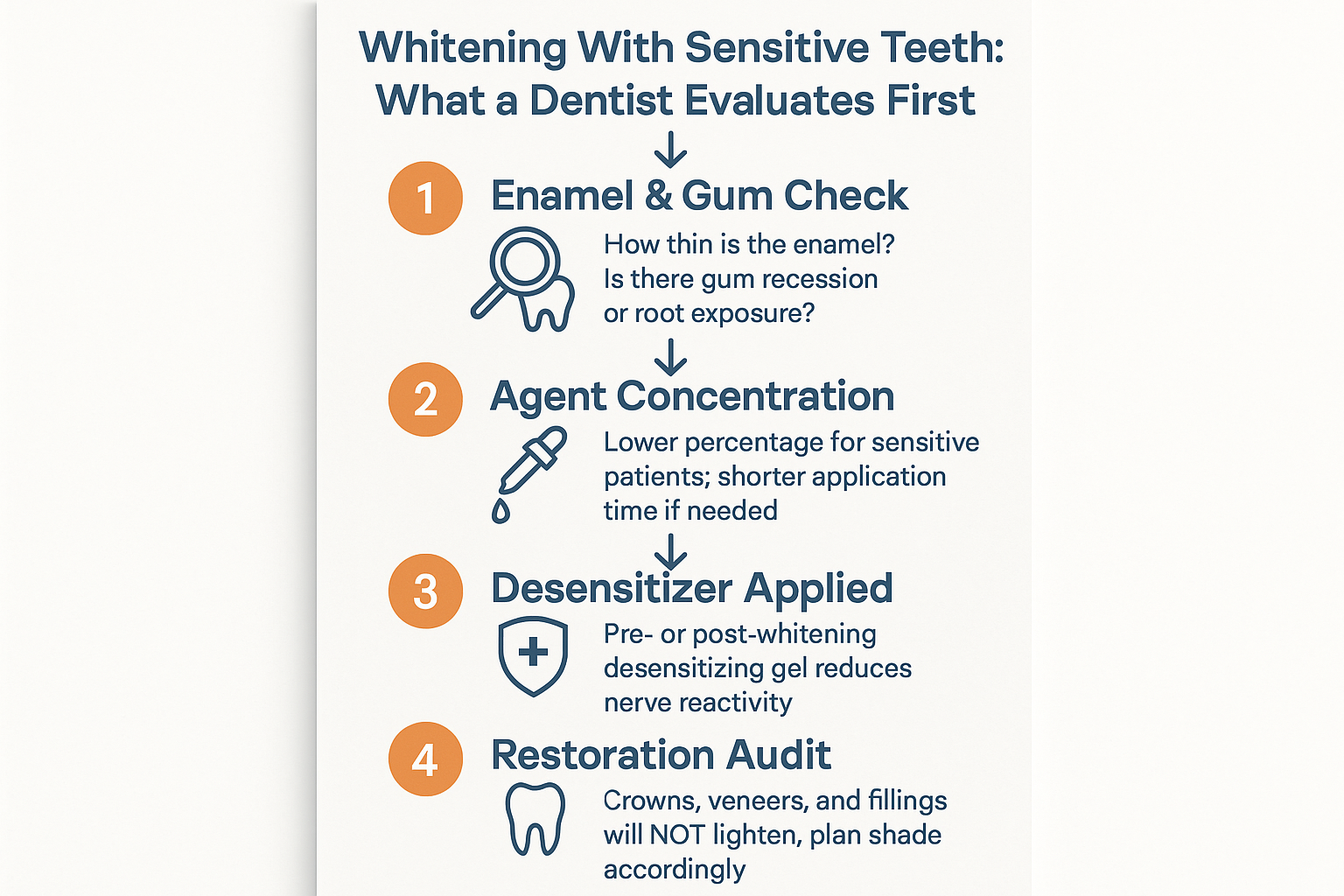
Whitening With Sensitive Teeth: A Quick Decision Map
This infographic walks through the key questions a dentist considers before adjusting a whitening plan for a sensitive-tooth patient.
Sensitive-Tooth Whitening: Professional vs. Over-the-Counter
This comparison covers the practical differences between supervised professional whitening and drugstore alternatives for patients who already have some tooth sensitivity.
| Factor | Professional Whitening | Over-the-Counter Products |
|---|---|---|
| Concentration | Adjusted to your enamel condition | Fixed, not calibrated to your teeth |
| Pre-treatment evaluation | Yes, gums, enamel, restorations reviewed | None |
| Desensitizing option | Yes, applied before or after | Rarely included; basic formulas only |
| Effect on restorations | Reviewed before treatment; plan adjusted | No review, mismatch risk is high |
| Post-treatment sensitivity | Usually 24-48 hours; often reduced with prep | Unpredictable; can be more intense |
| Result longevity | Several months to over a year with maintenance | Weeks; requires frequent reapplication |
How Much Improvement Is Realistic, and How Long It Lasts
One thing patients in Norterra and Cibola Vista ask regularly is how white their teeth can actually get. The honest answer is: it depends on what is causing the discoloration.
Surface stains from coffee, wine, and tea respond very well to professional whitening. Patients who maintain good habits after treatment, cutting back on acidic and pigmented beverages, brushing consistently, often hold their results for six months to over a year. Patients who reviewed their experience at Beyond Dental Care have specifically called out the quality of their whitening results, with more than one noting how noticeably different their smile looked afterward.
Intrinsic discoloration, staining from antibiotics, fluorosis, or aging inside the tooth, is harder to lift and may not respond fully to whitening agents alone. For those cases, a dentist might discuss whether cosmetic options like bonding or veneers make more sense, or whether a combination approach is worth exploring. The article In-Office vs. Take-Home Whitening: Which Results Actually Last? covers that distinction in more detail.
Arizona’s fall season brings a packed social calendar, reunions, weddings, holiday gatherings, and end-of-year events where photos happen. That timing makes late summer and early fall a natural window for patients who want results before things get busy. And because professionally supervised whitening typically delivers visible improvement in a single visit, the timeline is manageable even for patients with full schedules.
For anyone who is wondering whether their sensitivity history rules them out entirely, the better question to ask is: has a dentist actually looked at your enamel and gums and made that call? If the answer is no, it is worth finding out before writing off the option.
Frequently Asked Questions About Whitening With Sensitive Teeth
Can I whiten my teeth if I already have tooth sensitivity every day?
Ongoing daily sensitivity is a reason to get a thorough exam before whitening, not necessarily a reason to skip it entirely. A dentist needs to identify the source of that sensitivity first. If it is recession, thin enamel, or a cracked tooth, those factors change how the whitening plan is set up. Some patients with daily sensitivity whiten without issue after the right preparation. Others need to address an underlying problem first. There is no one-size answer without an evaluation.
Will whitening hurt my crown or existing fillings?
Whitening agents do not damage crowns or fillings, but they also do not change their color. The concern is a visible mismatch if your natural teeth lighten and the restoration does not. This matters most for front-tooth restorations. A dentist can review your smile line before treatment and help you decide whether whitening alone makes sense or whether a restoration update should be part of the plan.
How long does post-whitening sensitivity typically last?
For most patients, 24 to 48 hours. Patients who receive a desensitizing treatment before or after whitening often report less sensitivity than they expected. If you are still experiencing significant sensitivity beyond a few days, that is worth mentioning to your dentist.
Is professional whitening safe if I have gum recession?
Recession exposes the root surface, which has no enamel layer and is much more sensitive to whitening agents. That does not mean whitening is impossible, but it does mean the concentration and technique need to be adjusted carefully. A dentist who evaluates your gum levels before treatment can make that call accurately. Whitening without that evaluation when recession is present is where patients run into real discomfort.
What can I do to make whitening results last longer?
The biggest factors are diet and maintenance habits. Coffee, red wine, tea, and acidic beverages are the primary drivers of re-staining. Rinsing with water after drinking those, waiting 30 minutes before brushing, and keeping up with regular professional cleanings all help. Some patients use a mild touch-up treatment every several months to maintain their result.
Ready to Find Out If Whitening Is Right for Your Teeth?
Beyond Dental Care serves patients across North Glendale, Vistancia, Arrowhead Ranch, Stetson Valley, and the broader Northwest Phoenix area. Dr. Dariene Lazore, DMD, evaluates enamel condition, gum health, and existing restorations before any whitening treatment is recommended, so patients know exactly what to expect before they start. To ask questions or schedule a consultation, call 623-267-8088 or visit beyonddentalcare.com.