
Direct Answer: Bone loss after tooth loss does not automatically rule out dental implants. A 3D imaging scan gives your dentist an accurate picture of what bone remains and whether a graft is needed before implant placement.
One of the most common things I hear from seniors who are curious about dental implants goes something like this: “I’ve had a missing tooth for years, I’m probably not a candidate anymore.” It is an understandable assumption. But it is also one that stops a lot of people from even starting the conversation.
The real question is not your age or how long the tooth has been gone. The real question is how much bone remains at the site, and whether that bone can support an implant, either now or after a preparatory step. For seniors across North Glendale, Arrowhead Lakes, and North Canyon Ranch, understanding this distinction changes the picture entirely.
This article focuses on two things: how bone volume affects implant candidacy, and what the path forward looks like when bone has diminished. Both topics come up constantly in implant consultations, and both deserve a straight answer.
Why Bone Volume Matters More Than Age
When a tooth is lost and not replaced, the jawbone underneath it gradually begins to shrink. This process, called resorption, happens because bone needs stimulation to stay dense. A tooth root delivers that stimulation with every bite. Without it, the body slowly reabsorbs the bone.
Resorption typically begins within the first year after tooth loss and continues at a slow but steady pace after that. The longer a tooth goes unreplaced, the more volume may be lost at that site. This is why timing matters, and why a patient who has been living with a gap for several years may face a different starting point than someone who lost a tooth recently.
But here is the part worth understanding clearly: reduced bone volume is a clinical variable, not a disqualifier. What the dentist needs to know is whether there is enough bone, in height, width, and density, to place and support an implant. That answer comes from imaging, not from a visual exam and not from a self-assessment based on how long the tooth has been missing.
For more on how imaging shapes the candidacy conversation, the article Are You a Candidate for Dental Implants? What the Imaging Reveals goes into useful detail on what dentists are actually measuring and why.
What a CBCT Scan Actually Shows
A standard dental X-ray gives a flat, two-dimensional picture. It can reveal a lot, but it does not show bone depth or density in three dimensions. A CBCT scan, a cone beam computed tomography scan, does.
A CBCT produces a three-dimensional image of the jawbone, including the height and width of bone at the implant site and the density of that bone. It also shows the precise location of anatomical structures like the sinus floor and nerve canals, which affects where and at what angle an implant can be placed safely.
This imaging is the starting point for any honest candidacy conversation. Without it, a dentist is working with incomplete information. With it, the picture is specific: there is either adequate bone to place an implant, or there is not, and if not, the scan helps determine what would be needed to prepare the site.
Beyond Dental Care uses advanced digital imaging as part of its implant evaluation process. That technology is what makes it possible to give patients a real answer rather than a general one. The difference between implant types most patients don’t know often comes down to exactly these imaging findings.
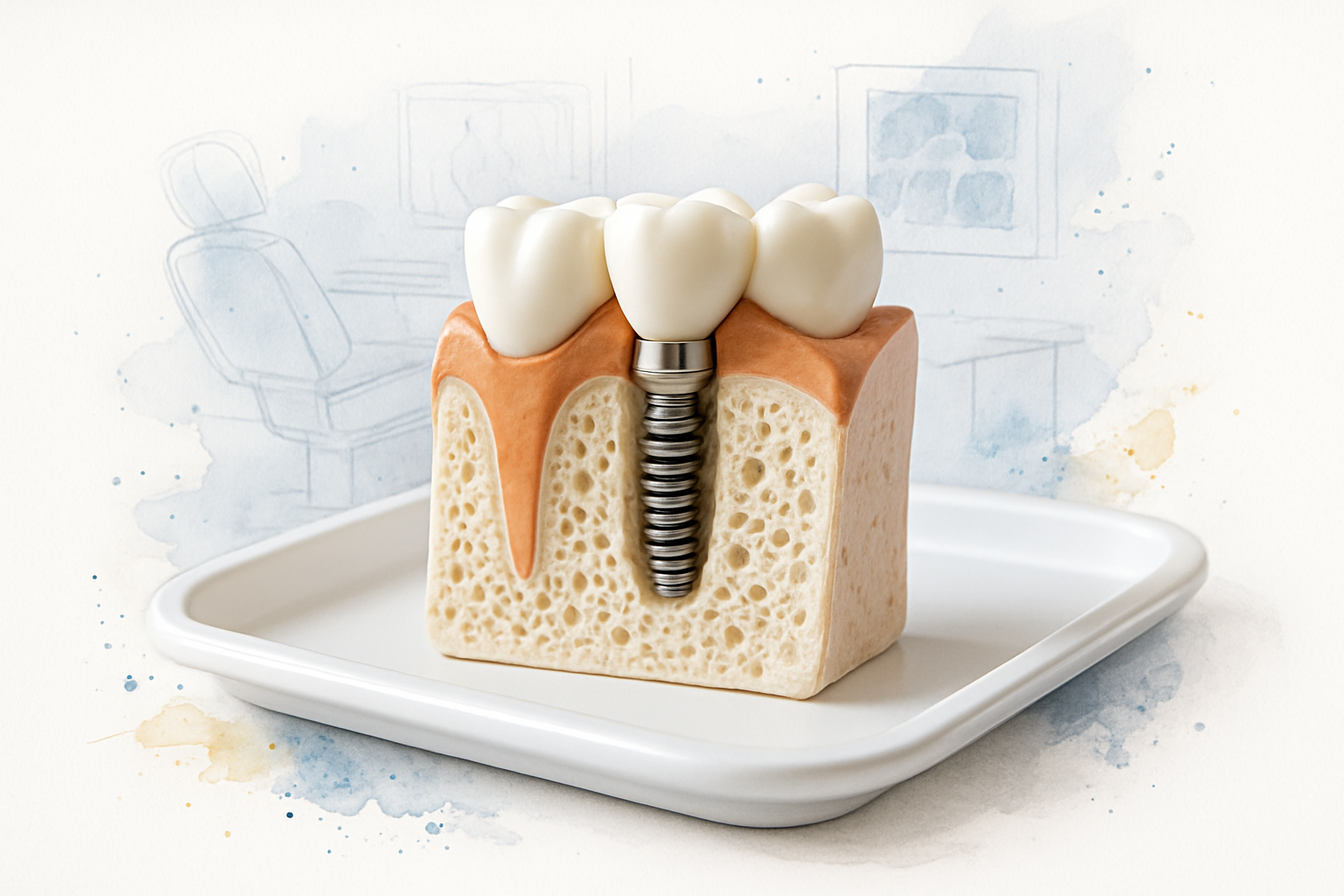
When There Is Not Enough Bone: What Grafting Actually Involves
Bone grafting is the step that stops a lot of seniors before they even ask about it. The name sounds serious, and many patients assume it means a major surgery with a long, difficult recovery. In most cases, that framing is more intimidating than accurate.
A bone graft at a dental implant site is a preparatory procedure. It rebuilds the volume at the site so the implant has adequate support when it is eventually placed. The graft material, which may come from a donor source, a synthetic material, or in some cases the patient’s own bone, is placed at the deficient site and given time to integrate with the existing bone.
After the graft heals, the site is re-evaluated with imaging before the implant body is placed. The timeline is longer than a straightforward implant placement, but the outcome is a stable implant in a properly prepared site. That is a meaningfully better result than placing an implant in inadequate bone, which creates its own set of problems down the road.
For seniors in North Glendale or Vistancia who have been putting off the implant conversation because of a grafting concern, the practical takeaway is this: the graft adds a step, not a barrier. And whether a graft is actually needed cannot be known without that imaging evaluation first.
The article How Long Do Dental Implants Really Take From Start to Finish? covers the full timeline, including how grafting affects it, in plain terms.
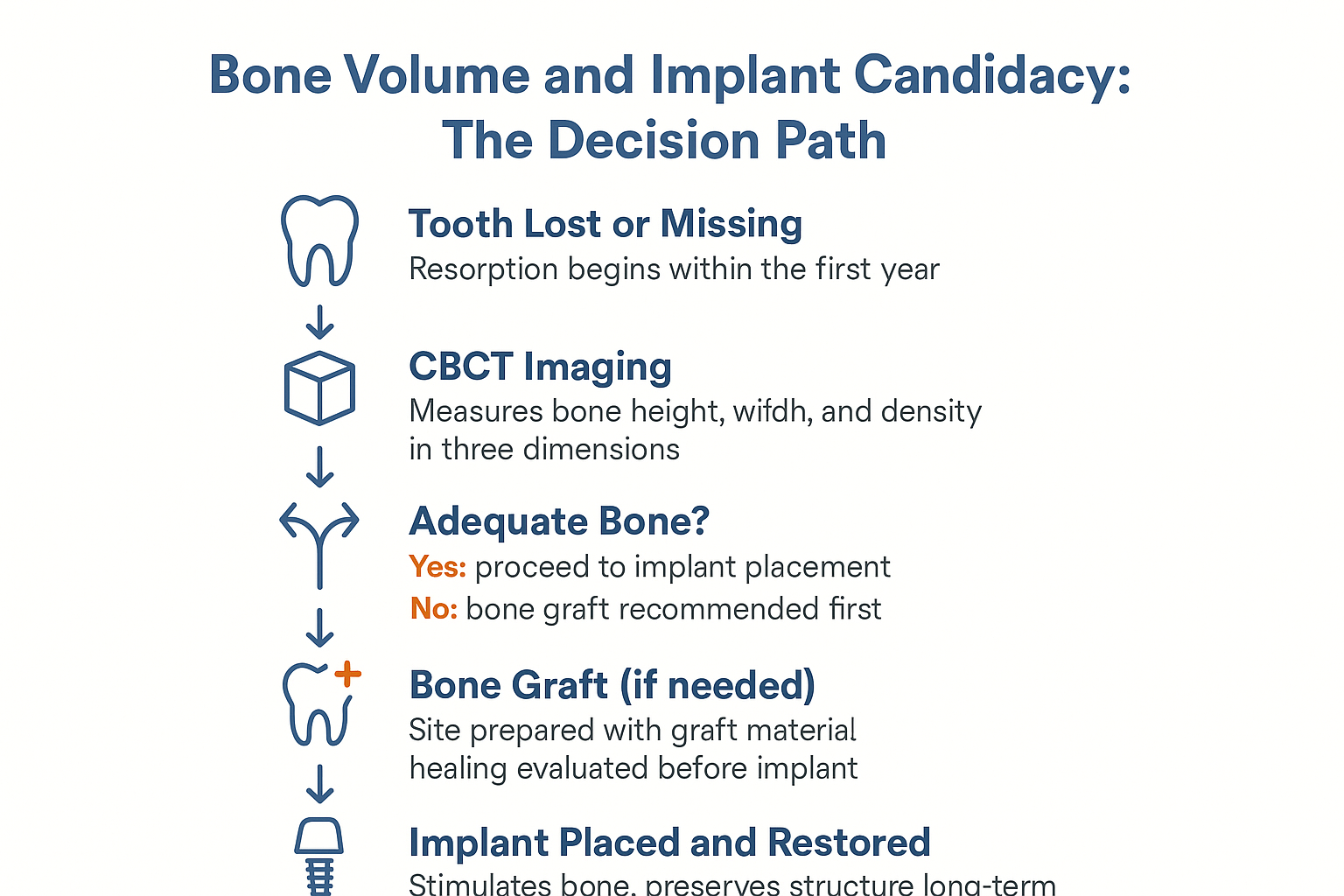
The Bone-to-Implant Path: How Candidacy Is Actually Determined
This infographic walks through the decision points a dentist evaluates when assessing bone volume for a dental implant in a senior patient.
Bone Volume Scenarios: What Each One Typically Means for Implant Planning
Bone conditions at an implant site are not all-or-nothing. The table below summarizes the most common scenarios and what each one generally means for the treatment path.
| Bone Condition at Site | What It Typically Means | Likely Next Step |
|---|---|---|
| Adequate height and width | Implant placement may proceed after medical review | Implant body placed; crown added after healing |
| Mild resorption | Some preparation may be needed depending on specific measurements | Minor graft or socket augmentation before or at placement |
| Significant resorption | Volume is insufficient for direct implant support | Bone graft first, re-imaging after healing, then implant |
| Resorption near sinus (upper jaw) | Sinus floor proximity limits vertical space | Sinus lift procedure to create room before placement |
| Dense but narrow ridge | Height is present but width is marginal | Ridge expansion or narrower implant diameter considered |
Health Conditions, Medications, and What They Actually Mean
A question I hear regularly from seniors is whether a health condition they are managing, controlled diabetes, osteoporosis, or a medication that affects bone density, automatically disqualifies them from implants. The short answer is: not automatically, no.
Controlled systemic conditions are part of the clinical picture a dentist reviews, but they are not a checkbox that ends the conversation. What matters is the specifics: how well-controlled the condition is, what medications are involved, and how those factors interact with healing and bone integration.
For example, certain medications in the bisphosphonate class, often prescribed for osteoporosis, can affect bone healing and are an important part of the health history conversation. The American Academy of Oral and Maxillofacial Surgeons has published guidance on medication-related bone considerations for patients undergoing dental procedures, and it is a useful resource for patients who want to understand the clinical picture before their consultation.
The right approach is a thorough health history review with the treating dentist, not an online self-elimination based on one health factor. Dr. Dariene Lazore, DMD, reviews each patient’s full medical history as part of the implant evaluation process precisely because these factors shape the plan, not just the outcome.
For a broader look at what the implant process involves for patients over 65, the article Dental Implants After 65: What the Process Actually Involves covers the clinical considerations in more depth.
Why Waiting Longer Does Not Make This Easier
One pattern I have noticed is that seniors who have been living with a missing tooth for several years sometimes feel like the window for implants has already passed. That is not how it works, but waiting does tend to narrow the options.
The longer a site goes without a tooth, the more bone may resorb. A site that would have supported a direct implant placement one year after tooth loss may require a graft after five. That is not a catastrophic difference, but it does add time, cost, and steps to the process.
The implant itself, once integrated, actively works against further bone loss. A titanium implant transfers biting force into the jawbone the same way a natural root does, which signals the body to maintain density at that site. This is one of the reasons implants are considered the most durable long-term tooth replacement option, they address the underlying bone problem that dentures do not.
For a detailed side-by-side comparison of implants and dentures from a senior patient’s perspective, the article Implants or Dentures After 65: How Seniors Can Compare the Two breaks down what each option actually involves over the long term.
Frequently Asked Questions About Bone Loss and Dental Implants for Seniors
If I have been missing a tooth for five or more years, is it too late for an implant?
Not necessarily. The critical factor is how much bone remains at the site, not how long the tooth has been missing. A CBCT imaging scan gives a precise picture of what is there. If bone volume has diminished significantly, a bone graft can rebuild the site before the implant is placed. That adds time, but it does not eliminate the option.
Does a bone graft hurt? What is recovery like?
Most patients report that a bone graft procedure is less uncomfortable than they expected. Local anesthesia is used during the procedure, and post-procedure soreness is common for a few days but typically manageable with over-the-counter pain relief. Healing time before the implant can be placed varies depending on the size of the graft and the patient’s overall health, the dentist will give a realistic estimate based on imaging.
I take medication for osteoporosis. Does that mean I cannot get an implant?
It means it is an important part of the conversation, not the end of it. Certain bone-modifying medications, particularly bisphosphonates, can affect how bone heals, and your dentist needs to know about them before any implant planning begins. In many cases, treatment can still proceed with appropriate modifications. An open, thorough health history review with your dentist is the right first step.
How much does a bone graft add to the overall implant cost?
Graft costs vary depending on the size of the site, the material used, and other clinical factors. Generally speaking, it adds a meaningful amount to the total treatment investment, but the range is wide enough that a general figure without context would not be helpful. The most accurate way to understand cost is with a full evaluation and a treatment plan that reflects your specific situation.
Can I have an implant placed at the same time as a bone graft?
In some cases, yes, this is called simultaneous placement, and it works when there is enough existing bone to stabilize the implant while the graft material integrates around it. In other cases, the graft needs to heal fully before the implant is placed. Which approach is appropriate depends entirely on what the CBCT scan reveals about bone volume at the site.
At what age is it too old to get a dental implant?
Age alone is rarely the deciding factor. Many implant patients are in their 60s, 70s, and beyond. What matters more is overall health, bone quality, and whether systemic conditions are well-managed. A 75-year-old with good bone density and controlled health conditions may be an excellent candidate. A frank conversation with the treating dentist, backed by imaging, is the only way to know for certain.
Ready to Find Out Where You Actually Stand?
For seniors in North Glendale, Arrowhead Lakes, Norterra, and the surrounding Northwest Phoenix area, the first real step is an evaluation that includes 3D imaging, not a best guess based on age or how long a tooth has been missing. Beyond Dental Care offers implant consultations led personally by Dr. Dariene Lazore, DMD, with the advanced imaging needed to give you a clear, honest picture of your options. To schedule a consultation, call 623-267-8088 or visit beyonddentalcare.com.