
Direct Answer: As of September 12, 2026, Arizona law bars dental insurers and their holding companies from owning a business that offers dental services to the public. Your dentist and your insurer must stay separate.
Almost every week, someone calls and asks a version of the same question before they will book: am I in network, and is there a cap? Underneath that question, I hear a second one that people rarely say out loud. Are you recommending this crown because I need it, or because of how my plan pays?
That second question got a real answer from the Arizona Legislature this year. HB2308 blocks dental insurance companies from owning dental practices in this state, and it takes effect September 12, 2026.
For households across North Glendale, Arrowhead Ranch, Stetson Valley, and Norterra, this is a quiet but meaningful change. Below is what the law actually says, what it changes at the chair, and the parts of your coverage it leaves exactly as they were.
What Arizona’s Law on Dental Insurance Companies Owning Dental Practices Actually Says
HB2308 was signed into law on June 4, 2026 and chaptered as Chapter 89. It amends A.R.S. 32-1213, the section of state law that sits under the Arizona State Board of Dental Examiners.
The substance is short. The bill prohibits dental insurers, or holding companies of dental insurers, from owning any business that offers professional dental services to the public.
Two definitions do the heavy lifting:
- Dental insurer: a company that provides dental insurance.
- Holding company: a business that owns a significant stake, meaning 10 percent or more of ownership or voting power, in a dental insurer.
The Arizona Dental Association described the result as protecting clinical independence, competition, and patient choice. Arizona Public Media reported that the Legislature lists September 12, 2026 as the general effective date for the 2026 session, which is the date this one lands on. The bill text and summary are also posted publicly on BillTrack50.
It applies to dental practices registered with the Arizona State Board of Dental Examiners statewide. That covers Glendale, Peoria, and the rest of Maricopa County, and it does not reach practices outside Arizona.

Why Separating the Payer From the Provider Matters in the Chair
Here is the practical version. The company that decides what your plan pays cannot also be the company that owns the practice recommending the treatment.
That matters most on the decisions where reasonable dentists already have to exercise judgment:
- Filling or crown on a tooth with a large old restoration
- Root canal and crown versus extraction and an implant
- Sedation for a patient with real dental anxiety
- Deep cleaning versus a standard cleaning when pocket depths are borderline
- Watching a small area of demineralization instead of drilling it today
Every one of those calls has a clinical answer and a claims answer, and they are not always the same. When an insurer sits at the top of the ownership chart, the second answer has a way of leaning on the first.
Patients feel this even when they cannot name it. One of the compliments I see most often in our reviews is some version of “no sales pitches, just honest conversation about needs.” Another patient wrote that she was glad to find an office that “truly listens, takes the time to evaluate things thoroughly, and follows through.”
That is the standard the law is trying to protect at the ownership level. If you have ever wondered how a dentist weighs the options, how a dentist decides between a crown and a filling walks through the actual reasoning.
What Changes on September 12 and What Stays the Same
Most of the confusion I hear is people assuming this changes their benefits. It does not. Here is the split.
| Part of Your Care | What HB2308 Does | What It Does Not Do |
|---|---|---|
| Practice ownership | Bars a dental insurer, or a holding company with 10 percent or more ownership or voting power in one, from owning a business offering dental services to the public | Does not restrict other forms of practice ownership |
| Treatment decisions | Keeps the company paying your claims out of the ownership chain above your dentist | Does not change what your plan chooses to cover |
| Annual maximum | Nothing | Your cap still resets and unused benefits still expire |
| Network status | Nothing | In network and out of network rules stay exactly as written in your plan |
| Where it applies | Dental practices registered with the Arizona State Board of Dental Examiners statewide, Maricopa County included | Does not apply to practices outside Arizona |
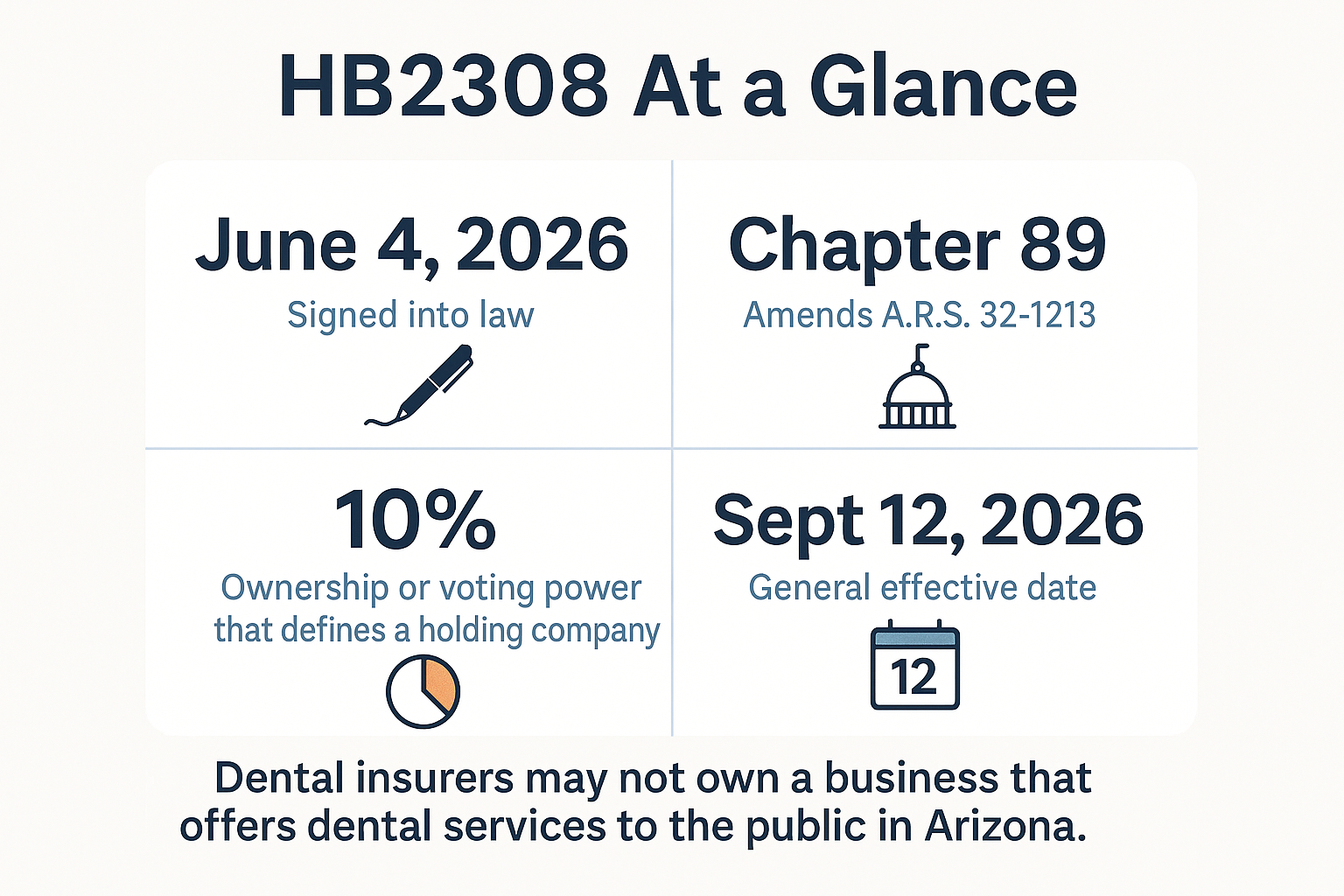
HB2308 at a Glance
Four numbers cover almost everything a patient needs to know about this law.
Your Plan Still Works the Way It Always Did
I want to be clear about this, because a new law makes people expect a new benefits letter. Nothing in HB2308 touches your coverage terms.
Your annual maximum still resets on your plan year, and whatever you did not use still disappears. If you have been carrying a treatment plan into next year, why dental benefits usually do not roll over is the piece to read before December.
Orthodontic coverage is its own animal. Clear aligner treatment often runs against a separate lifetime orthodontic cap rather than your yearly maximum, which is explained in how orthodontic benefits are structured.
And if you have no dental insurance at all, which describes a good share of the people who reach out to us from Vistancia and North Peoria after relocating, this law does not change your math either. Costs still come down to the exam findings, the materials, and the sequence of treatment. What actually shapes the cost of a cleaning and exam breaks that down honestly.
How to Tell Who Owns the Practice You Visit
Ownership is not something most offices advertise on the wall. A few things tend to reveal it quickly.
- Ask the front desk directly who owns the practice. A private office will answer in one sentence.
- Look at whether a single named dentist appears on the state license and the business registration.
- Notice whether your treatment plan is presented by the dentist who examined you or handed off to a script.
- Watch how long the appointment runs. Rushed 20-minute visits are usually a production target, not a clinical one.
I bring this up because the patients who find us from Arrowhead Lakes and Hillcrest Ranch often arrive after a bad experience somewhere else, and the complaint is almost never about the dentistry. It is about feeling processed.
If it has been a while since your last visit, or you are switching offices, what a thorough new patient exam should actually cover gives you a benchmark to judge the next one against.
Frequently Asked Questions About Arizona’s Dental Practice Ownership Law
Does HB2308 change my dental insurance benefits?
No. The law addresses who may own a dental practice, not what your plan covers. Your deductible, your annual maximum, and your network status all stay exactly as written in your policy.
When exactly does the law take effect?
The Arizona Legislature lists September 12, 2026 as the general effective date for the 2026 session, and HB2308 falls under that date. It was signed on June 4, 2026 and chaptered as Chapter 89.
Does it apply to dental offices here in Glendale?
Yes. It applies statewide to dental practices registered with the Arizona State Board of Dental Examiners, which includes every office in Glendale, Peoria, and the rest of Maricopa County.
What counts as a holding company under this law?
A business that owns a significant stake in a dental insurer, defined as 10 percent or more of ownership or voting power. That threshold is what keeps the restriction from being sidestepped through a parent company.
I do not have dental insurance. Is any of this relevant to me?
Indirectly, yes. Practice ownership shapes how treatment gets recommended for everyone in the chair, insured or not. For self-pay patients, the more useful thing to ask about is our in-office membership plan, which takes 20 percent off treatment for patients without insurance.
Will this make dental care cost more in Arizona?
There is no way to know yet, and I would be skeptical of anyone who claims otherwise this early. The stated intent was to protect competition and patient choice. What I can tell you is that fees at any given office are driven by the treatment itself, the materials, and the time involved, not by this statute.
Questions About Who Is Behind Your Treatment Plan?
Beyond Dental Care is a private, non-corporate practice on West Happy Valley Road, serving households from North Glendale to Vistancia, and the ownership question has always had a one-sentence answer here. If you want to talk through a treatment plan, a benefits question, or what this law means for your family, the office is open Monday through Thursday until 7pm. Call 623-267-8088 or read more at beyonddentalcare.com.