
Direct Answer: There is no safe waiting window for an untreated cavity. Decay moves through enamel slowly, but once it reaches dentin or the pulp, the treatment required changes dramatically, and so does the cost.
Most people who suspect they have a cavity ask the same quiet question: how bad could it really get if I wait a little longer? It is an honest question, and the answer is more nuanced than a simple scare tactic, but it is not the reassuring one most people are hoping for.
Arizona ranks 43rd in the country for adult dental visit rates, with only about 63.1% of adults reporting a dental visit in the past year, compared to a national average of 67.5%. That gap is not driven by a lack of need, it is driven by avoidance, scheduling pressure, and for some, a fear of being judged for the time that has already passed.
This article is not here to shame anyone for waiting. It is here to explain what is actually happening inside the tooth while you do, because that information changes the decision.
What Happens Inside a Tooth When Decay Is Left Alone
A cavity does not stay frozen in place. It is an active bacterial process, and it moves through the layers of your tooth in a predictable sequence, just not at a predictable speed.
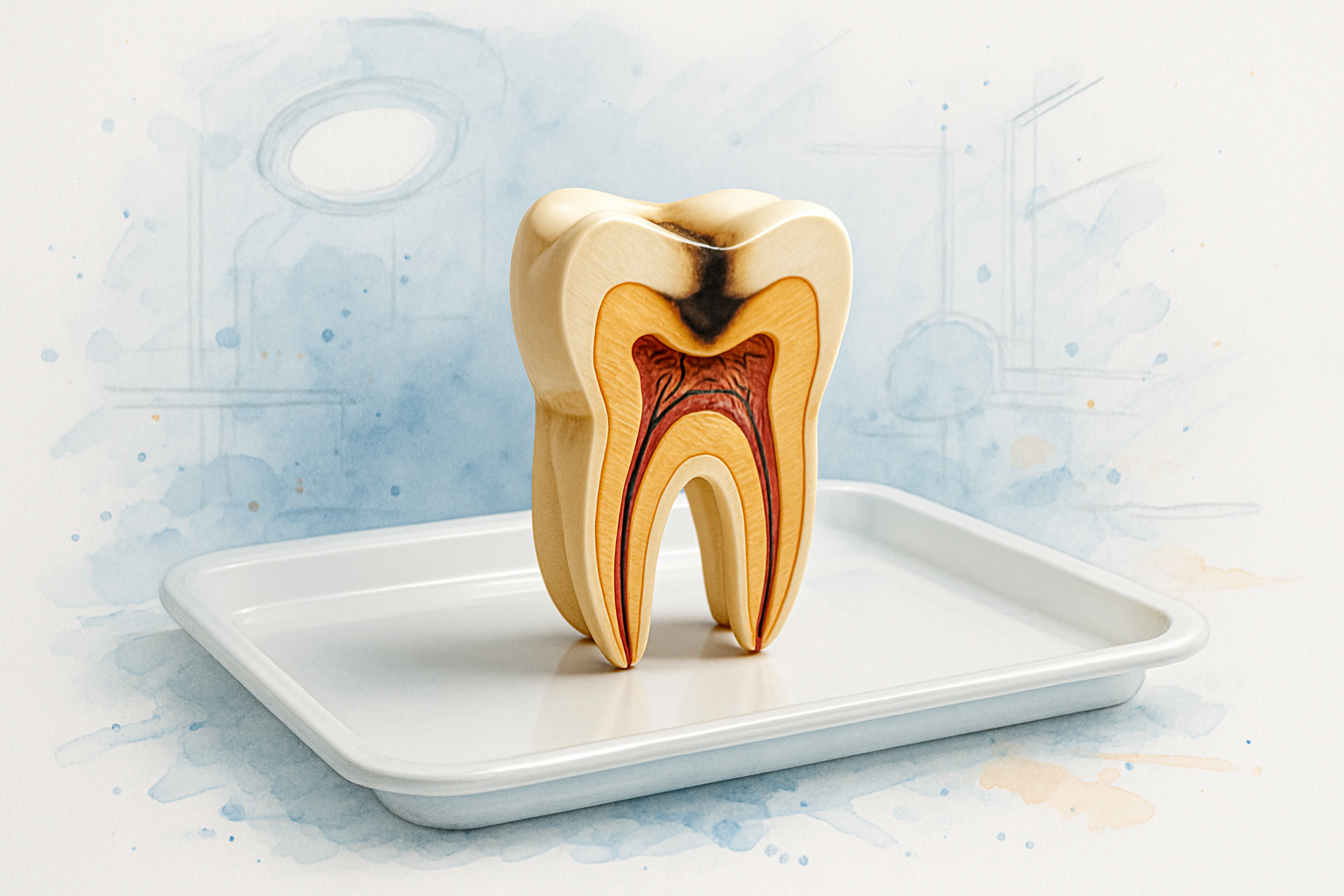
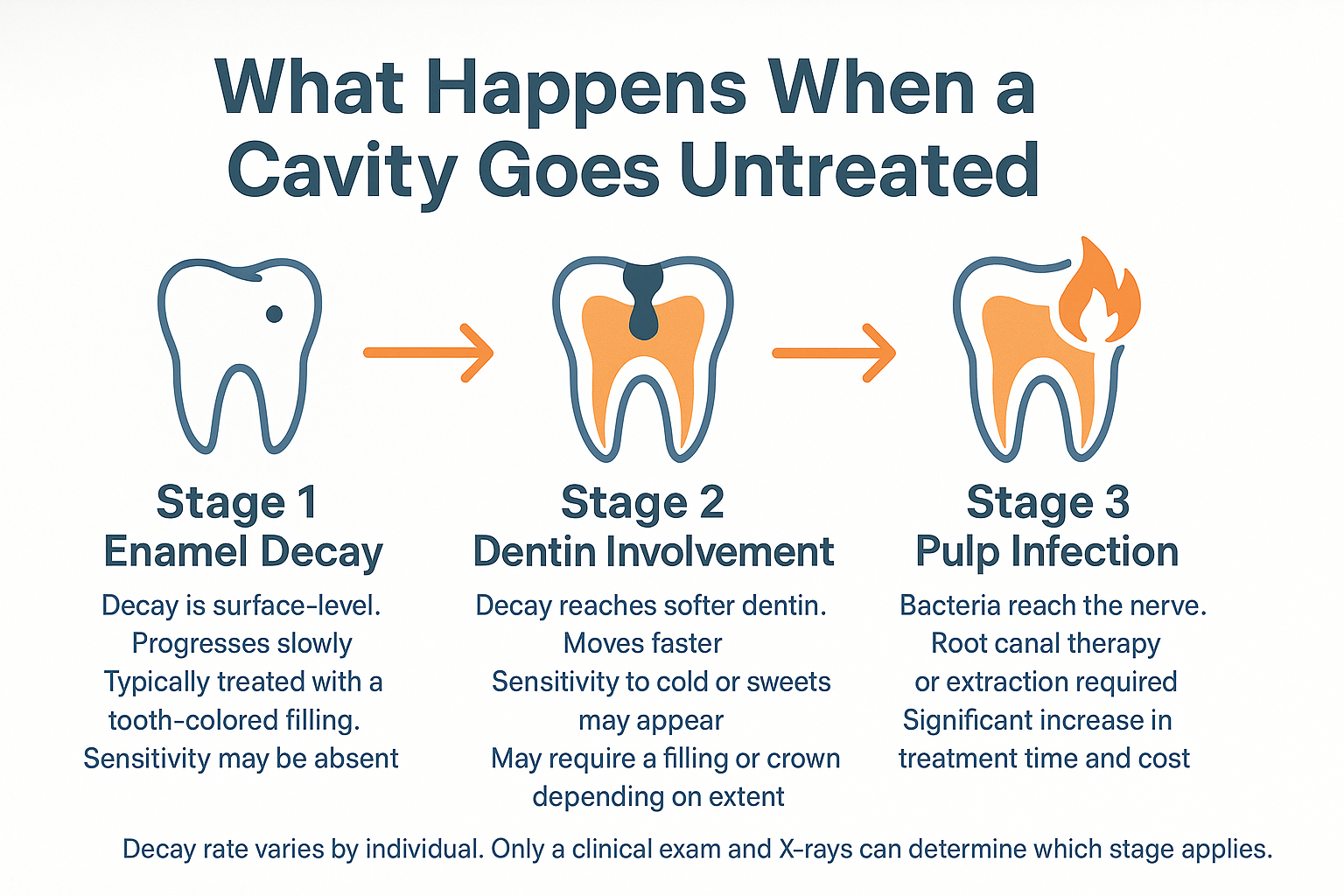
The outer layer of your tooth is enamel, the hardest substance in the human body. When decay starts here, it progresses relatively slowly. A small enamel cavity caught at this stage is typically a straightforward tooth-colored filling, a quick appointment, minimal discomfort, and the problem is resolved.
The trouble starts when decay breaks through into dentin. Dentin is significantly softer and more porous than enamel, and once bacteria reach it, the progression speeds up considerably. Dentin also contains tiny channels that run toward the tooth’s nerve, which is why dentin-level decay often produces sensitivity to cold or sweets, sometimes the first real symptom a patient notices.
If decay reaches the pulp, the soft tissue and nerve at the center of the tooth, the situation changes entirely. At that point, the tooth is typically infected. The options shift from a filling to either a root canal treatment to save the tooth or an extraction if it cannot be saved. Both involve more time, more appointments, and meaningfully higher cost than a filling would have.
The practical point: decay does not announce which stage it has reached. You cannot feel the difference between enamel and dentin involvement without an X-ray. That uncertainty is exactly why waiting has real clinical risk.
Why People Wait, and What That Gap Actually Costs
Fear of judgment is one of the most common reasons people delay dental care. One patient review from Beyond Dental Care describes it plainly: Dr. Lazore was “very thorough and explained everything so clearly” and “no one judged me for not having been to the dentist for a while.” That reviewer also noted the anxiety they felt going in, something worth naming directly, because it is real and it keeps people from getting care they need.
The clinical reality of that delay depends heavily on where the decay was when the gap started. Some patients come back after a year or two and find a small cavity that is still manageable. Others return to find that a problem which could have been a single filling has progressed into something that now needs a crown, or worse, root canal therapy before a crown can even be placed. Both outcomes happen, and there is no way to know which one applies without looking.
From a cost standpoint, the difference is significant. A tooth-colored filling is generally the least expensive restorative option. A dental crown involves more laboratory work and more chair time. Root canal treatment adds another layer before the crown. Costs vary by practice and by insurance, but the trajectory is consistent: earlier intervention means fewer steps and lower total cost, in almost every case.
For patients in North Glendale, Stetson Valley, and Norterra who are already managing full schedules, the idea of “dealing with it later” feels practical. But later rarely means easier, it usually means more appointments, not fewer.
It is also worth reading what a preventive dental visit actually catches before it gets expensive to understand how much a routine visit can intercept before it reaches this point.
How Decay Moves Through a Tooth Over Time
This visual shows the three stages of cavity progression and what treatment typically looks like at each point.
Cavity Stage vs. Likely Treatment, A Quick Reference
Treatment needs shift significantly depending on how far decay has progressed when it is finally addressed. This table gives a general picture of how the clinical conversation typically changes.
| Decay Stage | What It Affects | Typical Treatment | Approximate Complexity |
|---|---|---|---|
| Early Enamel | Outer tooth surface only | Tooth-colored filling | Low, often one appointment |
| Dentin Involvement | Softer inner layer, near nerve channels | Filling or dental crown depending on size | Moderate, may require more than one visit |
| Pulp Infection | Nerve and blood supply at tooth center | Root canal therapy, then crown | High, multiple appointments, higher cost |
| Tooth Loss | Entire tooth structure | Dental implant or bridge | Highest, longest timeline, most involved |
What a Diagnostic Appointment Actually Involves
A lot of people picture a dental appointment as a commitment to treatment. It is not. A diagnostic visit is simply a chance to find out where things actually stand, and that information alone is genuinely useful, even if you are not ready to move forward immediately.
At Beyond Dental Care, a new patient diagnostic visit includes digital X-rays and a comprehensive visual exam. Digital X-rays allow Dr. Lazore, DMD, to see decay between teeth and beneath the surface, areas that look perfectly fine from the outside. The exam also evaluates gum health, existing restorations, and any signs of wear or damage that might compound the cavity situation.
What you leave with is clarity. If the decay is still in early enamel, you will know the window for a simple filling is still open. If it has moved deeper, you will know what treatment is actually on the table, what it involves, and what the cost range looks like, before committing to anything.
For patients coming back after a longer gap, that visit often feels like lifting a weight. The Overdue for a Cleaning article on this site walks through exactly what that first appointment back looks like, which can help reduce the anxiety of not knowing what to expect walking in.
According to the American Dental Association, cavity risk is not fixed, it shifts based on diet, saliva, oral hygiene, and other factors. That means two people with the same cavity at the same starting point can have very different outcomes depending on what happens in the months that follow.
Frequently Asked Questions About Untreated Cavities
Can a cavity heal on its own if I brush more carefully?
Very early-stage demineralization, before a true cavity forms, can sometimes be reversed with fluoride and improved hygiene. But once the enamel surface has actually broken down and a cavity exists, it will not close on its own. It will continue to progress. Better brushing can slow things slightly, but it does not reverse decay that has already formed a hole in the tooth.
How fast does a cavity actually spread?
That depends on the individual. Some cavities progress slowly over a year or more; others move quickly depending on diet, saliva composition, the bacteria present, and how much enamel is left to protect the dentin beneath. There is genuinely no standard timeline, which is exactly why ‘I’ll wait and see how it feels’ is a risky approach. You cannot feel early-stage decay, and by the time you feel something, it has usually moved into dentin.
Is it normal to feel embarrassed going to the dentist after a long gap?
Very normal, and worth naming directly. Many patients in the Arrowhead Ranch and Vistancia area put off care specifically because of that anxiety. One patient at Beyond Dental Care described the exact same fear and noted that no one judged her for the time that had passed. A practice that makes patients feel that way is worth finding. If this concern is part of what is holding you back, reading what comfort-focused dental care actually looks like might help.
What happens if I just get the tooth pulled instead of treating it?
Extraction removes the immediate problem but creates a new one: the gap left behind. Adjacent teeth tend to drift into that space over time, which affects your bite and can make future restoration harder. For most patients, replacing a lost tooth with a dental implant or bridge ends up being more involved than treating the cavity would have been. The Crown or Filling article covers how these decisions are made clinically.
How much does it cost to fix a cavity versus a root canal?
Costs vary depending on the tooth, the severity, your insurance coverage, and the specific practice. In general terms, a tooth-colored filling is the least costly option, a crown adds significantly to that, and root canal therapy before a crown adds another layer. The difference between treating a cavity early versus late can easily be several hundred dollars or more. For an accurate picture of what your specific situation would involve, the only real answer comes from an exam and X-rays.
Ready to Find Out Where Things Actually Stand?
If you have been sitting with a suspected cavity and waiting to see if it gets better, the most useful thing you can do right now is find out what you are actually dealing with. Beyond Dental Care serves patients across North Glendale, Stetson Hills, Norterra, and the surrounding Upper West Side Phoenix area, with evening and Saturday appointment availability for patients who cannot get away during the workday. Call 623-267-8088 or visit beyonddentalcare.com to schedule a diagnostic exam, no commitment to treatment required, just a clear picture of where things stand.