
Direct Answer: Yes, but schedule it two to four weeks before the photo date. That gives sensitivity time to settle and leaves room for a touch-up if the shade is not where you want it.
Every spring I start hearing the same question from patients in Arrowhead Ranch and Stetson Valley. There is a wedding in June, a family reunion at the lake, or a photographer booked for the last cool weekend before the Phoenix summer really lands. Can we whiten in time?
The honest answer is almost always yes, but the timing matters more than most people expect. And two things decide how the whole plan should be sequenced: the baseline shade of your natural enamel, and whether you already have crowns, veneers, or tooth-colored fillings in your smile zone.
Most articles about whitening skip both of those. I want to walk through them the way I would in the chair, because the right answer genuinely changes from patient to patient.
Why Timing Teeth Whitening Before Summer Photos Is the Whole Game
The mistake I see most often is booking whitening for the day before the event. It feels efficient. It removes every safety net.
Whitening can leave teeth temporarily sensitive. If that happens the morning of a wedding, there is no recovery window and no time to adjust anything.
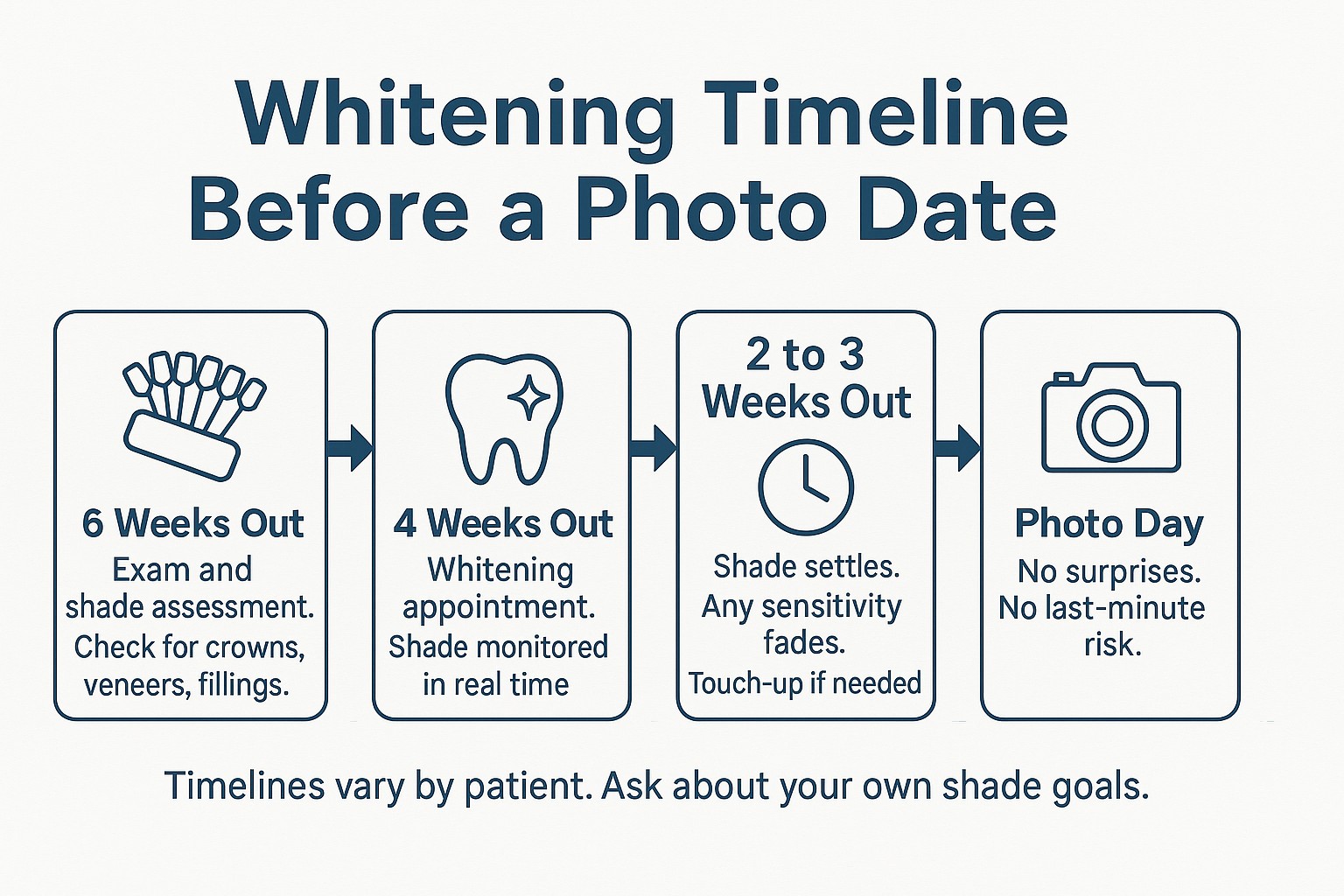
I ask patients to plan for a two to four week cushion before the target date. That window buys you three things:
- Time for any short-term sensitivity to fade completely
- Time for the shade to settle, since teeth often keep lightening slightly for a few days
- Room for a touch-up visit if you want to go one or two shades further
There is also a practical reason that window works well here. Summer schedules in North Glendale get crowded fast with travel and school breaks, so building in a buffer means you are not scrambling for the last open slot in a short week.
Our weekday hours run to 7pm Monday through Thursday, with Friday and Saturday by request, which makes a two-visit plan realistic without anyone taking time off work.
Crowns, Veneers and Fillings Do Not Lighten
This is the part that surprises people, and it is the single most important thing to sort out before you book.
Professional whitening works on natural tooth structure only. Porcelain and composite resin do not respond to the whitening agent at all.
So if you have a crown on a front tooth, a veneer, or a tooth-colored filling along the edge of an incisor, those restorations stay exactly where they are in terms of color while everything around them lightens. In a close-up photo, that contrast can be more noticeable than the original yellowing was.
That does not mean whitening is off the table. It means the sequence changes. A common approach is:
- Whiten the natural teeth first and let the shade stabilize
- Then match or replace the visible restoration to the new shade
- Build in enough lead time for the lab work if a crown or veneer needs to be remade
One patient came in with a plan she had already half built in her head: crowns on two worn front teeth, some bonding to close a gap, then whitening at the end. We reordered it. Whitening goes first when restorations are part of the picture, or the new work gets matched to the old shade.
If you want the longer version, I wrote more about this in Can You Whiten Teeth If You Already Have Crowns or Fillings?.
What Lightens and What Does Not
Here is the quick reference I use when a patient asks what will actually change during whitening.
| Surface | Responds to Whitening? | What That Means for Photos |
|---|---|---|
| Natural enamel | Yes | This is what lightens, and the change is usually most visible on upper front teeth |
| Porcelain crown | No | Stays its original shade; may need to be remade to match afterward |
| Porcelain veneer | No | Holds its color permanently, so surrounding teeth should be matched to it |
| Tooth-colored filling | No | Edge fillings on front teeth can start to stand out once enamel lightens |
| Deep internal staining | Partially | May lighten less than surface staining; a shade goal should be set realistically upfront |
A Simple Whitening Timeline Before a Photo Date
This is roughly how I map out a whitening plan when there is a fixed event on the calendar.
If Your Teeth Are Already Sensitive, Do Not Rule Whitening Out
Sensitivity is the most common reason people skip professional whitening entirely. They assume it is simply not for them.
That assumption is usually premature. Sensitivity after whitening is typically short-lived, and there is real room to adjust the approach.
Depending on how you respond, a provider can:
- Lower the concentration of the whitening agent
- Start a desensitizing protocol in the days before treatment
- Move you to a take-home tray system at a gentler strength over a longer stretch
- Space sessions further apart instead of pushing for the full change in one visit
The American Dental Association’s patient resource on tooth whitening safety and sensitivity covers the general science well if you want a neutral source to read.
What I will say from experience is that ruling it out without a conversation almost always costs patients an option they would have liked. We go deeper on this in Whitening With Sensitive Teeth: What Changes, What Still Works.
Why In-Office Whitening Behaves Differently Than Strips
In-office whitening is not a passive process. Someone is watching the shade change as it happens and adjusting.
That is the practical difference between professional treatment and a box of strips from the store. Strips apply the same thing to every tooth for the same amount of time, regardless of how each tooth responds.
One of our patients said her teeth were “SO white” after her visit, and in a separate note mentioned the team “checked in often” during the appointment. Those two comments are connected. The checking in is what produces the even result.
Cost varies quite a bit depending on the method, the starting shade, and whether restorations need to be addressed afterward. Rather than quoting a number here, I would rather talk through what your specific plan involves. If you want a broader look at the tradeoffs, In-Office vs. Take-Home Whitening: Which Results Actually Last? breaks down both paths.
One more thing worth knowing: if your teeth have yellowed despite good brushing, that is common and it has causes worth understanding before you whiten. Why Do Teeth Turn Yellow Even With Regular Brushing? covers that.
Frequently Asked Questions About Whitening Before Summer Photos
How far in advance should I whiten before a wedding or family photo session?
Plan for two to four weeks before the date. That leaves time for sensitivity to fade, for the shade to stabilize, and for a touch-up if you want to go lighter.
Can I whiten if I have a crown on a front tooth?
You can whiten the natural teeth around it, but the crown itself will not change color. If that crown is visible when you smile, the usual approach is to whiten first, let the shade settle, then decide whether the crown should be remade to match. That second step needs lab time, so start earlier.
Will one whitening session be enough?
Often yes for surface staining, but it depends on your baseline shade and what caused the discoloration. Deeper internal staining tends to lighten more gradually and may call for a second session or take-home trays.
Is whitening safe if I already deal with sensitive teeth?
For most people it is workable with adjustments. Concentration can be lowered, a desensitizing protocol can be started beforehand, and take-home trays at a gentler strength are an option. It is a conversation, not an automatic no.
Should I get a cleaning before whitening?
It helps. Whitening works more evenly on a clean surface, and an exam catches anything that should be handled first, like an untreated cavity near the gumline that would react poorly to the whitening agent.
Thinking About Whitening Before Your Summer Photos?
For households in Norterra, Cibola Vista, Arrowhead Ranch, or anywhere across the Upper West Side Phoenix corridor, the right first step is a short conversation with Dr. Dariene Lazore, DMD about your shade goals and whether you have restorations to work around. The answer really does vary from person to person. Appointments are available at 623-267-8088 or at beyonddentalcare.com if you would like to ask about timing that fits your calendar.